Showing posts with label Yang Zhang. Show all posts

Thursday, September 2, 2021

Abstract-High Electric Field-Enhanced Terahertz Metamaterials with Bowtie Triangle Rings: Modeling, Mechanism, and Carbohydrate Antigen 125 Detection


Ning Cui, Min Guan, Mengke Xu, Chenfeng Zhao, Hongyan Shao, Yang Zhang,  Yiping Zeng,


https://pubs.acs.org/doi/full/10.1021/acs.jpcc.1c05483

Spatial overlap between the electromagnetic field and analytes is a key factor to improve the sensitivity of label-free optical sensors. However, the overlap and sensitivity are limited by the plasma local field or the decaying resonant mode outside the cavity. In this paper, by constructing a bowtie triangle ring (BTR) metal microstructure array, a high electric-field enhanced terahertz (THz) metamaterials (MMs) absorber is proposed and demonstrated. By tuning the length and splits of the BTR structure, the greatly confined electromagnetic fields could be obtained in the channel, resulting in a significantly enhanced interaction between the analytes and terahertz. The split BTR (S-BTR) generates an additional dipole resonant, and the maximum calculating sensitivity of 498 GHz/RIU is obtained. Meanwhile, two kinds of THz MMs biosensors are fabricated and used to detect the breast cancer marker carbohydrate antigen 125 (CA125). The S-BTR has a resonance shift of 46.8 GHz (20 μg/mL), which is larger than the unbroken BTR (U-BTR). Therefore, the combination of electric-field enhancement with a dipole resonant could further improve the sensitivity of the MMs sensor. This BTR MMs sensor has great potential in the detection of proteins and small molecules.

Tuesday, May 25, 2021

Abstract-Terahertz detection based on nonlinear Hall effect without magnetic field


Yang Zhang, Liang Fu, 


https://www.pnas.org/content/118/21/e2100736118.short

Despite the enormous potential of terahertz technology, fast, sensitive, and broadband terahertz detection at room temperature has been a challenge. We propose a method for long-wavelength photodetection using topological quantum materials without invoking any diode or junction region. The inherently quadratic relation between transverse current and input voltage at zero magnetic field is used to rectify the incident terahertz or infrared electric field into a direct current. We identify the Weyl semimetal NbP and ferroelectric semiconductor GeTe for terahertz/infrared photodetection with large current responsivity without external bias.

Wednesday, May 19, 2021

Abstract-Terahertz detection based on nonlinear Hall effect without magnetic field


Yang Zhang and Liang Fu

https://www.pnas.org/content/118/21/e2100736118

Despite the enormous potential of terahertz technology, fast, sensitive, and broadband terahertz detection at room temperature has been a challenge. We propose a method for long-wavelength photodetection using topological quantum materials without invoking any diode or junction region. The inherently quadratic relation between transverse current and input voltage at zero magnetic field is used to rectify the incident terahertz or infrared electric field into a direct current. We identify the Weyl semimetal NbP and ferroelectric semiconductor GeTe for terahertz/infrared photodetection with large current responsivity without external bias.

Tuesday, May 26, 2020

Abstract-Design and application of terahertz metamaterial sensor based on DSRRs in clinical quantitative detection of carcinoembryonic antigen


Ning Cui, Min Guan, Mengke Xu, Weihao Fang, Yang Zhang, Chenfeng Zhao, and Yiping Zeng

(a) Schematic diagram of THz MMs biosensor chip; (b) Detection principle and the equivalent circuit for the DSRRs. (The capacitance of substrates and sample are expressed as Csub and Csam, respectively. Ls is expressed as inductance of DSRRs.)
https://www.osapublishing.org/oe/abstract.cfm?uri=oe-28-11-16834

The terahertz (THz) metamaterial biosensor has great potential for label-free and rapid specificity testing. Here, we designed two highly sensitive structures to detect the carcinoembryonic antigen (CEA) of the cancer biomarker in early stages. There was about 29 GHz (500 ng/ml) resonance shift for CEA with an insert grate metamaterial, which was consistent with simulation results. Moreover, the concentration of CEA was gained through the relationship between the cancer marker concentration and frequency shift (Δƒ). Our design and detection methods may provide a potential route for the early warning stages of cancer.
© 2020 Optical Society of America under the terms of the OSA Open Access Publishing Agreement

Sunday, June 30, 2019

Abstract-Control of terahertz pulse polarization by two crossing DC fields during femtosecond laser filamentation in air


Qiang Su, Qiang Xu, Nan Zhang, Yang Zhang, and Weiwei Liu

https://www.osapublishing.org/josab/abstract.cfm?uri=josab-36-10-G1

Terahertz (THz) radiation induced by the femtosecond laser filament in air can be strongly enhanced through applying an external DC field. In the present work, this technique has been extended to two-dimensional biasing; namely, two pairs of electrodes, which are placed perpendicular to each other, are applied to provide two crossing DC fields. The experimental results have demonstrated that the amplitudes of two orthogonal components of the polarized THz pulse could be modulated by the electric field parallel to it, in an in situ and real-time manner, while the phase delay between them remains constant. Hence, the polarization of the output THz pulse could be freely controlled by adjusting the voltages of the two crossing DC fields, achieving arbitrary ellipticity. It might be the simplest method to manipulate the THz polarization during femtosecond laser filamentation in air.
© 2019 Optical Society of America

Saturday, December 2, 2017

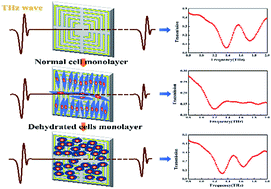
Abstract-Cell viability and hydration assay based on metamaterial-enhanced terahertz spectroscopy


Yu Liu,  Mingjie Tang,  Liangping Xia,  Wenjing Yu,  Jia Peng, Yang Zhang,  Marc Lamy de la Chapelle,  Ke Yang,  Hong-Liang Cui,  Weiling Fu


Graphical abstract: Cell viability and hydration assay based on metamaterial-enhanced terahertz spectroscopy


http://pubs.rsc.org/en/content/articlelanding/2017/ra/c7ra09609g#!divAbstract
As a fast-growing technology, terahertz time-domain spectroscopy (THz-TDS) is becoming increasingly pervasive in biological applications, targeting a range of biomaterials from biomolecules to tissues. However, THz-TDS studies at the cellular level are quite limited. Thus, a study to analyze the living state and hydration state of a tumor cell in a label-free manner is carried out and reported here. Combined with a specially designed THz metamaterial, a tumor cell monolayer was detected continuously over a period of time. In addition, in order to explore the possible impact of the metamaterial on tumor cells, the secretion of IL-6, IL-8, GM-CSF and GROα of cell supernatants was detected. The results demonstrated that the technology could characterize the living state by monitoring the extracellular water and investigate the hydration state inside a tumor cell in real time, showing great application potential for the label-free detection of normal cells and tumor cells of diverse malignant degree.

Friday, June 27, 2014

Abstract-Highly Sensitive and Wide-Band Tunable Terahertz Response of Plasma Waves Based on Graphene Field Effect Transistors


http://www.nature.com/srep/2014/140627/srep05470/full/srep05470.html
Scientific Reports
 
4,
 
Article number:
 
5470
 
doi:10.1038/srep05470
Received
 
Accepted
 
Published


Terahertz (THz) technology is becoming a spotlight of scientific interest due to its promising myriad applications including imaging, spectroscopy, industry control and communication. However, one of the major bottlenecks for advancing this field is due to lack of well-developed solid-state sources and detectors operating at THz gap which serves to mark the boundary between electronics and photonics. Here, we demonstrate exceptionally wide tunable terahertz plasma-wave excitation can be realized in the channel of micrometer-level graphene field effect transistors (FET). Owing to the intrinsic high propagation velocity of plasma waves (>~108 cm/s) and Dirac band structure, the plasma-wave graphene-FETs yield promising prospects for fast sensing, THz detection, etc. The results indicate that the multiple guide-wave resonances in the graphene sheets can lead to the deep sub-wavelength confinement of terahertz wave and with Q-factor orders of magnitude higher than that of conventional 2DEG system at room temperature. Rooted in this understanding, the performance trade-off among signal attenuation, broadband operation, on-chip integrability can be avoided in future THz smart photonic network system by merging photonics and electronics. The unique properties presented can open up the exciting routes to compact solid state tunable THz detectors, filters, and wide band subwavelength imaging based on the graphene-FETs.

Thursday, May 8, 2014

OT Abstract-Single exposure compressed imaging system with Hartmann-Shack wavefront sensor

My Note: I found this abstract on Igor Carron's amazing blog Nuit Blanche, and wanted to share it with readers here. Some in the THz community will find this to be of particular interest. Igor's blog is found here:
http://nuit-blanche.blogspot.com

http://opticalengineering.spiedigitallibrary.org/article.aspx?articleid=1869898
Xiao Xiao
Xidian University, Department School of Telecommunication Engineering, Xi’an 710071, China
Yang Zhang
Xidian University, Department School of Telecommunication Engineering, Xi’an 710071, China
Xiaowei Liu
Xidian University, Department School of Telecommunication Engineering, Xi’an 710071, China
Opt. Eng. 53(5), 053101 (May 05, 2014). doi:10.1117/1.OE.53.5.053101
History: Received November 27, 2013; Revised March 27, 2014; Accepted April 1, 2014
Text Size: A A A

Abstract.  A new compressed imaging system based on compressed sensing (CS) theory is proposed. One single exposure with a frame sensor can replace a sequence of measurements, which is necessary in the conventional CS imaging systems. First, the phase of the incident light is randomly modulated in the Fourier transform domain using a spatial light modulator. When the modulated light passes through the inverse Fourier transform lens, the information of the optical field will spread out across the entire modulated image. Then, a Hartmann-Shack wavefront sensor is employed to sense the intensity and phase information in the final imaging plane. The resolution of the Hartmann-Shack wavefront sensor is far less than the inherent resolution of the imaging system. Finally, a high-resolution image can be reconstructed from the image partially sampled from the Hartmann-Shack wavefront sensor at any position. The numerical experiments demonstrate the effectiveness of the proposed imaging method.
  • OE_53_5_053101_f001.png
  • OE_53_5_053101_f002.png
  • OE_53_5_053101_f003.png
  • OE_53_5_053101_f004.png
  • OE_53_5_053101_f005.png
Figures in this Article
© 2014 Society of Photo-Optical Instrumentation Engineers


Citation
Xiao Xiao ; Yang Zhang and Xiaowei Liu
"Single exposure compressed imaging system with Hartmann-Shack wavefront sensor", Opt. Eng. 53(5), 053101 (May 05, 2014). ;http://dx.doi.org/10.1117/1.OE.53.5.053101