Showing posts with label Manijeh Razeghi. Show all posts

Thursday, June 13, 2019

Abstract-Room temperature terahertz semiconductor frequency comb


Quanyong Lu, Feihu Wang, Donghai Wu, Steven Slivker,  Manijeh Razeghi,


https://www.nature.com/articles/s41467-019-10395-7

A terahertz (THz) frequency comb capable of high-resolution measurement will significantly advance THz technology application in spectroscopy, metrology and sensing. The recently developed cryogenic-cooled THz quantum cascade laser (QCL) comb has exhibited great potentials with high power and broadband spectrum. Here, we report a room temperature THz harmonic frequency comb in 2.2 to 3.3 THz based on difference-frequency generation from a mid-IR QCL. The THz comb is intracavity generated via down-converting a mid-IR comb with an integrated mid-IR single mode based on distributed-feedback grating without using external optical elements. The grating Bragg wavelength is largely detuned from the gain peak to suppress the grating dispersion and support the comb operation in the high gain spectral range. Multiheterodyne spectroscopy with multiple equally spaced lines by beating it with a reference Fabry-Pérot comb confirms the THz comb operation. This type of THz comb will find applications to room temperature chip-based THz spectroscopy.

Thursday, June 6, 2019

New Terahertz Comb for Chip-based Spectroscopy and Sensing


Manijeh Razeghi

http://ein.iconnect007.com/index.php/article/117651/new-terahertz-comb-for-chip-based-spectroscopy-and-sensing/117654/?skin=ein

Researchers use optical frequency combs — lasers that have a spectrum of equally spaced frequency lines — to precisely measure light, distance, and time.
But frequency combs in the terahertz range — radiation in the wavelength range of 30 to 300 microns —are more difficult to create, often involving elaborate laboratory set-ups that use cryogenic cooling. Such combs could be useful in detecting substances that emit spectroscopic signatures in that range, including explosives and dangerous chemical and biological agents.
Northwestern Engineering researchers have now developed a new kind of chip-based terahertz frequency comb that works at room temperature and is generated from a mid-infrared quantum cascade laser.
“This single-component solution will help enable next-generation terahertz spectroscopy systems,” said Manijeh Razeghi, Walter P. Murphy Professor of Electrical and Computer Engineering at Northwestern’s McCormick School of Engineering. “This could help improve the availability of the terahertz technology to the general public.”
The results were published June 3 in the journal Nature Communications.
This new research builds on Razeghi group’s years of research with Northwestern’s Center for Quantum Devices. In 2011 and 2014, she and her team developed the first single-mode room-temperature terahertz laser and the first room-temperature, continuous-wave terahertz laser.
The new comb-on-a-chip works by using an engineered grating dispersion – which is used to separate light into different wavelengths — and nonlinear mixing in quantum cascade lasers, and can emit up to multi-microwatts of continuous power. It has a wide frequency coverage of 2.2 to 3.3 terahertz.
The comb exhibits much less frequency noise and much more stability compared to its mid-infrared counterpart. This makes the device less sensitive to environmental perturbations.
“The key to the success of the comb is the dispersion optimization of the grating waveguide,” Razeghi said. “The giant nonlinearity of our laser design enables the comb emission without using any external optical components."
In additional to biological screening, the comb also has potential uses in medical and deep space imaging.
This work was funded by the National Science Foundation, Department of Homeland Security, Naval Air Systems Command, and NASA.

Thursday, August 31, 2017

Abstract-Broadband Heterogeneous Quantum Cascade Lasers


Manijeh Razeghi, Neelanjan Bandyopadhyay,

https://link.springer.com/chapter/10.1007/978-94-024-1093-8_16

Heterogeneous quantum cascade lasers have emerged as an important broadband radiation source for mid-infrared spectroscopy and sensing. Multiple quantum cascade stages with discrete peak wavelengths are grown together in single active region to have a broad gain. Different wavelength laser can be chosen by appropriate feedback mechanism. Heterogeneous strain-balanced Al0.63In0.37As/Ga0.35In0.65As/Ga0.47In0.53As quantum cascade lasers, having 5 and 6 quantum cascade stages respectively, has been demonstrated with gain between 6.2–9.9 μm and 5.9–10.9 μm in mid-infrared region.

Sunday, August 27, 2017

Abstract-Terahertz emitters at Center for Quantum Devices: recent advances and future trends


Manijeh Razeghi

https://www.spiedigitallibrary.org/conference-proceedings-of-spie/10383/1038305/Terahertz-emitters-at-Center-for-Quantum-Devices--recent-advances/10.1117/12.2277609.short

This paper reviews the recent advances and future trends of terahertz (THz) emitters at CQD/NU, highlights the high-performance THz sources based on intracavity nonlinear frequency generation in mid-infrared quantum cascade lasers. Significant performance improvements of our THz sources in the power, wall plug efficiency are achieved by systematic optimizing the device's active region, waveguide, and chip bonding strategy. High THz power up to 1.9 mW and 0.014 mW for pulsed mode and continuous wave operations at room temperature are demonstrated, respectively. Even higher power and efficiency are envisioned based on enhancements in outcoupling efficiency and mid-IR performance. Our compact THz device with high power and wide tuning range is highly suitable for the imaging, sensing, spectroscopy, medical diagnosis, and many other applications.
© (2017) COPYRIGHT Society of Photo-Optical Instrumentation Engineers (SPIE). Downloading of the abstract is permitted for personal use only.

Wednesday, January 18, 2017

Abstract-A lifetime of contributions to the world of semiconductors using the Czochralski invention


  • Center for Quantum Devices, Department of Electrical Engineering and Computer Science, Northwestern University, Evanston, IL 60208, USA

http://www.sciencedirect.com/science/article/pii/S0042207X16309630

Over the course of my career, I have made numerous contributions related to semiconductor crystal growth and high performance optoelectronics over a vast region of the electromagnetic spectrum (ultraviolet to terahertz). In 2016 this cumulated in my receiving the Jan Czochralski Gold Medal award from the European Materials Research Society. This article is designed to provide a historical perspective and general overview of these scientific achievements, on the occasion of being honored by this award. These achievements would not have been possible without high quality crystalline substrates, and this article is written in honor of Jan Czochralski on the 100th anniversary of his important discovery.

Thursday, December 8, 2016

Breakthroughs Bring THz Spectroscopy, Sensing Closer to Mainstream


Advances in terahertz optical frequency comb operations have helped make possible single-mode THz emission in a wide spectral range at high powers.

http://www.photonics.com/Article.aspx?AID=61292
MANIJEH RAZEGHI, QUANYONG LU, SANTANU MANNA, DONGHAI WU AND STEVEN SLIVKEN, NORTHWESTERN UNIVERSITY

The terahertz (THz) electromagnetic spectrum (1 to 10 THz), sitting between the infrared wavelengths on the higher frequency side and microwaves on the lower frequency side, has unique and important properties. THz waves can pass through a number of materials, including synthetics, textiles, paper and cardboard. Many biomolecules, proteins, explosives or narcotics feature characteristic absorption lines — so-called spectral “fingerprints” — at frequencies between 1 and 10 THz. The two main advantages of THz radiation are the penetration of conventionally opaque materials and high chemical selectivity.

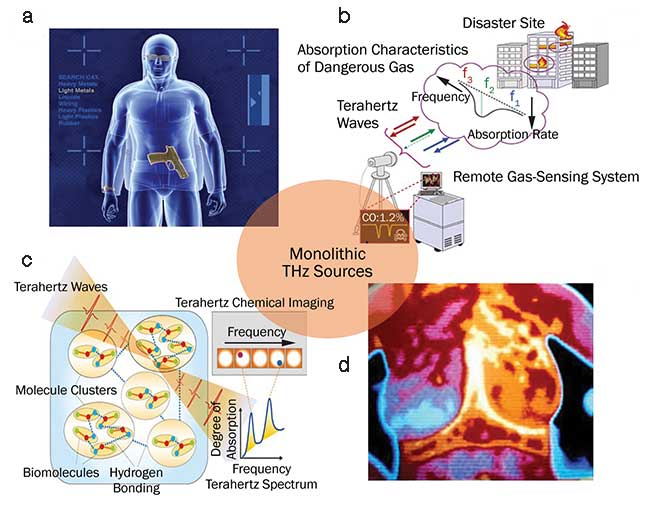
The major applications of THz radiation are imaging, sensing, spectroscopy and communication (Figure 1). Unlike x-rays, THz waves do not have any ionizing effects and are generally considered biologically innocuous. This makes THz waves much safer than x-rays when used for airport security and medical diagnosis.

Applications of THz source technology.


Figure 1.
 Applications of THz source technology.

Thanks to the rapid development of THz technologies in recent decades, there has been exponential growth in companies, products and research. In fact, BCC Research expects the market to reach $195.3 million by 2018. The diversification of the THz market is expected to accelerate after 2018, and the total market value should exceed $942 million by 20231.

Wanted: high-power, compact THz sources 

All of the previously mentioned applications stand to benefit from a compact THz source with high average THz power output. For example, if 100 µW of power images 1 cm2 in five minutes, then 100 mW would image 200 cm2in just one minute, a number that might make it valuable for large-scale security or medical screening. However, the options in high-power compact THz sources are limited. The electronic devices on the lower THz frequency side — frequencies lower than 1 THz — such as Schottky-diode based multipliers, Gunn diodes, resonant-tunneling diodes and impact ionization avalanche transit-time diodes, can deliver a room temperature THz signal with a compact device size2. However, these sources have limited frequency coverage, poor power efficiency and low output power levels at the super THz frequencies, which have a frequency greater than 2 THz. At these higher frequencies, THz quantum cascade lasers (QCLs) have emerged as the most powerful semiconductor THz sources. However, the working temperature is still below 200 K3.

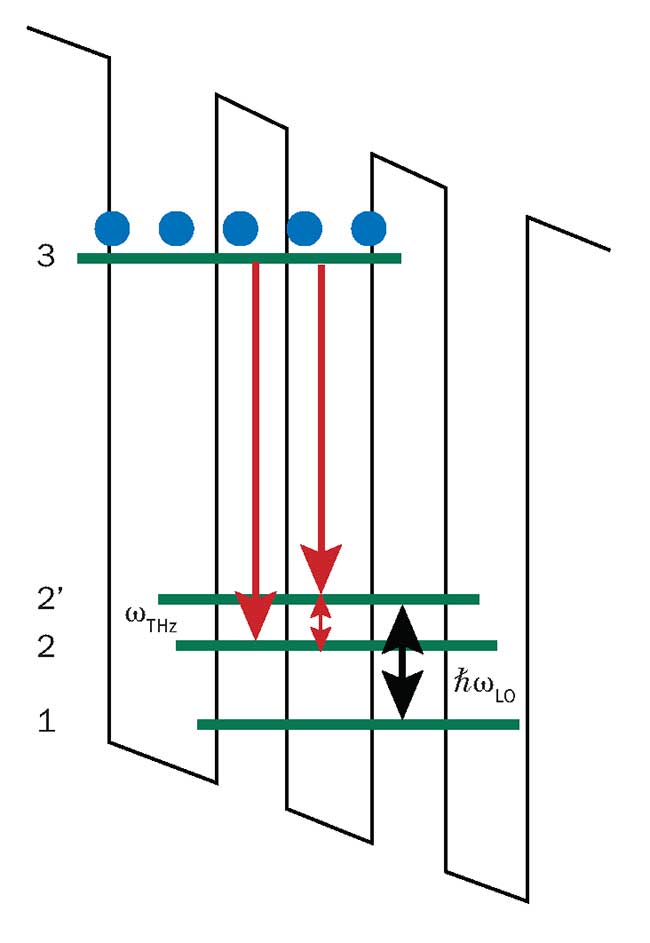
Currently, difference frequency generation (DFG) in mid-IR QCLs, the intracavity nonlinear optical approach, has been able to deliver multi-mW THz power at room temperature4. When a QCL active region is designed with strong nonlinear coupling between the lower lasing levels and injector levels, the result is a large nonlinear susceptibility x(2), and THz emission can be generated within the cavity (Figure 2). When the lower level 2 is designed with a strong coupling with its neighboring level 2′, a large nonlinear susceptibility x(2) up to 104 pm/V will be created in the active region, which is more than two orders of magnitude higher than the nonlinear crystals.

The difference frequency generation (DFG) process between the electron states in a band structure of a quantum cascade laser.
Figure 2.
 The difference frequency generation (DFG) process between the electron states in a band structure of a quantum cascade laser. Courtesy of Center for Quantam Devices, Northwestern University.

With certain mode-selecting mechanisms, such as the composite distributed feedback grating5, and certain phase- matching mechanisms, such as the modal or the Cerenkov phase-matching scheme with epi-down mounting6, single mode THz emission in a wide spectral range can be generated. Therefore, this type of THz source inherits all of the advantages of the mid-IR QCLs, such as room temperature operation, electrical pumping and compact size, as well as the potential for high-power output and mass production.

High-power QCL sources with wide frequency tuning

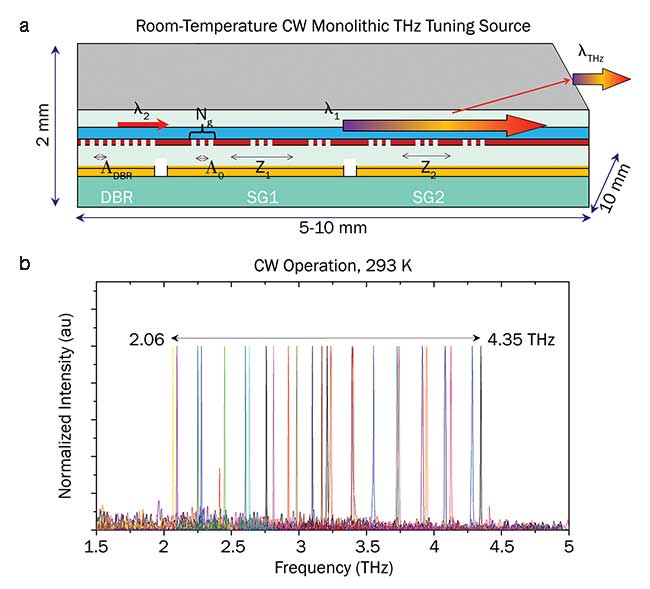
The past few years have seen the rapid development of room-temperature THz DFG QCL sources for higher power output, wider frequency tuning and continuous wave operation (Figure 3a). Currently, such devices can emit THz power up to 1.9 mW with a side mode suppression ratio of 30 decibel (dB) at 3.5 THz in pulsed mode operation (Figure 3b)4. In continuous wave operation, they can produce 0.014 mW, with a wide monolithic tuning frequency range of 2.06 to 4.35 THz at room temperature (Figure 4) by using a strain-balanced active region structure and sampled grating design7,8.

Recently demonstrated THz power records of the THz sources based on DFG quantum cascade lasers (QCLs) at room temperature as a function of year


Figure 3.
 Recently demonstrated THz power records of the THz sources based on DFG quantum cascade lasers (QCLs) at room temperature as a function of year (a). THz power and spectra (inset) for a high power THz source based on DFG QCL (b). Courtesy of Center for Quantam Devices, Northwestern University.

Considering another 30 percent reflection of the THz emissions, the outcoupling efficiency of the emitted THz power with respect to the generated power is as low as 15 percent. Given the maximum recorded 1.9-mW output power, the total generated THz power in the device is estimated to be about 12 mW. Therefore, there is a great potential for THz power enhancement when an efficient THz outcoupler is applied to the THz waveguide. By enlarging the outcoupling aperture with a Si prism to allow for more THz light to be coupled out from the substrate or extracting the THz light from the entire cavity via diffraction grating, even higher THz power and efficiency in a wider spectral range in pulsed and CW modes can be obtained. This is of special importance to high THz frequency generation (>4.5 THz) where the phonon absorption in the semi-insulating InP substrate plays a leading role in the THz absorption prior to outcoupling. Currently, THz QCL sources with a diffraction grating outcoupler can produce THz surface emission with mW level power9.

With further optimization to the diffraction grating design and fabrication, the THz outcoupling efficiency from the diffraction grating, much higher than that from the polished edge facet, has been recently demonstrated. Considering the fact that mid-IR QCLs operating up to 200 W have been demonstrated10, by following a similar strategy, it may be possible to further enhance the THz power to tens of MW by scaling the device.

This revolutionary CW monolithic tunable THz source, which is also compact (packaging size of ~10 × 10 × 2 mm3) and mass-producible, is becoming the ideal light source for emerging THz applications such as spectroscopy and sensing.

A monolithically tunable THz source based on DFG QCL


Figure 4.
 A monolithically tunable THz source based on DFG QCL (a). Tunable THz spectra at room temperature continuous wave operation (b). Courtesy of Center for Quantam Devices, Northwestern University.

High-power QCL frequency comb sources 

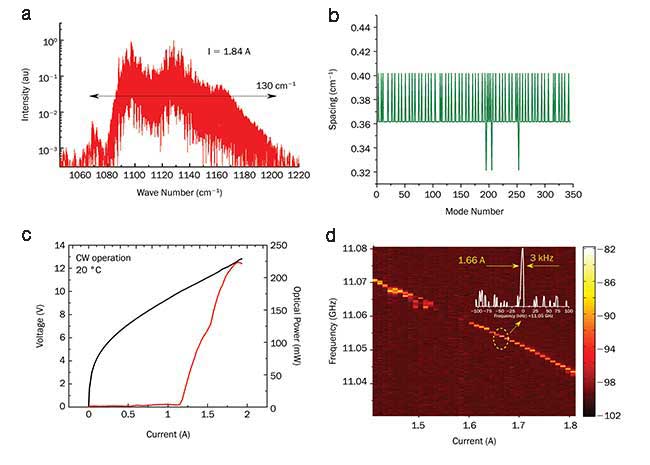
THz spectroscopy is a vital tool for detecting and quantifying many types of chemical molecules, and plays an important role in environmental monitoring, medical diagnosis, atmospheric chemistry and industrial quality control. Optical frequency combs have revolutionized metrology and spectroscopy with their extraordinary speed and precision. The evenly spaced modes in the frequency domain enable the frequency comb to act as a ruler and provide unprecedented precision and speed compared with other spectrometric techniques. Mode-locked femtosecond lasers have been used for the direct generation of the mid-IR frequency comb; however, the wavelengths are mainly limited to 3 µm11. Deep in the mid-IR and THz wavelength range, QCL frequncy combs are the only monolithic solid-state optical comb sources12,13. As a QCL is engineered with a sufficiently low group velocity dispersion using a broadband heterogeneous active region design, the device can emit a frequency comb via four-wave mixing. Frequency comb operation was achieved from a free-running CW broadband QCL at λ~9.0 µm with a spectral range of 130 cm-1 and an output power of 220 mW for 350 modes (Figure 5a,c). All the lasing modes exhibit near identical frequency spacing of 0.38 cm-1 (11.04 GHz).

Lasing spectrum measured at a current of 1.84 A


Figure 5.
 Lasing spectrum measured at a current of 1.84 A (a). The adjacent mode spacing as a function of mode number (b). P-I-V characterization of a 4-mm long Fabry-Perot QCL device in CW operation (c). Intermode beatnote spectra at different current. (Inset) Intermode beatnote spectrum measured at a current of 1.66 A (d). Courtesy of Center for Quantam Devices, Northwestern University.

The intermode beatnote spectra were characterized with a high-speed quantum well infrared detector and the photo-response was measured with a spectrum analyzer. A narrow intermode beating linewidth of 3 kHz (Figure 4d) was observed, which corresponds to a broad spectral coverage of 65 cm-1 and high CW power output of 180 mW for ~176 comb modes, nearly 1 mW power for most of the modes. The frequency comb power was recently enhanced up to 880 mW at λ~8.0 µm with a narrow intermode beatnote linewidth of only 50 Hz.

The demonstrated high-power frequency comb source is likely to find wide applications in chip-based spectroscopy and metrology. It also opens a way to THz optical frequency comb operation at room temperature based on intracavity DFG (down conversion) inside a mid-IR QCL.

Meet the authors

Manijeh Razeghi is the Walter P. Murphy Professor and director of the Center for Quantum Devices (CQD) at Northwestern University in Evanston, Ill.; email: razeghi@eecs.northwestern.edu. Quanyong Lu is a research assistant professor; Santanu Manna and Donghai Wu are postdoctoral researchers; and Steven Slivken is a research associate professor — all at CQD.

References

1. BCC Research (July 2013). Terahertz radiation systems: Technologies and global markets (IAS029C).

2. H. Eisele and G. I. Haddad (1998). Two terminal millimeter-wave sources. IEEE Trans Microwave Theory Tech, Vol. 46, Issue 6, pp. 739–746.

3. S. Fathololoumi and E. Dupont, et al. (2012). Terahertz quantum cascade lasers operating up to ~200 K with optimized oscillator strength and improved injection tunnelling. Opt Express, Vol. 20, p. 3866.

4. M. Razeghi and Q. Y. Lu, et al. (2015). Quantum cascade lasers: from tool to product. Opt Express, Vol. 23, p. 8462.

5. Q. Y. Lu and N. Bandyopadhyay, et al. (2011). Room temperature single-mode terahertz sources based on intracavity difference-frequency generation in quantum cascade lasers. Appl Phys Lett, Vol. 99, 131106.

6. Q. Y. Lu and N. Bandyopadhyay, et al. (2013). Room temperature terahertz quantum cascade laser sources with 215 µW output power through epilayer-down mounting. Appl Phys Lett, Vol. 103, 011101.

7. Q. Y. Lu and N. Bandyopadhyay, et al. (2014). Continuous operation of a monolithic semiconductor terahertz source at room temperature. Appl Phys Lett, Vol. 104, 221105.

8. Q. Y. Lu and D. H. Wu, et al. (2016). Room temperature continuous wave, monolithic tunable THz sources based on highly efficient mid-infrared quantum cascade lasers. Sci Reports, Vol. 6, 23595.

9. M. Razeghi and Q. Y. Lu, et al. (2015). Recent development of high power, widely tunable THz quantum cascade laser sources based on difference-frequency generation. Proc of SPIE, Vol. 9585, 958502-1.

10. D. Heydari and Y. Bai, et al. (2015). High brightness angled cavity quantum cascade lasers. Appl Phys Lett, Vol. 106, 091105.

11. A. Schliesser and N. Picqué, et al. (2002). Mid-infrared frequency combs. Nature Photon, Vol. 6, p. 449.

12. A. Hugi and G. Villares, et al. (2012). Mid-infrared frequency comb based on a quantum cascade laser. Nature, Vol. 492, Issue 229.

13. Q. Y. Lu and M. Razeghi, et al. (2015). High power frequency comb based on mid-infrared quantum cascade laser at λ~ 9 µm. Appl Phys Lett, Vol. 106, 051105.


Friday, October 7, 2016

S+D 2016: QCLs provide diverse defense solutions

As they replace solid state lasers as the “source of choice” for countermeasures.
http://optics.org/news/7/10/11
In the Technologies for Optical Countermeasures conference strand of SPIE’s Security + Defense conference in Edinburgh, last week, the application of quantum cascade lasers to defense systems was considered by several key speakers.
QCLs are seeing increasing application in defense and security applications. In many instances they are replacing traditional solid state lasers as the source of choice for countermeasures, remote and in situsensing and through-barrier sensing and explosives detection.
Following their development and demonstration in the early 1990s, QCLs reached some maturity and specific defense and security application prior to 2005; with much initial development being funded and achieved by DARPA-led initiatives in the US, and DSTL and Ministry of Defence funding initiatives in the UK, and university level R&D such as those by Prof Manijeh Razeghi at Northwestern University, and Prof Ted Masselink at Humboldt University.
As QCLs provide direct mid-IR laser output for electrical input, they demonstrate high quantum efficiency compared with diode pumped solid state lasers with optical parametric oscillators in the generation of mid-infrared outputs. One advantage of QCLs is their broad operational bandwidth, extending from the terahertz to the near-infrared spectral regions.
In a talk, delivered remotely from her office in Northwestern University, Evanston, IL, (near Chicago), Professor Manijeh Razeghi gave a presentation entitled “New frontiers in quantum cascade lasers: high-power solid-state frequency comb and terahertz sources at room temperature”.
'Tremendous development'
She said, “The past 20 years have witnessed the tremendous development of quantum cascade lasers. Nowadays, QCLs have become the leading light sources in the mid-infrared wavelength range [3-30 µm], and the only compact light sources that cover the frequency range 1-5THz.
"The special inter-sub-band optical transition of QCL not only enables wide-range laser emissions from mid-infrared to terahertz frequencies simply by tailoring the layer thickness of the quantum well-barrier structures, but also renders giant nonlinear optical properties to the lasers with proper quantum designs.”
She went on to say that this property means that when the quantized sub-bands are engineered with strong coupling, large nonlinear susceptibilities, including the second-order and third-order nonlinear susceptibilities are created for various nonlinear interactions.
Professor Razeghi also presented the recent development of room-temperature, high power terahertz sources based on difference-frequency generation from QCLs including terahertz peak power up to 1.9mW, continuous wave operation at 3.6THz, widely frequency coverage of up to 4.6THz with high side mode suppression ratio of around 40dB from an array of DFB devices, and the monolithic terahertz tuning of a chip-based THz sources up to 4.2THz with power up to 0.1mW in pulsed mode operation.

Pranalytica's Dr Kumar Patel.
Progress in MWIR and LWIR QCLs
Dr Kumar Patel, of Pranalytica (US) then gave a presentation entitled “Recent progress in MWIR and LWIR quantum cascade lasers”. Pranalytica is a leading manufacturer of QCL systems for industrial and defense markets. With capabilities across the entire 4µm to 12µm spectral region covered by QCLs, Pranalytica's sources cover applications in fields as diverse as spectroscopy, free space optical communications, directed infrared countermeasures and other security areas.
Dr Patel introduced his talk by saying, “There has been an explosion in the applications of quantum cascade lasers in the mid- and longwave infrared spectral regions, because QCLs are the only semiconductor lasers that operate in continuous wave mode at room temperature in this spectral region, by converting electrical power directly into optical power.”
Considering potential security and defense applications of this area of the spectrum, he said, “For Fabry-Perot configuration QCLs, producing broadband powers, these applications include protection of aircraft from MANPADS, DIRCM, testing of infrared countermeasure systems, target pointers/illuminators and IFF beacons.
“And for external cavity grating tuned QCLs, producing tunable radiation covering several hundred nanometers, applications include laboratory spectroscopy and detection and identification of chemical warfare agents, toxic industrial chemicals and explosives for in-situ as well as standoff configurations.”
Many of these applications require high powers and high wall-plug efficiency QCLs. Pranalytica is developing such high performance QCLs through the invention of a novel QCL structure design – the non-resonant extraction, and several engineering inventions including novel facet coating to significantly increase the catastrophic damage threshold and novel composite sub-mount material, AlN:SiC for much improved thermal management.
Dr Patel concluded, “The impact of these innovations is evident from our ability to deliver watt level or higher power at any wavelength from 3.6μm to 12μm. High powers available in Fabry-Perot configuration translate into high powers available from external cavity grating tuned QCLs.
“In the tunable QCL area, we have recently reported significant breakthrough in increasing the rate at which wavelengths can be switched by employing an all-electronic tuning mechanism. This has permitted us to switch wavelengths in a time less than 700ns. This is almost 3-4 orders magnitude faster than that possible using convention grating tuned systems.”

DSTL's Mark Elson.
Platform protection
Mark Elson, from the Defence Science and Technology Laboratory (DSTL), UK, also presented on defense applications of photonics systems in a talk entitled NATO Electronic Warfare – Challenges for Platform Protection.
Electronic warfare capabilities, especially photonics-based systems, are increasingly important to defense. While the fundamentals of electron warfare remain essentially the same, the scope of operations today reflects a new paradigm that expands its horizon into the fields of spectrum and cyber - requiring fresh concepts and technologies to outpace the threats.
Elson described the activities of his international defense systems working group known as Nato Air forces Armaments Group Air Capability Group 3, Subgroup 2. He said, “It was all about chaff to start with, leading towards IRCOMs and latterly it’s moved towards assessment of threat and understanding of appropriate defensive and sensing systems.
"These can include radio frequency / infrared / counter terrorism, laser countermeasures and other electro-optic countermeasures linking in to counter the lower technology threats, and optical counter measures especially from what we have learned in theaters such as Afghanistan."
His fascinating talk covered many real world examples of how optical sensing and automated response systems were developed by the various international defense groupings associated with Subgroup2, whether for protecting Chinook helicopters as they drop off troops in warzones to IR-based counter missile systems based on high-speed jet fighters.

Friday, July 8, 2016

Abstract-Recent Advances in Room Temperature, High-Power Terahertz Quantum Cascade Laser Sources Based on Difference-Frequency Generation


Quanyong Lu,  Manijeh Razeghi,

http://www.mdpi.com/2304-6732/3/3/42

We present the current status of high-performance, compact, THz sources based on intracavity nonlinear frequency generation in mid-infrared quantum cascade lasers. Significant performance improvements of our THz sources in the power and wall plug efficiency are achieved by systematic optimizing the device’s active region, waveguide, and chip bonding strategy. High THz power up to 1.9 mW and 0.014 mW for pulsed mode and continuous wave operations at room temperature are demonstrated, respectively. Even higher power and efficiency are envisioned based on enhancements in outcoupling efficiency and mid-IR performance. Our compact THz device with high power and wide tuning range is highly suitable for imaging, sensing, spectroscopy, medical diagnosis, and many other applications.

Tuesday, March 29, 2016

New terahertz source could strengthen sensing applications


The design of Razeghi's terahertz tuning source.
Credit: Image courtesy of Northwestern University
Cucrrent terahertz sources are large, multi-component systems that sometimes require complex vacuum systems, external pump lasers, and even cryogenic cooling. The unwieldy devices are heavy, expensive, and hard to transport, operate, and maintain.
https://www.sciencedaily.com/releases/2016/03/160328133743.htm

Now Northwestern University's Manijeh Razeghi has developed a new type of security detection device that bypasses these issues. With the ability to detect explosives, chemical agents, and dangerous biological substances from safe distances, the device could make public spaces more secure than ever.
"A single-component solution capable of room temperature continuous wave and widely frequency tunable operation is highly desirable to enable next generation terahertz systems," said Razeghi, Walter P. Murphy Professor of Electrical Engineering and Computer Science in Northwestern's McCormick School of Engineering.
Director of Northwestern's Center for Quantum Devices, Razeghi and her team have demonstrated a room temperature continuous wave, highly tunable, high-power terahertz source. Based on nonlinear mixing in quantum cascade lasers, the source can emit up to multi-milliwatts of power and has a wide frequency coverage of one-to-five terahertz in pulsed mode operation.
Funded by the National Science Foundation, Department of Homeland Security, Naval Air Systems Command, and NASA, the research was published on March 25 in Nature Scientific Reports. This new research builds on Razeghi group's many years of research with Northwestern's Center for Quantum Devices, including the development of the first single mode room temperature terahertz laser in 2011.
"I am very excited about these results," Razeghi said. "No one would believe any of this was possible, even a couple years ago. This initial demonstration was very exciting, and continuing developing will lead us to the new frontier of terahertz technology."

Story Source:
The above post is reprinted from materials provided by Northwestern UniversityNote: Materials may be edited for content and length.

Journal Reference:
  1. Quanyong Lu, Donghai Wu, Saumya Sengupta, Steven Slivken, Manijeh Razeghi. Room temperature continuous wave, monolithic tunable THz sources based on highly efficient mid-infrared quantum cascade lasersScientific Reports, 2016; 6: 23595 DOI: 10.1038/srep23595

Saturday, January 24, 2015

Infrared imaging technique operates at high temperatures


By: Amanda Morris
http://phys.org/news/2015-01-infrared-imaging-technique-high-temperatures.html

From aerial surveillance to cancer detection, mid-wavelength infrared (MWIR) radiation has a wide range of applications. And as the uses for high-sensitivity, high-resolution imaging continue to expand, MWIR sources are becoming more attractive.
Currently, commercial technologies for MWIR detection, such as indium antimonide (InSb) and mercury-cadmium-telluride (MCT), can only operate at  in order to reduce thermal and electrical noise. In a search for alternatives, a team of researchers at Northwestern University's Center for Quantum Devices (CQD) has incorporated new materials to develop detectors that can work at room temperature.
"A higher operating temperature eliminates the need for liquid nitrogen," said Manijeh Razeghi, Walter P. Murphy Professor of Electrical Engineering and Computer Science and director of the CQD at Northwestern's McCormick School of Engineering and Applied Science. "That makes detectors more compact, less expensive, and more portable."
Depending on its use,  is divided into several wavelength segments. MWIR have a radiation range between 3-5 microns; cameras able to see in this wavelength are capable of passive infrared imaging.
Razeghi and her group developed an indium arsenide/gallium antimonide (InAs/GaSb) type II superlattice that demonstrated high-resolution MWIR images while operating at high temperatures. The new technique was particularly successful at obtaining  of the human body, which has potential for vascular imaging and disease detection.
Supported by DARPA, the Army Research Laboratory, Air Force Research Laboratory, and NASA, the team's findings were reported in paper in the January 1 issue of Optics Letters, the journal of the Optical Society of America.
More information: Optics Letterswww.opticsinfobase.org/ol/abst… t.cfm?uri=ol-40-1-45


Read more at: http://phys.org/news/2015-01-infrared-imaging-technique-high-temperatures.html#jCp

Tuesday, November 25, 2014

Enabling The Next Generation Of Terahertz Devices


By Chuck Seegert, Ph.D.
http://www.photonicsonline.com/doc/enabling-the-next-generation-of-terahertz-devices-0001
A newly developed, single-component terahertz source was recently developed by researchers at Northwestern University. The device covers the full spectrum of terahertz radiation, comes in a small package, and is capable of functioning at room temperature. The device may enable new medical diagnostics and improve security measures at airports.
Many materials respond to terahertz radiation exposure by emitting characteristic spectroscopic signatures that can be used to identify them. Chemicals, biological specimens, drugs, and explosives are just a few of these materials. Like traditional X-rays, terahertz radiation can pass through tissue to form images. Unlike X-rays, however, this radiation doesn’t ionize the tissue and has a lower health risk.
Unfortunately, the generation of terahertz radiation has historically required equipment that is large and unwieldy, which doesn’t lend it to broad application in the field.
A recent advance from Northwestern University (NWU) researchers could now make terahertz radiation sources widely available, according to a recent press release from NWU. The detector could enable remote sensing in a number of settings, including airports, where identifying chemicals like explosives is critical. The technology would be particularly well suited for uses like this, since it could be deployed from a safe distance.
"A single-component solution capable of room temperature and widely tunable operation is highly desirable to enable next generation terahertz systems," said Manijeh Razeghi, Walter P. Murphy Professor of Electrical Engineering and Computer Science at Northwestern University's McCormick School of Engineering and Applied Science, according to the press release.
Razeghi and her team have developed such a system, according to a recent study published by the team in Applied Physics Letters. The new single-component device is capable of producing a tunable frequency range from 2.6 to 4.2 terahertz at room temperature using pulsed lasers. The lasers used were mid-infrared quantum cascade lasers, and the radiation source could achieve terahertz power up to 0.1 mW. This range is much larger than ever achieved previously when electrical tuning is used.
Terahertz radiation exists between traditional electromagnetic waves, like those used in radios and microwaves, and photonic waves, like ultraviolet and infrared, according to a recent story fromPhotonics Online. Because of this, it may be a candidate for extending certain communication wavebands.

Friday, November 21, 2014

New terahertz device could strengthen security


                                                                                                    Manijeh Razeghi

http://phys.org/news/2014-11-terahertz-device.html

We are all familiar with the hassles that accompany air travel. We shuffle through long lines, remove our shoes, and carry liquids in regulation-sized tubes. And even after all the effort, we still wonder if these procedures are making us any safer. Now a new type of security detection that uses terahertz radiation is looking to prove its promise. Able to detect explosives, chemical agents, and dangerous biological substances from safe distances, devices using terahertz waves could make public spaces more secure than ever.
But current terahertz sources are large, multi-component systems that sometimes require complex vacuum systems, external pump lasers, and even cryogenic cooling. The unwieldy devices are heavy, expensive, and hard to transport, operate, and maintain.
"A single-component solution capable of  and widely tunable operation is highly desirable to enable next generation terahertz systems," said Manijeh Razeghi, Walter P. Murphy Professor of Electrical Engineering and Computer Science at Northwestern University's McCormick School of Engineering and Applied Science.
Director of Northwestern's Center for Quantum Devices, Razeghi and her team have been working to develop such a device. In a recent paper in Applied Physics Letters, they demonstrate a room temperature, highly tunable, high power terahertz source. Based on nonlinear mixing in , the source can emit up to 1.9 milliwatts of power and has a wide frequency coverage of 1 to 4.6 terahertz. By designing a multi-section, sampled-grating distribution feedback and distributed Bragg reflector waveguide, Razeghi and her team were also able to give the device a tuning range of 2.6 to 4.2 terahertz at room temperature.
The device has applications in medical and deep space imaging as well as security screening.
"I am very excited about these results," Razeghi said. "No one would believe any of this was possible, even a couple years ago."


Read more at: http://phys.org/news/2014-11-terahertz-device.html#jCp

Monday, June 9, 2014

New Terahertz System Simpler, Clearer


http://www.photonics.com/Article.aspx?AID=56300
EVANSTON, Ill., June 6, 2014 — Biosensing, space research and the ability to see through opaque surfaces without x-rays are all enabled by terahertz radiation. However, such systems have long been elusive.

A team from Northwestern University has produced terahertz radiation in a simplified system, making it easier to harness the power of such waves. Existing terahertz systems are expensive and large, with numerous components that require complex technologies, such as vacuum electronics, external pump lasers and cryogenic cooling. Often, they are too difficult to generate and manipulate.

The new continuous terahertz radiation scheme is compact and, in the study, demonstrated six times more efficiency than previous systems, the researchers said. It works well at room temperature and can be used effectively with high-power quantum cascade lasers (QCLs).

Graph showing THz peak power as a function of current and emitting spectrum at 10 amps. Courtesy of Applied Physics Letters.

“Continuous terahertz operation at room temperature is of utter importance to the wide application and commercialization of our lasers,” said Manijeh Razeghi, lead researcher and director of the Center for Quantum Devices in the McCormick School of Engineering and Applied Science at Northwestern.

The team generated terahertz radiation through nonlinear frequency mixing of two mid-infrared wavelengths at 8.8 µm and 9.8 µm from a single QCL chip. This allowed continuous terahertz emission with 3 µW realized in a compact, monolithic nonlinear QCL device.

The researchers achieved this by improving the thermal conductance with epilayer-down bonding and a buried ridge waveguide. The optical loss was also decreased with a buried composite grating for stable, single-mode operation.

Razeghi said that the new system could make terahertz radiation more accessible for experiments.

The work was funded by the National Science Foundation, the Department of Homeland Security, Naval Air Systems Command and NASA. The research was published in Applied Physics Letters (doi: 10.1063/1.4881182). LINK: http://scitation.aip.org/content/aip/journal/apl/104/22/10.1063/1.4881182 

For more information, visit www.northwestern.edu.

Thursday, June 5, 2014

Continuous terahertz sources demonstrated at room temperature 2 hours ago


http://phys.org/news/2014-06-terahertz-sources-room-temperature.html


Imagine a technology that could allow us to see through opaque surfaces without exposure to harmful x-rays, that could give us the ability to detect harmful chemicals and bio-agents from a safe distance, and that could enable us to peer so deeply into space that scientists could better understand the formation of the universe.
All of these scenarios are possible with terahertz  with lengths that fall between microwaves and infrared light. However, the potential of  has yet to be reached because they are difficult to generate and manipulate. Current terahertz sources are large, multi-component systems that require complex vacuum electronics, external pump lasers, or cryogenic cooling. It's an expensive and cumbersome process.
Northwestern University professor Manijeh Razeghi and her team are the first to produce terahertz radiation in a simplified system, making it easier to harness the power of these elusive waves. They have developed the first , compact, continuous terahertz radiation source, and it's six times more efficient than previous systems.
Razeghi's research group excels at room-temperature, high-power  (QCL), which are compact semiconductor lasers emitting in mid-infrared.
"Continuous terahertz operation at room temperature is of utter importance to the wide application and commercialization of our lasers," says Razeghi, who is the Walter P. Murphy Professor of Electrical Engineering and Computer Science and director of the Center for Quantum Devices in the McCormick School of Engineering and Applied Science at Northwestern.
The team generated terahertz radiation through nonlinear frequency mixing of two mid-infrared wavelengths at 8.8 microns and 9.8 microns from a single QCL chip. Room temperature, continuous terahertz emission with 3 microwatts is realized in a monolithic nonlinear QCL device with a tiny packaging dimension (as small as 2x5x8 mm3). This is achieved by improving the thermal conductance with epilayer-down bonding and a buried ridge waveguide, as well as by decreasing the optical loss with a buried composite grating for stable, single mode operation.
This discovery will make  more accessible for experiments, potentially leading to advances in biosensing, homeland security, and space research.