Showing posts with label Honglei Zhan. Show all posts

Sunday, February 21, 2021

Abstract-Thermal Terahertz Analysis for the Detection of Trace Organic Matter


Fankai Qin, Ru Chen, Yicen Li, Zhaohui Meng, Sitong Chen, Kun Zhao, Xinyang Miao, Wenfeng Xiang, Wenzheng Yue, Honglei Zhan, 


https://pubs.acs.org/doi/10.1021/acs.energyfuels.0c04354

The technology of trace organic matter (OM) detection offers researchers numerous intriguing possibilities, ranging from fundamental science to applications in many fields. This study proposes a thermal terahertz (THz) analysis (TTA) method that is suitable for detecting trace OM in the field of oil–gas resource and can analyze the differences in the content and type of trace OM. In this research, THz time-domain spectroscopy (THz-TDS) technology combined with pyrolysis technology were used to detect the pyrolysis characteristics of trace OM in sand collected from a desert oilfield. According to thermogravimetric analysis, the main pyrolysis temperature range of the OM was 300–600 °C. Further analysis of the spectra indicated that when the pyrolysis temperature was 300 °C, the OM content in the sand was the highest and the THz waves were the most attenuated due to the strong interaction between OM and THz waves. As the pyrolysis temperature increased, the OM was gradually pyrolyzed into gas and escaped and the peak amplitude (Ep) of the THz-TDS clearly increased. When the pyrolysis temperature reached 600 °C, the OM was completely pyrolyzed while the Ep of the THz-TDS changed very little. Consequently, the trace OM detection method based on THz spectroscopy combined with pyrolysis technology is expected to become a new complementary means for the detection of trace OM information.

Sunday, September 16, 2018

Abstract-Size Effect on Microparticle Detection


 Honglei Zhan,  Ru Chen,  Xinyang Miao ;  Yizhang Li,  Kun Zhao, Shijie Hao, Xiaohong Chen

https://ieeexplore.ieee.org/document/8385189/

In this paper, terahertz (THz) spectroscopy was employed to analyze compacted sand particles. The dependence of attenuation coefficient spectra on thickness was obtained. Further analysis of the spectra indicated that as the particle size increased, the attenuation coefficient of the THz spectrum also increased. The smaller sand particle samples behaved as Rayleigh particles, their extinction spectrum was mainly affected by absorption of the THz waves, thus the attenuation was small. The extinction coefficient curve of the larger particle sand samples behaved as Mie particles and exhibited the strong characteristics of a Mie scattering curve. The THz wave attenuation in the larger sand particle samples was the result of the combined effect of absorption and scattering, thus the attenuation of the THz waves was larger.

Monday, September 3, 2018

Abstract-Determining the Humidity-Dependent Ortho-to-Para Ratio of Water Vapor at Room Temperature Using Terahertz Spectroscopy


Xinyang Miao, Jing Zhu, Kun Zhao, Honglei Zhan, Wenzheng Yue,

https://www.osapublishing.org/as/abstract.cfm?uri=as-72-7-1040&origin=search

The origin of the water spin isomers observed under various physico-chemical conditions is of great interest, including that of H2O molecules in the gas phase. Here, terahertz time-domain spectroscopy (THz-TDS) was used to study the humidity-dependent ortho-to-para (O/P) ratio of water vapor at room temperature. The relative contents of para and ortho molecules were obtained by fitting the absorption lines of water vapor showing the relationship between the spin isomer contents and humidity. Larger O/P ratios with values of 3.2 were observed at lower humidity (<20%) due to the stronger attractive forces of para molecules. The concentration of the ortho isomers then began to decrease at higher humidity (>20%) due to the preferential formation of dimers and clusters at increasing concentrations. Thus, the ratio gradually decreased with increasing humidity.
© 2018 The Author(s)

Wednesday, June 7, 2017

Abstract-Terahertz double-exponential model for adsorption of volatile organic compounds in active carbon

 and 


In terms of the evaluation of the diffusion-controlled adsorption and diffused rate, a mathematical model was built on the basis of the double-exponential kinetics model and terahertz amplitude in this letter. The double-exponential-THz model described the two-step mechanism controlled by diffusion. A rapid step involves external and internal diffusion, followed by a slow step controlled by intraparticle diffusion. The concentration gradient of the molecules promoted the organic molecules rapidly diffusing to the external surface of adsorbent. The solute molecules then transferred across the liquid film. Intraparticle diffusion began and was determined by the molecular sizes, as well as affinities between organics and activated carbon.

Tuesday, May 2, 2017

Abstract-Discriminating the Mineralogical Composition in Drill Cuttings Based on Absorption Spectra in the Terahertz Range


Xinyang Miao, Hao Li, Rima Bao, Chengjing Feng, Hang Wu, Honglei Zhan, Yizhang Li, and Kun Zhao

https://www.osapublishing.org/as/abstract.cfm?uri=as-71-2-186&origin=search

Understanding the geological units of a reservoir is essential to the development and management of the resource. In this paper, drill cuttings from several depths from an oilfield were studied using terahertz time domain spectroscopy (THz-TDS). Cluster analysis (CA) and principal component analysis (PCA) were employed to classify and analyze the cuttings. The cuttings were clearly classified based on CA and PCA methods, and the results were in agreement with the lithology. Moreover, calcite and dolomite have stronger absorption of a THz pulse than any other minerals, based on an analysis of the PC1 scores. Quantitative analyses of minor minerals were also realized by building a series of linear and non-linear models between contents and PC2 scores. The results prove THz technology to be a promising means for determining reservoir lithology as well as other properties, which will be a significant supplementary method in oil fields.

Wednesday, March 15, 2017

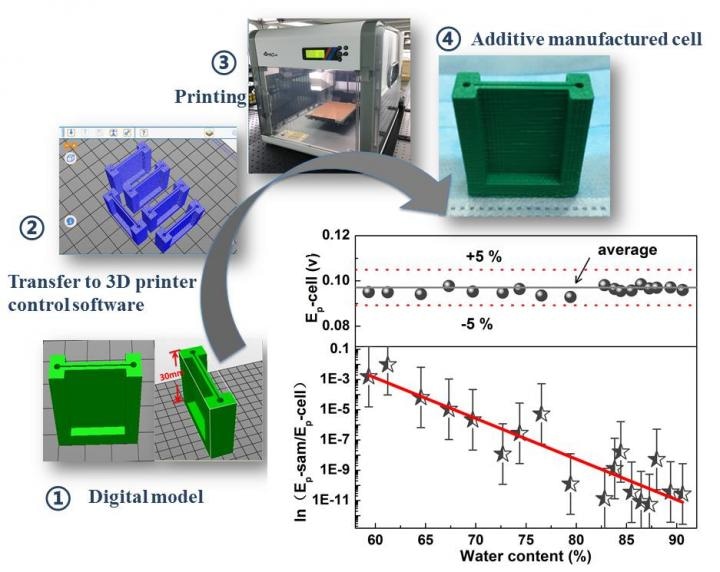
Combination of THz Spectroscopy and AM Technique Can be Used to Evaluate Water Content in Crude Oil


http://www.azom.com/news.aspx?newsID=47409

Water content in crude oil is closely related to the prediction of water level of oil well, the evaluation of oil reservoir exploitation and the recovery and development of mining scheme. Therefore, the accurate measurement of water content is significant not only for forecasting the exploiting capacity of an oil field before mining and estimating working status, but also for grading and evaluating oil products.


Producing sample pool using AM technology and the relationship between water content and THz parameters. (Credit: Science China Press)

In order to optimize the production and confirm the security, simple and secure methods have been proposed for detecting the water content in crude oil. Terahertz (THz) radiation is a newly-developed, non-contact and secure method, and can be absorbed by organics and water molecules in different degrees, which has been used to evaluate the quality of oil and oil products.
In the article, coauthored with LiMei Guan, HongLei Zhan, XinYang Miao, Jing Zhu, Kun Zhao, water content in oil-water mixtures from 1.8%-90.6% was measured by using special designed samplers for high-water-content oil which are manufactured by additive manufacturing system. These researchers stated: "water content of oil-water mixtures with high water content is quantitatively characterized by the combination of THz spectroscopy and 3D-printing technology".
The study was published in the journal Science China Physics, Mechanics & Astronomy. The strong absorption of water in the THz range leads to a decrease in SNR (signal-to-noiseratio), applying the additive manufactured samplers, the problem that signals usually affected by the significant signal attenuation can be resolved.
Detailed analysis shows the relationships among THz parameters such as signal peak, time delay, and refractive index as well as absorption coefficient and water content in crude oil. Therefore, these THz parameters can be used to continuously monitor the moisture content.
In summary, the combination of THz spectroscopy and AM technique can be applied in oil characterization, even when the oilfield enters the high-water-bearing period. This combination could be a promising selection for measuring water content of fluid with good accuracy, which in turn could open up a new area of research.

Wednesday, October 19, 2016

Characterizing PM2.5 in Beijing and Shanxi Province using terahertz radiation


Ning Li, Honglei Zhan, Kun Zhao, Zhenwei Zhang, Chenyu Li, Cunlin Zhang,

http://link.springer.com/article/10.1007/s12200-016-0608-1

Particles of aerodynamic diameter⩽2.5 µm (PM2.5) caused extremely severe and persistent haze pollution is of concern in many cities. In this study, samples of PM2.5 were collected from atmosphere environment of Beijing and Shanxi Province, and analyzed using terahertz (THz) radiation. The transmission spectrum of PM2.5 in Shanxi Province had two distinct absorption peaks at 6.0 and 6.7 THz, and the curve was increasing on the whole. However, the transmission spectrum of PM2.5 in Beijing had obviously different variation tendency and the absorption peak was studied by monitoring PM2.5 masses in conjunction with two-dimensional correlation spectroscopy (2DCOS). By comparing the pollutant species and concentrations of Shanxi Province and Beijing over the time of collecting samples, the concentrations of sulfate and ammonium were similar, which contributed to emerge absorption bands in the same position. While the concentrations of organic matter (OM), nitrate, chloride and elemental carbon (EC) were different. Furthermore, dust and some other inorganic ion are unique to Shanxi province, which lead to different variation tendency of the transmission spectrum of PM2.5. These results will be of importance for environmental monitoring and for controlling PM emissions. According to this research, optical techniques, and especially spectral methods, should be considered for PM2.5 monitoring.

Sunday, February 28, 2016

Abstract-Probing the sulfur content in gasoline quantitatively with terahertz time-domain spectroscop


FangLi Qin, Qian Li, HongLei Zhan, WuJun Jin, HongLan Liu, Kun Zhao

Terahertz time-domain spectroscopy (THz-TDS) was used for the quantitative detection of sulfur content in gasoline. Models of chemo metrics methods and partial least squares (PLS) were built to measure THz-TDS and the sulfur content. All of the samples were divided into two parts. One part was used for calibration and the other one for validation. In order to evaluate the quality of the models, the correlation coefficient (R) and root-mean-square errors (RMSE) of calibration and validation models were calculated. The value of R and RMSE were close to 1 and 0 within acceptable levels, respectively, indicating that the combination of THz-TDS and PLS is a potential method for further quantitative detection

Monday, March 2, 2015

Abstract-Optical characterization of the principal hydrocarbon components in natural gas using terahertz spectroscopy


Energy Fuels, Just Accepted Manuscript
DOI: 10.1021/ef5028235
Publication Date (Web): March 2, 2015
Copyright © 2015 American Chemical Society
http://pubs.acs.org/doi/abs/10.1021/ef5028235?journalCode=enfuem
A rapid technique is necessary to detect the natural gas which is a more and more significant fuel resource in modern industry. Terahertz (THz) technique was employed in this research to detect the principal hydrocarbon components of natural gas including methane, ethane and propane. Two- and three-component mixtures were measured by THz setup, respectively. The amplitude ratio and time delay deviation of THz peaks between samples and reference were calculated. Phase projection pictures were obtained between the component concentrations and the amplitude ratio as well as time deviation. The phase figures evidently reflected the concentration dependent THz response and a greatly different distribution was located in the whole phase projection area. In addition, back propagation artificial neural networks method was utilized for the quantitative determination of components concentration and total pressure, and the correlation coefficient of prediction set was proved to be 0.9859. Therefore, THz technique can satisfy the increasing need of the rapid and efficient detection in natural gas industry.

Monday, January 12, 2015

Abstract-Water adsorption dynamics into active carbon probed by terahertz spectroscopy


Honglei Zhan,   Shixiang Wu,   Rima Bao,   Kun Zhao,   Lizhi Xiao,  Lina Ge and   Hongjie Shi  
RSC Adv., 2015, Accepted Manuscript

DOI: 10.1039/C4RA14730H
Received 17 Nov 2014, Accepted 12 Jan 2015
First published online 12 Jan 2015

http://pubs.rsc.org/en/content/articlelanding/2015/ra/c4ra14730h#!divAbstract


It is vital to characterize the adsorption dynamics in oil-gas reservoirs and pollution control industry. Terahertz (THz) spectroscopy was used to study the adsorption of the water molecules into active carbons. The absorbance at selected frequencies and the first principal component scores over the whole THz range were related to the corresponding time lengths. The collective tendency expressly tracked the dynamics of water adsorbed into active carbon pores. Therefore, THz technique can be used as a promising tool to monitor the adsorption issue in petroleum and environment fields.

Monday, October 13, 2014

Abstract-Detecting NO 3 − concentration in nitrate solutions using terahertz time-domain spectroscopy


http://link.springer.com/article/10.1007/s12200-014-0437-z
In this paper, we employed terahertz time domain spectroscopy (THz-TDS) to investigate the nitrate () concentration in four types of nitrate solution (sodium nitrate, aluminum nitrate, calcium nitrate and magnesium nitrate). Their absorption coefficient and refractive index were calculated in 0.2–2.5 THz, and a logarithmic relationship was observed between NO 3 concentrations and selected optical parameters regardless of the kinds of nitrate solution. Partial least square (PLS) model was built between THz-TDS and NO 3 concentration. The correlation coefficient of PLS model was calculated. The results make the quantitative analysis of NO 3 concentration possible by THz-TDS and indicate the bright future in practical application.