Showing posts with label SOFIA. Show all posts

Monday, August 12, 2019

Towards quantum-limited coherent detection of terahertz waves in charge-neutral graphene

Graphene doped to charge neutrality shows potential for implementing the next generation of quantum-limited terahertz detectors

Experimental demonstration of THz detection


In the last 30 years or so, astronomical observation in the supra-terahertz frequency range (1-5 THz) have been dominated by superconducting devices, namely, hot electron bolometric mixers (HEBs). Breakthroughs in superconducting detector technology have led to major advancements in THz astronomy with both the Herschel Space Observatory and Stratospheric Observatory for Far Infrared Astronomy (SOFIA). But despite all design and optimization efforts, and restricted by intrinsic material properties, superconducting devices are not approaching quantum-limited detection. Moreover, their limited bandwidth complicates the observation of broad spectroscopic lines and, last but not least, the required Local Oscillator (LO) power is forbiddingly high for implementation of multiple pixel arrays. 
Beyond superconductors, there are few materials that can fulfill the requirements needed for making THz detectors for astronomy. The advent of graphene promised the paradigm shift in terahertz sensing, thanks to its reduced heat capacity. A key obstacle in using graphene, however, has been the lack of a scalable technology for uniform doping of graphene close to the Dirac point. It is only close to the Dirac point that the concentration of electrons and their heat capacity in graphene are remarkably low. Recently, our group demonstrated a new technique of stable and non-volatile carrier density control of graphene, based on molecular assemblies (Nat. Comms. 9, 3956 (2018)). The method yields gateless doping of graphene to the Dirac point with very high uniformity over wafer-scale. As an outcome, the quality of molecular-doped graphene is on pair with (microscopic) graphene flakes encapsulated in hexagonal boron nitride (hBN), which is currently the benchmark of electronic quality in 2D materials, but, at the moment, not a wafer-scale technology. 
Chemically engineered graphene displays the whole new regime of charge transport in which quantum-mechanical effects governs the heat and charge conductivity. In our work published in Nature Astronomy, we have explored this novel 2D composite system for heterodyne detection of THz signals and we find, experimentally and theoretically, that a heterodyne detector based on this material excels both in bandwidth and sensitivity. Moreover, the required local oscillator heterodyne power for our graphene device is PLO < 100 picowatt,  a few orders of magnitude less than that in state-of-the-art HEBs, and the measured bandwidth of 8 GHz on a proof-of concept device already matches the best values achievable in superconducting HEBs. According to our theoretical model, this graphene-based mixer has a potential to reach quantum-limited operation above 0.75 THz and a bandwidth exceeding 20 GHz. The performance of our graphene  THz mixer improves drastically at lower temperatures, and thus can capitalize on all the efforts made over the last decade to build long lifetime (closed-cycle) and light cryocoolers for operation in space missions. In short, we see that our proof-of-concept detector (show in fig. 1) outperforms superconductors, making it an exciting material for implementing the next generation of quantum-limited THz detectors. 
Fig. 1. Sketch of heterodyne mixing with graphene doped to the Dirac point. The terahertz signal at frequency fs is combined with a monochromatic wave emitted by a local oscillator at a nearby frequency fLO. The combined signal is fed into the graphene mixer via an integrated bow-tie antenna through a silicon lens. To match the resistance of the graphene sample to both the THz impedance of the antenna and the impedance of the IF readout amplifier, we used interdigitated electrodes, with a graphene length of L= 1.5 micrometer and a device width of W = 345 micrometer, resulting in nominally 230 squares of graphene in parallel. 
Scalability, needed for long-sought-after mixer arrays, is definitely foreseeable in our material. Together with the low heterodyne power requirements, it is tempting to envision building a large matrix of THz sensors able to measure the THz signal power down to single-photon level, and the frequency down to 1 millionth fraction. Such arrays could allow imaging large portions of a star-forming clouds, and not so remote galaxies, in orders-of-magnitude shorter times. 
We truly hope that our results will trigger new efforts in these fields and, hopefully, lead to a graphene THz detector operating on a space mission!

Link to the paper

Friday, April 19, 2019

Evidence found for elusive chemistry from the universe’s first minutes


Source: Composition: NIESYTO design; Image NGC 7027: William B. Latter (SIRTF Science Center/Caltech) and N An image showing the spectrum of HeH as observed with Great on board of Sofia towards the planetary nebula NGC 7027
BY 

https://www.chemistryworld.com/news/helium-hydride-ion-detected-in-space-for-the-first-time/3010394.article

Despite the helium hydride ion HeH+ first appearing 13.8 billion years ago, following the big bang, from humanity’s perspective it had been lost in space. Hydrogen and helium were the two first elements, and in the universe’s extreme birth conditions astrochemists presumed they formed the first ever molecular bond in HeH+.Rolf Güsten from the Max Planck Institute for Radioastronomy in Germany, and colleagues knew HeH+ can exist – it was spotted in the lab in 1925. But now, they have convincingly spied it in space for the first time, in a nebula that exists in the current universe.
‘The lack of evidence of HeH+ caused some doubts whether we do understand the formation and destruction of this special molecule as well as we thought,’ Güsten tells Chemistry World. ‘This concern is gone now.’
Güsten and colleagues observed the HeH+ rotational ground state in a planetary nebula using a terahertz (THz) spectrometer flying on the airborne Stratospheric Observatory for Infrared Astronomy (Sofia). In fact, this study is one of the reasons why the German Receiver for Astronomy at Terahertz Frequencies instrument was built.
Scientists previously failed to find vibrational infrared spectroscopy evidence for HeH+despite great effort. Terahertz spectrometry is a difficult alternative. The HeH+ rotational ground state has a wavelength of 149.137µm. Ozone and water in Earth’s atmosphere block out all this light, meaning researchers had to take to the stratosphere.
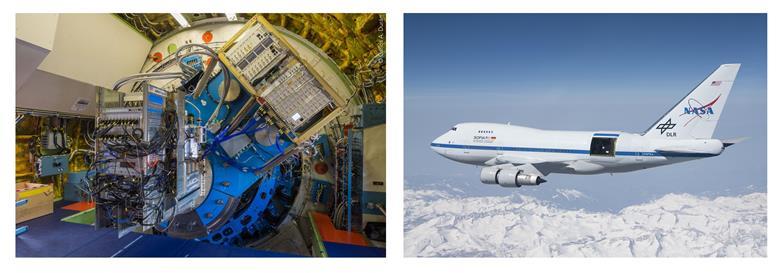
Great and Sofia
Source: Left: © Carlos Duran/MPIfR; Right: © NASA Photo/Jim Ross
The Great far-infrared spectrometer (left) is mounted to the telescope flange of the flying observatory Sofia (right)
Meanwhile, spectroscopic features from much more common carbon–hydrogen bonds appear at 149.09µm and 149.39µm. Success therefore required high spectral resolution, and very sensitive sensors, as Güsten’s team expected the signal to be weak. Reaching the 2THz frequency range of the 149.137µm signal also ‘took several years of technological advancements’.
‘This is a great first detection of a molecular species that is certainly of interest and relevance to a wider astronomical community, and this detection opens the door for further studies,’ comments astronomer Jan Cami from the University of Western Ontario, Canada.
For example, Güsten and colleagues will search for more HeH+ when Sofia next flies, in June. But now they know HeH+ exists, they can start looking for it further back in time towards the big bang. They will exploit cosmological redshifts, similar to how wavelengths emitted by objects moving away from observers expand in the Doppler shift. That will multiply the HeHwavelength approximately tenfold, he explains, making the light from the young universe visible ‘from large ground-based observatories’, Güsten says.

Tuesday, July 17, 2018

Abstract-SOFIA in the era of JWST and ALMA


Harold W. Yorke; Erick T. Young; Eric E. Becklin, (Jason) Zhixin Zeng,

https://www.spiedigitallibrary.org/conference-proceedings-of-spie/10700/107000E/SOFIA-in-the-era-of-JWST-and-ALMA/10.1117/12.2314222.short?SSO=1


SOFIA, the Stratospheric Observatory for Infrared Astronomy, is a joint project between NASA and the German Aerospace Center DLR to provide infrared and sub-millimeter observing capabilities to the worldwide astronomical community. With a wide range of instruments that cover both imaging and spectroscopy, SOFIA has produced unique scientific results that could not be obtained with a ground-based facility. In the coming decade, SOFIA will be a critical complement to the other major facilities for astronomical research, the James Webb Space Telescope (JWST) and the Atacama Large Millimeter/submillimeter Array (ALMA) by filling in the otherwise unobservable wavelength range of 30–300 μm. SOFIA provides a wide range of instrumentation, and this paper will describe some of the new capabilities in heterodyne spectroscopy, direct detection spectroscopy, and polarimetry.


© (2018) COPYRIGHT Society of Photo-Optical Instrumentation Engineers (SPIE). Downloading of the abstract is permitted for personal use only.

Tuesday, July 11, 2017

Abstract-SOFIA/GREAT Discovery of Terahertz Water Masers


   , and 


We report the discovery of water maser emission at frequencies above 1 THz. Using the GREAT instrument on SOFIA, we have detected emission in the 1.296411 THz ${8}_{27}-{7}_{34}$ transition of water toward three oxygen-rich evolved stars: W Hya, U Her, and VY CMa. An upper limit on the 1.296 THz line flux was obtained toward R Aql. Near-simultaneous observations of the 22.23508 GHz ${6}_{16}-{5}_{23}$ water maser transition were carried out toward all four sources using the Effelsberg 100 m telescope. The measured line fluxes imply 22 GHz/1.296 THz photon luminosity ratios of 0.012, 0.12, and 0.83, respectively, for W Hya, U Her, and VY CMa, values that confirm the 22 GHz maser transition to be unsaturated in W Hya and U Her. We also detected the 1.884888 THz ${8}_{45}-{7}_{52}$transition toward W Hya and VY CMa, and the 1.278266 THz ${7}_{43}-{6}_{52}$ transition toward VY CMa. Like the 22 GHz maser transition, all three of the THz emission lines detected here originate from the ortho-H2O spin isomer. Based upon a model for the circumstellar envelope of W Hya, we estimate that stimulated emission is responsible for ~85% of the observed 1.296 THz line emission, and thus that this transition may be properly described as a terahertz-frequency maser. In the case of the 1.885 THz transition, by contrast, our W Hya model indicates that the observed emission is dominated by spontaneous radiative decay, even though a population inversion exists

Wednesday, May 31, 2017

Abstract-SOFIA/GREAT Discovery of Terahertz Water Masers


David A. Neufeld (JHU), Gary J. Melnick (CfA), Michael J. Kaufman (SJSU), Helmut Wiesemeyer (MPIfR), Rolf Güsten (MPIfR), Alex Kraus (MPIfR), Karl M. Menten (MPIfR), Oliver Ricken (MPIfR),Alexandre Faure (Grenoble)
We report the discovery of water maser emission at frequencies above 1 THz. Using the GREAT instrument on SOFIA, we have detected emission in the 1.296411 THz 8(27)-7(34) transition of water toward three oxygen-rich evolved stars: W Hya, U Her, and VY CMa. An upper limit on the 1.296 THz line flux was obtained toward R Aql. Near-simultaneous observations of the 22.23508 GHz 6(16)-5(23) water maser transition were carried out towards all four sources using the Effelsberg 100m telescope. The measured line fluxes imply 22 GHz / 1.296 THz photon luminosity ratios of 0.012, 0.12, and 0.83 respectively for W Hya, U Her, and VY CMa, values that confirm the 22 GHz maser transition to be unsaturated in W Hya and U Her. We also detected the 1.884888 THz 8(45)-7(53) transition toward W Hya and VY CMa, and the 1.278266 THz 7(43)-6(52) transition toward VY CMa. Like the 22 GHz maser transition, all three of the THz emission lines detected here originate from the ortho-H2O spin isomer. Based upon a model for the circumstellar envelope of W Hya, we estimate that stimulated emission is responsible for ~ 85% of the observed 1.296 THz line emission, and thus that this transition may be properly described as a terahertz-frequency maser. In the case of the 1.885 THz transition, by contrast, our W Hya model indicates that the observed emission is dominated by spontaneous radiative decay, even though a population inversion exists

Wednesday, November 16, 2016

Upgraded German Receiver for Astronomy at Terahertz Frequencies


Flying observatory SOFIA expanding frontiers in solar system and beyond


NASA’s Stratospheric Observatory for Infrared Astronomy (SOFIA) is a Boeing 747SP jetliner modified to carry a 100-inch diameter telescope to study the universe at infrared wavelengths that cannot be detected from ground-based observatories. SOFIA’s Science Cycle 5, which runs from February 2017 through January 2018, spans the entire field of astronomy from planetary science to extragalactic investigations. 

Monday, May 9, 2016

Atomic oxygen detected in Mars atmosphere by Scientists


http://currentaffairs.gktoday.in/atomic-oxygen-detected-mars-atmosphere-scientists-05201632717.html

Scientists have detected atomic oxygen in the atmosphere of Mars for the first time since the last observation 40 years ago. It was detected using an instrument onboard the Stratospheric Observatory for Infrared Astronomy (SOFIA). SOFIA is a Boeing 747SP jetliner modified to carry a 100-inch diameter telescope. It is a joint project of NASA and the German Aerospace Centre. Key facts The detected atomic oxygen was found in the upper layers of the Martian atmosphere known as the mesosphere. It was detected by using the German Receiver for Astronomy at Terahertz Frequencies (GREAT), an advanced detector on one of the observatory’s instruments. The SOFIA was able to detect only about half the amount of oxygen expected, which may be due to variations in the Martian atmosphere. The observations were possible due to SOFIA’s airborne location, flying between 37,000-45,000 feet, above most of the infrared-blocking moisture in Earth’s atmosphere. Significance: Atomic oxygen affects other gases to escape from the Mars and therefore has a significant impact on the planet’s atmosphere. However the detection enabled astronomers to distinguish the oxygen in the Martian atmosphere from oxygen in Earth’s atmosphere. Atomic oxygen in the Martian atmosphere is notoriously difficult to measure as far-infrared wavelengths are needed to detect it. However SOFIA help to detect it as it has highly sensitive instruments including spectrometer. It should be noted that the last measurements of atomic oxygen in the Martian atmosphere were made by the Viking and Mariner missions of NASA in 1970s. Tags: Mars • NASA • Science And Technology

Wednesday, January 14, 2015

NASA's Airborne Observatory Begins 2015 Science Campaign


NASA's Stratospheric Observatory for Infrared Astronomy (SOFIA) is seen performing ground tests prior to its first science flight of 2015. The year's first mission was flown on the night of Jan. 13/14, with the German Receiver for Astronomy at Terahertz Frequencies (GREAT) spectrometer on board.
Image Credit: 
NASA/USRA/Greg Perryman
The Stratospheric Observatory for Infrared Astronomy, or SOFIA, Program began its third season of science flights on Jan. 13, 2015. SOFIA is NASA's next generation flying observatory and is fitted with a 2.5-meter (100-inch) diameter telescope that studies the universe at infrared wavelengths.
"Last night's flight used the German Receiver for Astronomy at Terahertz Frequencies (GREAT) spectrometer to study the chemical composition and motions of gas in a star-forming region, a young star, and a supernova remnant," said Pamela Marcum, NASA's SOFIA project scientist. "Observing at infrared wavelengths enables us to see through interstellar dust to record the spectral signatures of molecules in these regions. From this we can study the abundances of molecules and their formation process."
Water vapor in the Earth's atmosphere absorbs infrared radiation, preventing a large section of the infrared spectrum from reaching ground-based observatories. SOFIA is a heavily modified Boeing 747 Special Performance jetliner that flies at altitudes between 39,000 to 45,000 feet (12 to 14 km), above more than 99 percent of Earth's atmospheric water vapor giving astronomers the ability to study celestial objects at wavelengths that cannot be seen from ground-based observatories.
"The flights in January will conclude SOFIA's second annual observing series, known as Cycle 2, and the observatory will begin the Cycle 3 programs in March," said Erick Young, SOFIA's observatory director and a member of the Universities Space Research Association (USRA) team that operates the SOFIA Science Center at NASA Ames Research Center at Moffett Field, California. "Plans for Cycle 3 include 70 flights with more than 400 hours of science observations. The observations will span a broad range of astronomical topics including the interstellar medium, star formation, stars, bodies in our solar system, and extrasolar planets."
The observatory is expected to make a deployment to the Southern Hemisphere in June 2015, with science flights based out of Christchurch, New Zealand. There scientists will have the opportunity to observe areas of interest such as the Galactic Center and other parts of the Milky Way that are not visible from the Northern Hemisphere.
SOFIA is a joint project of NASA and the German Aerospace Center (DLR). The aircraft is based at and the program is managed from NASA Armstrong Flight Research Center's facility in Palmdale, California. NASA's Ames Research Center, manages the SOFIA science and mission operations in cooperation with the Universities Space Research Association (USRA) headquartered in Columbia, Maryland, and the German SOFIA Institute (DSI) at the University of Stuttgart.
For more information about SOFIA, visit:

For information about SOFIA's science mission, visit:

Felicia Chou

Headquarters, Washington
202-358-5241

felicia.chou@nasa.gov

Monday, April 28, 2014

New Record for Quantum-cascade Laser Operation Temperature


Laser chip mounted on a heat sink. The chip with several terahertz quantum-cascade lasers is soldered in the middle of a U-shaped contact pad with attached electrical leads. Courtesy of PDI

By: Forschungsverbund Berlin e.V. (FVB)
http://www.scientificcomputing.com/news/2014/04/new-record-quantum-cascade-laser-operation-temperature

For the observation of cold matter in the interstellar medium, astronomers need instruments for the detection of terahertz radiation. Specific high-resolution instruments are based on terahertz quantum-cascade lasers, but operate only at cryogenic temperatures. Physicists have now developed a terahertz quantum-cascade laser, which operates at significantly higher temperatures than previously achieved. The new development allows for the use of more compact cooling systems — also reducing the obstacles for many other applications.
The wavelengths of terahertz radiation lie between the microwave and infrared range. It penetrates many materials such as plastics and clothes. At the same time, terahertz radiation is — due to its small energy — non-ionizing and not dangerous for people. Applications of terahertz radiation include non-destructive material testing and safety checks at airports.
For astronomers, terahertz radiation provides new insights in the investigation of so-called cold matter. This kind of matter does not emit visible light such as the stars, but electromagnetic radiation in the infrared to microwave range. The German Aerospace Center (DLR) measures such emission lines with high precision within the US-German SOFIA project. Due to the Doppler shift of the detected frequencies, the researchers can determine the velocity of the motion of cold matter through the galaxy. To reduce the absorption by water in the earth atmosphere, the measurements are carried out from an airplane. One key element of the detector system is a quantum-cascade laser developed at the PDI.
In a joint project funded by the Investitionsbank Berlin, researchers  at the Paul Drude Institute (PDI) in Berlin have developed a compact quantum-cascade laser system. The partners in this project were in addition to the PDI the Ferdinand Braun Institute in Berlin, the Humboldt University in Berlin, and the company Eagleyard Photonics located also in Berlin.
“One problem of the lasers are the low operating temperatures, which are typically even below the temperature of liquid nitrogen  of 77 Kelvin or -196 °C for continuous-wave  operation”, explains Martin Wienold from the PDI. “We achieved a new record: our lasers operate up to 129 Kelvin (-144 °C) improving the previous record by more than 10 degrees.” This is still rather cold, “but, in combination with a significantly reduced power dissipation of the new lasers, it allows for the use of much smaller mechanical coolers. Thereby, we will be able to reduce the size of systems based on terahertz quantum-cascade lasers in the future — an important point for flight missions such as SOFIA”, Wienold emphasizes.
The physicists at the PDI achieved the high operating temperatures by developing a semiconductor heterostructure, which requires only a very low driving power. The laser ridge is only about 10-15 microns high and 15 microns wide, while the emission wavelength is about 100 microns. The active region is confined by two metal layers, which are almost perfect mirrors in the terahertz range. This combination results in very low power dissipation and operation at low current densities and voltages.
“However, there has been an additional problem”, explains Martin Wienold: “We achieved relatively high operating temperatures, but the strong spatial confinement of the light in the laser resulted in an extremely divergent beam profile”. The physicists solved the problem by applying a concept from the early days of radio broadcasting. A grating on top of the laser ridge — a so-called third-order grating — acts as a directive antenna, which collimates the laser emission. “We are currently working on achieving even higher operating temperatures”, says Wienold. “However, room temperature operation will become difficult to achieve because of some physical limits.”
Quantum-cascade laser
Quantum-cascade lasers differ from common diode lasers by its structure and the involved physical processes. Typical diode lasers emit light, when electrons from the conduction band recombine with holes from the valence band. Upon recombination, a photon is emitted with the energy of approximately the semiconductors energy gap. Since the energy gap is determined by the used semiconductor material, the wavelength of a diode laser is basically determined by the material.
In a quantum-cascade laser, the electron remains in the conduction band, and the laser transitions takes place between two confined subband states within the conduction band. This performance is achieved by alternating extremely thin semiconductor layers, resulting in so-called potential wells in the conduction band. When an electric field is applied, the electrons move from an energetically higher lying potential well to an energetically lower lying potential well via the quantum mechanical tunneling effect. The electrons tumble down from one potential well to the next potential well in such a way, as falling down a staircase.
Citation: High-temperature, continuous-wave operation of terahertz quantum-cascade lasers with metal-metal waveguides and third-order distributed feedback. M. Wienold, B. Röben, L. Schrottke, R. Sharma, A. Tahraoui, K. Biermann, and H. T. Grahn.Optics Express, Vol. 22, Issue 3, pp. 3334-3348 (2014) http://www.opticsinfobase.org/oe/abstract.cfm?uri=oe-22-3-3334


Thursday, July 18, 2013

SOFIA Airborne Telescope Heads South


Image Credit: With the large door over its 2.5-meter German-built telescope wide open, NASA's Stratospheric Observatory for Infrared Astronomy 747SP aircraft soars over Southern California's high desert during a test flight in 2010 in preparation for its Early Science missions. Credit: NASA / Jim Ross
http://www.redorbit.com/news/space/1112901471/nasa-sofia-airborne-telescope-south-new-zealand-southern-hemisphere-magellanic-clouds-071813/

Lee Rannals for redOrbit.com – Your Universe Online
NASA’s Stratospheric Observatory for Infrared Astronomy (SOFIA) telescope has moved south to New Zealand for the next two weeks to take advantage of the Southern Hemisphere’s orientation.
The space agency said the airborne observatory would be utilizing its southern position to take advantage of studying celestial objects that are difficult or impossible to see in the northern sky. SOFIA is a telescope attached to a modified Boeing 747SP aircraft with an effective diameter of 100 inches. It provides astronomers with visible, infrared and sub millimeter spectrum views of the night sky.
Astronomers used SOFIA on its first New Zealand flight to observe the disk of gas and dust orbiting the black hole at the center of our Milky Way galaxy. The airborne telescope was also able to take a peek at two dwarf galaxies and the Large and Small Magellanic Clouds. The Magellanic Clouds can be seen with the naked eye in the southern sky.
“SOFIA’s deployment to the Southern Hemisphere shows the remarkable versatility of this observatory, which is the product of years of fruitful collaboration and cooperation between the U.S. and German space agencies,” said Paul Hertz, director of NASA’s Astrophysics Division in Washington. “This is just the first of a series of SOFIA scientific deployments envisioned over the mission’s planned 20-year lifetime.”
Astronomers will be using a far-infrared spectrometer known as the German Receiver for Astronomy at Terahertz Frequencies (GREAT) mounted on SOFIA to study interstellar gas and the life cycle of stars.
“The success of the GREAT spectrometer in addressing exciting scientific questions at far-infrared wavelengths was demonstrated during SOFIA’s earlier, Northern Hemisphere flights,” said Rolf Guesten of the Max Planck Institute for Radio Astronomy in Bonn, Germany, and leader of the German researchers who developed the spectrometer. “Now, we are turning the instrument to new frontiers such as the Magellanic Clouds, including the Tarantula Nebula — that is the most active star-forming region known in the local group of galaxies.”
Pamela Marcum, the project scientists for SOFIA, said the results anticipated from these southern observations will further scientists’ understanding of star formation, stellar evolution and chemistry in the stellar clouds.
“The deployment exemplifies the synergistic relationship between SOFIA’s international partners, with NASA playing a crucial role in the planning and execution of the science observations,” Marcum said.
SOFIA received major upgrades back in December to its observatory and avionics systems. These upgrades will significantly improve the systems’ efficiency and operability.

Thursday, May 10, 2012

New Molecules and Star Formation in the Milky Way


Optical color image of the rho Ophiuchi star formation region, about 400 light-years from Earth, with dark dusty filamentary gas clouds. The position of the optically obscured low-mass protostar IRAS16293-2422 towards which interstellar deuterated hydroxyl OD has been detected is marked with a red circle. The absorption line spectrum, observed with GREAT onboard SOFIA, displays the molecule’s fingerprint at a frequency of 1.3915 Terahertz (or 0.215 mm wavelength). The inset shows the OD molecule (red: oxygene, gray: deuterium), an isotopic substitute of hydroxyl (OH) with the hydrogen atom replaced by heavier deuterium. This deuterated molecule is an important marker in the formation of interstellar water and may serve as a chemical clock in the early star formation process.The bright yellowish star in the bottom left is Antares, one of the brightest stars in the sky. Below and to Antares’ right is the globular cluster Messier 4. (Credit: Spectrum: MPIfR/B. Parise, Photo: ESO/S. Guisard


ScienceDaily (May 10, 2012) — SOFIA, the "Stratospheric Observatory for Infrared Astronomy," completed its first series of science flights, using the German Receiver for Astronomy at Terahertz Frequencies (GREAT). The scientific results are now being published in a special issue of the journalAstronomy & Astrophysics (Volume 542, May 10) along with reports on GREAT's advanced technologies. They include first detections of new interstellar molecules and important spectral lines in space, and address different stages of the star formation process.


The first series of astronomical observations with GREAT on board of SOFIA were successfully completed in November 2011. Now, six months later, the scientific results have been published in a special issue of the European journal Astronomy & Astrophysics. In total, 22 articles by an international group of scientists report on the first astronomical results as well as the technologies employed in the GREAT instrument on board SOFIA.
As a joint project between NASA and the German Aerospace Center (Deutsches Zentrum für Luft- und Raumfahrt, DLR), SOFIA operates a 2.7-m telescope in a modified Boeing 747SP aircraft and is the world's largest ever airborne infrared observatory. SOFIA flies at altitudes as high as 13700 meters to provide access to astronomical signals at far-infrared wavelengths that would otherwise be blocked due to absorption by water vapour in the atmosphere. The SOFIA observatory and the GREAT instrument open the far-infrared skies for high-resolution spectroscopy, and GREAT pushes its technology to higher frequencies and sensitivities than ever reached before.
Many of the contributed papers study the star formation process in its earliest phases, first when the protostellar molecular cloud is contracting and condensing, and then when the embryonic star is vigorously interacting with its surrounding parental molecular cloud -tearing it apart and ionizing it. The high spectral resolution capabilities of GREAT enabled scientists to resolve the velocity field of gas in the parental molecular clouds traced by the important cooling line radiation of ionized carbon in several star forming regions.
GREAT detected the velocity signature of infalling gas motion ("collapse") in the envelopes of three protostars, directly probing the dynamics of a forming star. Two interstellar molecular species were detected for the first time ever: OD, an isotopic substitute of hydroxyl (OH) with the hydrogen atom replaced by the heavier deuterium, and the mercapto radical SH. Observations of the ground-state transition of OH at a frequency of 2.5 Terahertz (120 microns wavelength) explored new astrochemical territories while pushing the technological frontier.
The remnant envelope of an evolved star, ionized by its hot stellar core, was also investigated as was the violent shock interaction of a supernova remnant and the surrounding interstellar medium. Furthermore, the circumnuclear accretion disk, ultimately feeding the black hole in the centre of the Milky Way galaxy was studied, as well as star formation in the circumnuclear region of the nearby galaxy IC342.
"The rich harvest of scientific results from this first observing campaign with SOFIA and the GREAT instrument gives a first glimpse of the tremendous scientific potential of this observatory and promises unique astronomical observations for years to come, particularly in the topical research areas of star formation and astrochemistry" states the Deputy Director of the SOFIA Science Mission, Hans Zinnecker, from DSI. In parallel with Rolf Güsten from the Max-Planck-Institut für Radioastronomie, the Principal Investigator of the GREAT project, Zinnecker organized the selection process and ultimately selected some of the most exciting observing proposals from the German astronomical community.
"The high resolving power of the GREAT spectrometer is designed for studies of interstellar gas and the stellar life cycle, from a protostar's early embryonic phase when still embedded in its parental cloud to an evolved star's death when the stellar envelope is ejected back into space," says Güsten. "This stunning collection of first scientific results is reward for the many years of development work, and underlines the huge scientific potential of airborne far-infrared spectroscopy."
The "Deutsches SOFIA Institut" (DSI) of the University of Stuttgart coordinates SOFIA's science mission and operation on behalf of the German partners.
GREAT, the German Receiver for Astronomy at Terahertz Frequencies is a receiver for spectroscopic observations in the far-infrared spectral regime between frequencies of 1.25 and 5 terahertz (60-240 microns), which are not accessible from the ground due to absorption by water vapour in the atmosphere. GREAT is a first generation German SOFIA instrument, developed by the Max-Planck Institute for Radio Astronomy (MPIfR) and the KOSMA at the Universität zu Köln, in collaboration with the Max-Planck Institute for Solar System Research and the DLR Institute for Planetary Research. Rolf Güsten (MPIfR) is the Principal Investigator for GREAT.
SOFIA, the "Stratospheric Observatory for Infrared Astronomy" is a joint project of the National Aeronautics and Space Administration (NASA) and the Deutsches Zentrum für Luft- und Raumfahrt e.V. (DLR; German Aerospace Centre, grant: 50OK0901).
Links to articles: