A repository & source of cutting edge news about emerging terahertz technology, it's commercialization & innovations in THz devices, quality & process control, medical diagnostics, security, astronomy, communications, applications in graphene, metamaterials, CMOS, compressive sensing, 3d printing, and the Internet of Nanothings. NOTHING POSTED IS INVESTMENT ADVICE! REPOSTED COPYRIGHT IS FOR EDUCATIONAL USE.
Showing posts with label Takeshi Yasui. Show all posts
Tuesday, June 9, 2020
Abstract-Adaptive-sampling near-Doppler-limited terahertz dual-comb spectroscopy with a free-running single-cavity fiber laser
Jie Chen, Kazuki Nitta, Xin Zhao, Takahiko Mizuno, Takeo Minamikawa, Francis Hindle, Zheng Zheng, Takeshi Yasui,
https://www.spiedigitallibrary.org/journals/advanced-photonics/volume-2/issue-3/036004/Adaptive-sampling-near-Doppler-limited-terahertz-dual-comb-spectroscopy-with/10.1117/1.AP.2.3.036004.full
Dual-comb spectroscopy (DCS) is an emerging spectroscopic tool with the potential to simultaneously achieve a broad spectral coverage and ultrahigh spectral resolution with rapid data acquisition. However, the need for two independently stabilized ultrafast lasers significantly hampers the potential application of DCS. We demonstrate mode-resolved DCS in the THz region based on a free-running single-cavity dual-comb fiber laser with the adaptive sampling method. While the use of a free-running single-cavity dual-comb fiber laser eliminates the need for two mode-locked lasers and their frequency control, the adaptive sampling method strongly prevents the degradation of spectroscopic performance caused by the residual timing jitter in the free-running dual-comb laser. Doppler-limit-approaching absorption features with linewidths down to 25 MHz are investigated for low-pressure acetonitrile/air mixed gas by comb-mode-resolved THz spectroscopy. The successful demonstration clearly indicates its great potential for the realization of low-complexity, Doppler-limited THz spectroscopy instrumentation.
Saturday, June 1, 2019
Abstract-Combination of lock-in detection with dual-comb spectroscopy
Hidenori Koresawa, Kyuki Shibuya, Takeo Minamikawa, Akifumi Asahara, Kaoru Minoshima, Takeshi Yasui
https://www.spiedigitallibrary.org/conference-proceedings-of-spie/10925/109251A/Combination-of-lock-in-detection-with-dual-comb-spectroscopy/10.1117/12.2509619.short?SSO=1
Dual-comb spectroscopy (DCS) is a powerful tool
for gas spectroscopy due to high resolution, high accuracy, broadband spectral
coverage, and rapid data acquisition, based on optical frequency comb (OFC)
traceable to a frequency standard. In DCS, after a temporal waveform of
interferogram is acquired in time domain, the corresponding mode-resolved OFC
spectrum is obtained by fast Fourier transform (FFT) calculation of the
acquired interferogram. However, FFT calculation of huge-sized temporal data
spends significantly longer time than the acquisition time of interferogram,
making it difficult to response the transient signal change. In this article,
we demonstrate frequency-domain DCS by a combination of DCS with lock-in
detection (LID), namely LID-DCS. LID-DCS directly extracts an arbitrary OFC
mode from a vast number of OFC modes without the need for FFT calculation by
the synchronous detection at a LID reference frequency while maintaining high
resolution and high accuracy. Usefulness of LID-DCS is demonstrated in rapid
monitoring of transient signal change and spectroscopy of hydrogen cyanide gas
by comparing with usual DCS.
Sunday, July 29, 2018
Abstract-Dual terahertz comb spectroscopy with a single free-running fibre laser
- Guoqing Hu,
- Tatsuya Mizuguchi,
- Ryo Oe,
- Kazuki Nitta,
- Xin Zhao,
- Takeo Minamikawa,
- Ting Li,
- Zheng Zheng,
- Takeshi Yasui,
Dual terahertz (THz) comb spectroscopy enables high spectral resolution, high spectral accuracy, and broad spectral coverage; however, the requirement for dual stabilized femtosecond lasers hampers its versatility. We here report the first demonstration of dual THz comb spectroscopy using a single free-running fibre laser. By tuning the cavity-loss-dependent gain profile with an intracavity Lyot filter together with precise management of the cavity length and dispersion, dual-wavelength comb light beams with slightly detuned repetition frequencies are generated in a single laser cavity. Due to sharing of the same cavity, such comb light beams suffer from common-mode fluctuation of the repetition frequency, and hence the corresponding frequency difference between them is passively stable around a few hundred hertz within millihertz fluctuation. While greatly reducing the size, complexity, and cost of the laser source by use of a single free-running fibre laser, the dual THz comb spectroscopy system maintains a spectral bandwidth and dynamic range of spectral power comparable to a system equipped with dual stabilized fibre lasers, and can be effectively applied to high-precision spectroscopy of acetonitrile gas at atmospheric pressure. The demonstrated results indicate that this system is an attractive solution for practical applications of THz spectroscopy and other applications.
Saturday, April 14, 2018
Abstract-Real-Time Amplitude and Phase Imaging of Optically Opaque Objects by Combining Full-Field Off-Axis Terahertz Digital Holography with Angular Spectrum Reconstruction
- Masatomo Yamagiwa,
- Takayuki Ogawa,
- Takeo Minamikawa,
- Dahi Ghareab Abdelsalam,
- Kyosuke Okabe,
- Noriaki Tsurumachi,
- Yasuhiro Mizutani,
- Testuo Iwata,
- Hirotsugu Yamamoto,
- Takeshi Yasui
Terahertz digital holography (THz-DH) has the potential to be used for non-destructive inspection of visibly opaque soft materials due to its good immunity to optical scattering and absorption. Although previous research on full-field off-axis THz-DH has usually been performed using Fresnel diffraction reconstruction, its minimum reconstruction distance occasionally prevents a sample from being placed near a THz imager to increase the signal-to-noise ratio in the hologram. In this article, we apply the angular spectrum method (ASM) for wavefront reconstruction in full-filed off-axis THz-DH because ASM is more accurate at short reconstruction distances. We demonstrate real-time phase imaging of a visibly opaque plastic sample with a phase resolution power of λ/49 at a frame rate of 3.5 Hz in addition to real-time amplitude imaging. We also perform digital focusing of the amplitude image for the same object with a depth selectivity of 447 μm. Furthermore, 3D imaging of visibly opaque silicon objects was achieved with a depth precision of 1.7 μm. The demonstrated results indicate the high potential of the proposed method for in-line or in-process non-destructive inspection of soft materials.
Sunday, December 24, 2017
Abstract- Interferometric Terahertz Wavefront Analysis
Emmanuel Abraham, Takayuki Ogawa, Mathilde Brossard, Takeshi Yasu
http://ieeexplore.ieee.org/document/7781635/
Wavefront characterization of terahertz beams is useful for various applications such as terahertz spectroscopy and imaging. In this paper, we report on the aberration measurement of a terahertz beam issued from a quantum cascade laser. By using a terahertz camera and a two-wave noncommon path interferometer, we measured the wavefront distortions. As an example, we evaluated the Zernike coefficients giving the aberrations of spherical wavefronts induced by a converging lens. Associated with a deformable mirror, the sensor will open the route to terahertz adaptive optics.
Thursday, August 31, 2017
Abstract-Scan-less hyperspectral dual-comb single-pixel-imaging in both amplitude and phase
Kyuki Shibuya, Takeo Minamikawa, Yasuhiro Mizutani, Hirotsugu Yamamoto, Kaoru Minoshima, Takeshi Yasui, and Tetsuo Iwata
https://www.osapublishing.org/oe/abstract.cfm?uri=oe-25-18-21947
We have developed a hyperspectral imaging scheme that involves a combination of dual-comb spectroscopy and Hadamard-transform-based single-pixel imaging. The scheme enables us to obtain 12,000 hyperspectral images of amplitude and phase at a spatial resolution of 46 µm without mechanical scanning. The spectral resolution given by the data point interval in the frequency domain is 20 MHz and the comb mode interval is 100 MHz over a spectral range of 1.2 THz centered at 191.5 THz. As an initial demonstration of our scheme, we obtained spectroscopic images of a standard test chart through an etalon plate. The thickness of an absorptive chromium-coated layer on a float-glass substrate was determined to be 70 nm from the hyperspectral phase images in the near-infrared wavelength region.
© 2017 Optical Society of America
Thursday, June 16, 2016
Abstract-Dynamic terahertz spectroscopy of gas molecules mixed with unwanted aerosol under atmospheric pressure using fibre-based asynchronous-optical-sampling terahertz time-domain spectroscopy
Terahertz (THz) spectroscopy is a promising method for analysing polar gas molecules mixed with unwanted aerosols due to its ability to obtain spectral fingerprints of rotational transition and immunity to aerosol scattering. In this article, dynamic THz spectroscopy of acetonitrile (CH3CN) gas was performed in the presence of smoke under the atmospheric pressure using a fibre-based, asynchronous-optical-sampling THz time-domain spectrometer. To match THz spectral signatures of gas molecules at atmospheric pressure, the spectral resolution was optimized to 1 GHz with a measurement rate of 1 Hz. The spectral overlapping of closely packed absorption lines significantly boosted the detection limit to 200 ppm when considering all the spectral contributions of the numerous absorption lines from 0.2 THz to 1 THz. Temporal changes of the CH3CN gas concentration were monitored under the smoky condition at the atmospheric pressure during volatilization of CH3CN droplets and the following diffusion of the volatilized CH3CN gas without the influence of scattering or absorption by the smoke. This system will be a powerful tool for real-time monitoring of target gases in practical applications of gas analysis in the atmospheric pressure, such as combustion processes or fire accident.
Wednesday, March 2, 2016
Abstract-Development of a wavefront sensor for terahertz pulses
https://www.osapublishing.org/oe/abstract.cfm?uri=oe-24-5-5203
Wavefront characterization of terahertz pulses is essential to optimize far-field intensity distribution of time-domain (imaging) spectrometers or increase the peak power of intense terahertz sources. In this paper, we report on the wavefront measurement of terahertz pulses using a Hartmann sensor associated with a 2D electro-optic imaging system composed of a ZnTe crystal and a CMOS camera. We quantitatively determined the deformations of planar and converging spherical wavefronts using the modal Zernike reconstruction least-squares method. Associated with deformable mirrors, the sensor will also open the route to terahertz adaptive optics.
© 2016 Optical Society of America
Full Article | PDF Article
Monday, January 11, 2016
Abstract-Real-Time Determination of Absolute Frequency in Continuous-Wave Terahertz Radiation with a Photocarrier Terahertz Frequency Comb Induced by an Unstabilized Femtosecond Laser
Takeo Minamikawa, Kenta Hayashi, Tatsuya Mizuguchi, Yi-Da Hsieh, Dahi Ghareab Abdelsalam, Yasuhiro Mizutani, Hirotsugu Yamamoto, Tetsuo Iwata, Takeshi Yasui,
A practical method for the absolute frequency measurement of continuous-wave terahertz (CW-THz) radiation uses a photocarrier terahertz frequency comb (PC-THz comb) because of its ability to realize real-time, precise measurement without the need for cryogenic cooling. However, the requirement for precise stabilization of the repetition frequency (f rep) and/or use of dual femtosecond lasers hinders its practical use. In this article, based on the fact that an equal interval between PC-THz comb modes is always maintained regardless of the fluctuation in f rep, the PC-THz comb induced by an unstabilized laser was used to determine the absolute frequency f THz of CW-THz radiation. Using an f rep-free-running PC-THz comb, the f THz of the frequency-fixed or frequency-fluctuated active frequency multiplier chain CW-THz source was determined at a measurement rate of 10 Hz with a relative accuracy of 8.2 × 10⁻¹³ and a relative precision of 8.8 × 10⁻¹² to a rubidium frequency standard. Furthermore, f THz was correctly determined even when fluctuating over a range of 20 GHz. The proposed method enables the use of any commercial femtosecond laser for the absolute frequency measurement of CW-THz radiation.
Tuesday, June 2, 2015
Abstract-Adaptive sampling dual terahertz comb spectroscopy using dual free-running femtosecond lasers
Terahertz (THz) dual comb spectroscopy (DCS) is a promising method for high-accuracy, high-resolution, broadband THz spectroscopy because the mode-resolved THz comb spectrum includes both broadband THz radiation and narrow-line CW-THz radiation characteristics. In addition, all frequency modes of a THz comb can be phase-locked to a microwave frequency standard, providing excellent traceability. However, the need for stabilization of dual femtosecond lasers has often hindered its wide use. To overcome this limitation, here we have demonstrated adaptive-sampling THz-DCS, allowing the use of free-running femtosecond lasers. To correct the fluctuation of the time and frequency scales caused by the laser timing jitter, an adaptive sampling clock is generated by dual THz-comb-referenced spectrum analysers and is used for a timing clock signal in a data acquisition board. The results not only indicated the successful implementation of THz-DCS with free-running lasers but also showed that this configuration outperforms standard THz-DCS with stabilized lasers due to the slight jitter remained in the stabilized lasers.
Wednesday, August 20, 2014
Abstract-Double-modulation reflection-type terahertz ellipsometer for measuring the thickness of a thin paint coating
Tetsuo Iwata, Hiroaki Uemura, Yasuhiro Mizutani, and Takeshi Yasui »View Author Affiliations
|
Optics Express, Vol. 22, Issue 17, pp. 20595-20606 (2014)
http://dx.doi.org/10.1364/OE.22.020595
We constructed a double-modulation, reflection-type terahertz (THz) ellipsometer for precise measurement of the thickness of a paint film which is coated on a metal surface and which is not transparent to visible or mid-infrared light. The double-modulation technique enabled us to directly obtain two ellipsometric parameters, Δ(ω) and Ψ(ω), as a function of angular frequency, ω, with a single measurement while reducing flicker noise due to a pump laser. The bias voltage of a photoconductive antenna (PCA) used as a THz pulse emitter was modulated at 100 kHz, and a first lock-in amplifier (LA1) was connected to the output of an electro-optic (EO) signal-sampling unit. In addition, a wire-grid polarizer (WGP) was rotated at 100 Hz to conduct polarization modulation with a frequency of 200 Hz. The output signal from LA1 was fed into a second lock-in amplifier (LA2) that worked in synchronization with the rotating WGP (RWGP). By operating LA2 in a quadrature phase-detection mode, we were able to obtain in-phase and out-of-phase signals simultaneously, from which the two ellipsometric parameters for an isotropic sample could be derived at the same time while cancelling common-mode noise. The lower detection limit of the thickness measurement and the relative standard deviation (RSD) of a black paint film coated on an aluminum substrate were 4.3 µm and 1.4%, respectively. The possibility of determining all elements of the Jones matrix for an anisotropic material is also discussed.
© 2014 Optical Society of America
Tuesday, March 25, 2014
Optical frequency combs with gapless mode-resolved spectra
Takeshi Yasui, Yi-Da Hsieh, Yuki Iyonaga, Yoshiyuki Sakaguchi, Tsutomu Araki, Shuko Yokoyama, Hajime Inaba, Kaoru Minoshima and Francis Hindle
Combining spectral interleaving and dual-comb spectroscopy in the terahertz region achieves a ‘ gapless’ mode-resolved spectrum for high resolution and accuracy in broadband spectroscopy.
24 March 2014, SPIE Newsroom. DOI: 10.1117/2.1201403.005401
Optical frequency combs are innovative tools that link radio and optical frequencies to enable measurement of the latter. The ‘comb’ is a set of lines that read out when coherent light pulses create a broad spectrum. Applications include spectroscopy and optical frequency metrology, where a series of comb modes serve as frequency markers that are traceable to a microwave frequency standard.1 For broadband spectroscopy, combs can achieve high spectral resolution and accuracy across a wide spectrum. However, the resolution of many spectrometers, including Fourier transform, is insufficient to resolve each mode because these are distributed too densely.
Recently, a dual-comb approach has unlocked further potential for broadband spectroscopy by providing a comb-mode-resolved spectrum.2However, the spectral sampling interval is limited to the comb mode spacing, rather than the comb mode spectral linewidth, because of the discrete mode distribution. To enhance the spectral sampling density, we filled the comb mode gaps by interleaving additional frequency marks.3
An optical comb in the terahertz (THz) region is a harmonic (or component) comb of the laser repetition frequency.2 Therefore, we can tune the absolute frequency of each comb mode by changing the repetition frequency. If we incrementally shift the mode-resolved spectrum frequency at an interval equal to the linewidth and all of the resulting comb spectra are overlaid in the spectral domain, we can completely remove the frequency gaps of the original comb. In this way, we have achieved a spectrally interleaved or gapless THz comb.
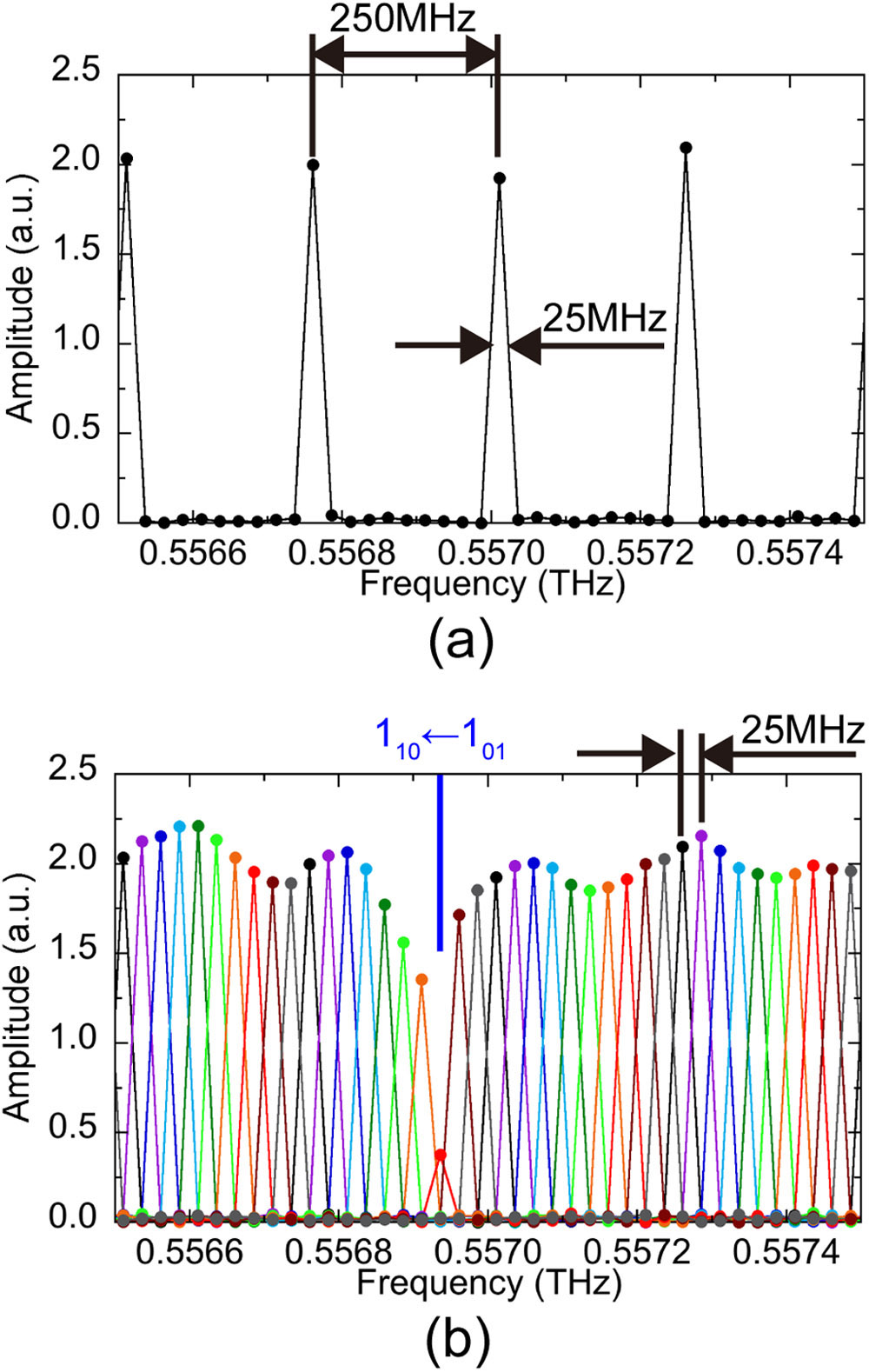
To assess our system's capacity to resolve fine spectral signatures, we measured the rotational transition 110←101 of low-pressure water-vapor molecules at 0.557THz. The gas sample has an expected pressure-broadening linewidth of 23MHz. Figure 1(a) shows the amplitude spectrum before spectral interleaving. The comb modes had a frequency gap of 250MHz and a linewidth of 25MHz. This mode gap was exactly equal to the laser repetition frequency, whereas the mode linewidth here was determined by the reciprocal of the measurement time window in the temporal waveform of the pulsed THz electric field for Fourier transform. The amplitude spectrum did not indicate the spectral shape of the absorption line because of the excessively coarse distribution of the comb modes compared with the narrow absorption linewidth.
Next, we demonstrated spectral interleaving across the absorption line at 0.557THz. We repeated 10 times incremental increases of the mode spacing at an interval of mode linewidth: see Figure 1(b). We filled the frequency gaps between the comb modes in Figure 1(a) by interleaving additional frequency marks, achieving a gapless THz comb. As a result, a sharp spectral dip with a linewidth of 24MHz clearly appeared at the position of the water absorption line. This linewidth is consistent with that of the expected pressure broadening (23MHz). The result indicated that the increased spectral sampling density in the gapless THz comb enhanced the spectral accuracy and resolution of the gas spectroscopy to the level of the comb mode linewidth from the comb mode spacing.
Figure 1. Amplitude spectra of the original terahertz (THz) comb (a) and the gapless THz comb (b) around 0.557THz after passing through low-pressure water vapor contained in a gas cell. a.u.: Arbitrary units.
In summary, to achieve a spectral sampling density equal to the linewidth of each comb mode, we successfully interleaved frequency gaps between THz modes using swept dual THz combs. This is the first demonstration of overcoming the inherent limitation in THz combs, namely, the excessively discrete distribution of the comb modes limiting the fine spectral sampling for broadband spectroscopy. The rotational transitions enable particularly rich spectral fingerprints in the THz region, and THz radiation is insensitive to scattering in the optical region. The gapless THz comb enables accurate discrimination of densely distributed absorption lines, even when the target gases are mixed with aerosols, smoke, dust, clouds, or soot: for example, gas analysis in smoke or a sooty flame.
In future, we would seek to achieve a gapless optical comb by sweeping not only the repetition frequency but also the carrier-envelope-offset frequency (the rate at which the peak of the carrier frequency shifts from the peak of the pulse envelope with each pulse). This would enable us to generate an optical comb that is uniformly gapless over the full spectral range.
This work was supported by Collaborative Research Based on Industrial Demand from the Japan Science and Technology Agency.
Takeshi Yasui
Institute of Technology and ScienceThe University of Tokushima
Tokushima, Japan
and
Graduate School of Engineering Science
Osaka University
Osaka, Japan
and
ERATO Intelligent Synthesizer Project, JST
Tokyo, Japan
and
Graduate School of Engineering Science
Osaka University
Osaka, Japan
and
ERATO Intelligent Synthesizer Project, JST
Tokyo, Japan
Yi-Da Hsieh, Yuki Iyonaga, Yoshiyuki Sakaguchi, Tsutomu Araki
Graduate School of Engineering ScienceOsaka University
Osaka, Japan
Shuko Yokoyama
Micro Optics Co., Ltd.
Kyoto, Japan
and
Graduate School of Engineering Science
Osaka University
Osaka, Japan
and
Graduate School of Engineering Science
Osaka University
Osaka, Japan
Hajime Inaba
National Metrology Institute of JapanNational Institute of Advanced Industrial Science and Technology
Ibaraki, Japan
and
ERATO Intelligent Optical Synthesizer Project, JST
Tokyo, Japan
Kaoru Minoshima
Graduate School of Informatics and Engineering
The University of Electro-Communications
Tokyo, Japan
and
ERATO Intelligent Optical Synthesizer Project, JST
Tokyo, Japan
Kaoru Minoshima
Graduate School of Informatics and Engineering
The University of Electro-Communications
Tokyo, Japan
and
ERATO Intelligent Optical Synthesizer Project, JST
Tokyo, Japan
Francis Hindle
Laboratoire de Physico-Chimie de l'AtmosphèreUniversité du Littoral Côte d'Opale
Dunkerque, France
References:
1. Th. Udem, R. Holzwarth, T. W. Hänsch, Optical frequency metrology, Nature 416, p. 233-237, 2002.
2. T. Yasui, Y. Kabetani, E. Saneyoshi, S. Yokoyama, T. Araki, Terahertz frequency comb by multi-frequency-heterodyning photoconductive detection for high-accuracy, high-resolution terahertz spectroscopy, Appl. Phys. Lett. 88, 241104, 2006.
3. Y.-D. Hsieh, Y. Iyonaga, Y. Sakaguchi, S. Yokoyama, H. Inaba, K. Minoshima, F. Hindle, T. Araki, T. Yasui, Spectrally interleaved, comb-mode-resolved spectroscopy using swept dual terahertz combs, Sci. Rep. 4, 3816, 2014.
Tuesday, March 26, 2013
Abstract-Gapless dual-comb spectroscopy in terahertz region
Takeshi Yasui, Yi-Da Hsieh, Yuki Iyonaga, Yoshiyuki Sakaguchi, Shuko Yokoyama, Hajime Inaba, Kaoru Minoshima, Francis Hindle, Tsutomu Araki
http://arxiv.org/abs/1303.5799
We demonstrated combination of gapless terahertz (THz) comb with dual-comb spectroscopy, namely gapless dual-THz-comb spectroscopy, to achieve the spectral resolution equal to width of the THz comb tooth. The gapless THz comb was realized by interpolating frequency gaps between the comb teeth with sweeping of a laser mode-locked frequency. The demonstration of low-pressure gas spectroscopy with gapless dual-THz-comb spectroscopy clearly indicated that the spectral resolution was decreased down to 2.5-MHz width of the comb tooth and the spectral accuracy was enhanced to 10-6 within the spectral range of 1THz. The proposed method will be a powerful tool to simultaneously achieve high resolution, high accuracy, and broad spectral coverage in THz spectroscopy.
Thursday, January 24, 2013
Abstract-Fast three-dimensional terahertz computed tomography using real-time line projection of intense terahertz pulse
Mukesh Jewariya, Emmanuel Abraham, Takayuki Kitaguchi, Yoshiyuki Ohgi, Masa-aki Minami,Tsutomu Araki, and Takeshi Yasui »View Author Affiliations
http://www.opticsinfobase.org/oe/fulltext.cfm?uri=oe-21-2-2423&id=248709Abstract
We demonstrated fast three-dimensional transmission terahertz computed tomography by using real-time line projection of intense terahertz beam generated by optical rectification in lithium niobate crystal. After emphasizing the advantage of intense terahertz pulse generation for two-dimensional spatio-temporal terahertz imaging, peak-to-peak amplitudes of pulsed terahertz electric field have been used to obtain a series of projection images at different rotation angles. Then a standard reconstruction algorithm has been employed to perform final three-dimensional reconstruction. Test samples including a medicine capsule have been investigated with a total acquisition time to only 6 minutes.
© 2013 OSA
1. Introduction
Computed tomography (CT) is an effective imaging method to visualize the internal structure of a three-dimensional (3D) object as cross-sectional images. In this method, a series of transmitted images are measured at different projection angles and the internal structure of the object is reconstructed by analyzing these images with specific reconstruction algorithms, such as the filtered back-projection (FBP) algorithm using Radon inverse transform [1]. Conventionally, X-ray CT has been widely used in non-destructive testing, quality control, material characterization and biomedical imaging [2]. However, the hazardous ionizing effects of X-ray often limit its utility. Also, high penetration power of X-ray reduces image contrast in composite or soft materials, such as plastics or ceramics. Furthermore, this imaging modality only produces monochrome pictures of the sample, making it difficult to identify its chemical components.
Recently, terahertz (THz) radiation has emerged as a new mode for CT because of free-space propagation, low photon energy, moderate penetration through soft materials and broad spectral range [3]. Since the first demonstration of THz CT in 2002 [4], it has been successively used to visualize internal structures of various objects from industrial, pharmaceutical to biological applications [5-12]. Moreover, THz spectral CT can provide colored pictures in THz range as compared to monochrome X-ray CT, associated to the possibility to tentatively analyze the chemical composition of the sample based on THz spectral fingerprints. However, considering practical applications of THz CT, we have to face a strong limitation which is the long acquisition time arising from use of THz time-domain spectroscopy (THz-TDS). This is because THz-CT based on THz-TDS needs serial scanning of four mechanical stages for time delay, two-dimensional (2D) sample position and sample rotation to record the series of THz projection images at multiple angles. In particular, the mechanical stage for time-delay scanning is the most time-consuming due to its reciprocating motion.
The simplest way to reduce time-delay scanning is to use a fast scanning mechanical delay stage. Asynchronous optical sampling (ASOPS) is another promising method without any mechanical delay [13]. However, to accomplish adequate signal-to-noise ratio and high dynamic range, multiple scans have to be integrated together associated with the problem of timing jitter between both lasers. An alternative method to achieve faster THz CT is the development of depth-resolving THz imaging with tomosynthesis which is similar to CT except that the number of projections is much smaller [12]. However, the efficiency of this system is mainly limited to thin samples. Furthermore, those methods are still based on point-by-point scanning measurements. If the pixel data could be measured in parallel simultaneously, the data acquisition time would be greatly reduced. 2D free-space electro-optics sampling (2D-FSEOS) enables us to acquire a 2D image of a sample in real-time [14]. Although 2D-FSEOS eliminates 2D scanning of the sample for THz CT, the mechanical time-delay scanning is still required. Finally, even if all those techniques can be used for THz-CT, they are still limited in practical use by the slow speed of final image acquisition.
Recently, we have developed a stage-free configuration combining single shot measurement of THz temporal waveform and one-dimensional (1D) transverse imaging, leading to real-time 2D spatio-temporal (2D-ST) THz imaging [15-17]. For this, we employed a combination of non-collinear electro-optic time-to-space conversion [18] with line focusing of a THz beam. Thanks to the elimination of both mechanical time-delay scanning due to time-to-space conversion and 1D sample scanning due to line focusing, THz reflective tomography [15] and spectral imaging of moving objects [16, 17] were successively demonstrated. Although this 2D-ST THz imaging is available for THz CT, the image acquisition time (typically a few tens to several tens seconds for one image) is still insufficient to achieve fast THz CT available for practical applications. Further decrease of the image acquisition time is indispensable to achieve fast THz CT.
Recent advance of intense THz source based on optical rectification in LiNbO3 crystal associated with the tilted pulse front technique [19-24] revolutionizes THz imaging as well as THz nonlinear spectroscopy [25, 26]. For example, real-time 2D THz near-field imaging [27, 28] has been achieved by combining such an intense THz source with 2D near-field imaging technique based on 2D-FSEOS [29]. Furthermore, we recently demonstrated fast 2D THz spectral CT based on combination of this intense THz source with 2D-ST THz imaging and succeeded to measure cross-sectional images of continuously rotating samples in only a few seconds [30, 31]. If such fast THz CT can be extended to visualize 3D internal structure of the sample, the application field of THz-CT will be largely increased. In this article, we propose to demonstrate, for the first time to the best of our knowledge, the possibility of 3D THz CT by using an intense THz source and only two mechanical stages without reciprocating motion (one for continuous translation of sample and another one for incremental rotation of sample) instead of four, as pointed out previously. The system has been used to investigate test samples such as four metallic bars, a toothpick into a plastic case and a more realistic one consisting in a medicine capsule.
2. Experimental setup and 3D data processing
The 3D THz CT system is based on an amplified Ti:Sapphire laser with 1 kHz repetition rate, 0.8 mJ/pulse, 800 nm central wavelength and 150 fs pulse duration. The laser beam is splitted into pump and probe beams for THz generation and detection, respectively. The pump beam is sent onto an Au-coated 2000 mm/lines holographic grating to introduce the desired pulse front tilt and satisfy the phase matching condition for optical rectification in a stoichiometric LiNbO3 crystal (1.5% Mg concentration), as shown in Fig. 1 . Appropriate tilt angle and grating imaging into the crystal are controlled by two lenses (L1, f = 200 mm; L2, f = 100 mm). The pump beam is finally focused onto the crystal with a spot size of 2 × 2 mm2. One surface of the crystal is cut with the phase matching angle of 62°. The generated THz beam is guided with an off-axis parabolic mirror (f = 190 mm), as shown in Fig. 1where top and side views of the THz beam are presented for a better understanding of the line focusing and imaging optics. The THz beam is line-focused onto the sample using a THz cylindrical lens (THz-CL1, f = 50 mm, Tsurupica), resulting in a line of illumination (length = 25 mm, width = 1 mm) across the sample. Next, the line is imaged along the vertical Y-axis of a (110)-oriented ZnTe crystal (thickness = 1 mm, size = 25 × 25 mm2) by a combination of a THz plano-convex lens (THz-L, f = 50 mm, Tsurupica) and a THz cylindrical lens (THz-CL2, f = 50 mm, Tsurupica). For detection, the probe beam is non-collinearly incident on the ZnTe crystal at a crossed angle of 25° with the THz beam. Since the temporal width of the probe pulse is much shorter than that of the THz pulse, wave fronts of the THz beam at different times overlap with that of the probe beam at different transverse positions. This non-collinear 2D-FSEOS provides a time-to-space conversion of the pulsed THz electric field, such as a single-shot autocorrelator [18]. After passing through two crossed polarizers (P and A), the spatial intensity distribution of the probe beam induced by the spatial birefringence distribution in the EO crystal is imaged with a plano-convex lens (L3, f = 80 mm) onto a high-speed CMOS camera (232 × 232 pixels, 1000 frames per second) synchronized with the 1 kHz laser pulse.
Fig. 1 Experimental setup and schematic representation of final 3D reconstruction (in the case of 36 projections). THz-CL1 and THz-CL2: Tsurupica THz cylindrical lenses, THz-L: Tsurupica THz plano-convex lens, P: polarizer, A: analyzer, L: plano-convex lens.
The resulting image, called “2D-ST image”, is composed of the time profile of the THz pulse (temporal window = 37 ps) and the line image (spatial range = 25 mm) of the sample, which are developing along horizontal and vertical coordinates of the camera, respectively. This THz image was acquired at a frame rate of 500 Hz by the CMOS camera working in the dynamic subtraction mode [32]. Finally, owing to the 10 ms integration time of the CMOS camera, the 2D-ST image is acquired with a 100 Hz acquisition rate. The transverse resolution along the line projection attains the diffraction limit of the imaging system [16]. The pixel number in the vertical direction of the 2D-ST image is 232 pixels, which provides a pixel rate of 2320 pixels/s. This is much faster than conventional THz imaging system where pixel rate is usually from 1 to 100 pixels/s. However, as for 3D CT it is important to limit the amount of data storage, we arbitrarily reduced the size of the 2D-ST image to 116 × 116 pixels. Data storage and total acquisition time of our 3D THz CT system will be presented into more details in Table 1 .
Table 1 Acquisition time and laptop data processing of the fast 3D THz CT
| Data acquisition | Data processing | ||||||||||
|---|---|---|---|---|---|---|---|---|---|---|---|
| 2D-ST image 116 × 116 pixels | Sample translation
2 mm/s
100 pixels | Sample rotation to get 36 projections | Peak-to-peak analysis of 2D-ST images to get the 36 frontal views | FBP algorithm to get the 116 axial views | |||||||
| Time (s) | 0.01 | 10 | 360 | 240 | 60 | ||||||
| Data storage (MB) | 0.082 | 8.2 | 295 | 1.58 | 4.35 | ||||||
To perform fast 3D THz CT, the sample is horizontally scanned along the X-axis with a translation stage at a constant speed of 2 mm/s whereas the THz beam is vertically line-focused along Y-axis of the sample so that a series of 2D-ST images can be acquired for a given projection angle. Unfortunately, the acquisition time to get the series of 2D-ST images is limited by the maximum scan speed ( = 2 mm/s) of the translation stage although the integration time of a 2D-ST image is only 10 ms. For instance, for a 20 mm scan range (acquisition time of 10 s), we usually record 100 2D-ST images corresponding to 100 horizontal pixels. We believe that it should be possible to further reduced the acquisition time down to only 1 s if a translation stage with 10-times faster scan speed (20 mm/s) can be used. Next, the sample is rotated (angle step of 5°) and a second 2D-ST image set is recorded. The operation is repeated 36 times from 0° to 175°. Finally, the total acquisition time corresponding to 36 projections is only 6 minutes. This shows a significant reduction in the measurement time compared with standard 3D THz CT systems using point-to-point scanning measurement (typically from 1 to 10 hours).
Finally, for each projection angle and at every horizontal and vertical sample positions, the pixel value is extracted by measuring the peak-to-peak value of the THz electric field in temporal waveform. Similarly, after FFT of temporal data, the spectral amplitude at a given frequency could also be extracted for spectral imaging [30]. Then, the application of the well-known FBP algorithm implemented in the ImageJ software will numerically provide the multiplanar slices of the sample in order to finally reconstruct the 3D volume [33]. It is well-known that FBP suffers from several drawbacks such as beam hardening, which can induce cupping, streaks and blurring because rays from some projection angles are hardened to a differing extent than rays from other angles, confusing the reconstruction algorithm. To reduce this phenomenon, it is important to record at least 36 projections. Of course, depending on maximum data storage and acquisition time fixed by the operator, it is also possible to record 72 projections with a 2.5° angle step. However, we considered that the best compromise between reconstruction quality (contrast, intensity and geometric preservation) and acquisition time consists in recording only 36 projections [34]. To summarize the experimental conditions and data processing, Table 1 provides the total acquisition time and laptop data processing of the 3D THz CT for 36 projections, 20 mm horizontal scan with 100 pixels (continuous speed of 2 mm/s) recording and 116 vertical pixels. Main remarkable feature is the short total acquisition time of only 6 minutes for this experiment associated with reasonable data storage of 295 MB.
3. Experimental results and discussion
3.1 Comparison between optical rectification in LiNbO3 and ZnTe crystals for 2D-ST THz imaging
In this sub-section, we want to evaluate the basic performances (i.e. maximum THz electric field and dynamic range) of 2D-ST THz imaging using optical rectification in LiNbO3 crystal as compared to ZnTe crystals.
First, we estimated the maximum THz electric field in the 2D-ST THz image. Unfortunately, since this 2D-ST THz image was obtained by FSEOS near the zero optical transmission point (crossed Nichol configuration for the probe beam, Fig. 1), it is difficult to calibrate the absolute value of the THz electric field directly from the measurement of the induced phase modulation [20, 23]. Alternatively, we modified the optical setup for THz detection in Fig. 1 to collinear FSEOS detection composed by a (110)-oriented GaP crystal (thickness = 0.3 mm) and two balanced photodiodes (not shown in Fig. 1) while maintaining the same setup for generation of intense THz pulse. Figure 2 shows the temporal evolution of the corresponding electric field ETHz evaluated from the EO signal, in which the electric field amplitude in the left axis has been calibrated according to the procedure of previous papers [20, 23]. The maximum amplitude of the THz electric field achieves 170 kV/cm, which is more than one order of magnitude higher than standard THz source using optical rectification in ZnTe (typically, a few tens kV/cm).
Fig. 2 Temporal profile of THz electric field generated by optical rectification from LiNbO3. Collinear FSEOS detection with a (110)-oriented GaP crystal (thickness = 0.3 mm) and balanced photodiodes are used for this measurement.
In the above experiment, the intense THz beam was point-focused onto the GaP crystal with a spot diameter of about 1 mm, resulting in the maximum electric field of 170 kV/cm. On the other hand, in the 2D-ST THz imaging, this intense THz beam is sent onto the ZnTe crystal with a beam diameter of about 25 mm. Taking into account this expansion factor of 25 for the THz beam, we can roughly estimate that the maximum electric field of the intense THz beam at the ZnTe crystal position in the case of 2D-ST THz imaging is about 7 kV/cm. For that, we simply argue that the electric field is inversely proportional to the beam radius for a given energy of the THz beam [35]. Of course, for further practical applications, it would be useful to get a THz line illumination of 50 mm onto the sample. If we want to keep the same dynamic range for the THz detection, we can estimate that this would require a THz electric field of 340 kV/cm, which may be achievable with an increase of the incident laser pulse energy onto the LiNbO3crystal. Figure 3(a) shows a 2D-ST THz image in the absence of a sample after integrating 5 images (corresponding measurement time = 10 ms). The green and red areas in the image indicate positive and negative electric field, respectively. The main THz pulse is visible around 6 ps (additional THz pulse around 28 ps is a replica generated by the ZnTe crystal). Figure 3(b) shows a temporal waveform of the THz electric field extracted along the dashed white line in the 2D-ST THz image. The color scale in Fig. 3(a) and vertical axis in Fig. 3(b) have been calibrated based on the expansion factor of the THz beam, as explained previously. Here, it is worth to emphasize that this intense THz source maintains a maximum electric field similar to that of a point-focused THz beam from usual ZnTe-based THz source. This is due to the large enhancement of THz electric field even though the THz beam is not focused onto the crystal in our experimental setup. It is worth noting that, according to Kristensen et al. [36], such an intense THz pulsed electric field will give a negligible temperature increase of a water content sample. These authors mentioned that if the THz beam is focused down to a spot size of 0.5 mm, the steady-state temperature increase per mW of transmitted power is 1.8 °C/mW. In our case, the maximum THz beam power sent onto the sample is in the order of a few tens of to one hundred microwatts associated to a line focusing of 1 × 25 mm2. This indicates that heating effects on water can be neglected in our measurements which can be essential for further biological applications.
Fig. 3 (a) 2D-ST THz image and (b) temporal waveform of the pulsed THz electric field along white line in panel (a). Non-collinear FSEOS detection with a (110)-oriented ZnTe crystal (thickness = 1 mm) and CMOS camera were used for this measurement.
Next, we investigated the dynamic range in the temporal waveform of THz electric field extracted from a 2D-ST image. Here, the dynamic range is defined as a ratio of a peak-to-peak value of pulsed electric field in the presence of THz beam to a standard deviation of noise signal in the absence of THz beam. Figure 4 shows the result for the present THz-CT system based on optical rectification in LiNbO3 crystal. For comparison, we also plotted the similar dynamic range obtained with our previous system using optical rectification in ZnTe crystal [16, 17]. One can confirm that the dynamic range is largely enhanced in LiNbO3 crystal combined with tilted pulse front technique compared to collinear phase-matching in ZnTe crystal. For example, at an integration time of 10 ms (100 Hz frame rate), the dynamic range is 619 with LiNbO3 and only 49 with ZnTe. This confirms the potential of optical rectification in LiNbO3 crystal using tilted pulse front for fast THz imaging applications, as shown in the next sub-sections.
3.2 Fast 3D THz CT
To demonstrate the ability of fast 3D THz CT, we first investigated a simple test sample consisting of four vertical asymmetric metallic bars (2 mm diameter), as shown in an inset of Fig. 5(a) , illuminated by the vertical THz focal line. As explained previously, 3D CT is performed in only 6 minutes after continuous horizontal translation (2 mm/s, 100 pixels) of the sample and 36 rotations with a 5° angle step in order to collect the projection data. From these raw data, after the peak-to-peak extraction of the THz electric field, we can visualize the frontal views (XY-plane) of the sample corresponding to the different projections. One of these views (100 × 116 pixels) is presented in Fig. 5(a), showing the position of the four asymmetric bars, white and black colors indicating weak and strong transmitted THz signal, respectively. From this image, we can clearly see the arrangement of the sample consisting in two long bars at the extremities and two shorter ones in the middle. Diffraction effects can also be observed near the edges of the two central bars. The video (36 projections) is available in Media 1 and makes it possible to clearly see the position of the bars from each other. Using the standard FBP algorithm [1], we can reconstruct the 116 cross-sectional images (also called “axial view”) corresponding to the portion of the object illuminated by the THz line. Figure 5(b1) shows the axial view corresponding to the position of the upper red horizontal line in Fig. 5(a), whereas Fig. 5(b2) is for the lower red horizontal line. From these two cross sections, it is obvious to identify the respective position of all the bars from each other, with a good contrast (no THz signal through the metallic bars) and a sub-millimeter spatial resolution. Finally, using the ImageJ software, the 3D reconstruction of the sample can be obtained, as shown in Fig. 5(c) which corresponds to one still picture from the 3D movie (available in Media 2). We have to notice that inhomogeneities in thickness over the complete length of the bars can be visible inFigs. 5(a) and 5(c), attributed to peak-to-peak extraction errors and reconstruction artifacts inherent to the FBP algorithm.
The second test sample is a plastic box (section 10 × 10 mm2) with a wooden toothpick inside. Similarly, Fig. 6(a) shows one of the 36 frontal views (video in Media 3), Figs. 6(b1) and 6(b2) give the two axial views at the position of the red horizontal lines, andFig. 6(c) is the final 3D reconstruction including a picture of the sample as inset (video in Media 4). First, we can notice that we are able to determine the position of the toothpick inside the plastic box in all figures. Then, especially from the axial views, we observe that the shape of the rectangular plastic box is not perfectly reconstructed. This comes for the relative transparency of the plastic material for THz radiation giving a weak attenuation of the transmitted THz pulse except around the four corners, which are much clearly visible in the figure. These first two examples demonstrate the ability of the system to properly reconstruct in a relatively short time the 3D shape of simple samples.
The last object is a gelatin soluble capsule enclosing a dose of medicine powder (inset in Fig. 7(a) , object size: 7 × 20 mm). This sample represents a more realistic object in order to test the potential of the system for pharmaceutical applications. From the frontal view [Fig. 7(a)], it is possible to clearly see the capsule with the localization of its internal content. We note that the extreme lower part of the capsule is not imaged because it is attached on a metallic rod for precise rotation. Of course, from the peak-to-peak analysis, it is not possible to get any information from the chemical structure of the medicine powder. This should require a spectroscopic analysis of the 2D-ST image as in ref 29. Here, we can observe that THz radiation is totally absorbed by the medicine powder. Consequently, it is impossible to get any information on the powder homogeneity from this measurement. From this view, it is also not possible to see the separation between the two semi-cylindrical gelatin parts constituting the capsule because the amount of medicine powder is too high. However, the axial views make it possible to see the empty part of the capsule (Fig. 7(b1)) and the localization of the powder [Fig. 7(b2)]. Finally, Fig. 7(c) and Media 5 show the 3D reconstruction of the capsule which is useful to get a global view of the object even if, for a quantitative visualization of 3D objects using CT, mainly axial and front views are used. From this 3D view, even if the powder is clearly identified in the lower part of the capsule, its outer shape is not perfectly reconstructed. Especially, the top of the capsule presents some reconstruction artifacts, probably due to diffraction effects and THz beam deviation occasioned by the spherical shape of the sample in this region.
Fig. 7 Medicine capsule. (a) Frontal view (inset: photograph). (b1) Axial view from the upper red line in (b). (b2) Axial view from the lower red line in (b). (c) 3D reconstruction (Media 5).
4. Conclusion
In this paper, we demonstrated the potential of intense THz pulse generated by optical rectification in LiNbO3 crystal for 3D THz CT. We estimated that the maximum amplitude of the electric field of the 25 mm diameter THz beam attained 7 kV/cm. We also measured a dynamic range of 619 for the THz detection at the integration time of 10 ms, which is 13-times higher than that of our previous system based on collinear optical rectification in ZnTe crystal [16, 17]. The main advantage of the proposed method relies on real-time THz line projection providing 10 ms acquisition time of 2D-ST THz image. Therefore, 3D THz CT has been performed in only 6 minutes, representing a significant improvement compared with common systems. The use of another translation stage with 10-times faster speed will further decrease the total measurement time for 3D THz CT down to only 36 s. Finally, demonstration of 3D reconstructions of selected samples clearly indicated a high potential for sensing, non-destructive inspection and material characterization in real world applications.
Acknowledgments
E. Abraham is grateful to the BRIDGE Fellowship Program, Japan Society for the Promotion of Science, Japan. This work was supported by Grants-in-Aid for Scientific Research 21650111 and 23656265 from the Ministry of Education, Culture, Sports, Science, and Technology of Japan. We also gratefully acknowledge financial support from the Renovation Center of Instruments for Science Education and Technology at Osaka University, Japan.
References and links
W. L. Chan, J. Deibel, and D. M. Mittleman, “Imaging with terahertz radiation,” Rep. Prog. Phys. 70(8), 1325–1379 (2007). [CrossRef]
| |
B. Ferguson, S. Wang, D. Gray, D. Abbot, and X.-C. Zhang, “T-ray computed tomography,” Opt. Lett. 27(15), 1312–1314 (2002). [CrossRef] [PubMed]
| |
A. Brahm, M. Kunz, S. Riehemann, G. Notni, and A. Tünnermann, “Volumetric spectral analysis of materials using terahertz-tomography techniques,” Appl. Phys. B 100(1), 151–158 (2010). [CrossRef]
| |
E. Abraham, A. Younus, C. Aguerre, P. Desbarats, and P. Mounaix, “Refraction losses in terahertz computed tomography,” Opt. Commun. 283(10), 2050–2055 (2010). [CrossRef]
| |
K. L. Nguyen, M. L. Johns, L. F. Gladden, C. H. Worrall, P. Alexander, H. E. Beere, M. Pepper, D. A. Ritchie, J. Alton, S. Barbieri, and E. H. Linfield, “Three-dimensional imaging with a terahertz quantum cascade laser,” Opt. Express 14(6), 2123–2129 (2006). [CrossRef] [PubMed]
| |
J. P. Caumes, A. Younus, S. Salort, B. Chassagne, B. Recur, A. Ziéglé, A. Dautant, and E. Abraham, “Terahertz tomographic imaging of XVIIIth dynasty Egyptian sealed pottery,” Appl. Opt. 50(20), 3604–3608 (2011). [CrossRef] [PubMed]
| |
M. Bessou, H. Duday, J. P. Caumes, S. Salort, B. Chassagne, A. Dautant, A. Ziéglé, and E. Abraham, “Advantages of terahertz radiation versus X-ray to detect hidden organic materials in sealed vessels,” Opt. Commun. 285(21–22), 4175–4179 (2012).[CrossRef]
| |
M. Bessou, B. Chassagne, J. P. Caumes, C. Pradère, P. Maire, M. Tondusson, and E. Abraham, “Three-dimensional terahertz computed tomography of human bones,” Appl. Opt. 51(28), 6738–6744 (2012). [CrossRef] [PubMed]
| |
N. Sunaguchi, Y. Sasaki, N. Maikusa, M. Kawai, T. Yuasa, and C. Otani, “Depth-resolving THz imaging with tomosynthesis,” Opt. Express 17(12), 9558–9570 (2009). [CrossRef] [PubMed]
| |
T. Yasui, E. Saneyoshi, and T. Araki, “Asynchronous optical sampling terahertz time-domain spectroscopy for ultrahigh spectral resolution and rapid data acquisition,” Appl. Phys. Lett. 87(6), 061101 (2005). [CrossRef]
| |
Q. Wu, T. D. Hewitt, and X.-C. Zhang, “Two-dimensional electro-optic imaging of THz beams,” Appl. Phys. Lett. 69(8), 1026–1028 (1996). [CrossRef]
| |
T. Yasuda, T. Yasui, T. Araki, and E. Abraham, “Real-time two-dimensional terahertz tomography of moving objects,” Opt. Commun. 267(1), 128–136 (2006). [CrossRef]
| |
T. Yasui, K. Sawanaka, A. Ihara, E. Abraham, M. Hashimoto, and T. Araki, “Real-time terahertz color scanner for moving objects,” Opt. Express 16(2), 1208–1221 (2008). [CrossRef] [PubMed]
| |
M. Schirmer, M. Fujio, M. Minami, J. Miura, T. Araki, and T. Yasui, “Biomedical applications of a real-time terahertz color scanner,” Biomed. Opt. Express 1(2), 354–366 (2010). [CrossRef] [PubMed]
| |
J. Shan, A. S. Weling, E. Knoesel, L. Bartels, M. Bonn, A. Nahata, G. A. Reider, and T. F. Heinz, “Single-shot measurement of terahertz electromagnetic pulses by use of electro-optic sampling,” Opt. Lett. 25(6), 426–428 (2000). [CrossRef] [PubMed]
| |
J. Hebling, K.-L. Yeh, M. C. Hoffmann, B. Bartal, and K. A. Nelson, “Generation of high-power terahertz pulses by tilted-pulse-front excitation and their application possibilities,” J. Opt. Soc. Am. B 25(7), B6–B19 (2008). [CrossRef]
| |
M. Jewariya, M. Nagai, and K. Tanaka, “Enhancement of terahertz wave generation by cascaded χ(2) processes in LiNbO3,” J. Opt. Soc. Am. B 26(9), A101–A106 (2009). [CrossRef]
| |
J. A. Fülöp, L. Pálfalvi, G. Almási, and J. Hebling, “Design of high-energy terahertz sources based on optical rectification,” Opt. Express 18(12), 12311–12327 (2010). [CrossRef] [PubMed]
| |
J. A. Fülöp, L. Pálfalvi, M. C. Hoffmann, and J. Hebling, “Towards generation of mJ-level ultrashort THz pulses by optical rectification,” Opt. Express 19(16), 15090–15097 (2011). [CrossRef] [PubMed]
| |
H. Hirori, A. Doi, F. Blanchard, and K. Tanaka, “Single-cycle terahertz pulses with amplitudes exceeding 1 MV/cm generated by optical rectification in LiNbO3,” Appl. Phys. Lett. 98(9), 091106 (2011). [CrossRef]
| |
M. Nagai, E. Matsubara, and M. Ashida, “High-efficiency terahertz pulse generation via optical rectification by suppressing stimulated Raman scattering process,” Opt. Express 20(6), 6509–6514 (2012). [CrossRef] [PubMed]
| |
M. Jewariya, M. Nagai, and K. Tanaka, “Ladder climbing on the anharmonic intermolecular potential in an amino acid microcrystal via an intense monocycle terahertz pulse,” Phys. Rev. Lett. 105(20), 203003 (2010). [CrossRef] [PubMed]
| |
K. Tanaka, H. Hirori, and M. Nagai, “THz nonlinear spectroscopy of solids,” IEEE Trans. Terahertz Sci. Technol. 1(1), 301–312 (2011). [CrossRef]
| |
A. Doi, F. Blanchard, H. Hirori, and K. Tanaka, “Near-field THz imaging of free induction decay from a tyrosine crystal,” Opt. Express 18(17), 18419–18424 (2010). [CrossRef] [PubMed]
| |
F. Blanchard, A. Doi, T. Tanaka, H. Hirori, H. Tanaka, Y. Kadoya, and K. Tanaka, “Real-time terahertz near-field microscope,” Opt. Express 19(9), 8277–8284 (2011). [CrossRef] [PubMed]
| |
Z. Jiang, X. G. Xu, and X.-C. Zhang, “Improvement of terahertz imaging with a dynamic subtraction technique,” Appl. Opt. 39(17), 2982–2987 (2000). [CrossRef] [PubMed]
| |
E. Abraham, Y. Ohgi, M. A. Minami, M. Jewariya, M. Nagai, T. Araki, and T. Yasui, “Real-time line projection for fast terahertz spectral computed tomography,” Opt. Lett. 36(11), 2119–2121 (2011). [CrossRef] [PubMed]
| |
T. Yasui, M. Jewariya, T. Yasuda, M. Schirmer, T. Araki, and E. Abraham, “Real- time two-dimensional spatio-temporal terahertz imaging based non-collinear free-space electro-optic sampling application to functional terahertz imaging of moving object,” IEEE J. Sel. Top. Quantum Electron. 19(1), (2013), doi:. [CrossRef]
| |
F. Miyamaru, T. Yonera, M. Tani, and M. Hangyo, “Terahertz two-dimensional electrooptic sampling using high speed complementary metal-oxide semiconductor camera,” Jpn. J. Appl. Phys. 43(4A 4A), L489–L491 (2004). [CrossRef]
| |
W. S. Rasband, ImageJ (U.S. National Institutes of Health, Bethesda, Maryland, USA) http://imagej.nih.gov/ij/, 1997–2012.
| |
B. Recur, A. Younus, S. Salort, P. Mounaix, B. Chassagne, P. Desbarats, J.-P. Caumes, and E. Abraham, “Investigation on reconstruction methods applied to 3D terahertz computed tomography,” Opt. Express 19(6), 5105–5117 (2011). [CrossRef] [PubMed]
| |
M. D. Thomson, M. Kreß, T. Löffler, and H. G. Roskos, “Broadband THz emission from gas plasmas induced by femtosecond optical pulses: From fundamentals to applications,” Laser & Photon. Rev. 1(4), 349–368 (2007). [CrossRef]
| |
T. T. L. Kristensen, W. Withayachumnankul, P. U. Jepsen, and D. Abbott, “Modeling terahertz heating effects on water,” Opt. Express 18(5), 4727–4739 (2010). [CrossRef] [PubMed]
|
Subscribe to:
Posts (Atom)