A repository & source of cutting edge news about emerging terahertz technology, it's commercialization & innovations in THz devices, quality & process control, medical diagnostics, security, astronomy, communications, applications in graphene, metamaterials, CMOS, compressive sensing, 3d printing, and the Internet of Nanothings. NOTHING POSTED IS INVESTMENT ADVICE! REPOSTED COPYRIGHT IS FOR EDUCATIONAL USE.
The design of antennas for terahertz systems remains a significant challenge. These antennas must provide very high gain to overcome significant free-space path loss, which limits their ability to broadcast or receive a beam over a wide angular range. To circumvent this limitation, here we describe a new device concept, based on the application of quasi-conformal transformation optics to the traditional Luneburg lens. This device offers the possibility for wide-angle beam steering and beam reception over a broad bandwidth, scalable to any frequency band in the THz range.
Kimberly S. Reichel, Nicolas Lozada-Smith, Ishan D. Joshipura, Jianjun Ma, Rabi Shrestha, Rajind Mendis, Michael D. Dickey, Daniel Mittleman,
https://www.nature.com/articles/s41467-018-06463-z Many applications of terahertz (THz) technology require the ability to actively manipulate a free space THz beam. Yet, although there have been many reports on the development of devices for THz signal processing, few of these include the possibility of electrical control of the functionality, and novel ideas are needed for active and reconfigurable THz devices. Here, we introduce a new approach, based on the integration of electrically actuated liquid metal components in THz waveguides. This versatile platform offers many possibilities for control of THz spectral content, wave fron"ts, polarization, and power flow. We demonstrate two illustrative examples: the first active power-splitting switch, and the first channel add–drop filter. We show that both of these devices can be used to electrically switch THz communication signals while preserving the information in a high bit-rate-modulated data stream.
In recent years, the THz field has gained considerable interest in the scientific community due to a multitude of potential applications, ranging from spectroscopy to communications. However, there is a lack of fundamental device components that are needed to propel the field from mere scientific curiosities to real-world applications. And, the quest for high performance, energy efficient, and low cost device architectures that could manipulate THz radiation is an on-going endeavor. Here, we review recent work on how to fabricate several fundamental THz devices by revitalizing an age old, little known, and unconventional material-design technology called artificial dielectrics. These are man-made media that mimic the properties of naturally occurring dielectric media, or even manifest properties that cannot generally occur in nature. For example, the well-known dielectric property, the refractive index, which usually has a value greater than unity, can have a value less than unity in an artificial dielectric. Using artificial dielectrics, we demonstrate a lens that can focus THz radiation, a polarizing-beamsplitter that can split an arbitrarily polarized beam into two linearly polarized orthogonal components, a quarter-waveplate that can change a linearly polarized beam into a circularly polarized one, and an isolator that can minimize harmful back-reflections. These artificial-dielectric devices exhibit remarkable performance characteristics, exceeding what has been reported in the literature, in some cases by several orders of magnitude. Indeed, our device specifications rival those of similar functional devices commercially available for optical wavelengths. Furthermore, the inherent simplicity of the device geometry makes these devices inexpensive to fabricate.
In this paper we theoretically and experimentally demonstrate a stepped-refractive-index convergent lens made of a parallel stack of metallic plates for terahertz frequencies based on artificial dielectrics. The lens consist of a non-uniformly spaced stack of metallic plates, forming a mirror-symmetric array of parallel-plate waveguides (PPWGs). The operation of the device is based on the TE1 mode of the PPWG. The effective refractive index of the TE1 mode is a function of the frequency of operation and the spacing between the plates of the PPWG. By varying the spacing between the plates, we can modify the local refractive index of the structure in every individual PPWG that constitutes the lens producing a stepped refractive index profile across the multi stack structure. The theoretical and experimental results show that this structure is capable of focusing a 1 cm diameter beam to a line focus of less than 4 mm for the design frequency of 0.18 THz. This structure shows that this artificial-dielectric concept is an important technology for the fabrication of next generation terahertz devices.
Nicholas Karl, Martin S. Heimbeck, Henry O. Everitt, Hou-Tong Chen, Antoinette J. Taylor, Igal Brener, Alexander Benz, John L. Reno, Rajind Mendis, Daniel M. Mittleman,
Switchable metasurfaces fabricated on a doped epi-layer have become an important platform for developing techniques to control terahertz (THz) radiation, as a DC bias can modulate the transmission characteristics of the metasurface. To model and understand this performance in new device configurations accurately, a quantitative understanding of the bias-dependent surface characteristics is required. We perform THz variable angle spectroscopic ellipsometry on a switchable metasurface as a function of DC bias. By comparing these data with numerical simulations, we extract a model for the response of the metasurface at any bias value. Using this model, we predict a giant bias-induced phase modulation in a guided wave configuration. These predictions are in qualitative agreement with our measurements, offering a route to efficient modulation of THz signals.
Brown University researchers have developed a new kind of polarizing beamsplitter for terahertz radiation, which could prove useful in imaging and communications systems.
PROVIDENCE, R.I. [Brown University] — Brown University researchers have developed a new method of manipulating the polarization of light at terahertz frequencies.
The technique uses stacks of carefully spaced metal plates to make a polarizing beamsplitter, a device that splits a beam of light by its differing polarization states, sending vertically polarized light in one direction and horizontally polarized light in another. Such a beamsplitter could be useful in a wide variety of systems that make use of terahertz radiation, from imaging systems to future communications networks.
In the imaging world, the ability to deliver and detect radiation at different polarizations could be useful in terahertz microscopy and material characterization. In communications, polarized beams can enable multiple data streams to be sent down the same medium without interference.
“This stack-of-plates idea has advantages over traditional methods of manipulating polarization in the terahertz region,” said Dan Mittleman, a professor in Brown’s School of Engineering and senior author of a research paper describing the work in the journal Scientific Reports. “It’s cheaper and physically more robust than other methods, and it’s more versatile in what it allows us to do.”
Rajind Mendis, a research assistant professor at Brown, led the work along with Mittleman, Brown graduate student Wei Zhang and Masaya Nagai, an associate professor at Osaka University in Japan.
The terahertz range is the swath of the electromagnetic spectrum between microwave and infrared frequencies. Use of terahertz waves in technological applications such as spectroscopy, sensing, imaging and ultra-high-bandwidth communications is growing, and researchers are working to develop the hardware components necessary to build these advanced terahertz systems.
Polarization refers to the orientation of an electromagnetic wave’s peaks and valleys as the wave propagates. If a wave is propagating toward you, the peaks and valleys can be oriented vertically, horizontally or anywhere in between.
“Polarization is one of the key properties of any electromagnetic wave,” Mittleman said. “Being able to manipulate polarization — to measure it or to change it — is one of the important capabilities you need in any electromagnetic system.”
In the visible light realm, for example, manipulating polarization is used to create modern 3-D movies and to make sunglasses that reduce the glare of reflected light. Polarizing sunglasses are made by arranging polymer strands horizontally within lenses like bars on a jail cell. Those strands allow light that’s polarized vertically to pass through, while blocking horizontally polarized light, which is the dominant polarization state of light reflected off shiny surfaces like cars and water.
Existing methods of manipulating polarization in the terahertz range are very similar to the technique used in polarizing sunglasses, albeit scaled to the much longer wavelengths of terahertz light compared to visible light. Polarizing filters for terahertz are generally an array of metal wires a few microns in diameter and spaced several microns apart.
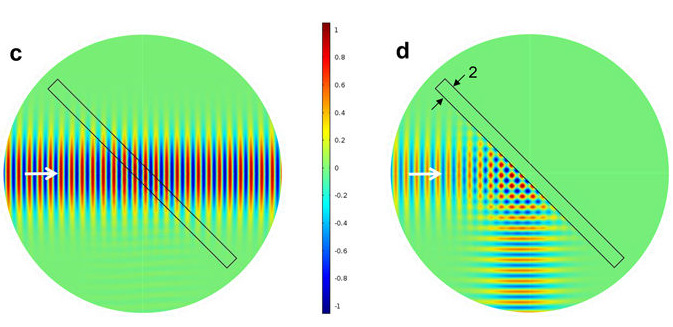
The new technique the Brown and Osaka team developed replaces the wires with a stack of closely-spaced steel plates. Each pair of plates forms what’s known as a parallel-plate waveguide. When terahertz light is shined on the stack at a 45-degree angle, it splits the beam by exciting two waveguide modes. One beam of vertically polarized light passes straight through the device, while another beam of horizontally polarized light is reflected in a 90-degree angle from the original beam axis.
The new device uses waveguides to separate terahertz radiation according to polarization state. Mittleman lab / Brown University
The technique has a number of advantages over traditional wire filters, the researchers say. The stack-of-plates architecture, which is knows as an “artificial dielectric,” is easy to make, and the materials are inexpensive. The plates are also much less fragile than wires.
“The artificial-dielectric concept also makes the device more versatile,” Mendis said. “The device can be easily tuned for use at different terahertz frequencies simply by changing the size of the spacers separating the plates or by changing the illuminating angle.”
Another advantage is that with the addition of a second similar artificial-dielectric structure, the researchers were able to build a device called an isolator. Isolators are used on high-powered lasers to prevent light from being reflected back into a laser emitter, which could destabilize or even damage it. A terahertz isolator could be an important component for future high-powered terahertz devices.
The Brown and Osaka team is in the process of patenting the new artificial-dielectric devices, and the researchers are hopeful that these devices will enable the development of new terahertz systems with far better capabilities.
“In anything you might want to do with an optical system, it’s useful to be able to manipulate polarization,” Mittleman said. “This is a simple, efficient, effective and versatile way to do that.”
The work was supported in part by the National Science Foundation (EPMD #1609521).
Brown University researchers have developed a new method of manipulating the polarization of light at terahertz frequencies.
The technique uses stacks of carefully spaced metal plates to make a polarizing beamsplitter, a device that splits a beam of light by its differing polarization states, sending vertically polarized light in one direction and horizontally polarized light in another. Such a beamsplitter could be useful in a wide variety of systems that make use of terahertz radiation, from imaging systems to future communications networks.
In the imaging world, the ability to deliver and detect radiation at different polarizations could be useful in terahertz microscopy and material characterization. In communications, polarized beams can enable multiple data streams to be sent down the same medium without interference.
"This stack-of-plates idea has advantages over traditional methods of manipulating polarization in the terahertz region," said Dan Mittleman, a professor in Brown's School of Engineering and senior author of a research paper describing the work in the journal Scientific Reports. "It's cheaper and physically more robust than other methods, and it's more versatile in what it allows us to do."
Rajind Mendis, a research assistant professor at Brown, led the work along with Mittleman, Brown graduate student Wei Zhang and Masaya Nagai, an associate professor at Osaka University in Japan.
The terahertz range is the swath of the electromagnetic spectrum between microwave and infrared frequencies. Use of terahertz waves in technological applications such as spectroscopy, sensing, imaging and ultra-high-bandwidth communications is growing, and researchers are working to develop the hardware components necessary to build these advanced terahertz systems.
Polarization refers to the orientation of an electromagnetic wave's peaks and valleys as the wave propagates. If a wave is propagating toward you, the peaks and valleys can be oriented vertically, horizontally or anywhere in between.
"Polarization is one of the key properties of any electromagnetic wave," Mittleman said. "Being able to manipulate polarization -- to measure it or to change it -- is one of the important capabilities you need in any electromagnetic system."
In the visible light realm, for example, manipulating polarization is used to create modern 3-D movies and to make sunglasses that reduce the glare of reflected light. Polarizing sunglasses are made by arranging polymer strands horizontally within lenses like bars on a jail cell. Those strands allow light that's polarized vertically to pass through, while blocking horizontally polarized light, which is the dominant polarization state of light reflected off shiny surfaces like cars and water.
Existing methods of manipulating polarization in the terahertz range are very similar to the technique used in polarizing sunglasses, albeit scaled to the much longer wavelengths of terahertz light compared to visible light. Polarizing filters for terahertz are generally an array of metal wires a few microns in diameter and spaced several microns apart.
The new technique the Brown and Osaka team developed replaces the wires with a stack of closely-spaced steel plates. Each pair of plates forms what's known as a parallel-plate waveguide. When terahertz light is shined on the stack at a 45-degree angle, it splits the beam by exciting two waveguide modes. One beam of vertically polarized light passes straight through the device, while another beam of horizontally polarized light is reflected in a 90-degree angle from the original beam axis.
The technique has a number of advantages over traditional wire filters, the researchers say. The stack-of-plates architecture, which is knows as an "artificial dielectric," is easy to make, and the materials are inexpensive. The plates are also much less fragile than wires.
"The artificial-dielectric concept also makes the device more versatile," Mendis said. "The device can be easily tuned for use at different terahertz frequencies simply by changing the size of the spacers separating the plates or by changing the illuminating angle."
Another advantage is that with the addition of a second similar artificial-dielectric structure, the researchers were able to build a device called an isolator. Isolators are used on high-powered lasers to prevent light from being reflected back into a laser emitter, which could destabilize or even damage it. A terahertz isolator could be an important component for future high-powered terahertz devices.
The Brown and Osaka team is in the process of patenting the new artificial-dielectric devices, and the researchers are hopeful that these devices will enable the development of new terahertz systems with far better capabilities.
"In anything you might want to do with an optical system, it's useful to be able to manipulate polarization," Mittleman said. "This is a simple, efficient, effective and versatile way to do that."
We study the influence of the input spatial mode on the extraordinary optical transmission (EOT) effect. By placing a metal screen with a 1D array of subwavelength holes inside a terahertz (THz) parallel-plate waveguide (PPWG), we can directly compare the transmission spectra with different input waveguide modes. We observe that the transmitted spectrum depends strongly on the input mode. A conventional description of EOT based on the excitation of surface plasmons is not predictive in all cases. Instead, we utilize a formalism based on impedance matching, which accurately predicts the spectral resonances for both TEM and non-TEM input modes.
We introduce two waveguide based devices for signal processing in future terahertz wireless communications systems: a leaky-wave antenna for frequency multiplexing and a Tjunction waveguide for broadband power splitting.
A power splitter is one of the most fundamental parts of any communications network. It allows a signal to be transmitted to numerous devices and users. A team of researchers at Brown University have created such a device meant for terahertz radiation — a range of frequencies that probably will facilitate data transfer up to 100 times quicker than current Wi-Fi and cellular networks.
One of the most basic components of any communications network is a power splitter that allows a signal to be sent to multiple users and devices. Researchers from Brown University have now developed just such a device for terahertz radiation -- a range of frequencies that may one day enable data transfer up to 100 times faster than current cellular and Wi-Fi networks. (Photo Credit: Mittleman lab / Brown University)
“One of the big thrusts in terahertz technology is wireless communications,” said Kimberly Reichel, a post-doctoral researcher in Brown’s School of Engineering who led the device’s development. “We believe this is the first demonstration of a variable broadbrand power splitter for terahertz, which would be a fundamental device for use in a terahertz network.”
The device could have a number of uses, including as a part in terahertz routers that would transmit data packets to several computers, similar to routers in current Wi-Fi networks.
This innovative new device is illustrated in the Nature journal Scientific Reports.
The current Wi-Fi and cellular networks depend on microwaves, but the quantity of data that can travel on microwaves is restricted by frequency. Terahertz waves span between 100 and 10,000GHz on the electromagnetic spectrum, and possess greater frequency and thus have the potential to transmit plenty more data. Until recent times, however, terahertz has not received a lot of attention from researchers and scientists, therefore several of the standard parts for a terahertz communications network just does not exist.
Daniel Mittleman, a professor in Brown’s School of Engineering, has been involved in building some of those standard parts. Recently, his lab built the first system for terahertz multiplexing and demultiplexing, a technique of transmitting many signals via a single medium and then splitting them back out on the other side. Mittleman’s lab has also been involved in creating a unique type of lens for focusing terahertz waves.
All the parts created by Mittleman make use of parallel-plate waveguides — metal sheets capable of restraining terahertz waves and guiding them in specific directions.
“We’re developing a family of waveguide tools that could be integrated to create the appropriate signal processing that one would need to do networking,”said Mittleman, who was a co-author on the new paper along with Reichel and Brown research professor Rajind Mendis. “The power splitter is another member of that family.”
The novel device comprises many waveguides set to form a T-junction. Signal passing into the leg of the T is divided by a triangular septum at the junction, transmitting a fraction of the signal down the two arms. The triangular shape of the septum reduces the quantity of radiation that reflects back down the leg of the T, decreasing signal loss. The septum can be shifted left or right so as to vary the quantity of power that is transmitted down either arm.
We can go from an equal 50/50 split up to a 95/5 split, which is quite a range.
Reichel
The septum is controlled manually in this proof-of-concept device. Mittleman states that the process could easily be automated to facilitate dynamic switching of power output to each channel. Then it may be possible for the device to be integrated in a terahertz router.
It’s reasonable to think that we could operate this at sub-millisecond timescales, which would be fast enough to do data packet switching. So this is a component that could be used to enable routing in the manner of the microwave routers we use today.
Mittleman
The Brown University team aim to further tweak the new device. The subsequent step would be to initiate testing error rates in data streams transmitted via the device.
The goal of this work was to demonstrate that you can do variable power switching with a parallel-plate waveguide architecture. We wanted to demonstrate the basic physics and then refine the design.
Mittleman
The National Science Foundation and the W. M. Keck Foundation funded part of this project.
Kimberly S. Reichel, Rajind Mendis, Daniel M. Mittleman http://www.nature.com/articles/srep28925 In order for the promise of terahertz (THz) wireless communications to become a reality, many new devices need to be developed, such as those for routing THz waves. We demonstrate a power splitting router based on a parallel-plate waveguide (PPWG) T-junction excited by the TE1 waveguide mode. By integrating a small triangular septum into the waveguide plate, we are able to direct the THz light down either one of the two output channels with precise control over the ratio between waveguide outputs. We find good agreement between experiment and simulation in both amplitude and phase. We show that the ratio between waveguide outputs varies exponentially with septum translation offset and that nearly 100% transmission can be achieved. The splitter operates over almost the entire range in which the waveguide is single mode, providing a sensitive and broadband method for THz power splitting.
Researchers have used an array of stacked plates to make a lens for terahertz radiation. The technique could set stage for new types of components for manipulating terahertz waves. Credit: Mittleman lab / Brown University
Terahertz radiation is a relatively unexplored slice of the electromagnetic spectrum, but it holds the promise of countless new imaging applications as well as wireless communication networks with extremely high bandwidth. The problem is that there are few off-the-shelf components available for manipulating terahertz waves.
Now, researchers from Brown University's School of Engineering have developed a new type of lens for focusing terahertzradiation (which spans from about 100 to 10,000 GHz). The lens, made from an array of stacked metal plates with spaces between them, performs as well or better than existing terahertz lenses, and the architecture used to build the device could set the stage for a range of other terahertz components that don't currently exist.
The work was led by Rajind Mendis, assistant professor of engineering (research) at Brown, who worked with Dan Mittleman, professor of engineering at Brown. The work is described in the journal Nature Scientific Reports.
"Any photonic system that uses terahertz - whether it's in imaging, wireless communications or something else - will require lenses," said Dan Mittleman, professor of engineering at Brown and the senior author on the new paper. "We wanted to look for new ways to focus terahertz radiation."
Most lenses use the refractive properties of a material to focus light energy. Eyeglasses, for example, use convex glass to bend visible light and focus it on a certain spot. But for this new terahertz lens, the properties of the materials used don't matter as much as the way in which the materials are arranged.
The image shows a a two-centimeter beam focused to four millimeters. Credit: Mittleman lab / Brown University
"It's the architecture here that's important," Mendis said.
The new device is made from 32 metal plates, each 100 microns thick, with a 1-millimeter space between each plate. The plates have semicircular notches of different sizes cut out of one edge, such that when stacked horizontally the notches form a three-dimensional divot on one side of the device. When a terahertz beam enters the input side of the device, slices of the beam travel through the spaces between the plates. The concave output side of the device bends the beam slices to varying degrees such that the slices are all focused on a certain point.
Using the configuration developed for this new study, the researchers were able to focus a two-centimeter-diameter terahertz beam down to a four-millimeter spot. The radiation transmission through the device - the amount of radiation that makes it through the spaces as opposed to reflected back toward the source or dissipated inside the device - was about 80 percent. That's significantly better than silicon lenses, which typically have a transmission loss of about 50 percent, and about the same as lenses made from Teflon.
The new device has some advantages over existing Teflon lenses, however. In particular, by changing the spacing between the plates, the new device can be calibrated for specific terahertz wavelengths, something that isn't possible with existing lenses.
"That can be particularly interesting if you want to image things at one frequency and not at others," Mittleman said. "One of the important things here is that this design offers you a versatility that a simple chunk of plastic with a curved surface doesn't offer."
The work also suggests that the technique of using spaced metal plates to manipulate terahertz radiation could be useful in making other types of components that currently don't exist. Since a metallic architecture mimics a plastic (a dielectric), this material technology is called "artificial dielectrics."
"As much as anything else, this paper proves that the technology is feasible," Mittleman said. "Now we can go and make devices that are totally new in the terahertz world."
The same technology could be used, Mendis said, to make a polarizing beam splitter for terahertz waves - a device that separates waves according to their polarization state. Such a device could be used to implement elementary logic gates for terahertz photonic systems, where the binary (one and zero) logic states are assigned to the two polarization states. That would be an essential component of a terahertz data network.
"The spirit of this work is to develop a new technology for building terahertz components that might be alternatives to things that exist or that might be new," Mittleman said. "That's important for the terahertz field because there aren't a lot of off-the-shelf components yet."
We have designed, fabricated, and experimentally characterized a lens for the THz regime based on artificial dielectrics. These are man-made media that mimic properties of naturally occurring dielectric media, or even manifest properties that cannot generally occur in nature. For example, the well-known dielectric property, the refractive index, which usually has a value greater than unity, can have a value less than unity in an artificial dielectric. For our lens, the artificial-dielectric medium is made up of a parallel stack of 100 μm thick metal plates that form an array of parallel-plate waveguides. The convergent lens has a plano-concave geometry, in contrast to conventional dielectric lenses. Our results demonstrate that this lens is capable of focusing a 2 cm diameter beam to a spot size of 4 mm, at the design frequency of 0.17 THz. The results further demonstrate that the overall power transmission of the lens can be better than certain conventional dielectric lenses commonly used in the THz regime. Intriguingly, we also observe that under certain conditions, the lens boundary demarcated by the discontinuous plate edges actually resembles a smooth continuous surface. These results highlight the importance of this artificial-dielectric technology for the development of future THz-wave devices.
We demonstrate the focusing of a free-space THz beam emerging from a leaky parallel-plate waveguide (PPWG). Focusing is accomplished by grading the launch angle of the leaky wave using a PPWG with gradient plate separation. Inside the PPWG, the phase velocity of the guided TE1 mode exceeds the vacuum light speed, allowing the wave to leak into free space from a slit cut along the top plate. Since the leaky wave angle changes as the plate separation decreases, the beam divergence can be controlled by grading the plate separation along the propagation axis. We experimentally demonstrate focusing of the leaky wave at a selected location at frequencies of 100 GHz and 170 GHz, and compare our measurements with numerical simulations. The proposed concept can be valuable for implementing a flat and wide-aperture beam-former for THz communications systems.
The idea of using radiation in the 0.1–1.0 THz range as carrier waves for free-space wireless communications has attracted growing interest in recent years, due to the promise of the large available bandwidth1, 2. Recent research has focused on system demonstrations3, 4, as well as the exploration of new components for modulation5, beam steering6 and polarization control7. However, the multiplexing and demultiplexing of terahertz signals remains an unaddressed challenge, despite the importance of such capabilities for broadband networks. Using a leaky-wave antenna based on a metal parallel-plate waveguide, we demonstrate frequency-division multiplexing and demultiplexing over more than one octave of bandwidth. We show that this device architecture offers a unique method for controlling the spectrum allocation, by variation of the waveguide plate separation. This strategy, which is distinct from those previously employed in either the microwave8 or optical9regimes, enables independent control of both the centre frequency and bandwidth of multiplexed terahertz channels.