Showing posts with label Yu Liu. Show all posts

Sunday, July 15, 2018

Abstract-Multifunctional Hybrid Metasurfaces for Dynamic Tuning of Terahertz Waves


Honglei Cai,  Shi Chen,   Chongwen Zou,   Qiuping Huang,   Yu Liu,  Xiang Hu,   Zhengping Fu,  Yi Zhao,  Hongchuan He,   Yalin Lu,

https://onlinelibrary.wiley.com/doi/abs/10.1002/adom.201800257


Actively tuning optical transmission through hybrid metasurfaces incorporated with multifunctional active media holds great promise for the next generation optical devices. In the terahertz (THz) range, they remain rare due to the lack of dynamic and multifunctional designs and materials. Here, a vanadium dioxide (VO2)‐based hybrid metasurface is proposed to present multifunctional control of THz waves via electrically triggering and ultrafast optical excitation. By minimizing the thermal mass of VO2 and optimizing the VO2 patterns within two side gaps of the asymmetric split‐ring resonators, a hybrid metasurface which can tune the THz wave with an absolute modulation depth up to 54% and a figure of merit as high as 138% is hereby presented. The hybrid metasurface achieves a switching time of 2.2 s under the electrically triggering and offers an ultrafast modulation within 30 ps under the femtosecond pulse excitation. More interestingly, owing to the intrinsic hysteresis behavior of VO2, the hybrid metasurface exhibits distinguishing multistate transmission amplitudes with a single electrical input. In short, this study paves the way for robust multifunctionality in electric‐controlled terahertz switching, photonic memory, and ultrafast terahertz optics.

Saturday, December 2, 2017

Abstract-Cell viability and hydration assay based on metamaterial-enhanced terahertz spectroscopy


Yu Liu,  Mingjie Tang,  Liangping Xia,  Wenjing Yu,  Jia Peng, Yang Zhang,  Marc Lamy de la Chapelle,  Ke Yang,  Hong-Liang Cui,  Weiling Fu


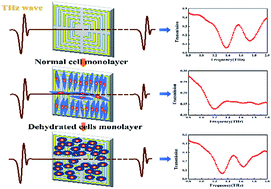
Graphical abstract: Cell viability and hydration assay based on metamaterial-enhanced terahertz spectroscopy


http://pubs.rsc.org/en/content/articlelanding/2017/ra/c7ra09609g#!divAbstract
As a fast-growing technology, terahertz time-domain spectroscopy (THz-TDS) is becoming increasingly pervasive in biological applications, targeting a range of biomaterials from biomolecules to tissues. However, THz-TDS studies at the cellular level are quite limited. Thus, a study to analyze the living state and hydration state of a tumor cell in a label-free manner is carried out and reported here. Combined with a specially designed THz metamaterial, a tumor cell monolayer was detected continuously over a period of time. In addition, in order to explore the possible impact of the metamaterial on tumor cells, the secretion of IL-6, IL-8, GM-CSF and GROα of cell supernatants was detected. The results demonstrated that the technology could characterize the living state by monitoring the extracellular water and investigate the hydration state inside a tumor cell in real time, showing great application potential for the label-free detection of normal cells and tumor cells of diverse malignant degree.

Friday, March 31, 2017

Abstract-Dielectric properties of a CsPbBr3 quantum dot solution in the terahertz region


Dongsheng Yang, Xiangai Cheng, Yu Liu, Chao Shen, Zhongjie Xu, Xin Zheng, and Tian Jiang

https://www.osapublishing.org/ao/abstract.cfm?uri=ao-56-10-2878

In recent years, CsPbBr3 quantum dots (QDs) have attracted much attention due to their bright prospects in solar cell studies. Dielectric properties are important for the fabrication of optoelectronic devices. Here, the dielectric properties of a CsPbBr3 QD solution are investigated between 0.1 and 2.0 THz by terahertz time-domain spectroscopy. The measured frequency-dependent transmitted ratio is found to decrease from 0.96 to 0.80 in this range. By comparing different concentrations of the QD solution, the frequency-averaged absorption is linearly increased with the increase in QD concentration. After that, the frequency-dependent dielectric constant, including the complex refractive index, complex dielectric constant, and conductivity, is extracted by Fourier transform of the time-domain spectrum. An effective medium approach method is adopted to extract the complex dielectric constant of a CsPbBr3 QD inclusion, and a slight peak around 0.4 THz is found in the imaginary part of the dielectric constant. The result of Drude–Lorentz fitting shows that the phonon plays a dominant role in the dielectric properties of a CsPbBr3 QD solution. Moreover, the THz response of a CsPbBr3 QD is found to be unchanged when the test is conducted under illumination. We attribute this phenomenon to the discrete energy level of excitons in CsPbBr3 QDs due to quantum confinement, and design a comparative experiment to validate it. This study is significant for its deeper insight into the dielectric properties of CsPbBr3 QDs, and thus is helpful through its applications in optoelectronics.
© 2017 Optical Society of America

Friday, May 20, 2016

Abstract-Biomedical Applications of Terahertz Spectroscopy and Imaging


Xiang Yang, Xiang Zhao, Ke Yang, Yueping Liu, Yu Liu, Weiling Ful, Yang Luo

http://www.cell.com/trends/biotechnology/abstract/S0167-7799(16)30027-0?_returnURL=http%3A%2F%2Flinkinghub.elsevier.com%2Fretrieve%2Fpii%2FS0167779916300270%3Fshowall%3Dtrue

Terahertz (THz = 1012 Hz) radiation has attracted wide attention for its unprecedented sensing ability and its noninvasive and nonionizing properties. Tremendous strides in THz instrumentation have prompted impressive breakthroughs in THz biomedical research. Here, we review the current state of THz spectroscopy and imaging in various biomedical applications ranging from biomolecules, including DNA/RNA, amino acids/peptides, proteins, and carbohydrates, to cells and tissues. We also address the potential biological effects of THz radiation during its biological applications and propose future prospects for this cutting-edge technology.