A repository & source of cutting edge news about emerging terahertz technology, it's commercialization & innovations in THz devices, quality & process control, medical diagnostics, security, astronomy, communications, applications in graphene, metamaterials, CMOS, compressive sensing, 3d printing, and the Internet of Nanothings. NOTHING POSTED IS INVESTMENT ADVICE! REPOSTED COPYRIGHT IS FOR EDUCATIONAL USE.
Showing posts with label plasmons. Show all posts
Monday, January 22, 2018
Abstract-Broadband gate-tunable terahertz plasmons in graphene heterostructures
Baicheng Yao, Yuan Liu, Shu-Wei Huang, Chanyeol Choi, Zhenda Xie, Jaime Flor Flores, Yu Wu, Mingbin Yu, Dim-Lee Kwong, Yu Huang, Yunjiang Rao, Xiangfeng Duan, Chee Wei Wong,
https://www.nature.com/articles/s41566-017-0054-7
Graphene, a unique two-dimensional material comprising carbon in a honeycomb lattice1, has brought breakthroughs across electronics, mechanics and thermal transport, driven by the quasiparticle Dirac fermions obeying a linear dispersion2,3. Here, we demonstrate a counter-pumped all-optical difference frequency process to coherently generate and control terahertz plasmons in atomic-layer graphene with octave-level tunability and high efficiency. We leverage the inherent surface asymmetry of graphene for strong second-order nonlinear polarizability4,5, which, together with tight plasmon field confinement, enables a robust difference frequency signal at terahertz frequencies. The counter-pumped resonant process on graphene uniquely achieves both energy and momentum conservation. Consequently, we demonstrate a dual-layer graphene heterostructure with terahertz charge- and gate-tunability over an octave, from 4.7 THz to 9.4 THz, bounded only by the pump amplifier optical bandwidth. Theoretical modelling supports our single-volt-level gate tuning and optical-bandwidth-bounded 4.7 THz phase-matching measurements through the random phase approximation, with phonon coupling, saturable absorption and below the Landau damping, to predict and understand graphene plasmon physics.
Saturday, March 25, 2017
Abstract-Mapping vibrational surface and bulk modes in a single nanocube
Imaging of vibrational excitations in and near nanostructures is essential for developing low-loss infrared nanophotonics1, controlling heat transport in thermal nanodevices2, 3, inventing new thermoelectric materials4 and understanding nanoscale energy transport. Spatially resolved electron energy loss spectroscopy has previously been used to image plasmonic behaviour in nanostructures in an electron microscope5, 6, but hitherto it has not been possible to map vibrational modes directly in a single nanostructure, limiting our understanding of phonon coupling with photons7 and plasmons8. Here we present spatial mapping of optical and acoustic, bulk and surface vibrational modes in magnesium oxide nanocubes using an atom-wide electron beam. We find that the energy and the symmetry of the surface polariton phonon modes depend on the size of the nanocubes, and that they are localized to the surfaces of the nanocube. We also observe a limiting of bulk phonon scattering in the presence of surface phonon modes. Most phonon spectroscopies are selectively sensitive to either surface or bulk excitations; therefore, by demonstrating the excitation of both bulk and surface vibrational modes using a single probe, our work represents advances in the detection and visualization of spatially confined surface and bulk phonons in nanostructures.
Sunday, January 22, 2017
Abstract-Plasmons in one and two dimensions
H. Pfnür, C. Tegenkamp, L. Vattuone
http://export.arxiv.org/abs/1701.05049
Plasmons in low-dimensional systems respresent an important tool for coupling energy into nanostructures and the localization of energy on the scale of only a few nanometers. Contrary to ordinary surface plasmons of metallic bulk materials, their dispersion goes to zero in the long wavelength limit, thus covering a broad range of energies from terahertz to near infrared, and from mesoscopic wavelengths down to just a few nanometers. Using specific and most characteristic examples, we review first the properties of plasmons in two-dimensional (2D) metallic layers from an experimental point of view. As demonstrated, tuning of their dispersion is possible by changes of charge carrier concentration in the partially filled 2D conduction bands, but for the relativistic electron gas like in graphene only in the long wavelength limit. For short wavelengths, on the other hand, the dispersion turns out to be independent of the position of the Fermi level with respect to the Dirac point. A linear dispersion, seen under the latter conditions in graphene, can also be obtained in non-relativistic electron gases by coupling between 2D and 3D electronic systems. As a well investigated example, the acoustic surface plasmons in Shockley surface states, coupled with the bulk electronic system, are discussed. Also the introduction of anisotropy, e.g. by regular arrays of steps, seems to result in linearization (and to partial localization of the plasmons normal to the steps, depending on wavelengths). In quasi-one dimensional (1D) systems, such as arrays of gold chains on regularly stepped Si surfaces, only the dispersion is 1D, whereas shape and slope of the dispersion curves depend on the 2D distribution of charge within each terrace and on coupling between wires on different terraces.
Friday, August 5, 2016
Abstract-Plasmons and terahertz devices in graphene
Hossam Galal
https://arxiv.org/abs/1608.01215
We introduce a novel scheme for efficient manipulation and detection of terahertz (THz) radiation. Our work consists of two parts; with a focus on proving the concept of our novel scheme, and the exploitation of graphene's peculiar properties.
For the first part, we report on the successful demonstration of two multiresonance Split Ring Resonator (SRR) designs, for efficient modulation of THz frequency beams. The two designs are based on SRR intracoupling, with multiple predefined resonances covering the bandwidth 40-300 GHz. The simulation results obtained have been experimentally verified.
The second part of the work reports on the computational development of novel architectures of low-impedance broadband antennas, for efficient detection of THz frequency beams. The conceived Split Ring Resonator-Resonance Assisted (SRR-RA) antennas are based on both a capacitive and inductive scheme, exploiting a 200
Tuesday, April 12, 2016
Abstract-Chiral plasmons without magnetic field
Plasmons, the collective oscillations of interacting electrons, possess emergent properties that dramatically alter the optical response of metals. We predict the existence of a new class of plasmons—chiral Berry plasmons (CBPs)—for a wide range of 2D metallic systems including gapped Dirac materials. As we show, in these materials the interplay between Berry curvature and electron–electron interactions yields chiral plasmonic modes at zero magnetic field. The CBP modes are confined to system boundaries, even in the absence of topological edge states, with chirality manifested in split energy dispersions for oppositely directed plasmon waves. We unveil a rich CBP phenomenology and propose setups for realizing them, including in anomalous Hall metals and optically pumped 2D Dirac materials. Realization of CBPs will offer a powerful paradigm for magnetic field-free, subwavelength optical nonreciprocity, in the mid-IR to terahertz range, with tunable splittings as large as tens of THz, as well as sensitive all-optical diagnostics of topological bands.
Friday, December 25, 2015
Abstract-Terahertz Nonlinearity in Graphene Plasmons
Mohammad M. Jadidi, Jacob C. König-Otto, Stephan Winnerl, Andrei B. Sushkov, H. Dennis Drew, Thomas E. Murphy, Martin Mittendorff
http://arxiv.org/abs/1512.07508
Sub-wavelength graphene structures support localized plasmonic resonances in the terahertz and mid-infrared spectral regimes. The strong field confinement at the resonant frequency is predicted to significantly enhance the light-graphene interaction, which could enable nonlinear optics at low intensity in atomically thin, sub-wavelength devices. To date, the nonlinear response of graphene plasmons and their energy loss dynamics have not been experimentally studied. We measure and theoretically model the terahertz nonlinear response and energy relaxation dynamics of plasmons in graphene nanoribbons. We employ a THz pump-THz probe technique at the plasmon frequency and observe a strong saturation of plasmon absorption followed by a 10 ps relaxation time. The observed nonlinearity is enhanced by two orders of magnitude compared to unpatterned graphene with no plasmon resonance. We further present a thermal model for the nonlinear plasmonic absorption that supports the experimental results.
Tuesday, June 25, 2013
Abstract-Terahertz Magnetoplasmon Energy Concentration and Splitting in Graphene PN Junctions
Terahertz plasmons and magnetoplasmons propagating along electrically and chemically doped graphene p-n junctions are investigated. It is shown that such junctions support non-reciprocal magnetoplasmonic modes which get concentrated at the middle of the junction in one direction and split away from the middle of the junction in the other direction under the application of an external static magnetic field. This phenomenon follows from the combined effects of circular birefringence and carrier density non-uniformity. It can be exploited for the realization of plasmonic isolators.
Wednesday, December 5, 2012
Abstract-Plasmonic terahertz lasing in an array of graphene nanocavities
V. V. Popov, O. V. Polischuk, A. R. Davoyan, V. Ryzhii, T. Otsuji, and M. S. Shur
http://prb.aps.org/abstract/PRB/v86/i19/e195437
.We propose a novel concept of terahertz lasing based on stimulated generation of plasmons in a planar array of graphene resonant micro/nanocavities strongly coupled to terahertz radiation. Due to the strong plasmon confinement and superradiant nature of terahertz emission by the array of plasmonic nanocavities, the amplification of terahertz waves is enhanced by many orders of magnitude at the plasmon resonance frequencies. We show that the lasing regime is ensured by the balance between the plasmon gain and plasmon radiative damping.
http://prb.aps.org/abstract/PRB/v86/i19/e195437
.We propose a novel concept of terahertz lasing based on stimulated generation of plasmons in a planar array of graphene resonant micro/nanocavities strongly coupled to terahertz radiation. Due to the strong plasmon confinement and superradiant nature of terahertz emission by the array of plasmonic nanocavities, the amplification of terahertz waves is enhanced by many orders of magnitude at the plasmon resonance frequencies. We show that the lasing regime is ensured by the balance between the plasmon gain and plasmon radiative damping.
Saturday, June 30, 2012
Magnetoplasmonics moves on
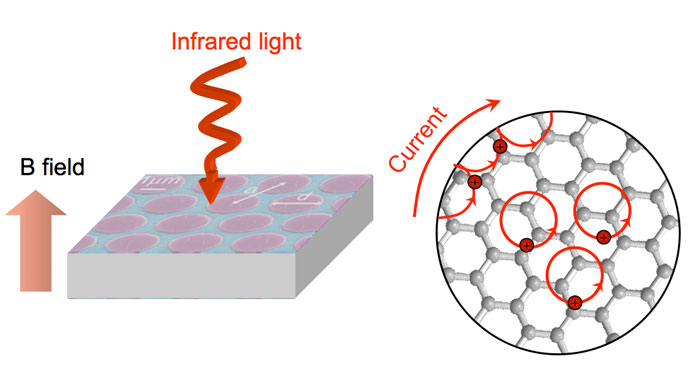
Researchers at IBM have come across an unexpected phenomenon while studying how plasmons in graphene behave in the presence of a magnetic field. The finding could help the new and upcoming field of magnetoplasmonics, with graphene finding its way into terahertz magneto-optical devices, such as modulators and Faraday rotators.
The team, headed by Phaedon Avouris of IBM's TJ Watson Research Center in New York and Zhiqiang Li of the National High Magnetic Field Laboratory in Florida, studied graphene that had been patterned into a periodic array of microdisks. The structure absorbs light by confining it into regions that are hundreds of times smaller than the wavelength of the light by exploiting plasmons that occur within the individual microdisks. Plasmons are quantized collective oscillations of electrons – and they interact strongly with light.
Graphene appears to be emerging as a very promising plasmonic material thanks to the material's unusual electronic properties, which result in its electrons moving extremely fast and behaving like relativistic "Dirac" particles with virtually no rest mass. Graphene absorbs light particularly well in the terahertz and infrared parts of the electromagnetic spectrum – something that could lead to novel applications in photonics and quantum optics. "What is more, unlike plasmons in metals, the plasmons in graphene should
be strongly affected by an external magnetic field – all because graphene electrons behave like massless fermions," explained project leader Hugen Yan.
Longer-lived edge plasmons
The researchers obtained their results by measuring the light transmission spectrum of the graphene disk arrays, using a Fourier transform IR spectrometer together with a silicon bolometer, while a magnetic field was applied perpendicular to the disks. To their surprise, they found that plasmons at the edges of the nanostructures appear to last longer when a magnetic field is applied. This is counter-intuitive, Yan tells nanotechweb.org, because there are potentially more defects in the vicinity of an edge plasmon that should, conversely, reduce its lifetime.
According to the team, the applied magnetic field may be suppressing electron backscattering at the edges of the microdisks, so allowing the plasmons to last longer in the samples. The result is doubly unexpected given that the phenomenon has never been observed before in conventional 2D electron gas systems in the terahertz range.
And that is not all: the lifetimes of the edge plasmons can also be tuned by varying the magnitude of the applied magnetic field, with larger fields encouraging longer-lived plasmons.
"A long plasmon lifetime is a big advantage for applications in chemical and biological sensing, as well as in electric field enhancement, and could lead to a variety of magneto-optical applications in the future," said Yan.
The IBM team is now planning to study magnetoplasmons in other graphene microstructures, such as graphene rings, dots, ribbons and elliptical disks.
The current work is detailed in Nano Letters.
About the author
Belle Dumé is contributing editor at nanotechweb.org
Subscribe to:
Posts (Atom)