Showing posts with label Ke Yang. Show all posts

Monday, July 23, 2018

Abstract-Multiple antenna techniques for terahertz nano-bio communication


Aya Abdelaziz,  Ke Yang,  Khalid Qaraqe,  Joseph Boutros,  Qammer H. Abbasi,  Akram Alomainy

https://ieeexplore.ieee.org/document/8402408/

Using higher frequency bands becomes an essential demand resulting from the explosive wireless traffic needs and the spectrum shortage of the currently used bands. This paper presents an overview on the terahertz technology and its application in the area of multi-input multi-output antenna system and in-vivo nano-communication. In addition, it presents a preliminary study on applying multiple input-single output (MISO) antenna technique to investigate the signal propagation and antenna diversity techniques inside the human skin tissues, which is represented by three layers: stratum corneum (SC), epidermis, and dermis layers, in the terahertz (THz) frequency range (0.8–1.2) THz. The spatial antenna diversity is investigated in this study to understand MISO system performance for two different in-vivo channels resulting from the signal propagation between two transmitting antennas, located at the dermis layer, and one receiving antenna, located at epidermis layer. Three techniques are investigated: selection combining (SC), equal-gain combing (EGC), and maximum-ratio combining (MRC). The initial study indicates that using multiple antenna technique with THz might be not useful for in-vivo nano-communication.

Thursday, July 12, 2018

Abstract-Impact of Cell Density and Collagen Concentration on the Electromagnetic Properties of Dermal Equivalents in the Terahertz Band


 Rui Zhang,  Ke Yang,  Qammer H. Abbasi, Najah Abed AbuAli, Akram Alomainy,

https://ieeexplore.ieee.org/document/8353436/

In this paper, the measurement of collagen gels and dermal equivalents (DEs) with three kinds of fibroblast cell densities and collagen concentrations is performed, respectively, using terahertz time-domain spectroscopy (THz-TDS) in transmission mode. With the objective to reduce the thickness uncertainty, an algorithm to extract material parameters and sample thickness of thin samples simultaneously is employed. The statistical mean and standard deviation of the refractive indexes and absorption coefficients in a THz band from 0.2 to 1.5 THz are presented. It is shown that the refractive indexes of DEs drop by around 10%, whereas the absorption coefficients decrease by 20% when cell density increases by one order from 0.1 to 1 M/mL. In addition, the complex refractive indexes of DEs with 3-mg/mL collagen are higher than those with 2 mg/mL, whereas the THz optical parameters of DEs with 2.5 mg/mL are the lowest. The obtained results indicate that the difference in the intrinsic biological features, initial cell density, and collagen concentration changes the tissue hydration, which in turn brings changes to the electromagnetic properties.

Monday, May 7, 2018

Abstract-Label‐free bacterial colony detection and viability assessment by continuous‐wave terahertz transmission imaging


Xiang Yang,   Jia Shi,  Yuye Wang,   Ke Yang,   Xiang Zhao,   Guiyu Wang,   Degang Xu,   Yunxia Wang,  Jianquan Yao,   Weiling Fu,

https://onlinelibrary.wiley.com/doi/abs/10.1002/jbio.201700386

Timely and accurate bacterial detection is critical for various health and safety applications, which promotes the continuous development of versatile optical sensors for bacterial investigations. Here, we report a new strategy for bacterial colony sensing using terahertz (THz) imaging with minimal assay procedures. The proposed method utilizes the acute sensitivity of THz wave to the changes in the water content and cellular structures. Single bacterial colonies of four bacterial species were directly distinguished using THz imaging by utilizing their differences in THz absorption. In addition, the distribution of mixed bacterial samples has been demonstrated by THz imaging, which demonstrated that the target bacterium could be easily recognized. Furthermore, we investigated the differentiation of bacterial viability, which indicated that bacteria under different living states could be distinguished by THz imaging because of their different hydration levels and cellular structures. Our results suggest that THz imaging has the potential to be used for mixed bacterial sample detection and bacterial viability assessment in a label‐free and nondestructive manner.

Saturday, December 2, 2017

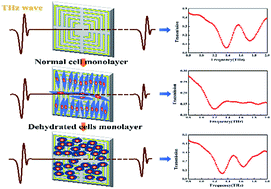
Abstract-Cell viability and hydration assay based on metamaterial-enhanced terahertz spectroscopy


Yu Liu,  Mingjie Tang,  Liangping Xia,  Wenjing Yu,  Jia Peng, Yang Zhang,  Marc Lamy de la Chapelle,  Ke Yang,  Hong-Liang Cui,  Weiling Fu


Graphical abstract: Cell viability and hydration assay based on metamaterial-enhanced terahertz spectroscopy


http://pubs.rsc.org/en/content/articlelanding/2017/ra/c7ra09609g#!divAbstract
As a fast-growing technology, terahertz time-domain spectroscopy (THz-TDS) is becoming increasingly pervasive in biological applications, targeting a range of biomaterials from biomolecules to tissues. However, THz-TDS studies at the cellular level are quite limited. Thus, a study to analyze the living state and hydration state of a tumor cell in a label-free manner is carried out and reported here. Combined with a specially designed THz metamaterial, a tumor cell monolayer was detected continuously over a period of time. In addition, in order to explore the possible impact of the metamaterial on tumor cells, the secretion of IL-6, IL-8, GM-CSF and GROα of cell supernatants was detected. The results demonstrated that the technology could characterize the living state by monitoring the extracellular water and investigate the hydration state inside a tumor cell in real time, showing great application potential for the label-free detection of normal cells and tumor cells of diverse malignant degree.

Tuesday, October 3, 2017

Abstract-Collagen Analysis at Terahertz Band using Double-Debye Parameter Extraction and Particle Swarm Optimisation


Ke Yang, Nishtha Chopra,  Qammer Abbasi,  Khalid Qaraqe,  Akram Alomainy

http://ieeexplore.ieee.org/document/7872380/

The paper focuses on the analysis of cultivated collagen samples at the terahertz (THz) band using double debye model parameter extraction. Based on measured electrical and optical parameters, we propose a model to describe such parameters extracted with a global optimisation method; namely, Particle Swarm Optimisation (PSO). Comparing the measured data with ones in the open literature, it is evident that using only cultivated collagen is not sufficient to represent the performance of the epidermis layer of the skin tissue at the THz band of interest. The results show that the differences between the measured data and published ones are as high as 14 and 6 for the real and imaginary values of the dielectric constant, respectively. Our proposed double debye model agrees well with the measured data.

Sunday, June 25, 2017

Abstract-Analytical Characterisation of the Terahertz In-Vivo Nano-Network in the Presence of Interference Based on TS-OOK Communication Scheme


 Rui Zhang,  Ke Yang,  Qammer H. Abbasi,  Khalid A. Qaraqe, Akram Alomainy


This figure shows the average SINR versus communication distance for different node densities in human blood (red), skin (blue) and fat (green) tissues . High node density potentially impairs the system performance and SINR drops about 10 dB when the node density rises one order. The effective communication distance for dense in-vivo nano-networks is restrained to about 1 mm


http://ieeexplore.ieee.org/document/7945235/


The envisioned dense nano-network inside the human body at terahertz (THz) frequency suffers a communication performance degradation among nano-devices. The reason for this performance limitation is not only the path loss and molecular absorption noise, but also the presence of multi-user interference and the interference caused by utilising any communication scheme, such as time spread ON—OFF keying (TS-OOK). In this paper, an interference model utilising TS-OOK as a communication scheme of the THz communication channel inside the human body has been developed and the probability distribution of signal-to-interference-plus-noise ratio (SINR) for THz communication within different human tissues, such as blood, skin, and fat, has been analyzed and presented. In addition, this paper evaluates the performance degradation by investigating the mean values of SINR under different node densities in the area and the probabilities of transmitting pulses. It results in the conclusion that the interference restrains the achievable communication distance to approximate 1 mm, and more specific range depends on the particular transmission circumstance. Results presented in this paper also show that by controlling the pulse transmission probability and node density, the system performance can be ameliorated. In particular, SINR of in vivo THz communication between the deterministic targeted transmitter and the receiver with random interfering nodes in the medium improves about 10 dB, when the node density decreases one order. The SINR increases approximate 5 and 2 dB, when the pulse transmitting probability drops from 0.5 to 0.1 and 0.9 to 0.5.

Saturday, March 25, 2017

Abstract-Cooperative In-Vivo Nano-Network Communication at Terahertz Frequencies


Nano devices have great potential to play a vital role in future medical diagnostics and treatment technologies because of its non-invasive nature and ability to reach delicate body sites easily as compared to conventional devices. In this paper, a novel concept of cooperative communication for in-vivo nano-network is presented to enhance the communication among these devices. The effect on the system outage probability performance is conducted for various parameters including relay lacement, number of relays, transmit power, bandwidth and carrier frequency. Results show approximately a 10-fold increase in the system outage performance whenever an additional relay is included in the cooperative network, hence show a great potential of using cooperative communication to enhance the performance of nano-network at terahertz frequencies.

Friday, May 20, 2016

Abstract-Biomedical Applications of Terahertz Spectroscopy and Imaging


Xiang Yang, Xiang Zhao, Ke Yang, Yueping Liu, Yu Liu, Weiling Ful, Yang Luo

http://www.cell.com/trends/biotechnology/abstract/S0167-7799(16)30027-0?_returnURL=http%3A%2F%2Flinkinghub.elsevier.com%2Fretrieve%2Fpii%2FS0167779916300270%3Fshowall%3Dtrue

Terahertz (THz = 1012 Hz) radiation has attracted wide attention for its unprecedented sensing ability and its noninvasive and nonionizing properties. Tremendous strides in THz instrumentation have prompted impressive breakthroughs in THz biomedical research. Here, we review the current state of THz spectroscopy and imaging in various biomedical applications ranging from biomolecules, including DNA/RNA, amino acids/peptides, proteins, and carbohydrates, to cells and tissues. We also address the potential biological effects of THz radiation during its biological applications and propose future prospects for this cutting-edge technology.