Showing posts with label terahertz time domain spectroscopy. Show all posts

Wednesday, July 21, 2021

Abstract-Comprehensive analysis of Terahertz frequency response of Bi2Se3 and Bi2Te3 single crystals using Terahertz time-domain spectroscopy


Prince Sharma, Mahesh Kumar, V.P.S. Awana, Anushree Singh, Himanshu Gohil, S.S. Prabhu, 


https://www.sciencedirect.com/science/article/abs/pii/S0921510721003159

We report the Terahertz time-domain spectroscopy (THz-TDS) dielectric response of the large single crystal of Bi2Se3 and Bi2Te3, which are grown in-house through a solid-state reaction route via the self-flux method technique. We fit the obtained experimental complex dielectric constant to the Lorentz oscillator model and obtain various resonating mode strengths in both materials. The strength of dielectric constants is an order of magnitude different while comparing the Terahertz response of both the crystals. However, the dielectric relaxation times are similar for stronger modes, depicting the similarity between the two crystals.

Friday, July 17, 2020

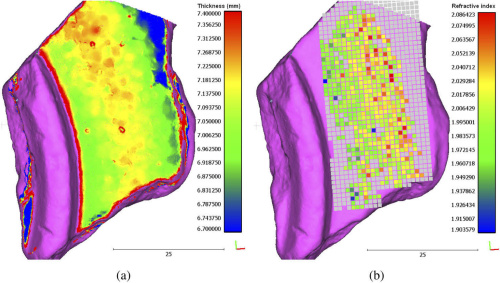
Abstract-Analysis of ancient ceramics using terahertz imaging and photogrammetry


Mikhail Mikerov, Rabi Shrestha, Peter van Dommelen, Daniel M. Mittleman, and Martin Koch
(a) Estimated thicknesses in mm and (b) refractive indices. Grey points show positions where the refractive index could not be calculated.

https://www.osapublishing.org/oe/abstract.cfm?uri=oe-28-15-22255

Imaging using terahertz time-domain spectroscopy is a valuable diagnostic tool for material inspection. However, in the case of samples with inhomogeneous shape and composition, the reliable extraction of spatially varying dielectric properties can be very challenging. Here, we demonstrate a new approach which combines THz-TDS with photogrammetric reconstruction. We show that this technique can be used to estimate the local refractive index of samples with a complex geometry. We employ this method to study samples of ancient pottery, and demonstrate that THz techniques can provide a valuable new tool for this branch of archaeological science.
© 2020 Optical Society of America under the terms of the OSA Open Access Publishing Agreement

Monday, June 22, 2020

Abstract-Terahertz Optical Constants of Solid CO2


Bagvanth Reddy Sangala, Prathap Kumar Jharapla, Rajkumar Golconda, Kurumurthy Guda,  G. Vaitheeswaran


https://link.springer.com/article/10.1007/s10762-020-00718-x

We report the optical constants of the solid CO2 (dry ice) measured using terahertz time domain spectroscopy. The CO2 ice sample was grown by vapor deposition method. The optical constants were obtained by minimizing the amplitude of the oscillations of refractive index in the spectral domain. We found that the mean refractive index of CO2 ice at 10 K is 1.485 between 0.2 and 1.6 THz with a standard deviation of 0.0137. The experiments were accompanied by first-principles density functional theory calculations using full-potential linear augmented plane wave method. The calculated refractive index is found to be 1.37 which is in reasonable agreement with the experimental value. In addition, the vibrational frequencies of solid CO2 were also studied using density functional perturbation theory, and the corresponding modes were assigned.

Friday, November 29, 2019

Abstract-Time-domain terahertz compressive imaging


We present an implementation of the single-pixel imaging approach into a terahertz (THz) time-domain spectroscopy (TDS) system. We demonstrate the indirect coherent reconstruction of THz temporal waveforms at each spatial position of an object, without the need of mechanical raster-scanning. First, we exploit such temporal information to realize (far-field) time-of-flight images. In addition, as a proof of concept, we apply a typical compressive sensing algorithm to demonstrate image reconstruction with less than 50% of the total required measurements. Finally, the access to frequency domain is also demonstrated by reconstructing spectral images of an object featuring an absorption line in the THz range. The combination of single-pixel imaging with compressive sensing algorithms allows to reduce both complexity and acquisition time of current THz-TDS imaging systems.

Monday, October 14, 2019

Abstract-Investigation of aging characteristics in explosive using terahertz time-domain spectroscopy


Wei Shi, Chengang Dong, Lei Hou, Zhiyang Xing, Qian Sun,  Lihao Zhang

https://www.worldscientific.com/doi/abs/10.1142/S0217979219502722

The terahertz absorption spectrum of the five aging explosive samples (PETN, RDX, HMX, LLM-105 and TATB) was measured and calculated by Terahertz time-domain spectroscopy system (THz-TDS) and air-biased coherent detection system (ZAP-ABCD), respectively. In this paper, compared with the unaging explosive, each aging explosive sample’s terahertz time-domain spectra were obtained and the terahertz absorption spectra were calculated by using Fourier transform and Lambert’s law. The results show that there are several terahertz absorption peaks which were called “fingerprint spectra” for different aging explosive samples in the range of 0.3–6.0 THz spectrum. Meanwhile, the results also show that the locations of the characteristic absorption peaks are not the same. Moreover, the unaging and aging explosive samples have obviously different terahertz absorption spectra.

Sunday, July 21, 2019

Abstract-Micro-Raman spectroscopy and THz time domain spectroscopic imaging of Pietra Dura marble inlay work resembling Taj Mahal architectural motifs


The Taj Mahal, a 17th century architectural wonder is known worldwide for its visual appeal in white marble with beautiful inlay works in the style of ‘Pietra Dura’ from Florence, Italy. The long-drawn restoration process for structural damage and surface discoloration of this heritage structure has drawn international attention. The conventional means of structural survey is based mostly on visual assessments by experts which is highly time-consuming and subjective; and in most cases can be done only after the damages become apparent. Consequently, the restoration involves exhaustive repair procedures. In this work, we have introduced a combination of optical imaging and spectroscopy techniques, namely, µ-Raman Spectroscopy and Terahertz Time Domain Spectroscopic Imaging, as an alternative approach for both surface and subsurface damage detection in Marble structures. In our work, we have examined some of the most common structural and surface damages in heritage Marble architectures found worldwide using some selected representative models. These model slabs bearing similar ornamental colourful motifs like those in the Taj Mahal were probed by the above two techniques, which showed tremendous promise in sensing very fine cracks which are visually impossible to detect. Also, minute changes in surface quality due to the introduction of organic materials were mapped with high accuracy. This paves the way for an efficient and trusted survey platform that could be deployed in future which would be able to provide a fast and reliable structural assessment of our cultural heritage architectures for the next generation.
© (2019) COPYRIGHT Society of Photo-Optical Instrumentation Engineers (SPIE). Downloading of the abstract is permitted for personal use only.

Thursday, November 8, 2018

Abstract-Terahertz Spectral of Enantiomers and Racemic Amino Acids by Time-Domain-Spectroscopy Technology


Yan Liu, Tao Zhou, Jun-Cheng Cao,

Fig. 2. Schematic of the Terahertz Time domain SpectrometerFig. 6. The molecular vibration model
https://www.sciencedirect.com/science/article/pii/S1350449518307102

The absorption spectra of four amino acids were studied. These spectra are obtained by terahertz time-domain spectroscopy (TDS) technique. The four amino acids are alanine, methionine, leucine, and valine, respectively. The spectra of their enantiomers (L-, D-) and racemic compounds (DL-) were investigated. Although the two isomers have very similar structures, their absorption spectra are obviously different. The absorption coefficient of each structure is calculated by the density functional theory (DFT), and the simulated spectra of each structure are obtained. It is shown that the number of the calculated peaks is in good agreement with the experimental ones. The experimental spectra were compared with the theoretical spectra. The differences between the absorption spectra of isomers are presented, and the reasons for the differences were analyzed. The vibratory spectra of biomolecules were studied, and the correlation between molecular structure and function was further understood.

Friday, October 12, 2018

Abstract-Optical tuning of dielectric properties of La0.7Sr0.3MnO3/SrTiO3 superlattices in the terahertz range


Honglei Cai, Haoliang Huang, Qiuping Huang, Xiang Hu, Jie Zhang, Xiaofang Zhai,  Yalin Lu

Fig. 2 (a) Schematic diagram of the home-made THz-TDS system. The green arrow indicates the excitation under 532 nm continuous waves. (b) Schematic diagram of the home-made OPTP system. Here, λ/4 and W.P. refer to a quarter-wave plate and a Wollaston prism, respectively.

https://www.osapublishing.org/oe/abstract.cfm?uri=oe-26-6-7842&origin=search

Two (La0.7Sr0.3MnO3)n/(SrTiO3)m superlattices with different superlattice period but the same total thickness were deposited on LaAlO3 substrates by pulsed laser deposition. Dielectric properties of these samples were investigated by means of terahertz time-domain spectroscopy (THz-TDS) under external continuous wave green laser excitation and optical-pump terahertz-probe spectroscopy (OPTP) at room temperature. Experimental results show that the real part of the permittivity for both superlattices increases significantly with increasing green laser pump power, which indicates the decrease of the plasma frequency, along with the increase of the electron scattering rate, soft mode eigenfrequency and oscillator strength in the Drude-Lorentz model. Furthermore, it’s observed that the insulating superlattice exhibits a more significant dielectric tunability than the metallic superlattice. Besides, the carrier lifetime of superlattices is much shorter than the La0.7Sr0.3MnO3 thin film in the OPTP measurements, indicating that the electrons excited in the La0.7Sr0.3MnO3 layers may be trapped by the defects located in the interfaces of La0.7Sr0.3MnO3 and SrTiO3 or the SrTiO3 layers. With the optical field-induced tunability of dielectric properties, (La0.7Sr0.3MnO3)n/(SrTiO3)m superlattices show great potential in the actively tunable devices in the THz range.
© 2018 Optical Society of America under the terms of the OSA Open Access Publishing Agreement

Tuesday, June 19, 2018

Abstract-Investigation into tautomeric polymorphism of 2-thiobarbituric acid using experimental vibrational spectroscopy combined with DFT theoretical simulation


Qiqi Wang, Jiadan Xue, Yaguo Wang, Shunji Jin, Qi Zhang, Yong Du,

https://www.sciencedirect.com/science/article/pii/S1386142518305687

Vibrational modes of 2-thiobarbituric acid (TBA) tautomeric polymorphs (form I, II and IV) were characterized by terahertz time-domain spectroscopy (THz-TDS) and Raman spectral techniques. The experimental results indicate that both vibrational spectroscopy techniques could be used to recognize the above TBA three tautomeric forms clearly. Experimental THz spectral results show that each of TBA tautomeric polymorphs has distinctive fingerprint peaks in the terahertz region. Raman spectra also show similar results about differences of TBA tautomeric polymorphs, but not significant as that of terahertz spectra since Raman-active vibrational modes are mostly from intra-molecular interaction of various functional groups within the specific molecule while that of terahertz region is more sensitive to inter-molecular interaction within crystalline unit cells. In addition, density functional theory (DFT) was used to simulate the optimized structures and vibrational modes of these three TBA tautomeric forms. The characteristic vibrational modes of TBA polymorphs are assigned comparing the simulated DFT results with experimental vibrational spectra. The results provide fundamental benchmark for the study of pharmaceutical polymorphism based on both Raman and terahertz vibrational spectroscopic techniques combined with theoretical simulations.

Friday, November 17, 2017

Abstract-Nondestructive evaluation of GFRP composite including multi-delamination using THz spectroscopy and imaging


Dae-Hyun Han, Lae-Hyong Kang

https://www.sciencedirect.com/science/article/pii/S0263822317323103


We utilize a fiber-coupled terahertz time-domain spectroscopy system (THz-TDS) based on photoconductive antennas to visualize multi-delamination and their thickness in a glass-fiber-reinforced polymer (GFRP) composite plate. We simulate a hidden multi-delamination by inserting a Teflon film in the GFRP composite plate that is fabricated using the vacuum-assisted resin transfer molding (VARTM) process. Reflected or transmitted terahertz (THz) waves are recorded from GFRP samples mounted on the x–y linear motorized stage during the investigation. The x–y linear motorized stage is driven in steps of 0.2 mm, thereby allowing us to scan the sample. We examine and compare the performances of the THz time-domain visualization (TTV) and THz frequency-domain visualization (TFV) algorithms to evaluate their characteristics for the visualization of defects. The thickness of the GFRP sample and multi-delamination is estimated using the reflection geometry method. Finally, we confirm that the hidden multi-delamination of the GFRP sample has been successfully visualized in the B- and C-scans. In addition, the thicknesses of the GFRP sample and the simulated delamination as compared with the experimental values exhibit a close consistency.

Thursday, October 19, 2017

Abstract-Excitations and relaxation dynamics in multiferroic GeV 4 S 8 studied by terahertz and dielectric spectroscopy


S. Reschke, Zhe Wang, F. Mayr, E. Ruff, P. Lunkenheimer, V. Tsurkan, and A. Loidl


We report on THz time-domain spectroscopy on multiferroic GeV4S8, which undergoes orbital ordering at a Jahn-Teller transition at 30.5 K and exhibits antiferromagnetic order below 14.6 K. The THz experiments are complemented by dielectric experiments at audio and radio frequencies. We identify a low-lying excitation close to 0.5 THz, which is only weakly temperature dependent and probably corresponds to a molecular excitation within the electronic level scheme of the V4 clusters. In addition, we detect complex temperature-dependent behavior of a low-lying phononic excitation, closely linked to the onset of orbitally driven ferroelectricity. In the high-temperature cubic phase, which is paramagnetic and orbitally disordered, this excitation is of relaxational character becomes an overdamped Lorentzian mode in the orbitally ordered phase below the Jahn-Teller transition, and finally appears as well-defined phonon excitation in the antiferromagnetic state. Abrupt changes in the real and imaginary parts of the complex dielectric permittivity show that orbital ordering appears via a structural phase transition with strong first-order character and that the onset of antiferromagnetic order is accompanied by significant structural changes, which are of first-order character, too. Dielectric spectroscopy documents that at low frequencies, significant dipolar relaxations are present in the orbitally ordered, paramagnetic phase only. In contrast to the closely related GaV4S8, this relaxation dynamics that most likely mirrors coupled orbital and polar fluctuations does not seem to be related to the dynamic processes detected in the THz regime.
  • Figure
  • Figure
  • Figure
  • Figure
  • Figure
  • Figure
  • Figure

Saturday, October 14, 2017

Abstract-Epitaxial strain driven crossover from Drude to Drude-Smith terahertz conductivity dynamics in LaNiO3 thin films


 and 

We investigate the hetero-epitaxial strain driven low-energy charge dynamics in compressive and tensile strained LaNiO3 thin films employing terahertz (THz) time-domain spectroscopy. The complex THz conductivity exhibits a crossover from Drude type metallic behavior for the compressive film to a Drude-Smith type disordered behavior for the tensile film. This demonstration of strain driven crossover in THz conductivity dynamics, while the two films have qualitatively similar dc conductivities, (i) brings out the potential of THz technology in distinguishing between similar dc electronic phases and (ii) suggests that LaNiO3 under compressive strain is a better candidate for applications as electrodes in oxides electronics.

Thursday, April 20, 2017

Abstract-Effects of environmental conditions on the ultrafast carrier dynamics in graphene revealed by terahertz spectroscopy


H. A. Hafez, X. Chai, Y. Sekine, M. Takamura, K. Oguri, I. Al-Naib, M. M. Dignam, H. Hibino, and T. Ozaki

https://journals.aps.org/prb/abstract/10.1103/PhysRevB.95.165428

A thorough understanding of the stability of graphene under ambient environmental conditions is essential for future graphene-based applications. In this paper, we study the effects of ambient temperature on the properties of monolayer graphene using terahertz time-domain spectroscopy as well as time-resolved terahertz spectroscopy enabled by an optical-pump/terahertz-probe technique. The observations show that graphene is extremely sensitive to the ambient environmental conditions and behaves differently depending on the sample preparation technique and the initial Fermi level. The analysis of the spectroscopic data is supported by van der Pauw and Hall effect measurements of the carrier mobility and carrier density at temperatures comparable to those tested in our THz spectroscopic experiments.
  • Figure
  • Figure
  • Figure
  • Figure
  • Figure
  • Figure
  • Figure

Sunday, March 26, 2017

Abstract-Terahertz Spectra of Ninhydrin and Indane-1,2,3-Trione


Tao Zou, Shaoping Li, Tingting Pan, Bo Zhang, Zheng Yu, Xindi Li, Jianbing Zhang, Hongwei Zhao,

https://link.springer.com/article/10.1007%2Fs10762-017-0376-z


Distinctive terahertz (THz) absorption spectra of ninhydrin and indane-1,2,3-trione ranging from 0.5 to 4.5 THz were observed firstly in our experiment by terahertz time-domain spectroscopy (THz-TDS). The dehydration process of ninhydrin was also monitored online. The experimental results indicate that THz spectroscopy is highly sensitive to the crystal structure, weak intermolecular interactions, and the environmental change. Multitechniques including differential scanning calorimetry (DSC) and powder X-ray diffraction (PXRD) were also carried out to further investigate ninhydrin and indane-1,2,3-trione. And the results support the reliability of THz spectroscopy. Density functional theory (DFT) calculations based on the samples’ crystalline structures were performed for better understanding the THz characteristic spectra. The calculations agree with the experimental observation, and the corresponding vibrational modes of ninhydrin and indane-1,2,3-trione are assigned.