Showing posts with label Rabi Shrestha. Show all posts

Wednesday, March 10, 2021

Abstract-Broadband wide-angle terahertz antenna based on the application of transformation optics to a Luneburg lens


Yasith Amarasinghe, Rajind Mendis, Rabi Shrestha, Hichem Guerboukha, Jochen Taiber, Martin Koch & Daniel M. Mittleman


https://www.nature.com/articles/s41598-021-84849-8

The design of antennas for terahertz systems remains a significant challenge. These antennas must provide very high gain to overcome significant free-space path loss, which limits their ability to broadcast or receive a beam over a wide angular range. To circumvent this limitation, here we describe a new device concept, based on the application of quasi-conformal transformation optics to the traditional Luneburg lens. This device offers the possibility for wide-angle beam steering and beam reception over a broad bandwidth, scalable to any frequency band in the THz range.

Friday, July 17, 2020

Abstract-Analysis of ancient ceramics using terahertz imaging and photogrammetry


Mikhail Mikerov, Rabi Shrestha, Peter van Dommelen, Daniel M. Mittleman, and Martin Koch
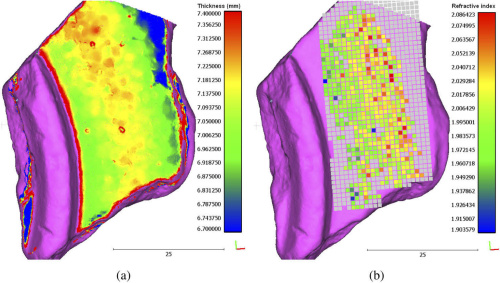
(a) Estimated thicknesses in mm and (b) refractive indices. Grey points show positions where the refractive index could not be calculated.

https://www.osapublishing.org/oe/abstract.cfm?uri=oe-28-15-22255

Imaging using terahertz time-domain spectroscopy is a valuable diagnostic tool for material inspection. However, in the case of samples with inhomogeneous shape and composition, the reliable extraction of spatially varying dielectric properties can be very challenging. Here, we demonstrate a new approach which combines THz-TDS with photogrammetric reconstruction. We show that this technique can be used to estimate the local refractive index of samples with a complex geometry. We employ this method to study samples of ancient pottery, and demonstrate that THz techniques can provide a valuable new tool for this branch of archaeological science.
© 2020 Optical Society of America under the terms of the OSA Open Access Publishing Agreement

Tuesday, April 28, 2020

Abstract-Single-shot link discovery for terahertz wireless networks


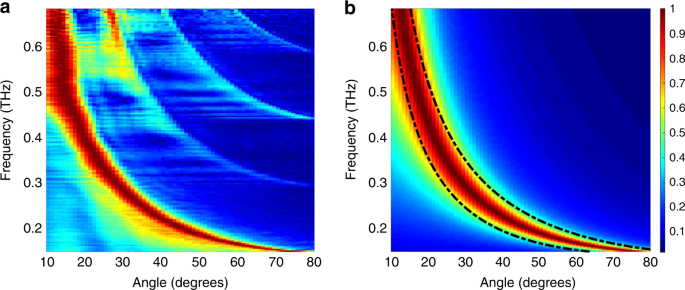
The spectrum of emitted radiation vs. emission angle.
https://www.nature.com/articles/s41467-020-15761-4

Of the many challenges in building a wireless network at terahertz frequencies, link discovery remains one of the most critical and least explored. In a network of mobile receivers using narrow directional beams, how do the nodes rapidly locate each other? This direction information is crucial for beam forming and steering, which are fundamental operations for maintaining link quality. As the carrier frequency increases into the terahertz range, the conventional methods used by existing networks become prohibitively time-consuming, so an alternative strategy is required. Using a leaky-wave antenna with a broadband transmitter, we demonstrate a single-shot approach for link discovery which can be accomplished much more rapidly. Our method relies on measurements of the width of a broad spectrum, and does not require any information about the phase of the received signal. This protocol, which relies on a detailed understanding of the radiation from leaky-wave devices, offers a realistic approach for enabling mobility in directional networks.

Sunday, November 25, 2018

Abstract-Electrically reconfigurable terahertz signal processing devices using liquid metal components


Kimberly S. Reichel, Nicolas Lozada-Smith, Ishan D. Joshipura, Jianjun Ma, Rabi Shrestha, Rajind Mendis, Michael D. Dickey, Daniel Mittleman,


https://www.nature.com/articles/s41467-018-06463-z

Many applications of terahertz (THz) technology require the ability to actively manipulate a free space THz beam. Yet, although there have been many reports on the development of devices for THz signal processing, few of these include the possibility of electrical control of the functionality, and novel ideas are needed for active and reconfigurable THz devices. Here, we introduce a new approach, based on the integration of electrically actuated liquid metal components in THz waveguides. This versatile platform offers many possibilities for control of THz spectral content, wave fron"ts, polarization, and power flow. We demonstrate two illustrative examples: the first active power-splitting switch, and the first channel add–drop filter. We show that both of these devices can be used to electrically switch THz communication signals while preserving the information in a high bit-rate-modulated data stream.

Wednesday, October 31, 2018

Study exposes security vulnerabilities in terahertz data links


InterceptedA new study shows that it's possible to steal data undetected from terahertz wireless links even though those links involved beam transmissions from transmitter to receiver.Mittleman Lab / Brown University
https://news.brown.edu/articles/2018/10/thzsecurity
Terahertz radiation may one day be used in wireless data networks that are many times faster than today's microwave networks. The conventional wisdom in the research community has been that, in addition to greater speed, terahertz data links would also have an inherent immunity to eavesdropping. Unlike microwaves, which travel in wide-angle broadcasts, terahertz waves travel directly from transmitter to receiver in narrow beams. The assumption was that it would be impossible to for an eavesdropper to intercept a terahertz signal without blocking some or all of the beam, which would be easily detected by an intended receiver. But new research finds that a clever eavesdropper can indeed steal terahertz signals undetected. In order for a link to be reliable, the beam's diameter must be slightly larger than the aperture of the receiver. That leaves a sliver of signal available for an attacker to steal without casting a shadow in a receiver. Credit: Mittleman lab / Brown University

Scientists have assumed that future terahertz data links would have an inherent immunity to eavesdropping, but new research shows that’s not necessarily the case.
PROVIDENCE, R.I. [Brown University] — A new study shows that terahertz data links, which may play a role in ultra-high-speed wireless data networks of the future, aren’t as immune to eavesdropping as many researchers have assumed. The research, published in the journal Nature, shows that it is possible for a clever eavesdropper to intercept a signal from a terahertz transmitter without the intrusion being detected at the receiver.
“The conventional wisdom in the terahertz community has been that it’s virtually impossible to spy on a terahertz data link without the attack being noticed,” said Daniel Mittleman, a professor in Brown University’s School of Engineering and a coauthor of the research. “But we show that undetected eavesdropping in the terahertz realm is easier than most people had assumed and that we need to be thinking about security issues as we think about designing network architectures.”
Because of its higher frequency, terahertz radiation can carry up to 100 times more data than the microwaves used in wireless communication today, which makes terahertz an attractive option for use in future wireless networks. Along with enhanced bandwidth, it has also been generally assumed that the way in which high-frequency waves propagate would naturally enhance security. Unlike microwaves, which propagate in wide-angle broadcasts, terahertz waves travel in narrow, very directional beams.
“In microwave communications, an eavesdropper can put an antenna just about anywhere in the broadcast cone and pick up the signal without interfering with the intended receiver,” Mittleman said. “Assuming that the attacker can decode that signal, they can then eavesdrop without being detected. But in terahertz networks, the narrow beams would mean that an eavesdropper would have to place the antenna between the transmitter and receiver. The thought was that there would be no way to do that without blocking some or all of the signal, which would make an eavesdropping attempt easily detectable by the intended receiver.”
Mittleman and colleagues from Brown, Rice University and the University at Buffalo set out to test that notion. They set up a direct line-of-site terahertz data link between a transmitter and receiver, and experimented with devices capable of intercepting signal. They were able show several strategies that could steal signal without being detected — even when the data-carrying beam is very directional, with a cone angle of less than 2 degrees (in contrast to microwave transmission, where the angle is often as large as 120 degrees).  
One set of strategies involves placing objects at the very edge of a beam that is capable of scattering a tiny portion of the beam. In order for a data link to be reliable, the diameter of the beam must be slightly larger than the aperture of the receiver. That leaves a sliver of signal for an attacker to work with without casting a detectable shadow on the receiver.
The researchers showed that a flat piece of metal could redirect a portion of the beam to a secondary receiver operated by an attacker. The researchers were able to acquire a usable signal at the second receiver with no significant loss of power at the primary receiver.
The team showed an even more flexible approach (from the attacker’s perspective) by using a metal cylinder in the beam instead of a flat plate.
“Cylinders have the advantage that they scatter light in all directions, giving an attacker more options in setting up a receiver,” said Josep Jornet, an assistant professor of electrical engineering at Buffalo and a study co-author. “And given the physics of terahertz wave propagation, even a very small cylinder can significantly scatter the signal without blocking the line-of-sight path.”
The researchers went on to demonstrate another type of attack involving a lossless beam splitter that would also be difficult, if not impossible, to detect. The beam splitter placed in front of a transmitter would enable an attacker to steal just enough to be useful, yet not so much that it would set off alarm bells among network administrators.
The bottom line, the researchers say, is that while there are inherent security enhancements associated with terahertz links in comparison with lower frequencies, these security improvements are still far from foolproof.
“Securing wireless transmission from eavesdroppers has been a challenge since the days of Marconi,” said Edward Knightly, professor of electrical and computer engineering at Rice University and a study coauthor. “While terahertz bands take a huge leap in this direction, we unfortunately found that a determined adversary can still be effective in intercepting the signal.”
The research was funded in part by the National Science Foundation, the Army Research Office, the Air Force Office of Scientific Research, and the W. M. Keck Foundation. Other coauthors on the paper were Jianjun Ma, Rabi Shrestha and Jacob Adelberg from Brown University; Chia-Yi Yeh and Edward Knightly from Rice University; and Zahed Hossain from Buffalo.

Tuesday, April 3, 2018

Researchers take terahertz data links around the bend


A new study shows terahertz data links are possible even without direct line-of-sight between transmitter and receiver, a promising finding for future ultra-high-capacity terahertz data networks.

(Terahertz testsIn an effort to better understand the architecture needed for future terahertz data networks, Brown University researchers investigate how terahertz waves propagate and bounce off of objects both indoors and out.Mittleman Lab / Brown University)
https://news.brown.edu/articles/2018/02/terahertz

PROVIDENCE, R.I. [Brown University] — An off-the-wall new study by Brown University researchers shows that terahertz frequency data links can bounce around a room without dropping too much data. The results are good news for the feasibility of future terahertz wireless data networks, which have the potential to carry many times more data than current networks.

Today’s cellular networks and Wi-Fi systems rely on microwave radiation to carry data, but the demand for more and more bandwidth is quickly becoming more than microwaves can handle. That has researchers thinking about transmitting data on higher-frequency terahertz waves, which have as much as 100 times the data-carrying capacity of microwaves. But terahertz communication technology is in its infancy. There’s much basic research to be done and plenty of challenges to overcome.

For example, it’s been assumed that terahertz links would require a direct line of sight between transmitter and receiver. Unlike microwaves, terahertz waves are entirely blocked by most solid objects. And the assumption has been that it’s not possible to bounce a terahertz beam around—say, off a wall or two—to find a clear path around an object.

“I think it’s fair to say that most people in the terahertz field would tell you that there would be too much power loss on those bounces, and so non-line-of-sight links are not going to be feasible in terahertz,” said Daniel Mittleman, a professor in Brown University’s School of Engineering and senior author of the new research published in APL Photonics. “But our work indicates that the loss is actually quite tolerable in some cases — quite a bit less than many people would have thought.”


(New research shows that non-line-of-site terahertz data links are possible because the waves can bounce off of walls without losing too much data.)

For the study, Mittleman and his colleagues bounced terahertz waves at four different frequencies off of a variety of objects—mirrors, metal doors, cinderblock walls and others — and measured the bit-error-rate of the data on the wave after the bounces. They showed that acceptable bit-error-rates were achievable with modest increases in signal power.

“The concern had been that in order to make those bounces and not lose your data, you’d need more power than was feasible to generate,” Mittleman said. “We show that you don’t need as much power as you might think because the loss on the bounce is not as much as you’d think.”

In one experiment, the researchers bounced a beam off two walls, enabling a successful link when transmitter and receiver were around a corner from each other, with no direct line-of-sight whatsoever. That’s a promising finding to support the idea of terahertz local-area networks.

“You can imagine a wireless network,” Mittleman explained, “where someone’s computer is connected to a terahertz router and there’s direct line-of-sight between the two, but then someone walks in between and blocks the beam. If you can’t find an alternative path, that link will be shut down. What we show is that you might still be able to maintain the link by searching for a new path that could involve bouncing off a wall somewhere. There are technologies today that can do that kind of path-finding for lower frequencies and there’s no reason they can’t be developed for terahertz.”

The researchers also performed several outdoor experiments on terahertz wireless links. An experimental license issued by the FCC makes Brown the only place in the country where outdoor research can be done legally at these frequencies. The work is important because scientists are just beginning to understand the details of how terahertz data links behave in the elements, Mittleman says.

Their study focused on what’s known as specular reflection. When a signal is transmitted over long distances, the waves fan out forming an ever-widening cone. As a result of that fanning out, a portion the waves will bounce off of the ground before reaching the receiver. That reflected radiation can interfere with the main signal unless a decoder compensates for it. It’s a well-understood phenomenon in microwave transmission. Mittleman and his colleagues wanted to characterize it in the terahertz range.  

They showed that this kind of interference indeed occurs in terahertz waves, but occurs to a lesser degree over grass compared to concrete. That’s likely because grass has lots of water, which tends to absorb terahertz waves. So over grass, the reflected beam is absorbed to a greater degree than concrete, leaving less of it to interfere with the main beam. That means that terahertz links over grass can be longer than those over concrete because there’s less interference to deal with, Mittleman says.

But there’s also an upside to that kind of interference with the ground.

“The specular reflection represents another possible path for your signal,” Mittleman said. “You can imagine that if your line-of-site path is blocked, you could think about bouncing it off the ground to get there.”

Mittleman says that these kinds of basic studies on the nature of terahertz data transmission are critical for understanding how to design the network architecture for future terahertz data systems.

Mittleman’s co-authors were Jianjun Ma, Rabi Shrestha and Lothar Moeller. The research was supported by the National Science Foundation and the W.M. Keck Foundation.

Tuesday, February 6, 2018

Researchers take terahertz data links around the bend


New research shows that non-line-of-site terahertz data links are possible because the waves can bounce off of walls without losing too much data CREDIT Mittleman lab / Brown University

PROVIDENCE, R.I. [Brown University] -- An off-the-wall new study by Brown University researchers shows that terahertz frequency data links can bounce around a room without dropping too much data. The results are good news for the feasibility of future terahertz wireless data networks, which have the potential to carry many times more data than current networks.
Today's cellular networks and Wi-Fi systems rely on microwave radiation to carry data, but the demand for more and more bandwidth is quickly becoming more than microwaves can handle. That has researchers thinking about transmitting data on higher-frequency terahertz waves, which have as much as 100 times the data-carrying capacity of microwaves. But terahertz communication technology is in its infancy. There's much basic research to be done and plenty of challenges to overcome.
For example, it's been assumed that terahertz links would require a direct line of sight between transmitter and receiver. Unlike microwaves, terahertz waves are entirely blocked by most solid objects. And the assumption has been that it's not possible to bounce a terahertz beam around--say, off a wall or two--to find a clear path around an object.
"I think it's fair to say that most people in the terahertz field would tell you that there would be too much power loss on those bounces, and so non-line-of-sight links are not going to be feasible in terahertz," said Daniel Mittleman, a professor in Brown University's School of Engineering and senior author of the new research published in APL Photonics. "But our work indicates that the loss is actually quite tolerable in some cases -- quite a bit less than many people would have thought."
For the study, Mittleman and his colleagues bounced terahertz waves at four different frequencies off of a variety of objects--mirrors, metal doors, cinderblock walls and others -- and measured the bit-error-rate of the data on the wave after the bounces. They showed that acceptable bit-error-rates were achievable with modest increases in signal power.
"The concern had been that in order to make those bounces and not lose your data, you'd need more power than was feasible to generate," Mittleman said. "We show that you don't need as much power as you might think because the loss on the bounce is not as much as you'd think."
In one experiment, the researchers bounced a beam off two walls, enabling a successful link when transmitter and receiver were around a corner from each other, with no direct line-of-sight whatsoever. That's a promising finding to support the idea of terahertz local-area networks.
"You can imagine a wireless network," Mittleman explained, "where someone's computer is connected to a terahertz router and there's direct line-of-sight between the two, but then someone walks in between and blocks the beam. If you can't find an alternative path, that link will be shut down. What we show is that you might still be able to maintain the link by searching for a new path that could involve bouncing off a wall somewhere. There are technologies today that can do that kind of path-finding for lower frequencies and there's no reason they can't be developed for terahertz."
The researchers also performed several outdoor experiments on terahertz wireless links. An experimental license issued by the FCC makes Brown the only place in the country where outdoor research can be done legally at these frequencies. The work is important because scientists are just beginning to understand the details of how terahertz data links behave in the elements, Mittleman says.
Their study focused on what's known as specular reflection. When a signal is transmitted over long distances, the waves fan out forming an ever-widening cone. As a result of that fanning out, a portion the waves will bounce off of the ground before reaching the receiver. That reflected radiation can interfere with the main signal unless a decoder compensates for it. It's a well-understood phenomenon in microwave transmission. Mittleman and his colleagues wanted to characterize it in the terahertz range.
They showed that this kind of interference indeed occurs in terahertz waves, but occurs to a lesser degree over grass compared to concrete. That's likely because grass has lots of water, which tends to absorb terahertz waves. So over grass, the reflected beam is absorbed to a greater degree than concrete, leaving less of it to interfere with the main beam. That means that terahertz links over grass can be longer than those over concrete because there's less interference to deal with, Mittleman says.
But there's also an upside to that kind of interference with the ground.
"The specular reflection represents another possible path for your signal," Mittleman said. "You can imagine that if your line-of-site path is blocked, you could think about bouncing it off the ground to get there."
Mittleman says that these kinds of basic studies on the nature of terahertz data transmission are critical for understanding how to design the network architecture for future terahertz data systems.
###
Mittleman's co-authors were Jianjun Ma, Rabi Shrestha and Lothar Moeller. The research was supported by the National Science Foundation and the W.M. Keck Foundation.