Showing posts with label X. Zhang. Show all posts

Saturday, April 21, 2018

Toward Control of Spin States for Molecular Electronics


https://als.lbl.gov/toward-control-spin-states-molecular-electronics/

SCIENTIFIC ACHIEVEMENT

Researchers demonstrated, via x-ray absorption spectroscopy, that a molecule’s spin state can be reversibly switched at constant room temperature by magnetism.

SIGNIFICANCE AND IMPACT

The results represent a major step toward the goal of programmable, nanoscale molecular electronics for high-speed, low-power, logic and memory applications.
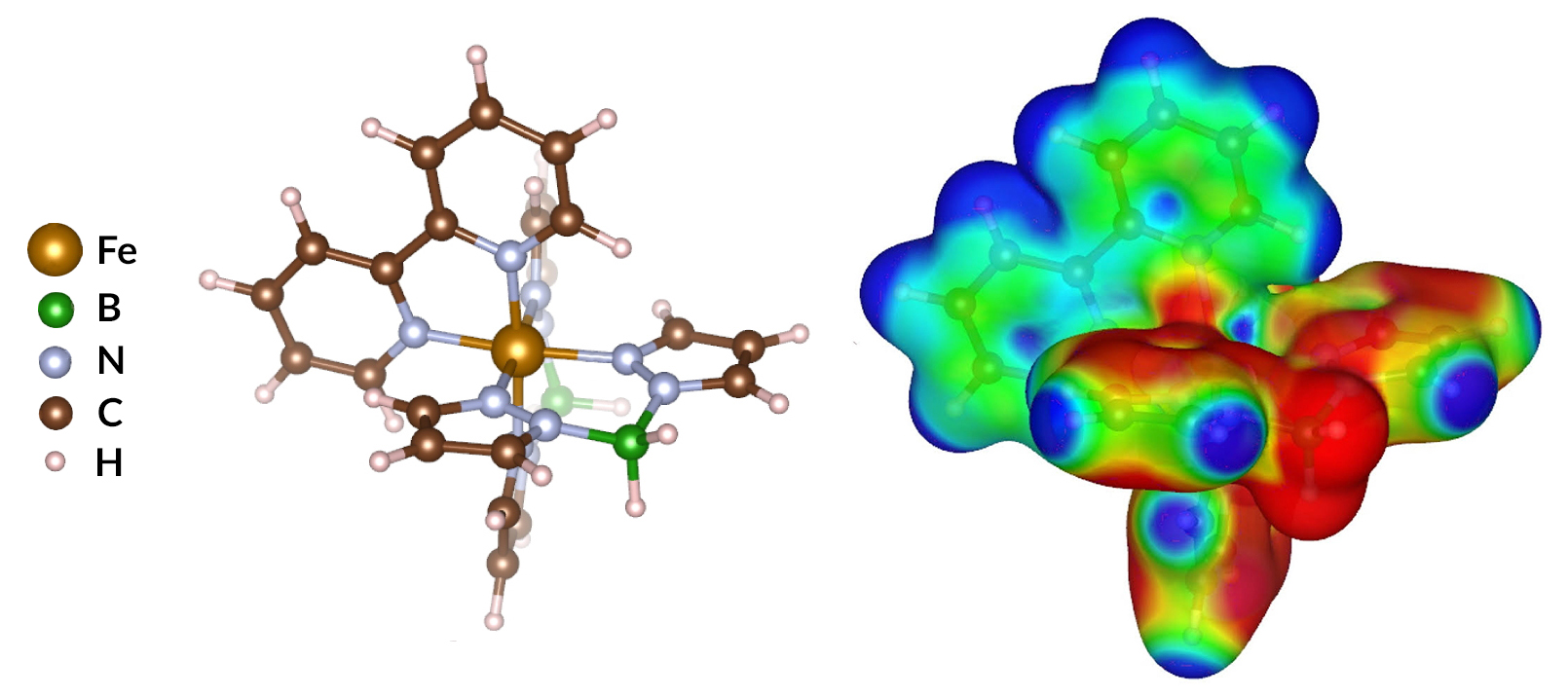
The molecule studied in this work is a metal–organic coordination complex, i.e., a molecule with a transition metal (iron) at the center, surrounded by organic compounds (“ligands”). The molecular formula is [Fe{H2B(pz)2}2(bipy)], where pz = pyrazol-1-yl and bipy = 2,2′-bipyridine. Left: Ball-and-stick model. Right: Ball-and-stick model with a map of the computed electrostatic potential (red = electron-rich areas, blue = electron-poor areas).

Downsizing: How low can we go?

To squeeze more information into smaller spaces, we will need to downsize from microchips to the nanoscale: the molecular level. Compared to bulk silicon, organic molecules have many advantages when used as building blocks for memory and logic components. They can be implemented as flexible thin films, they can be easily printed, and their potential switching speed is high, while their power requirements are low. But the field of molecular spintronics is still very young, and before its promise can be realized, scientists need a fuller understanding of the fundamental physics in play.

A molecule with crossover appeal
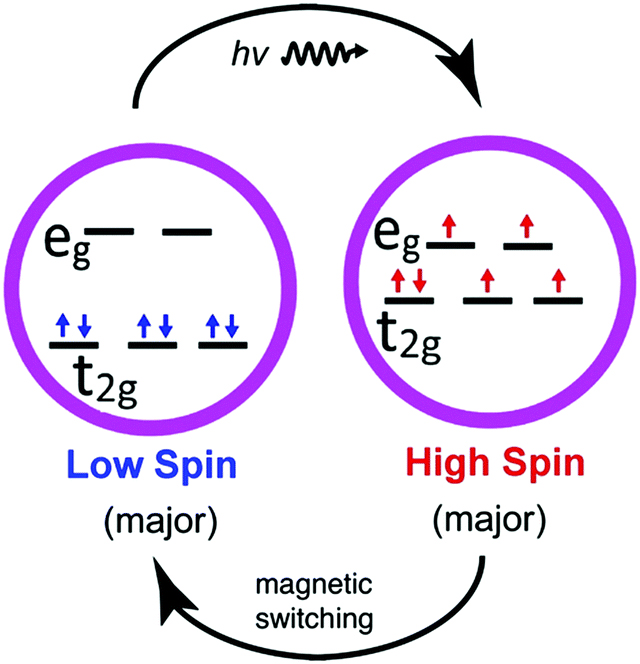
Reversible control of the spin state of [Fe{H2B(pz)2}2(bipy)]. X-ray irradiation (hν) can transform the low-spin state into the high-spin state, and, as revealed in this work, an oscillating substrate magnetization can cause the system to relax into a low-spin configuration.
In the molecule studied here—[Fe{H2B(pz)2}2(bipy)]—the spin state is determined by the configuration of the central metal’s outer electrons (i.e., the Fe d-orbital electrons). The presence of the surrounding organic ligands splits the Fe d orbitals. If the splitting is large, the electrons will pair up in the lower orbitals (a low-spin state). If the splitting is small, the electrons can spread out over both levels (a high-spin state). For some classes of molecules, transitions from low- to high-spin states (and vice versa) can be triggered. This “spin crossover” phenomenon is a promising functionality that may be suitable for application in molecular spintronic devices.
For memory applications, there is a strong need to identify mechanisms to lock and unlock the spin state. Previous work had shown that the spin state of [Fe(H2B(pz)2)2(bipy)] can be locked in a largely low-spin configuration up to temperatures well above its thermal spin crossover temperature (160 K), by appropriate design of the molecule’s electrostatic and chemical environment (e.g., growing thin films of the molecule on a nonconducting oxide substrate). It was also found that exposure to x-rays excites the “locked” low-spin system to a high-spin state, and heating slightly above room temperature restores the low-spin state. Ultimately, the goal is direct control of the spin state via an external voltage at constant room temperature.

A missing link: magnetoelectric coupling

In this work, the researchers explored how the spin state of thin-film [Fe(H2B(pz)2)2(bipy)], grown on various substrates, is affected by an oscillating magnetic field. At ALS Beamline 6.3.1, x-ray absorption spectroscopy (XAS) measurements were performed at the Fe L3 and L2 edges.
The results showed that, on a substrate of NiCo2O4, alternating the direction of the magnetic field assists in the relaxation of the excited high-spin state, even with continued x-ray irradiation of the sample. However, on a substrate of La0.67Sr0.33MnO3 (LSMO), relaxation under the oscillating magnetic field only occurred in the absence of the x-ray beam—evidence that magnetic coupling with the substrate is involved. More specifically, coupling of the substrate’s local magnetic moment with the ligand electrostatic field is somehow involved in reversing the molecular spin state.
This work affirms that metal–organic molecular complexes allow the possibility of nanometer-scale, low-power, high-speed, magnetoelectric logic or memory devices. In addition, the work reveals very interesting physics that calls for further investigation, both experimentally and with advances in theory.
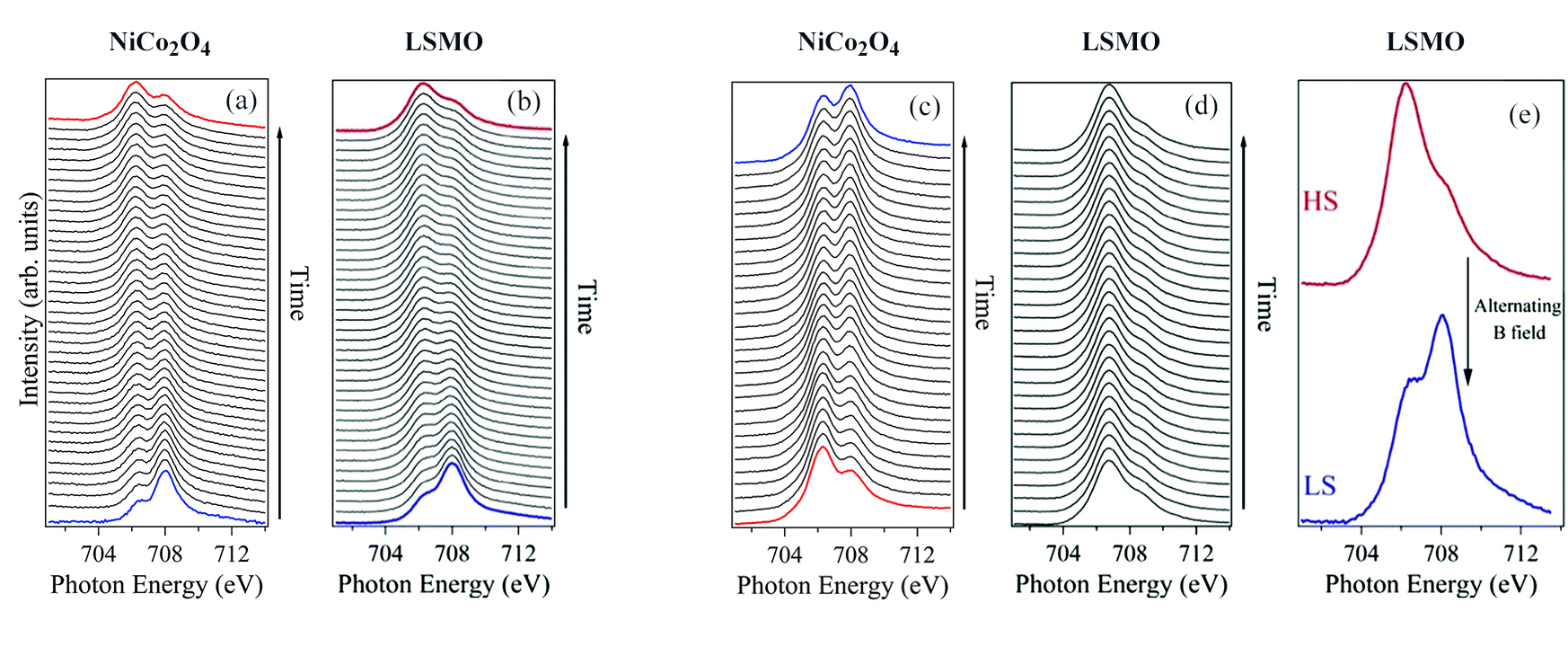
X-ray absorption spectra for thin films of [Fe{H2B(pz)2}2(bipy)] on substrates of NiCo2O4 and LSMO. (a-b) On both substrates, the sample transitioned from a low-spin state (blue curve, peak at 708 eV) to a high-spin state (red curve, peak at 706.5 eV) when exposed to soft x-rays at constant room temperature. (c) On the NiCo2O4 substrate, the sample relaxed from high to low spin in an alternating magnetic field. (d) On the LSMO substrate, however, the sample remained in the high-spin state despite the alternating magnetic field. (e) De-excitation in an oscillating magnetic field did occur in the LSMO in the absence of the x-ray beam.
Contact: Peter Dowben
Researchers: X. Zhang, X. Jiang, X. Zhang, Y. Yin, X. Chen, X. Hong, X. Xu, and P.A. Dowben (University of Nebraska) and A.T. N’Diaye (ALS).
Funding: National Science Foundation. Operation of the ALS is supported by the U.S. Department of Energy, Office of Science, Basic Energy Sciences Program (DOE BES).
Publication: X. Zhang, A.T. N’Diaye, X. Jiang, X. Zhang, Y. Yin, X. Chen, X. Hong, X. Xu, and P.A. Dowben, “Indications of magnetic coupling effects in spin cross-over molecular thin films,” Chem. Commun. 54, 944 (2018), doi:10.1039/C7CC08246K.

Tuesday, February 20, 2018

Abstract-Detecting the propagation effect of terahertz wave inside the two-color femtosecond laser filament in the air


J. Zhao, X. Zhang, S. Li, C. Liu, Y. Chen, Y Peng, Y. Zhu,

https://link.springer.com/article/10.1007/s00340-018-6913-1

In this work, to decide the existence of terahertz (THz) wave propagation effect, THz pulses emitted from a blocked two-color femtosecond laser filament with variable length were recorded by a standard electric–optic sampling setup. The phenomenon of temporal advance of the THz waveform’s peak with the increasing filament length has been observed. Together with another method of knife-edge measurement which aims at directly retrieving the THz beam diameter, both the experimental approaches have efficiently indicated the same filament range within which THz wave propagated inside the plasma column. At last, a preliminary two-dimensional near-field scanning imaging of the THz spot inside the cross section of the filament has been suggested as the third way to determine the issue of THz wave propagation effect.

Friday, January 26, 2018

Abstract-Identifying the perfect absorption of metamaterial absorbers


G. Duan, J. Schalch, X. Zhao, J. Zhang, R. D. Averitt, and X. Zhang


We present a detailed analysis of the conditions that result in unity absorption in metamaterial absorbers to guide the design and optimization of this important class of functional electromagnetic composites. Multilayer absorbers consisting of a metamaterial layer, dielectric spacer, and ground plane are specifically considered. Using interference theory, the dielectric spacer thickness and resonant frequency for unity absorption can be numerically determined from the functional dependence of the relative phase shift of the total reflection. Further, using transmission line theory in combination with interference theory we obtain analytical expressions for the unity absorption resonance frequency and corresponding spacer layer thickness in terms of the bare resonant frequency of the metamaterial layer and metallic and dielectric losses within the absorber structure. These simple expressions reveal a redshift of the unity absorption frequency with increasing loss that, in turn, necessitates an increase in the thickness of the dielectric spacer. The results of our analysis are experimentally confirmed by performing reflection-based terahertz time-domain spectroscopy on fabricated absorber structures covering a range of dielectric spacer thicknesses with careful control of the loss accomplished through water absorption in a semiporous polyimide dielectric spacer. Our findings can be widely applied to guide the design and optimization of the metamaterial absorbers and sensors.
  • Figure
  • Figure
  • Figure
  • Figure
  • Figure
  • Figure

Monday, October 26, 2015

Abstract-The dynamic process and microscopic mechanism of extraordinary terahertz transmission through perforated superconducting films


http://www.nature.com/articles/srep15588

Superconductor is a compelling plasmonic medium at terahertz frequencies owing to its intrinsic low Ohmic loss and good tuning property. However, the microscopic physics of the interaction between terahertz wave and superconducting plasmonic structures is still unknown. In this paper, we conducted experiments of the enhanced terahertz transmission through a series of superconducting NbN subwavelength hole arrays, and employed microscopic hybrid wave model in theoretical analysis of the role of hybrid waves in the enhanced transmission. The theoretical calculation provided a good match of experimental data. In particular, we obtained the following results. When the width of the holes is far below wavelength, the enhanced transmission is mainly caused by localized resonance around individual holes. On the contrary, when the holes are large, hybrid waves scattered by the array of holes dominate the extraordinary transmission. The surface plasmon polaritions are proved to be launched on the surface of superconducting film and the excitation efficiency increases when the temperature approaches critical temperature and the working frequency goes near energy gap frequency. This work will enrich our knowledge on the microscopic physics of extraordinary optical transmission at terahertz frequencies and contribute to developing terahertz plasmonic devices.

Friday, August 29, 2014

Abstract-Structural control of metamaterial oscillator strength and electric field enhancement at terahertz frequencies


The design of artificial nonlinear materials requires control over internal resonant charge densities and local electric field distributions. We present a MM design with a structurally controllable oscillator strength and local electric field enhancement at terahertz frequencies. The MM consists of a split ring resonator (SRR) array stacked above an array of closed conducting rings. An in-plane, lateral shift of a half unit cell between the SRR and closed ring arrays results in an increase of the MM oscillator strength by a factor of 4 and a 40% change in the amplitude of the resonant electric field enhancement in the SRR capacitive gap. We useterahertz time-domain spectroscopy and numerical simulations to confirm our results. We show that the observed electromagnetic response in this MM is the result of image chargesand currents induced in the closed rings by the SRR.