A repository & source of cutting edge news about emerging terahertz technology, it's commercialization & innovations in THz devices, quality & process control, medical diagnostics, security, astronomy, communications, applications in graphene, metamaterials, CMOS, compressive sensing, 3d printing, and the Internet of Nanothings. NOTHING POSTED IS INVESTMENT ADVICE! REPOSTED COPYRIGHT IS FOR EDUCATIONAL USE.
Showing posts with label Rimvydas Venckevičius. Show all posts
Thursday, December 6, 2018
Abstract-Spectroscopic Analysis of Melatonin in the Terahertz Frequency Range
Uroš Puc, Andreja Abina, Anton Jeglič, Aleksander Zidanšek, Irmantas Kašalynas, Rimvydas Venckevičius, Gintaras Valušis,
https://www.mdpi.com/search?article_type=&authors=&journal=sensors&q=terahertz&search=Search§ion=&special_issue=
There is a need for fast and reliable quality and authenticity control tools of pharmaceutical ingredients. Among others, hormone containing drugs and foods are subject to scrutiny. In this study, terahertz (THz) spectroscopy and THz imaging are applied for the first time to analyze melatonin and its pharmaceutical product Circadin. Melatonin is a hormone found naturally in the human body, which is responsible for the regulation of sleep-wake cycles. In the THz frequency region between 1.5 THz and 4.5 THz, characteristic melatonin spectral features at 3.21 THz, and a weaker one at 4.20 THz, are observed allowing for a quantitative analysis within the final products. Spectroscopic THz imaging of different concentrations of Circadin and melatonin as an active pharmaceutical ingredient in prepared pellets is also performed, which permits spatial recognition of these different substances. These results indicate that THz spectroscopy and imaging can be an indispensable tool, complementing Raman and Fourier transform infrared spectroscopies, in order to provide quality control of dietary supplements and other pharmaceutical product
Tuesday, September 19, 2017
Abstract-Compact solutions for spectroscopic solid-state-based terahertz imaging systems
Rimvydas Venckevičius, Linas Minkevičius, Antanas Reklaitis, Vincas Tamošiūnas, Irmantas Kašalyns, Domas Jokubauskis, Dalius Seliuta, Bogdan Voisiat, Gediminas Račiukaitis, Gintaras Valušis,
https://www.spiedigitallibrary.org/conference-proceedings-of-spie/10383/103830S/Compact-solutions-for-spectroscopic-solid-state-based-terahertz-imaging-systems/10.1117/12.2273353.short
Convenience in use of room-temperature terahertz (THz) imaging systems, reduction of their dimensions and presence of on-chip solutions remains one of prime interests for direct implementation aims. Solid-state-based solutions in miniaturization of spectroscopic THz imaging systems including novel semiconductor nanostructures bias-free emitters, diffractive THz optics components and their on-chip integration with THz detectors are discussed. In particular, pulsed optoelectronic terahertz emitter based on a δ-doped p-i-n-i GaAs/AlxGa1−xAs heterostructure was studied and it is demonstrated that the heterostructure can serve as efficient antenna- and bias-free surface emitter. Diffractive optics elements – Fresnel zone plates –with integrated band-pass filters were simulated employing Finite-difference time domain method. Structures were fabricated using the laser direct writing and investigated using electronic THz sources and an optically pumped terahertz laser. Advantages of on-chip integration of diffractive optics and bow-tie-shaped InGaAs-based terahertz detectors are revealed via detection enhancement. Bow-tie diodes properties in frequency scale and detection sensitivity are considered and compared for different materials. Homodyne detection and imaging of low-absorbing objects at 0.6 THz are demonstrated and discussed.
© (2017) COPYRIGHT Society of Photo-Optical Instrumentation Engineers (SPIE). Downloading of the abstract is permitted for personal use only.
Saturday, March 26, 2016
Abstract-Spectroscopic Terahertz Imaging at Room Temperature Employing Microbolometer Terahertz Sensors and Its Application to the Study of Carcinoma Tissues
Irmantas Kašalynas 1,* , Rimvydas Venckevičius 1
, Linas Minkevičius 1
, Aleksander Sešek 2
,Faustino Wahaia 3
, Vincas Tamošiūnas 1
, Bogdan Voisiat 1
, Dalius Seliuta 1
, Gintaras Valušis 1
,Andrej Švigelj 2
and Janez Trontelj 2
1 Department of Optoelectronics, Center for Physical Sciences and Technology, Savanoriu Ave. 231, Vilnius 02300, Lithuania2 Faculty of Electrical Engineering, University of Ljubljana, Trzaska 25, Ljubljana 1000, Slovenia3 Instituto de Investigacao e Inovacao em Saudeand, Instituto de Engenharia Biomedica, University of Porto, Rua do Campo Alegre, 823, Porto 4150-180, Portugal
* Author to whom correspondence should be addressed.
Academic Editors: Dragan Indjin and Vincenzo Spagnolo
Received: 6 February 2016 / Revised: 4 March 2016 / Accepted: 18 March 2016 / Published: 25 March 2016
A terahertz (THz) imaging system based on narrow band microbolometer sensors (NBMS) and a novel diffractive lens was developed for spectroscopic microscopy applications. The frequency response characteristics of the THz antenna-coupled NBMS were determined employing Fourier transform spectroscopy. The NBMS was found to be a very sensitive frequency selective sensor which was used to develop a compact all-electronic system for multispectral THz measurements. This system was successfully applied for principal components analysis of optically opaque packed samples. A thin diffractive lens with a numerical aperture of 0.62 was proposed for the reduction of system dimensions. The THz imaging system enhanced with novel optics was used to image for the first time non-neoplastic and neoplastic human colon tissues with close to wavelength-limited spatial resolution at 584 GHz frequency. The results demonstrated the new potential of compact RT THz imaging systems in the fields of spectroscopic analysis of materials and medical diagnostics.
Tuesday, February 23, 2016
‘Color’ photography at terahertz frequencies
Rimvydas Venckevičius, Irmantas Kašalynas and Gintaras Valušis
Terahertz images obtained with solid-state-based sensors at different frequencies can be used to analyze the chemical content of packaged materials when the spectra are known a priori.
22 February 2016, SPIE Newsroom. DOI: 10.1117/2.1201601.006285
Color photography is now a ubiquitous part of everyday life, where compact and convenient cameras integrated within mobile phones are the main tool for recording high-resolution and high-sensitivity pictures. In general, these devices include complementary CMOS-based CCD cameras. For non-visible light regions of the electromagnetic spectrum, however, colored photographs cannot be taken with a CCD camera. Such wavelength ranges include the terahertz (THz) region, i.e., 0.1–10THz. THz imaging systems therefore exist mainly in scientific laboratories. Furthermore, very specific conditions are required to record THz images. This is because the THz quantum is too small (a 1THz quantum has an energy of 4.1meV) to be used (at room temperature) in imaging systems that are based on quantum mechanical structures, whereas THz frequencies are higher than can be reached through conventional carrier transport in the solid state.
THz imaging is a powerful tool for many non-invasive inspection applications, e.g., non-destructive material testing,1 identifying the chemical composition of drugs,2, 3and non-invasive screening of biological tissues.4 In addition, this technique can be used for the development of THz security systems, such as screening for illicit objects in packages or for concealed weapons on people.5 As a rule, the materials can be identified optically via spectral measurements. In the THz region, however—and especially when the objects are packaged or hidden under clothing—such spectral measurements are complicated by additional scattering caused by the packaging. It is therefore desirable to avoid direct spectral recording during the identification of materials.
In this work, we describe our innovative development of solid-state-based sensors (and their arrays) that operate at room temperature in spectroscopic THz imaging systems. We show that THz images obtained at different frequencies (‘colored’ THz photographs) can be used to identify the content of packaged materials if their spectra are known a priori. We have focused on the solid-state approach because it permits a large number of possibilities for the design and fabrication of compact systems. The physical principles of solid-state detection also mean that operation at room temperature is not a restricting factor for optimal device operation. In our approach, we require a monochromatic THz emission source and a sensitive detection system to obtain THz snapshots at different frequencies. We can operate these in either the broadband sensing regime (with a tunability option) or in specially designed sensors that enable detection at selected frequencies.
To illustrate the performance and possibilities of our spectroscopic THz imaging technique and to obtain THz snapshots at different frequencies, we prepared samples that contained tartaric acid (TA) and sucrose (SC) as simulators of explosive materials. We prepared three different samples in which we mixed polytetrafluoroethylene (PTFE) powder with 10% TA, 10% SC, and 5% of both TA and SC, respectively. We then applied pressure and formed pellets with thickness of 1.4mm and diameter of 13mm. We also prepared a pure PTFE pellet for reference purposes. The samples were then placed in a metallic frame so that we could conduct free standing measurements—see Figure 1(a)—and packed inside a 4mm-thick high-density polyethylene (HDPE) container, as shown in Figure 1(b).
Figure 1. Photographs of pellet samples containing a mixture of polytetrafluoroethylene (PTFE), tartaric acid, and sucrose. Samples are shown (a) arranged in a free standing geometry for measurements and (b) within a 4mm-thick high-density polyethylene (HDPE) container (top removed).6
We used a customized vacuum Fourier spectrometer to measure the transmittance of the samples (see Figure 2). Our results show that the pellets containing TA and SC have spectral signatures in the 0.6–3.3THz frequency range, which are very similar to the signatures of real explosives. In addition, samples with a SC or TA content of 10% or more can be distinguished—because of the different absorptions of the two components—by obtaining images at discrete frequencies (e.g., 0.762, 1.84, or 2.52THz).
Figure 2. Absorption spectra of tartaric acid and sucrose within a PTFE matrix, as measured using a customized vacuum Fourier spectrometer. Arrows mark the emission frequencies of the optically pumped molecular terahertz (THz) laser.
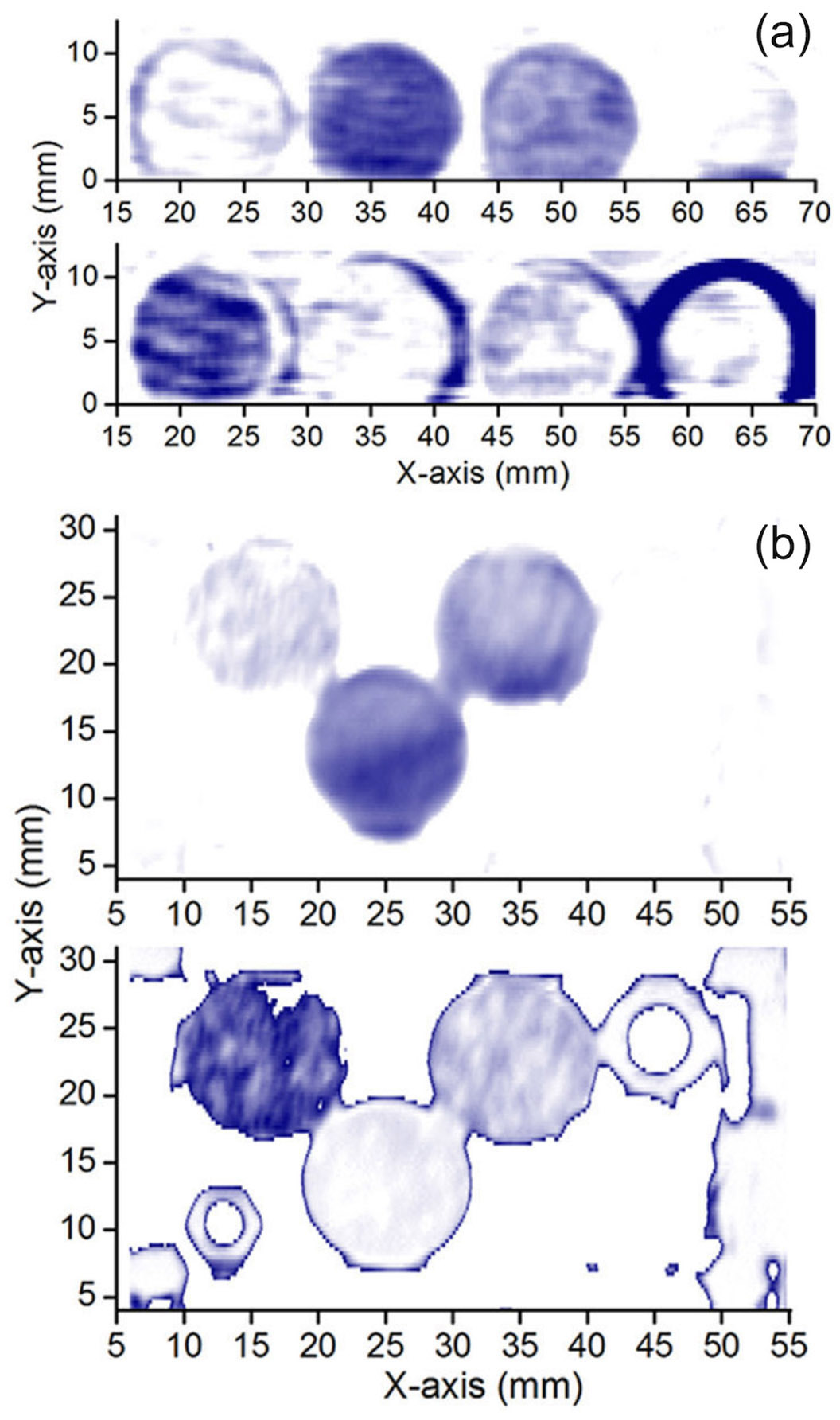
To demonstrate the acquisition of THz snapshots at different frequencies, we used indium gallium arsenide (InGaAs) bow-tie diodes. These are planar asymmetrically shaped structures, where one of the two semiconductor leaves is metallized and the other is left to be semiconducting. The metallic leaf concentrates the incident THz radiation in the vicinity of the apex. This induces an inhomogeneous electric field, which then heats electrons in the semiconductor leaf non-uniformly and generates a DC voltage signal.7 Such devices exhibit broadband operation7 and fast response times,8 and can thus be used for spectroscopic THz imaging.9 Our recorded snapshots (see Figure 3) show that the ‘colors’ and ‘shadows’ of the pellets are different (at absorbances of 0.762THz and 1.84THz). This indicates that the images are sensitive to the chemical composition of the samples.
Figure 3. Spectroscopic THz images (‘colored’ THz photographs) of the pellet samples obtained at a frequency of (a) 0.762THz and (b) 1.84THz.
We also used a principal component analysis to determine the distribution of the ingredients (on a percentage scale) within the pellets.6 For instance, the SC and TA distribution is shown in Figure 4. By defining the range of interest, we estimated that the SC content was 9.9±0.7% and 6.1±0.8% for samples 2 and 3, respectively, and that the TA content was 10.1±1.4% and 2.5±1.3% for sample 1 and 3, respectively (refer also to Figure 1). We note that there are some interference effects that are caused by the packaging of the samples (i.e., a container that is opaque to visible light). We are thus able to determine the chemical composition of the materials with reasonable accuracy—without direct spectral measurements—if the spectrum of the object or material is known a priori, and the discrete frequency THz imaging system is optimized to characteristic lines.
We can operate the bow-tie diodes in a heterodyne imaging mode and thus achieve high detection sensitivity.10 With the aim of implementing our concept into direct applications and compact camera designs, we fabricated arrays of the bow-ties for THz imaging.11 We have also recently demonstrated the enhanced performance of these bow-tie sensors and on-chip integration of optical focusing components (zone plates).12 Our results indicated that commercially available CMOS technology can be well-suited for solid-state-based spectroscopic THz imaging. In this approach, plasmonic effects in nanometric field effect transistors coupled with resonant antennas are used as the detection principle. We also showed that it is possible to overcome limitations set by carrier momentum relaxation time—which is inherent to bow-tie diodes—and thus extend the THz snapshots recording scale to 4.25THz.13
In summary, we developed new solid-state-based sensors that can be operated at room temperature for spectroscopic THz imaging purposes. We also obtained THz photographs at different frequencies to demonstrate the viability of our technique. Our results show that it is possible to determine the chemical composition of packaged samples if their spectra are known a priori. In our work, we are currently focused on the optimal design and fabrication of the on-chip integrated compact THz imaging system for spectroscopic needs. We aim to demonstrate the performance of the system by imaging biomedical tissues, and to provide increased depth sensitivity and better spatial resolution.
Rimvydas Venckevičius, Irmantas Kašalynas, Gintaras Valušis
Center for Physical Sciences and Technology
Vilnius, Lithuania
Rimvydas Venckevičius has been a researcher in the Optoelectronics Department since 2009. His current research interests include terahertz imaging, Fourier spectroscopy, and carrier transport investigations in semiconductor superlattices.
Irmantas Kašalynas is a senior research associate in the Optoelectronics Department and is the leader of the Terahertz Photonics Laboratory. His current research interests cover compact room-temperature terahertz and sub-terahertz radiation detectors and sources, passive filters, and plasmon resonance devices.
Gintaras Valušis is currently the director of the Center for Physical Sciences and Technology, and is a professor in the Semiconductors Physics Department at Vilnius University. His current research interests include terahertz physics, as well as spectroscopy and physics of semiconductor devices.
References:
1. N. Krumbholz, T. Hochrein, N. Vieweg, T. Hasek, K. Kretschmer, M. Bastian, M. Mikulics, M. Koch, Monitoring polymeric compounding processes inline with THz time-domain spectroscopy, Polym. Test. 28, p. 30-35, 2009.
2. B. Fischer, M. Hoffmann, H. Helm, G. Modjesch, P. U. Jepsen, Chemical recognition in terahertz time-domain spectroscopy and imaging, Semicond. Sci. Technol. 20, p. S246-S253, 2005.
3. A. G. Davies, A. D. Burnett, W. Fan, E. H. Linfield, J. E. Cunningham, Terahertz spectroscopy of explosives and drugs, Mater. Today 11, p. 18-26, 2008.
4. F. Wahaia, G. Valusis, L. M. Bernardo, A. Almeida, J. A. Moreira, P. C. Lopes, J. Macutkevic, et al., Detection of colon cancer by terahertz techniques, J. Molec. Struct.1006, p. 77-82, 2011.
5. F. Friederich, W. von Spiegel, M. Bauer, F. Meng, M. D. Thomson, S. Boppel, A. Lisauskas, et al., THz active imaging systems with real-time capabilities, IEEE Trans. Terahertz Sci. Technol. 1, p. 183-200, 2011.
6. I. Kašalynas, R. Venckevičius, G. Valušis, Continuous wave spectroscopic terahertz imaging with InGaAs bow-tie diodes at room temperature, IEEE Sensors J. 13, p. 50-54, 2013.
7. D. Seliuta, I. Kašalynas, V. Tamošiǔnas, S. Balakauskas, Z. Martunas, S. Asmontas, G. Valušis, A. Lisauskas, H. G. Roskos, K. Kohler, Silicon lens-coupled bow-tie InGaAs-based broad band terahertz sensor operating at room temperature, Electron. Lett. 42, p. 825-827, 2006.
8. I. Kašalynas, D. Seliuta, R. Simniškis, V. Tamošiunas, K. Kohler, G. Valušis, Terahertz imaging with bow-tie InGaAs-based diode with broken symmetry, Electron. Lett. 45, p. 833-835, 2009. doi:10.1049/el.2009.0336
9. I. Kašalynas, R. Venckevičius, D. Seliuta, I. Grigelionis, G. Valušis, InGaAs-based bow-tie diode for spectroscopic terahertz imaging, J. Appl. Phys. 110(114505), 2011.doi:10.1063/1.3658017
10. L. Minkevičius, V. Tamošiūnas, I. Kašalynas, D. Seliuta, G. Valušis, A. Lisauskas, S. Boppel, H. G. Roskos, K. Köhler, Terahertz heterodyne imaging with InGaAs-based bow-tie diodes, Appl. Phys. Lett. 99(131101), 2011. doi:10.1063/1.3641907
11. L. Minkevičius, K. Madeikis, I. Kašalynas, R. Venckevičius, D. Seliuta, V. Tamošiūnas, G. Valušis, Discrete spectrum terahertz imaging using bow-tie diodes: optimized antenna designs and arrays, Proc. SPIE 8846, p. 88460P, 2013. doi:10.1117/12.2023887
12. L. Minkevičius, V. Tamošiūnas, K. Madeikis, B. Voisiat, I. Kašalynas, G. Valušis, On-chip integration of laser-ablated zone plates for detection enhancement of InGaAs bow-tie terahertz detectors, Electron. Lett. 50, p. 1367-1369, 2014.
13. M. Bauer, R. Venckevičius, I. Kašalynas, S. Boppel, M. Mundt, L. Minkevičius, A. Lisauskas, G. Valušis, V. Krozer, H. G. Roskos, Antenna-coupled field-effect transistors for multi-spectral terahertz imaging up to 4.25THz, Opt. Express 22, p. 19235-19241, 2014.
Wednesday, January 8, 2014
Abstract-Exploration of Terahertz Imaging with Silicon MOSFETs
Subscribe to:
Posts (Atom)