Showing posts with label Irmantas Kašalynas. Show all posts

Tuesday, August 11, 2020

Abstract-Terahertz time-domain spectroscopy of two-dimensional plasmons in AlGaN/GaN heterostructures

Publisher Logo


Daniil PashnevTommi KaplasVadym KorotyeyevVytautas JanonisAndrzej Urbanowicz, Justinas Jorudas, Irmantas Kašalynas

THz waveforms measured after transmission through a cryostat without (reference) and with (SP1000F50) the sample and (b) corresponding FFT power spectra obtained using the time window tcut2. (c) Transmission power spectrum T1(f) found using the time window tcut2 and tcut1 providing data with (w/) and without (w/o) FP oscillations, respectively.

https://aip.scitation.org/doi/abs/10.1063/5.0014977

Two-dimensional plasmons were investigated by terahertz time domain spectroscopy observing experimentally the distinctive minima and inflection points in the transmission power amplitude and phase spectra, respectively. Gratings of different periods (600, 800, and 1000 nm) and filling factors (50 and 80%) were provided to the two-dimensional electron gas in AlGaN/GaN heterostructures in order to measure the plasmon dispersion and the coupling efficiency with THz radiation. Comparative analysis of experimental data revealed that the resonant plasmon features in the amplitude spectrum are related to those in the phase spectrum by a simple integral relation, paving the way for phase spectroscopy of the plasmon phenomena in fields of THz physics and engineering.
This work was supported by the Research Council of Lithuania (Lietuvos mokslo taryba) under the “TERAGANWIRE” Project (Grant No. S-LL-19-1).

Wednesday, January 29, 2020

Abstract-Terahertz Spectroscopy of Thermal Radiation from AlGaN/GaN Heterostructure on Sapphire at Low Temperatures


Ignas Grigelionis and Irmantas Kašalynas

https://res.mdpi.com/d_attachment/applsci/applsci-10-00851/article_deploy/applsci-10-00851.pdf

Terahertz spectroscopy of thermal radiation from electrically pumped AlGaN/GaN
structures on sapphire substrate was investigated in this work. Comparison of experimental THz spectroscopy results to theoretical spectra calculations shows that thermal radiation of the sample lattice is the main mechanism causing the emission above T = 155 K, and it is mainly influenced by sapphire substrate. Here, the emission was attributed to the radiative electron transitions in shallow impurities and nitrogen vacancies as well as to radiative decay of longitudinal optical phonons (387 cm−1) in sapphire substrate. We have successfully demonstrated that THz emission spectroscopy can be used to define the temperature at which thermal emission from AlGaN/GaN HEMT structures dominates the emission spectrum.

Thursday, May 9, 2019

Abstract-Non-destructive inspection of food and technical oils by terahertz spectroscopy


Mindaugas Karaliūnas, Kinan E. Nasser, Andrzej Urbanowicz, Irmantas Kašalynas, Dalia Bražinskienė, Svajus Asadauskas, Gintaras Valušis


https://www.nature.com/articles/s41598-018-36151-3

Quality control and non-destructive monitoring are of notable interest of food and pharmaceutical industries. It relies on the ability of non-invasive inspection which can be employed for manufacturing process control. We hereby apply terahertz (THz) time-domain spectroscopy as non-destructive technique to monitor pure and degraded oils as well as hydrocarbon chemicals. Significant differences in the spectra of refractive index (RI) and absorption coefficient arising from the presence of ester linkages in the edible and technical oils were obtained. Explicit increase from 1.38 to 1.5 of the RI in all THz spectrum range was observed in hydrocarbons and mono-functional esters with the increase of molar mass. This fact is in contrast of RI dependence on molar mass in multi-functional esters, such as Adipate or vegetable oils, where it is around 1.54. Degradation products, Oleic Acid (OA) and water in particular, lead only to some changes in absorption coefficient and RI spectra of vegetable oils. We demonstrate that complex colloidal and supramolecular processes, such as dynamics of inverse micelles and oil hydrolysis, take part during oil degradation and are responsible for non-uniform dependence of optical properties on extent of degradation.

Monday, January 28, 2019

Abstract-Terahertz electroluminescence of shallow impurities in AlGaN/GaN heterostructures at 20 K and 110 K temperature


Ignas Grigelionis, Justinas Jorudas, Vytautas Jakštas, Vytautas Janonis, Irmantas Kašalynas, Pawel Prystawko, Piotr Kruszewski, Michal Leszczyński,

Fig. 2. Fourier transform spectra of THz emission from the AlGaN/AlN/GaN/Al2O3 HEMT…

https://www.sciencedirect.com/science/article/pii/S1369800118319425


Terahertz (THz) electroluminescence of shallow impurities in the AlGaN/GaN HEMT structures grown either on sapphire or silicon carbide substrates were studied in this work. The radiative electron transitions 2p1s in the oxygen and silicon donors as well as additional c1s transitions in the carbon atoms also were identified by THz emission spectroscopy at the temperatures of 110 K and 20 K, respectively. Moreover, the thermal quenching effect of the THz electroluminescence signals was found to occur at much higher electrical powers that were injected in the HEMT structures grown on silicon carbide as compared to that grown on the sapphire substrate.

Thursday, December 6, 2018

Abstract-Spectroscopic Analysis of Melatonin in the Terahertz Frequency Range


Uroš Puc, Andreja Abina, Anton Jeglič, Aleksander Zidanšek, Irmantas Kašalynas, Rimvydas Venckevičius,  Gintaras Valušis,

https://www.mdpi.com/search?article_type=&authors=&journal=sensors&q=terahertz&search=Search&section=&special_issue=

There is a need for fast and reliable quality and authenticity control tools of pharmaceutical ingredients. Among others, hormone containing drugs and foods are subject to scrutiny. In this study, terahertz (THz) spectroscopy and THz imaging are applied for the first time to analyze melatonin and its pharmaceutical product Circadin. Melatonin is a hormone found naturally in the human body, which is responsible for the regulation of sleep-wake cycles. In the THz frequency region between 1.5 THz and 4.5 THz, characteristic melatonin spectral features at 3.21 THz, and a weaker one at 4.20 THz, are observed allowing for a quantitative analysis within the final products. Spectroscopic THz imaging of different concentrations of Circadin and melatonin as an active pharmaceutical ingredient in prepared pellets is also performed, which permits spatial recognition of these different substances. These results indicate that THz spectroscopy and imaging can be an indispensable tool, complementing Raman and Fourier transform infrared spectroscopies, in order to provide quality control of dietary supplements and other pharmaceutical product

Saturday, September 22, 2018

Abstract-Focusing of Terahertz Radiation With Laser-Ablated Antireflective Structures


 Milda Tamošiūnaitė,  Simonas Indrišiūnas, Vincas Tamošiūnas,   Linas Minkevičius,  Andrzej Urbanowicz,  Gediminas Račiukaitis,   Irmantas Kašalynas,  Gintaras Valuši

https://ieeexplore.ieee.org/document/8419328/

Numerical simulations and experimental characterization of laser-ablated focusing antireflective and phase-shifting structures for terahertz frequencies are presented. More than 10% shift of reflectance minimum to lower frequencies was predicted by simulations for relatively coarse structures with the period of 100  μ m in comparison with that of a substantially smaller period and with results of the model used for the design of antireflective surfaces in the terahertz range. Such a shift of the resonance frequency can be employed to optimize the thickness of antireflective layers simultaneously obtaining additional means of more precise control of layer properties due to ablation of larger structures. Nearly 90% transmittance of silicon wafers within 0.5–0.6 THz frequencies was confirmed experimentally. Optical path differences equivalent to a half period at 0.53 THz, suitable for applications in high-efficiency zone plates, were demonstrated with high transmittance simultaneously. Possibilities of delay adjustment up to one wavelength were illustrated by numerical simulations. A focusing binary zone plate for 0.6 THz was produced employing phase-shift differences of the dual-function antireflective layer. Its close to diffraction-limited focusing performance was evaluated, further confirming sufficient uniformity of the structured layer.

Thursday, September 21, 2017

Abstract-Progress in Development of the Resonant Tunneling Diodes as Promising Compact Sources at the THz Gap Bottom


Andres Udal, Martin Jaanus, Gintaras Valušis, Irmantas Kašalynas, Zoran Ikonic, Dragan Indjin
In recent years remarkable progress has been made in filling the “terahertz gap” of compact sources from the “optical” side using quantum cascade lasers and difference frequency generation systems. On the “electronic” side the range up to 0.5 THz is covered by several devices like Gunn diodes, IMPATT diodes and HEMT transistors. However for the most difficult central range 0.5–2 THz, which includes frequencies for detection of explosives and several airborne threats, along with the popular semi-compact Schottky diodes based frequency multiplier systems, the resonant tunneling diodes (RTD) as micrometer-size range ultrafast electronic devices able to operate at room temperature may offer a real solution for the design of compact portable equipment. It has been predicted that frequency limit for operation of the RTDs may extend up to 3 THz if the problem of the low, microwatt-range output power could be solved. Over the last 10 years remarkable progress has been achieved in increasing the output power of RTDs by almost 2 orders of magnitude, and in extending the operation frequencies from earlier 0.7 THz range to the values near 2 THz, thus making RTDs competitive with the Schottky diode based multipliers. The chapter compares the RTDs with other compact THz sources and discusses the design approaches that have yielded remarkable increase of power and frequency of RTDs.

Tuesday, February 23, 2016

‘Color’ photography at terahertz frequencies


Terahertz images obtained with solid-state-based sensors at different frequencies can be used to analyze the chemical content of packaged materials when the spectra are known a priori.
22 February 2016, SPIE Newsroom. DOI: 10.1117/2.1201601.006285
Color photography is now a ubiquitous part of everyday life, where compact and convenient cameras integrated within mobile phones are the main tool for recording high-resolution and high-sensitivity pictures. In general, these devices include complementary CMOS-based CCD cameras. For non-visible light regions of the electromagnetic spectrum, however, colored photographs cannot be taken with a CCD camera. Such wavelength ranges include the terahertz (THz) region, i.e., 0.1–10THz. THz imaging systems therefore exist mainly in scientific laboratories. Furthermore, very specific conditions are required to record THz images. This is because the THz quantum is too small (a 1THz quantum has an energy of 4.1meV) to be used (at room temperature) in imaging systems that are based on quantum mechanical structures, whereas THz frequencies are higher than can be reached through conventional carrier transport in the solid state.
THz imaging is a powerful tool for many non-invasive inspection applications, e.g., non-destructive material testing,1 identifying the chemical composition of drugs,2, 3and non-invasive screening of biological tissues.4 In addition, this technique can be used for the development of THz security systems, such as screening for illicit objects in packages or for concealed weapons on people.5 As a rule, the materials can be identified optically via spectral measurements. In the THz region, however—and especially when the objects are packaged or hidden under clothing—such spectral measurements are complicated by additional scattering caused by the packaging. It is therefore desirable to avoid direct spectral recording during the identification of materials.
In this work, we describe our innovative development of solid-state-based sensors (and their arrays) that operate at room temperature in spectroscopic THz imaging systems. We show that THz images obtained at different frequencies (‘colored’ THz photographs) can be used to identify the content of packaged materials if their spectra are known a priori. We have focused on the solid-state approach because it permits a large number of possibilities for the design and fabrication of compact systems. The physical principles of solid-state detection also mean that operation at room temperature is not a restricting factor for optimal device operation. In our approach, we require a monochromatic THz emission source and a sensitive detection system to obtain THz snapshots at different frequencies. We can operate these in either the broadband sensing regime (with a tunability option) or in specially designed sensors that enable detection at selected frequencies.
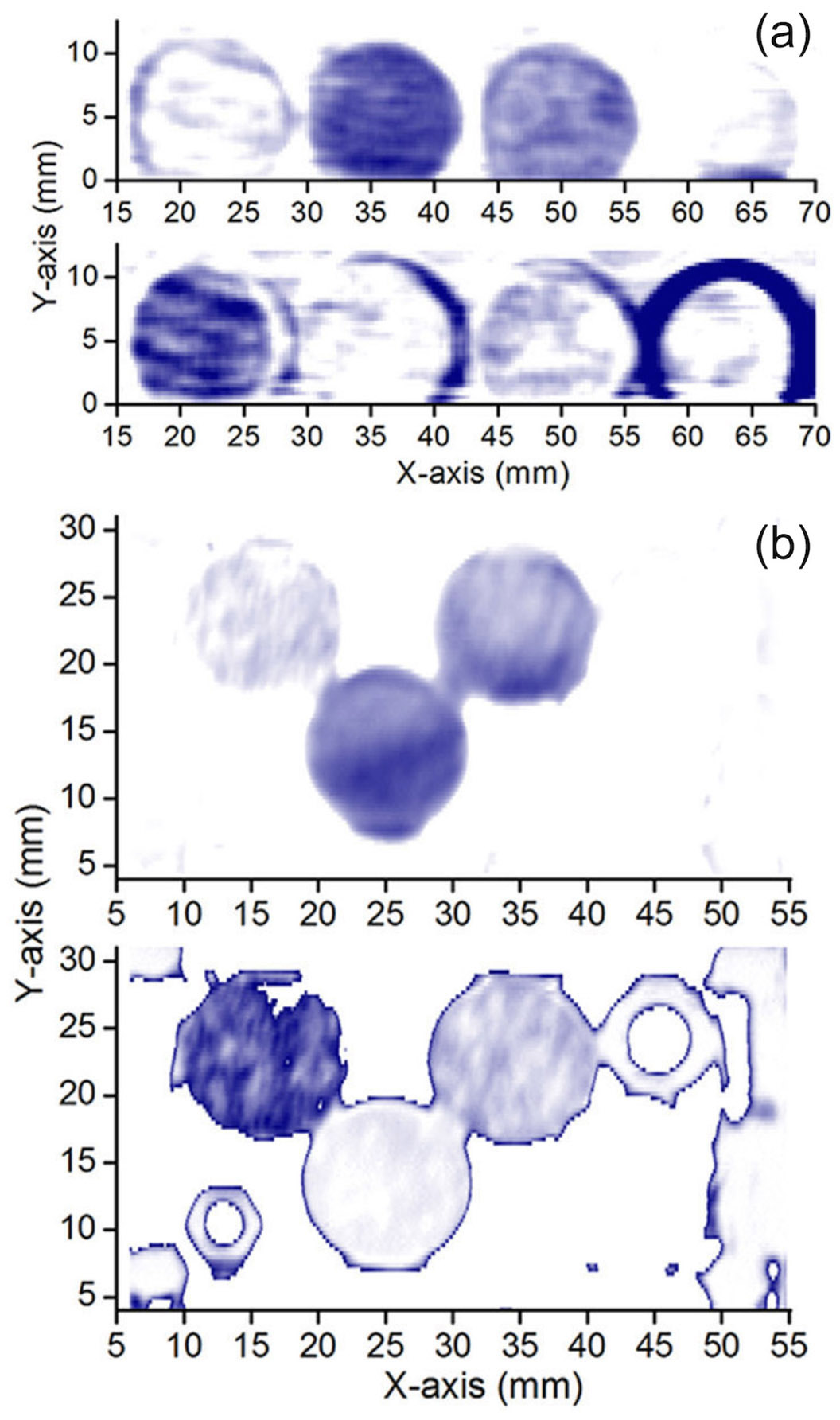
To illustrate the performance and possibilities of our spectroscopic THz imaging technique and to obtain THz snapshots at different frequencies, we prepared samples that contained tartaric acid (TA) and sucrose (SC) as simulators of explosive materials. We prepared three different samples in which we mixed polytetrafluoroethylene (PTFE) powder with 10% TA, 10% SC, and 5% of both TA and SC, respectively. We then applied pressure and formed pellets with thickness of 1.4mm and diameter of 13mm. We also prepared a pure PTFE pellet for reference purposes. The samples were then placed in a metallic frame so that we could conduct free standing measurements—see Figure 1(a)—and packed inside a 4mm-thick high-density polyethylene (HDPE) container, as shown in Figure 1(b).
 
Figure 1. Photographs of pellet samples containing a mixture of polytetrafluoroethylene (PTFE), tartaric acid, and sucrose. Samples are shown (a) arranged in a free standing geometry for measurements and (b) within a 4mm-thick high-density polyethylene (HDPE) container (top removed).6
We used a customized vacuum Fourier spectrometer to measure the transmittance of the samples (see Figure 2). Our results show that the pellets containing TA and SC have spectral signatures in the 0.6–3.3THz frequency range, which are very similar to the signatures of real explosives. In addition, samples with a SC or TA content of 10% or more can be distinguished—because of the different absorptions of the two components—by obtaining images at discrete frequencies (e.g., 0.762, 1.84, or 2.52THz).
 
Figure 2. Absorption spectra of tartaric acid and sucrose within a PTFE matrix, as measured using a customized vacuum Fourier spectrometer. Arrows mark the emission frequencies of the optically pumped molecular terahertz (THz) laser.
To demonstrate the acquisition of THz snapshots at different frequencies, we used indium gallium arsenide (InGaAs) bow-tie diodes. These are planar asymmetrically shaped structures, where one of the two semiconductor leaves is metallized and the other is left to be semiconducting. The metallic leaf concentrates the incident THz radiation in the vicinity of the apex. This induces an inhomogeneous electric field, which then heats electrons in the semiconductor leaf non-uniformly and generates a DC voltage signal.7 Such devices exhibit broadband operation7 and fast response times,8 and can thus be used for spectroscopic THz imaging.9 Our recorded snapshots (see Figure 3) show that the ‘colors’ and ‘shadows’ of the pellets are different (at absorbances of 0.762THz and 1.84THz). This indicates that the images are sensitive to the chemical composition of the samples.
 
Figure 3. Spectroscopic THz images (‘colored’ THz photographs) of the pellet samples obtained at a frequency of (a) 0.762THz and (b) 1.84THz.
We also used a principal component analysis to determine the distribution of the ingredients (on a percentage scale) within the pellets.6 For instance, the SC and TA distribution is shown in Figure 4. By defining the range of interest, we estimated that the SC content was 9.9±0.7% and 6.1±0.8% for samples 2 and 3, respectively, and that the TA content was 10.1±1.4% and 2.5±1.3% for sample 1 and 3, respectively (refer also to Figure 1). We note that there are some interference effects that are caused by the packaging of the samples (i.e., a container that is opaque to visible light). We are thus able to determine the chemical composition of the materials with reasonable accuracy—without direct spectral measurements—if the spectrum of the object or material is known a priori, and the discrete frequency THz imaging system is optimized to characteristic lines.
 
Figure 4. Distribution of sucrose (top plots) and tartaric acid (bottom plots) in the pellet samples, as imaged from (a) the free standing geometry and (b) within the HDPE container. Photographs of the two samples arrangements are shown in Figure 1.6
We can operate the bow-tie diodes in a heterodyne imaging mode and thus achieve high detection sensitivity.10 With the aim of implementing our concept into direct applications and compact camera designs, we fabricated arrays of the bow-ties for THz imaging.11 We have also recently demonstrated the enhanced performance of these bow-tie sensors and on-chip integration of optical focusing components (zone plates).12 Our results indicated that commercially available CMOS technology can be well-suited for solid-state-based spectroscopic THz imaging. In this approach, plasmonic effects in nanometric field effect transistors coupled with resonant antennas are used as the detection principle. We also showed that it is possible to overcome limitations set by carrier momentum relaxation time—which is inherent to bow-tie diodes—and thus extend the THz snapshots recording scale to 4.25THz.13
In summary, we developed new solid-state-based sensors that can be operated at room temperature for spectroscopic THz imaging purposes. We also obtained THz photographs at different frequencies to demonstrate the viability of our technique. Our results show that it is possible to determine the chemical composition of packaged samples if their spectra are known a priori. In our work, we are currently focused on the optimal design and fabrication of the on-chip integrated compact THz imaging system for spectroscopic needs. We aim to demonstrate the performance of the system by imaging biomedical tissues, and to provide increased depth sensitivity and better spatial resolution.

Rimvydas Venckevičius, Irmantas Kašalynas, Gintaras Valušis
Center for Physical Sciences and Technology
Vilnius, Lithuania
Rimvydas Venckevičius has been a researcher in the Optoelectronics Department since 2009. His current research interests include terahertz imaging, Fourier spectroscopy, and carrier transport investigations in semiconductor superlattices.
Irmantas Kašalynas is a senior research associate in the Optoelectronics Department and is the leader of the Terahertz Photonics Laboratory. His current research interests cover compact room-temperature terahertz and sub-terahertz radiation detectors and sources, passive filters, and plasmon resonance devices.
Gintaras Valušis is currently the director of the Center for Physical Sciences and Technology, and is a professor in the Semiconductors Physics Department at Vilnius University. His current research interests include terahertz physics, as well as spectroscopy and physics of semiconductor devices.

References:
1. N. Krumbholz, T. Hochrein, N. Vieweg, T. Hasek, K. Kretschmer, M. Bastian, M. Mikulics, M. Koch, Monitoring polymeric compounding processes inline with THz time-domain spectroscopy, Polym. Test. 28, p. 30-35, 2009.
2. B. Fischer, M. Hoffmann, H. Helm, G. Modjesch, P. U. Jepsen, Chemical recognition in terahertz time-domain spectroscopy and imaging, Semicond. Sci. Technol. 20, p. S246-S253, 2005.
3. A. G. Davies, A. D. Burnett, W. Fan, E. H. Linfield, J. E. Cunningham, Terahertz spectroscopy of explosives and drugs, Mater. Today 11, p. 18-26, 2008.
4. F. Wahaia, G. Valusis, L. M. Bernardo, A. Almeida, J. A. Moreira, P. C. Lopes, J. Macutkevic, et al., Detection of colon cancer by terahertz techniques, J. Molec. Struct.1006, p. 77-82, 2011.
5. F. Friederich, W. von Spiegel, M. Bauer, F. Meng, M. D. Thomson, S. Boppel, A. Lisauskas, et al., THz active imaging systems with real-time capabilities, IEEE Trans. Terahertz Sci. Technol. 1, p. 183-200, 2011.
6. I. Kašalynas, R. Venckevičius, G. Valušis, Continuous wave spectroscopic terahertz imaging with InGaAs bow-tie diodes at room temperature, IEEE Sensors J. 13, p. 50-54, 2013.
7. D. Seliuta, I. Kašalynas, V. Tamošiǔnas, S. Balakauskas, Z. Martunas, S. Asmontas, G. Valušis, A. Lisauskas, H. G. Roskos, K. Kohler, Silicon lens-coupled bow-tie InGaAs-based broad band terahertz sensor operating at room temperature, Electron. Lett. 42, p. 825-827, 2006.
8. I. Kašalynas, D. Seliuta, R. Simniškis, V. Tamošiunas, K. Kohler, G. Valušis, Terahertz imaging with bow-tie InGaAs-based diode with broken symmetry, Electron. Lett. 45, p. 833-835, 2009. doi:10.1049/el.2009.0336
9. I. Kašalynas, R. Venckevičius, D. Seliuta, I. Grigelionis, G. Valušis, InGaAs-based bow-tie diode for spectroscopic terahertz imaging, J. Appl. Phys. 110(114505), 2011.doi:10.1063/1.3658017
10. L. Minkevičius, V. Tamošiūnas, I. Kašalynas, D. Seliuta, G. Valušis, A. Lisauskas, S. Boppel, H. G. Roskos, K. Köhler, Terahertz heterodyne imaging with InGaAs-based bow-tie diodes, Appl. Phys. Lett. 99(131101), 2011. doi:10.1063/1.3641907
11. L. Minkevičius, K. Madeikis, I. Kašalynas, R. Venckevičius, D. Seliuta, V. Tamošiūnas, G. Valušis, Discrete spectrum terahertz imaging using bow-tie diodes: optimized antenna designs and arrays, Proc. SPIE 8846, p. 88460P, 2013. doi:10.1117/12.2023887
12. L. Minkevičius, V. Tamošiūnas, K. Madeikis, B. Voisiat, I. Kašalynas, G. Valušis, On-chip integration of laser-ablated zone plates for detection enhancement of InGaAs bow-tie terahertz detectors, Electron. Lett. 50, p. 1367-1369, 2014.
13. M. Bauer, R. Venckevičius, I. Kašalynas, S. Boppel, M. Mundt, L. Minkevičius, A. Lisauskas, G. Valušis, V. Krozer, H. G. Roskos, Antenna-coupled field-effect transistors for multi-spectral terahertz imaging up to 4.25THz, Opt. Express 22, p. 19235-19241, 2014.

Saturday, October 24, 2015

Abstract-Investigation of pharmaceutical drugs and caffeine-containing foods using Fourier and terahertz time-domain spectroscopy


Mindaugas Karaliūnas; Rimvydas Venckevičius; Irmantas Kašalynas; Uroš Puc; Andreja Abina; Anton Jeglič; Aleksander Zidanšek; Gintaras Valušis

http://spie.org/Publications/Proceedings/Paper/10.1117/12.2188015

Several pharmaceutical drugs, such as alprazolam, ibuprofen, acetaminophen, activated carbon and others, and caffeine-containing foods were tested using terahertz (THz) time domain spectroscopy in the range from 0.3 to 2 THz. The dry powder of pharmaceutical drugs was mixed with HDPE and pressed into the pellets using hydraulic press. The coffee grounds were also pressed into the pellets after ball-milling and mixing with HDPE. The caffeine containing liquid foods were dried out on the paper strips of various stacking. Experiments allow one to determine characteristic spectral signatures of the investigated substances within THz range caused by active pharmaceutical ingredients, like in the case of caffeine, as well as supporting pharmaceutical ingredients. Spectroscopic THz imaging approach is considered as a possible option to identify packaged pharmaceutical drugs. The caffeine spectral features in the tested caffeine containing foods are difficult to observed due to the low caffeine concentration and complex caffeine chemical surrounding.

Wednesday, January 8, 2014

Abstract-Exploration of Terahertz Imaging with Silicon MOSFETs


We summarize three lines of development and investigation of foundry-processed patch-antenna-coupled Si MOSFETs as detectors of THz radiation: (i) Exploiting the pinciple of plasma-waved-based mixing in the two-dimensional electron gas of the transistors’ channels, we demonstrate efficient detection at frequencies as high as 9 THz, much above the transit-time-limited cut-off frequencies of the devices (tens of GHz). Real-time imaging at 600 GHz with a 12 × 12 detector array is explored. (ii) Given the limited THz power usually available for applications, we explore imaging with enhanced sensitivity in heterodyne mode. We show that real-time operation of a 100 × 100-pixel heterodyne camera should be possible at 600 GHz with a better dynamic range (30 dB) than for direct power detection (20 dB), even if only a quarter-milliwatt of local-oscillator power, distributed radiatively over all detector pixels, is available. (iii) Finally, we present an all-electronic raster-scan imaging system for 220 GHz entirely based on CMOS devices, combining the CMOS detectors with an emitter circuit implemented in a 90-nm CMOS process and delivering radiation with a power on the 100- μW scale. Considering progress in the field, we anticipate that the emitter concept of oscillator-based power generation with on-chip frequency multiplication will carry well into the sub-millimeter-wave regime.