Showing posts with label Frederico Capasso. Show all posts

Monday, August 13, 2018

Laser Frequency Combs May Be the Future of Wi-Fi


AUTUM C. PYLANT

Wi-Fi and cellular data traffic are increasing exponentially but, unless the capacity of wireless links can be increased, all that traffic is bound to lead to bottlenecks. Upcoming 5G networks are a temporary fix. 

Researchers are focusing on terahertz frequencies — the submillimeter wavelengths of the electromagnetic spectrum — for the long-term fix. Data traveling at terahertz frequencies could move hundreds of times faster than today’s wireless. 
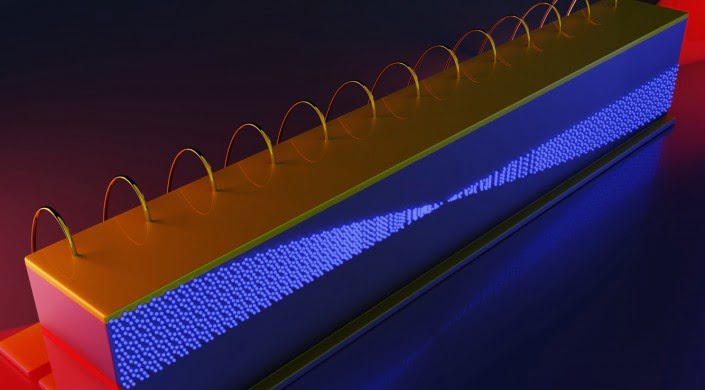
Inside an infrared frequency comb in a quantum cascade laser, the different frequencies of light beat together to generate microwave radiation.
Inside an infrared frequency comb in a quantum cascade laser, the different frequencies of light beat together to generate microwave radiation. Courtesy of Jared Sisler/Harvard University.

Researchers at Harvard’s John A. Paulson School of Engineering and Applied Sciences (SEAS) have discovered that an infrared frequency comb in a quantum cascade laser could offer a new way to generate terahertz frequencies. They also uncovered a new phenomenon of quantum cascade laser (QCL) frequency combs, which would allow the devices to act as integrated transmitters or receivers that can efficiently encode information.

“This work represents a complete paradigm shift for the way a laser can be operated,” said Federico Capasso, the Robert L. Wallace Professor of Applied Physics and Vinton Hayes Senior Research Fellow in Electrical Engineering and senior author of the paper. “This new phenomenon transforms a laser — a device operating at optical frequencies — into an advanced modulator at microwave frequencies, which has a technological significance for efficient use of bandwidth in communication systems.” 


Frequency combs are widely-used, high-precision tools for measuring and detecting different frequencies of light. Unlike conventional lasers, which emit a single frequency, frequency combs emit multiple frequencies simultaneously, evenly spaced to resemble the teeth of a comb. Optical frequency combs are used for everything from measuring the fingerprints of specific molecules to detecting distant exoplanets.

The SEAS research represents a complete paradigm shift for the way a laser can be operated. However, the researchers weren’t interested in the optical output of the laser.

“We were interested in what was going on inside the laser, in the laser’s electron skeleton,” said Marco Piccardo, a postdoctoral fellow at SEAS and first author of the paper. “We showed, for the first time, that a laser at optical wavelengths can operate as a microwave device.”

Inside the laser, the different frequencies of light beat together to generate microwave radiation. The researchers discovered that light inside the cavity of the laser causes electrons to oscillate at microwave frequencies — which are within the communications spectrum. These oscillations can be externally modulated to encode information onto a carrier signal.

Capasso told Photonics Media that QCL’s, if operated carefully, are naturally frequency combs.

“We call them harmonic combs,” Capasso said. “Instead of the modes being very close, they are very far apart. They are tunable, and that opens up an entirely new perspective.”


“This functionality has never been demonstrated in a laser before,” said Piccardo. “We have shown that the laser can act as a so-called quadrature modulator, allowing two different pieces of information to be sent simultaneously through a single frequency channel and successively be retrieved at the other end of a communication link.”

The Harvard Office of Technology Development has protected the intellectual property relating to this project and is exploring commercialization opportunities.

“Currently, terahertz sources have serious limitations due to limited bandwidth,” said Capasso. “This discovery opens up an entirely new aspect of frequency combs and could lead, in the near future, to a terahertz source for wireless communications.” 

The research has been published in the journal Optica (doi.org/10.1364/OPTICA.5.000475).

Saturday, November 4, 2017

A strange new world of light


By Leah Burrows,


(Nanowerk News) There's nothing new thing under the sun -- except maybe light itself. 
Over the last decade, applied physicists have developed nanostructured materials that can produce completely new states of light exhibiting strange behavior, such as bending in a spiral, corkscrewing and dividing like a fork.
These so-called structured beams not only can tell scientists a lot about the physics of light, they have a wide range of applications from super-resolution imaging to molecular manipulation and communications.
Now, researchers at the Harvard John A. Paulson School of Engineering and Applied Sciences have developed a tool to generate new, more complex states of light in a completely different way.

A metasurface uses circularly polarized light to generate and control new and complex states of light, such swirling vortices of light. The new tool can be used to not only explore new states of light but also new applications for structured light. (Image: Second Bay Studio/Harvard SEAS)
The research is published in Science.
"We have developed a metasurface which is a new tool to study novel aspects of light," said Federico Capasso, the Robert L. Wallace Professor of Applied Physics and Vinton Hayes Senior Research Fellow in Electrical Engineering at SEAS and senior author of the paper. "This optical component makes possible much more complex operations and allows researchers to not only explore new states of light but also new applications for structured light."
The Harvard Office of Technology Development has protected the intellectual property relating to this project and is exploring commercialization opportunities.
The new metasurface connects two aspects of light, known as orbital angular momentum and circular polarization (or spin angular momentum). Polarization is direction along which light vibrates. In circularly polarized light, the vibration of light traces a circle. Think about orbital angular momentum and circular polarization like the motion of a planet. Circular polarization is the direction in which a planet rotates on its axis while orbital momentum describes how the planet orbits the sun.
The fact that light can even carry orbital momentum is a relatively recent discovery -- only about 25 years old?-- but it's this property of light which produces strange new states, such as beams in the shape of corkscrews.

A metasurface can generate strange new beams of light that swirl and corkscrew. The black hole in the center of these vortices can be used to image features smaller than half a wavelength of light or move tiny molecules. (Image: Capasso Lab/Harvard SEAS)
Previous research has used the polarization of light to control the size and shape of these exotic beams but the connection was limited because only certain polarizations could convert to certain orbital momentums.
This research, however, significantly expands that connection.
"This metasurface gives the most general connection, through a single device, between the orbital momentum and polarization of light that's been achieved so far," said Robert Devlin, co-first author of the paper and former graduate student in the Capasso Lab.
The device can be designed so that any input polarization of light can result in any orbital angular momentum output -- meaning any polarization can yield any kind of structured light, from spirals and corkscrews to vortices of any size. And, the multifunctional device can be programmed so that one polarization results in one vortex and a different polarization results in a completely different vortex.
"This is a completely new optical component," said Antonio Ambrosio, Principal Scientist at Harvard Center for Nanoscale Systems (CNS) and co-first author of the paper. "Some metasurfaces are iterations or more efficient, more compact versions of existing optical devices but, this arbitrary spin-to-orbital conversion cannot be done with any other optical device. There is nothing in nature as well that can do this and produce these states of light."
One potential application is in the realm of molecular manipulation and optical tweezers, which use light to move molecules. The orbital momentum of light is strong enough to make microscopic particles rotate and move.
"You can imagine, if we illuminate the device with one polarization of light, it will create a force of a particular kind," said Ambrosio. "Then, if you want to change the force, all you need to do is change the polarization of the incoming light. The force is directly related to the design of the device."
Another application is high-powered imaging. The black hole in the center of the vortex, known as the zero-light intensity region, can image features smaller than the diffraction limit, which is usually half of the wavelength of light. By changing the polarization of light, the size of this center region can be changed to focus different-sized features.
But these beams can also shed light on fundamental questions of physics.
"These particular beams are first and foremost of fundamental scientific interest," said Noah Rubin, co-first author of the paper and graduate student in the Capasso Lab. "There is interest in these beams in quantum optics and quantum information. On the more applied side, these beams could find application in free-space optical communication, especially in scattering environments where this is usually difficult. Moreover, it has been recently shown that similar elements can be incorporated into lasers, directly producing these novel states of light. This may lead to unforeseen applications."

Thursday, May 15, 2014

BioPhotonics-High Hurdles Daunting But Doable

                                                           BIOPHOTONICS 


Karen A. Newman, Group Publisher, karen.newman@photonics.com 

http://www.photonics.com/Article.aspx?AID=56198


In the course of writing a feature for this issue on the inroads that quantum cascade lasers are making into the medical arena, I was reminded once again of the many hurdles that new technologies (and devices that employ them) face on the track from bench to bedside. Not only must a technology be proven viable – and viable for targeted applications – but it must also face myriad challenges not specifically related to the technology.

In explaining a potential application for QCLs in diabetes detection, Dr. Federico Capasso expressed part of the challenge when he said that “any such tests would have to be FDA approved. What is needed is a lot of research, with doctors and biologists teaming up with QCL researchers and developers.” Capasso is a Harvard professor and part of the team that 20 years ago first demonstrated the quantum cascade laser at Bell Labs.

With a QCL-based microscope platform now on the market, Daylight Solutions is well positioned to talk about both the technology and the market challenges. Matt Barre, business development manager for the California company, said the instrument faces other hurdles “related to validation of the technique involving large-scale trials, establishing standards, generating databases, etc.” The microscope platform will allow medical professionals to experience “the power of the technique,” Barre said. Read the article, “QCLs for Medicine: The Promise and the Payoff,” beginning on page 34. 

And for a look at how another technology – photoacoustics – is making inroads in medicine, see “Photoacoustics Applications Expand Beyond Cancer,” by Managing Editor Laura S. Marshall, starting on page 22. Fans of QCLs will find more on the subject there, where Dr. Werner Mäntele of Johann Wolfgang Goethe University in Frankfurt explains how the high laser power available from QCLs has given photoacoustics increased sensitivity, which will in turn open up more applications for the technology.

Also in this issue, contributing editor Marie Freebody talks about the hurdles to clear before terahertz spectroscopy can find commercial success in “Challenges Not Insurmountable for Terahertz Spectroscopy,” beginning on page 26; and Barbara Foster of The Microscopy & Imaging Place Inc. describes how more complex biology experiments are demanding multiple wavelengths in tunable formats in “Microscopy Light Sources Illuminate Research Biology,” starting on page 29.

And if you have an interest in microscopy light sources, check out our recent webinar with researcher Dr. Aaron Slepkov of Trent University in Ontario, Canada. You can find the archived version of “Light Sources for Stimulated Vibrational Microscopy” at www.photonics.com/webinars.

Saturday, August 25, 2012

Ultrathin wafer of silicon and gold focuses telecom wavelengths without distortion


Flat lens offers a perfect image

A new ultrathin, flat lens focuses light without imparting the optical distortions of conventional lenses. Credit: Artist's rendition courtesy of Francesco Aieta.

 http://phys.org/news/2012-08-ultrathin-wafer-silicon-gold-focuses.html#jCp

(Phys.org)—August 23, 2012 – Applied physicists at the Harvard School of Engineering and Applied Sciences (SEAS) have created an ultrathin, flat lens that focuses light without imparting the distortions of conventional lenses.


At a mere 60 nanometers thick, the flat lens is essentially two-dimensional, yet its focusing power approaches the ultimate physical limit set by the laws of diffraction.
Operating at telecom wavelengths (i.e., the range commonly used in fiber-optic communications), the new device is completely scalable, from near-infrared to terahertz wavelengths, and simple to manufacture. The results have been published online in the journal .
Left: A micrograph of the flat lens (diameter approximately 1 mm) made of silicon. The surface is coated with concentric rings of gold optical nanoantennas (inset) which impart different delays to the light traversing the lens. Right:The colored rings show the magnitude of the phase delay corresponding to each ring. (Image courtesy of Francesco Aieta.)
"Our flat lens opens up a new type of technology," says principal investigator Federico Capasso, Robert L. Wallace Professor of Applied Physics and Vinton Hayes Senior Research Fellow in Electrical Engineering at SEAS. "We're presenting a new way of making lenses. Instead of creating phase delays as light propagates through the thickness of the material, you can create an instantaneous phase shift right at the surface of the lens. It's extremely exciting."
Capasso and his collaborators at SEAS create the flat lens by plating a very thin wafer of silicon with an nanometer-thin layer of gold. Next, they strip away parts of the gold layer to leave behind an array of V-shaped structures, evenly spaced in rows across the surface. When Capasso's group shines a laser onto the flat lens, these structures act as nanoantennas that capture the incoming light and hold onto it briefly before releasing it again. Those delays, which are precisely tuned across the surface of the lens, change the direction of the light in the same way that a thick glass lens would, with an important distinction.
The flat lens eliminates optical aberrations such as the "fish-eye" effect that results from conventional wide-angle lenses. Astigmatism and coma aberrations also do not occur with the flat lens, so the resulting image or signal is completely accurate and does not require any complex corrective techniques.
The array of nanoantennas, dubbed a "metasurface," can be tuned for specific wavelengths of light by simply changing the size, angle, and spacing of the antennas.
"In the future we can potentially replace all the bulk components in the majority of optical systems with just flat surfaces," says lead author Francesco Aieta, a visiting graduate student from the Università Politecnica delle Marche in Italy. "It certainly captures the imagination."
Journal reference: Nano Letters  
Provided by Harvard University  

Thursday, October 13, 2011

Terahertz plasmonics


http://www.scopus.com/record/display.url?eid=2-s2.0-80053221143&origin=inward&txGid=GBKPi-RhYsF5wzzY9grdYof%3a2
Semiconductor microstructures can be used to tailor the dispersion properties of surface plasmon polaritons in the terahertz (THz) frequency range, and therefore can be used as important building blocks for terahertz optical devices. The physical principles of three structures are discussed: plasmonic second-order gratings, designer (spoof) surface plasmon polariton structures, and channel polariton structures. The effectiveness of these structures is demonstrated by utilising them to improve power throughput and to reduce the beam divergence of edge-emitting THz quantum cascade lasers. Plasmonics promises compact and low-loss solutions for manipulating light at THz wavelengths, and will have a large impact on applications such as imaging, light detection and ranging (LIDAR), and the heterodyne detection of chemicals. © 2010 The Institution of Engineering and Technology.