A repository & source of cutting edge news about emerging terahertz technology, it's commercialization & innovations in THz devices, quality & process control, medical diagnostics, security, astronomy, communications, applications in graphene, metamaterials, CMOS, compressive sensing, 3d printing, and the Internet of Nanothings. NOTHING POSTED IS INVESTMENT ADVICE! REPOSTED COPYRIGHT IS FOR EDUCATIONAL USE.
Showing posts with label Terahertz Sensing. Show all posts
Friday, May 29, 2020
Abstract-Terahertz Sensing with Optimized Q /V eff Metasurface Cavities
Manoj Gupta, Ranjan Singh
https://onlinelibrary.wiley.com/doi/abs/10.1002/adom.201902025
Confinement of electromagnetic radiation in a subwavelength cavity is an important platform for strong light–matter interaction as it enables efficient design of photonic switches, modulators, and ultrasensitive sensors. Metallic metasurfaces consist of an array of planar cavities that allow easy access to confined electromagnetic modes on the surface. However, the radiative and nonradiative losses limit the quality factor (Q ) of the resonantly confined mode. Therefore, metasurface designs with effectively low mode volume (V eff) cavities become extremely important for enhancing the photonic density of states. Here, a symmetric Lorentzian resonant metasurface with lower V eff is demonstrated as compared to asymmetric Fano resonators. Lower mode volume and optimized Q /V eff metasurfaces reveal enhanced sensitivity for ultrathin analyte overlayers deposited on metasurfaces signaling enhanced light–matter interaction. Such metasurfaces with tightly confined electromagnetic modes could find wide range of applications in the development of terahertz metadevices including ultrasensitive sensors, bandpass filters, and energy‐efficient modulators.
Wednesday, October 16, 2019
Abstract-Terahertz sensing of 7 nm dielectric film with bound states in the continuum metasurfaces
Yogesh Kumar Srivastava, Rajour Tanyi Ako, Manoj Gupta, Madhu Bhaskaran, Sharath Sriram, Ranjan Singh,
https://aip.scitation.org/doi/abs/10.1063/1.5110383
The fingerprint spectral response of several materials with terahertz electromagnetic radiation indicates that terahertz technology is an effective tool for sensing applications. However, sensing few nanometer thin-films of dielectrics with much longer terahertz waves (1 THz = 0.3 mm) is challenging. Here, we demonstrate a quasibound state in the continuum (BIC) resonance for sensing of a nanometer scale thin analyte deposited on a flexible metasurface. The large sensitivity originates from the strong local field confinement of the quasi-BIC Fano resonance state and extremely low absorption loss of a low-index cyclic olefin copolymer substrate. A minimum thickness of 7 nm thin-film of germanium is sensed on the metasurface, which corresponds to a deep subwavelength scale of λ/43 000, where λ is the resonance wavelength. The low-loss, flexible, and large mechanical strength of the quasi-BIC microstructured metamaterial sensor could be an ideal platform for developing ultrasensitive wearable terahertz sensors.
The authors acknowledge valuable and timely assistance from Zhang Qiannan in performing the thickness measurements of the analyte layer using Atomic Force Microscopy. Y.K.S., M.G., and R.S. acknowledge the research funding support from the Ministry of Education AcRF Tier 1 Grant No. RG191/17 and Tier 2 Grant No. MOE2017-T2-1-110. S.S. and R.S. acknowledge support from an RMIT Foundation Research Exchange Fellowship. This work was performed in part at the Micro Nano Research Facility at RMIT University in the Victorian Node of the Australian National Fabrication Facility (ANFF).
Thursday, October 3, 2019
Abstract-Industrial Applications of Terahertz Sensing: State of Play
Mira Naftaly ,Nico Vieweg, Anselm Deninger
https://www.mdpi.com/1424-8220/19/19/4203
This paper is a survey of existing and upcoming industrial applications of terahertz technologies, comprising sections on polymers, paint and coatings, pharmaceuticals, electronics, petrochemicals, gas sensing, and paper and wood industries. Finally, an estimate of the market size and growth rates is given, as obtained from a comparison of market reports.
https://www.mdpi.com › ...
Monday, April 23, 2018
Abstract-Continuous Wave Terahertz Sensing Using GaN HEMTs
Elham Javadi, Juan Antonio Delgado Notario, Nasser Masoumi, Y. M. Meziani,
https://www.researchgate.net/publication/324264744_Continuous_Wave_Terahertz_Sensing_Using_GaN_HEMTs
A commercial GaN high electron mobility transistor (HEMT) is investigated as efficient detector of terahertz radiations. Enhancement of the photoresponse in excess of one order of magnitude (up to 1 kV W−1) is obtained when a constant drain‐to‐source current is applied. The photoresponse remains unchanged with chopping frequency up to 5 kHz demonstrating a high‐speed response of GaN HEMT detectors. It is demonstrated that the bounding wires play an important role to couple terahertz radiations to the channel of the device. Terahertz imaging of hidden objects by using GaN HEMTs as a sensor is also demonstrated. GaN high electron mobility transistor (HEMT) is used as an efficient detector of terahertz radiations with good responsivity. Terahertz imaging of hidden objects is obtained using the GaN HEMTs as a sensor. This open the way for new compact terahertz system for inspection and imaging applications.
Monday, November 27, 2017
Abstract-Quality-control of UV offset lithographicaly printed electronic-ink by THz technology
Yang Zeng, Robert Donnan, Marc Edwards, Bin Yang,
http://ieeexplore.ieee.org/document/8068504/
In this paper, a novel quality-monitor method of inkjet-printed electronics based on terahertz (THz) sensing is presented. Specifically, two different approaches, namely THz reflection spectroscopy and THz near-field scanning, are proposed.
Tuesday, February 11, 2014
SPIE Sensing Technology + Applications Set for May 2014 -
http://www.novuslight.com/spie-sensing-technology-applications_N2201.html
SPIE Sensing Technology + Applications will take place 5 to 9 May 2014 in the Balitimore Convention Centre, Baltimore, Maryland (US). The conference is part of SPIE DSS 2014. It focuses on advanced sensing and imaging topics with an emphasis on civilian application areas, such as energy, environment, health, and agriculture.
Join 6,000 scientists, engineers, product developers, and decision makers in Baltimore and help move these vital technologies into a growing array of applications. Registration includes access to the 500-company DSS Expo; meet with leading suppliers and make vital project connections.
Conference topics include:
- Hyperspectral Imaging
- IR Sensors and Systems
- Imagery and Pattern Analysis
- Next-Generation Sensors and Systems
- Fiber Optic Sensors
- Wireless Sensing
- Terahertz Device and Systems Sensing for Agriculture and Food Safety
- Thermosense Energy Harvesting
- 3D Imaging & Visualization
- Next-Generation Robotics
- Remote Sensing and more...
Thursday, December 30, 2010
Terahertz performs noninvasive mail inspection
My note: I just saw this somewhat dated story on the Yahoo MB. It's notable, as it provides concrete evidence of another THz application we will see in the near future.
Hiromichi Hoshina, Yoshiakim Sasaki, Aya Hayashi, Chiko Otani, and Koko Kawase
Telltale spectra can identify illicit drugs hidden in packages.
24 February 2009, SPIE Newsroom. DOI: 10.1117/2.1200902.1505
Detecting hazardous materials and illicit drugs inside posted mail is necessary because of security concerns and to deter drug trafficking. In Japan, confidentiality of private mail is guaranteed by law, and only noninvasive inspection methods are permitted. Detection (sniffer) dogs and x-ray imaging have been used, but x-rays cannot identify suspect materials and dogs are only useful if drug vapors leak from a package.
Systems using terahertz (THz) radiation have recently been demonstrated as quick and reliable mail-inspection devices.1–4 Like radio waves, THz radiation is not significantly scattered by soft materials such as paper, wood, and plastics, and creates clear images of hidden objects. In addition, many materials exhibit unique THz-absorption spectra—fingerprint spectra—which can be used to identify the contents of suspicious packages.
A prototype apparatus has been built to inspect all mail handled in Japanese international post offices (around 100,000 items per day). However, the THz spectrometer takes too long to examine every package. Therefore, to achieve complete inspection, the process has been divided into two stages. The first involves rapid screening using x-rays and THz waves, and the second identifies the suspicious substances selected in the first stage. The initial screening stage uses x-rays to exclude envelopes containing only paper. Images revealing shadows are then scanned and measured at 0.54THz. A diagram of the THz system is shown in Figure 1.
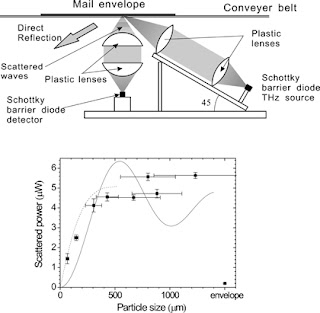
According to Mie scattering theory,5 which describes electromagnetic-radiation scattering by spherical particles, THz waves are intensely scattered when the particle size is comparable to the wavelength. Our experiment confirms that powders with particle sizes greater than 100μm result in a significantly stronger scattering signal than empty envelopes. Therefore, the rapid-screening system flags envelopes showing strong THz-wave scattering as suspicious mail.
Substance identification is achieved with a THz time-domain spectrometer (based on time-resolved Fourier-transform spectroscopy) using femtosecond laser pulses. The absorption spectra are obtained from 0.1 to 3THz with a frequency resolution of 0.03THz and a measurement time of two minutes. Figure 2 shows typical spectra of (a) empty envelopes and (b) folders containing methamphetamine hydrochloride powder. The empty envelopes show weak absorption and almost no spectral features, while those containing methamphetamine hydrochloride show strong absorption and fingerprint peaks at 1.2, 1.6, and 1.8THz. The spectral baselines in Figure 2(b) increase gradually with frequency due to the powder's scattering properties, and reach the detection limit at 2.4THz.
To identify controlled substances, we assembled a THz-spectrum database of widely used chemicals and drugs. Most of these show clear fingerprint spectra at 0.5–3THz, with different peaks, positions, and line shapes for each chemical. Any match between the spectra of suspicious envelopes and the database is evaluated using the correlation between their first derivatives, which removes the baseline slope and clarifies the spectral features: see Figures 2(c) and (d). The appropriate frequency range over which to calculate the correlation coefficients depends on the powder's particle size and the condition of the package. The range is determined on the basis of the spectrum's absorption intensity. A list of possible materials is displayed based on the correlation coefficient.
Procedures for spectral analysis and database retrieval are executed automatically and no special knowledge is necessary to operate the system. The prototype is now installed in Japanese post offices, and our current research focuses on evaluating the system's performance and its limits.
A prototype apparatus has been built to inspect all mail handled in Japanese international post offices (around 100,000 items per day). However, the THz spectrometer takes too long to examine every package. Therefore, to achieve complete inspection, the process has been divided into two stages. The first involves rapid screening using x-rays and THz waves, and the second identifies the suspicious substances selected in the first stage. The initial screening stage uses x-rays to exclude envelopes containing only paper. Images revealing shadows are then scanned and measured at 0.54THz. A diagram of the THz system is shown in Figure 1.
Figure 1. (top) THz rapid-screening system. A Schottky diode is characterized by a very low forward-voltage drop. (bottom) THz-scattering signal intensity of sucrose powder of different particle sizes. The Mie-scattering extinction curves are for nonabsorbing (solid line) and partially absorbing spheres (dashed line). The data point labeled ‘envelope’ illustrates the extinction for a paper-only envelope.
Substance identification is achieved with a THz time-domain spectrometer (based on time-resolved Fourier-transform spectroscopy) using femtosecond laser pulses. The absorption spectra are obtained from 0.1 to 3THz with a frequency resolution of 0.03THz and a measurement time of two minutes. Figure 2 shows typical spectra of (a) empty envelopes and (b) folders containing methamphetamine hydrochloride powder. The empty envelopes show weak absorption and almost no spectral features, while those containing methamphetamine hydrochloride show strong absorption and fingerprint peaks at 1.2, 1.6, and 1.8THz. The spectral baselines in Figure 2(b) increase gradually with frequency due to the powder's scattering properties, and reach the detection limit at 2.4THz.
Figure 2. (a) THz absorption spectra of different kinds of empty envelopes. (b) THz absorption spectra of methamphetamine hydrochloride (HCl) with a particle size of 170μm and (c) first derivative. (d) First derivative of the database spectrum of methamphetamine HCl. Dashed lines show the frequency range used for calculating the correlation coefficients.
Procedures for spectral analysis and database retrieval are executed automatically and no special knowledge is necessary to operate the system. The prototype is now installed in Japanese post offices, and our current research focuses on evaluating the system's performance and its limits.
Hiromichi Hoshina, Yoshiakim Sasaki, Aya Hayashi, Chiko Otani
Terahertz Sensing and Imaging Laboratory
RIKEN
Sendai, Japan
Hiromichi Hoshina received his PhD from Kyoto University in 2003. His current research focuses on developing spectroscopic applications using THz waves.
Yoshiaki Sasaki received his PhD from Yamagata University in 2004. His current research interests include the detection of scattered THz waves from powders, THz imaging, and THz heterodyne detection.
Aya Hayashi received her MSc from Meiji University in 2002. Her research is in bioimaging of cancer and DNA using THz waves.
Chiko Otani received his PhD in astronomy from the University of Tokyo in 1995 and is now head of the Terahertz Sensing and Imaging Laboratory. His research interests include superconducting THz detectors and their applications.
Yoshiaki Sasaki received his PhD from Yamagata University in 2004. His current research interests include the detection of scattered THz waves from powders, THz imaging, and THz heterodyne detection.
Aya Hayashi received her MSc from Meiji University in 2002. Her research is in bioimaging of cancer and DNA using THz waves.
Chiko Otani received his PhD in astronomy from the University of Tokyo in 1995 and is now head of the Terahertz Sensing and Imaging Laboratory. His research interests include superconducting THz detectors and their applications.
Koko Kawase
Optical Quantum Engineering Group
Nagoya University
Nagoya, Japan
Kodo Kawase received his PhD in electronic engineering from Tohoku University in 1996. A professor in the Graduate School of Engineering (since 2005), he has been involved in research on THz-wave generation using nonlinear optics since 1992.
References:
2. T. Ikeda, A. Matsushita, M. Tatsuno, Y. Minami, M. Yamaguchi, K. Yamamoto, M. Tani, M. Hangyo, Investigation of inflammable liquids by terahertz spectroscopy , Appl. Phys. Lett. 87, pp. 034105, 2005. doi:10.1063/1.199847
3. J. F. Federici, B. Schulkin, F. Huang, D. Gary, R. Barat, F. Oliveira, D. Zimdars, THz imaging and sensing for security applications-explosives, weapons and drugs , Semicond. Sci. Technol. 20, pp. S266-S280, 2005. doi:10.1088/0268-1242/20/7/018
Subscribe to:
Posts (Atom)


