A repository & source of cutting edge news about emerging terahertz technology, it's commercialization & innovations in THz devices, quality & process control, medical diagnostics, security, astronomy, communications, applications in graphene, metamaterials, CMOS, compressive sensing, 3d printing, and the Internet of Nanothings. NOTHING POSTED IS INVESTMENT ADVICE! REPOSTED COPYRIGHT IS FOR EDUCATIONAL USE.
Showing posts with label Pavel Belov. Show all posts
Saturday, May 5, 2018
Abstract-Boosting Terahertz Photoconductive Antenna Performance with Optimised Plasmonic Nanostructures
Sergey Lepeshov, Andrei Gorodetsky, Alexander Krasnok, Nikita Toropov, Tigran A. Vartanyan, Pavel Belov, Andrea Alú, Edik U. Rafailov,
https://www.nature.com/articles/s41598-018-25013-7
Advanced nanophotonics penetrates into other areas of science and technology, ranging from applied physics to biology, which results in many fascinating cross-disciplinary applications. It has been recently demonstrated that suitably engineered light-matter interactions at the nanoscale can overcome the limitations of today’s terahertz (THz) photoconductive antennas, making them one step closer to many practical implications. Here, we push forward this concept by comprehensive numerical optimization and experimental investigation of a log-periodic THz photoconductive antenna coupled to a silver nanoantenna array. We shed light on the operation principles of the resulting hybrid THz antenna, providing an approach to boost its performance. By tailoring the size of silver nanoantennas and their arrangement, we obtain an enhancement of optical-to-THz conversion efficiency 2-fold larger compared with previously reported results for similar structures, and the strongest enhancement is around 1 THz, a frequency range barely achievable by other compact THz sources. We also propose a cost-effective fabrication procedure to realize such hybrid THz antennas with optimized plasmonic nanostructures via thermal dewetting process, which does not require any post processing and makes the proposed solution very attractive for applications.
Monday, June 19, 2017
Abstract-Boosting the Terahertz Photoconductive Antenna Performance with Optimized Plasmonic Nanostructures
Sergey Lepeshov, Andrei Gorodetsky, Alexander Krasnok, Nikita Toropov, Tigran A. Vartanyan, Pavel Belov, Andrea Alu, Edik U. Rafailov
(Submitted on 14 Jun 2017)
Advanced nanophotonics penetrates into other areas of science and technology, ranging from applied physics to biology and resulting in many fascinating cross-disciplinary applications. It has been recently demonstrated that suitably engineered light-matter interactions at the nanoscale can overcome the limitations of today's terahertz (THz) photoconductive antennas, making them one step closer to many practical implications. Here we push forward this concept by comprehensive numerical optimization and experimental investigation of a log-periodic THz photoconductive antenna coupled to a silver nanoantenna array. We shed light on the operation principles of the resulting hybrid THz antenna, providing an approach to boost its performance. By tailoring the size of silver nanoantennas and the distance between them, we obtain an enhancement of optical-to-THz conversion efficiency 2-fold larger compared with previously reported results, and the strongest enhancement is around 1 THz, a frequency range barely achievable by other compact THz sources. Moreover, we propose a cost-effective fabrication procedure to realize such hybrid THz antennas with optimized plasmonic nanostructures via thermal dewetting process, which does not require any post processing and makes the proposed solution very attractive for applications.
Thursday, July 3, 2014
Terahertz hyperbolic metamaterials and nonlinear couplers in graphene
Ivan Iorsh, Pavel Belov, Daria Smirnova, Ilya Shadrivov and Yuri Kivshar
Metamaterials based on multilayered graphene structures offer new possibilities for control of the emission and transfer of terahertz radiation.
2 July 2014, SPIE Newsroom. DOI: 10.1117/2.1201406.005445
Graphene exhibits a wide range of unique electronic and optical properties.1 Previous research has shown that a specific type of localized wave, a surface plasmon polariton, can propagate along a single layer of graphene or its bilayer.2–5 Both transverse magnetic (TM) and transverse electric (TE) polarized plasmons can theoretically exist in graphene, and their dispersion properties can be changed by applying an external gate voltage to the graphene sheet.6 This would allow us to construct effective two-dimensional metamaterial structures.7 Such structures could be used for nanoscale optical information processing and storage.
We studied the electromagnetic properties of the multilayer graphene structure shown in Figure 1(a), and derived the dispersion equation for the eigenmodes of the infinite multilayer structure for the cases of TM and TE polarizations:12


where
and KTE,TM is the Bloch wavenumber. We found that the structure is defined by the hyperbolic isofrequency contours in the terahertz frequency range for the TM polarization case. To evaluate the terahertz emission enhancement from this hyperbolic medium, we calculated the Purcell factor for the dipole placed on top of our structure, as shown in Figure 1(b), and showed that it is proportional to (λ/d)3 and that it can reach values of up to 108.
where
Figure 1. (a) Geometry of the multilayer graphene structure, and (b) frequency dependence of the Purcell factor (RIITM) of a dipole oriented along the graphene sheets.12σ: Conductivity. ∊: Permittivity. c: Speed of light in a vacuum.
We further studied nonlinear propagation of light in two coupled layers of graphene and demonstrated that this simple double-layer structure can operate as an efficient optical coupler for both continuous plasmon polaritons and for subwavelength spatial solitons.13 To describe the propagation of nonlinear plasmons in this double-layer graphene structure, we used the slowly varying envelope approximation usually employed in the physics of optical solitons. We found that three types of nonlinear modes can propagate in the double-layer graphene coupler: symmetric, antisymmetric, and asymmetric. In the linear regime, only symmetric and antisymmetric modes exist. However, above a critical power level, a symmetry breaking occurs in this nonlinear system when a novel, asymmetric branch emerges. This novel branch describes the nonlinear states where the power is not distributed equally between the lower and upper graphene layers.
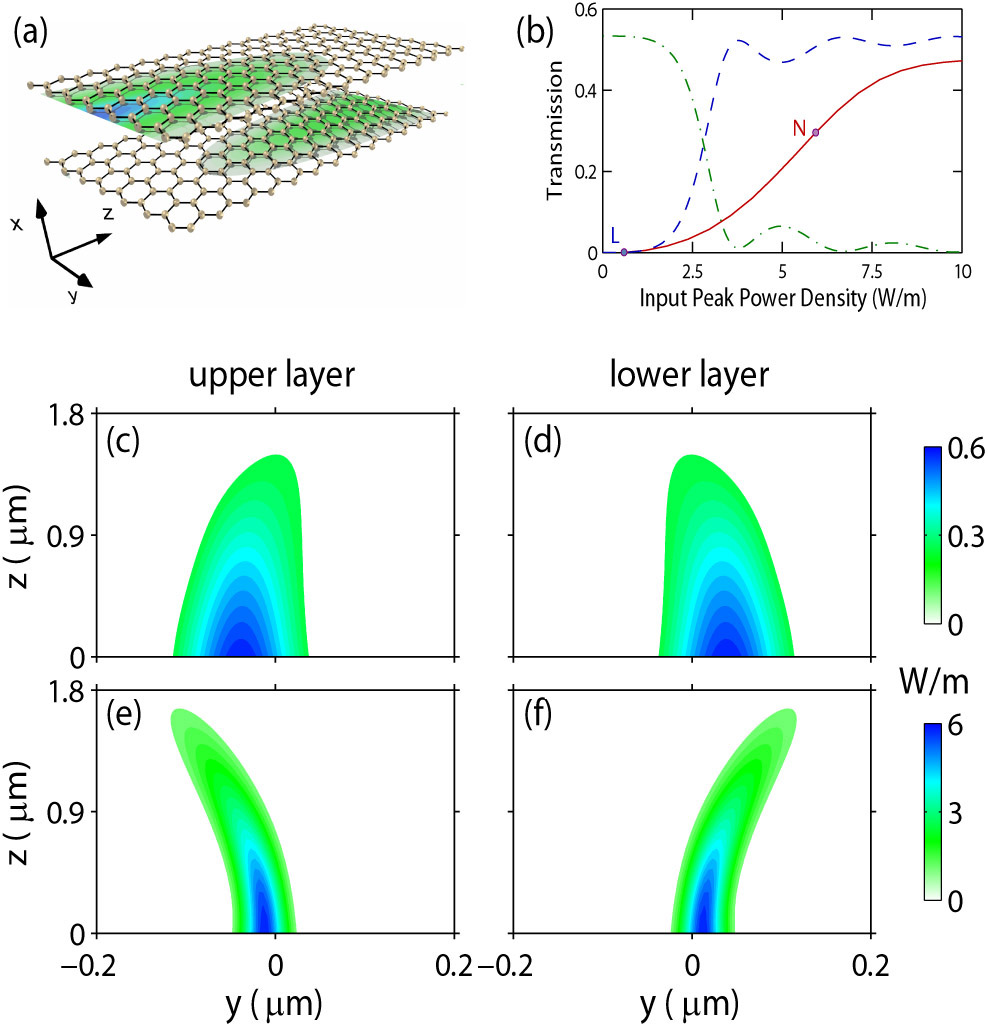
Next, we focused our attention on the power-controlled switching of plasmon beams between the layers and studied numerically the propagation of a sech-like input beam launched into the upper layer: see Figure 2(a). The input beam was the fundamental solution of a single (uncoupled) nonlinear equation, and it described a spatial soliton. For the peak power density of 6W/m, the soliton beam width was about 50nm. This significant sub-wavelength localization was supported by the high effective Kerr nonlinearity of graphene.14
Figure 2. (a) Schematic of a nonlinear graphene coupler composed of two layers of graphene. The color pattern demonstrates how a plasmon beam excited on the top layer tunnels to the bottom layer (numerical results are not to scale). (b) Switching characteristics of the nonlinear graphene coupler. Shown is a fraction of the power transmitted in the pumped layer for the continuous wave (dashed curve) and soliton input beam (solid curve) in a half-beat-length coupler as a function of the input peak power density. The dashed-dotted curve is the calculated relative fractional output power emerging from the other layer in the continuous plasmon regime. The plasmon beam routing in the nonlinear graphene coupler is shown in panels (c) through (f). Spatial distribution of the power density in the layers of the nonlinear graphene coupler for different input peak power densities: (c,d) linear regime, Pin=0 .6 W/m; (e,f) nonlinear regime, Pin=6W/m.13
We compared the corresponding switching characteristics of the nonlinear graphene coupler for the continuous plasmons (whose amplitude is constant along y, shown as dashed curves) and for the beams of a finite extent including the soliton switching (solid curves) in Figure 2(b). The coupler length was selected at the half-beat length L=π/(2Q). When in the linear regime, the input power transfers completely into the second layer. Apart from an increase of the threshold power density, the two regimes of coupler operation could be clearly distinguished.
For relatively small input powers, the plasmon beam of the upper layer coupled to the lower layer and tunneled almost completely. The energy transfer between the layers was inhibited, and we observed the nonlinear regime when the plasmon beam remained in the upper layer. Importantly, the dissipation did not inhibit switching, but it did modify the slopes of the curves and the asymptotic value of the switching curve did not achieve unity: see Figure 2(b). Therefore, the beam may be effectively routed between the graphene layers by changing its input power.
From the power flow (6W/m) and the plasmon structure, we estimated the maximum amplitude of the electric field on the graphene layer at 7 · 106V/m, which is below graphene's breakdown threshold. We also explored the case when two in-phase beams of identical shape were launched into the layers, one beam in each layer. The beams were shifted initially by half of their width with respect to each other. In the linear regime, the power exchange between the layers led to effective attraction between the centers of mass of the beams: see Figure 2(c) and (d). However, in the strongly nonlinear regime the energy exchange was suppressed, and the mutual interaction of the optical solitons generated in the two different layers was accompanied by their repulsion: see Figure 2(e) and (f). To conclude, we showed that the layered graphene nanostructures can be used to control the propagation of the terahertz surface plasmons.
In the future, we plan to study the linear and nonlinear plasmonic properties of patterned graphene nanostructures. Patterning of the graphene sheet can alter the electronic band structure and, thus, the conductivity of the graphene significantly. This should modify the dispersion properties of the surface plasmons propagating along the graphene sheets, opening new possibilities for the control of terahertz radiation with graphene nanostructures.
This work was supported by the Government of the Russian Federation (grant 074-U01) and by the Australian Research Council.
Ivan Iorsh, Pavel Belov
Metamaterials LaboratoryNational Research University of Information Technologies, Mechanics and Optics (ITMO)
Saint-Petersburg, Russia
Ivan Iorsh's main research interests lie in the field of graphene plasmonics and hyperbolic metamaterials.
Pavel Belov heads the Metamaterials Laboratory of ITMO, and also holds an Engineering and Physical Sciences Research Council Advanced Fellow post in Queen Mary University of London in the UK. His research interests include metamaterials, nanophotonics, and classical electrodynamics.
Daria Smirnova, Ilya Shadrivov, Yuri Kivshar
Nonlinear Physics CenterAustralian National University (ANU)
Canberra, Australia
Daria A. Smirnova is pursuing her PhD research at the Nonlinear Physics Center, where she focuses on nonlinear nanophotonics of graphene structures.
Ilya Shadrivov is a Queen Elizabeth II Fellow at the Nonlinear Physics Center. His current research interests include metamaterials, nonlinear optics of metamaterials and graphene, nanophotonics, and plasmonics.
Yuri S. Kivshar established the Nonlinear Physics Center and currently holds the position of ANU Distinguished Professor. His research interests include nonlinear photonics, optical solitons, plasmonics, and metamaterials. He has authored and co-authored more than 700 papers and received many awards, including the Lyle Medal of the Australian Academy of Science. He is a fellow of the Optical Society of America, the American Physical Society, and the Institute of Physics, and Deputy Director of the Center of Excellence for Ultrahigh-bandwidth Devices for Optical Systems.
References:
1. R. R. Nair, P. Blake, A. N. Grigorenko, K. S. Novoselov, T. J. Booth, T. Stauber, N. M. R. Peres, A. K. Geim, Fine structure constant defines visual transparency of graphene,Science 320, p. 1308, 2008.
2. Y. V. Bludov, M. I. Vasilevskiy, N. M. R. Peres, Mechanism for graphene-based optoelectronic switches by tuning surface plasmon-polaritons in monolayer graphene,EuroPhys. Lett. 92, p. 137, 2010. EPL
3. F. Koppens, D. E. Chang, F. de Abajo, Graphene photonics and optoelectronics, Nano Lett. 11, p. 3370, 2011.
4. Z. Fei, A. S. Rodin, G. Andreev, W. Bao, A. McLeod, M. Wagner, L. Zhang, Gate-tuning of graphene plasmons revealed by infrared nano-imaging, Nature 487, p. 82, 2012.
5. J. Chen, M. Badioli, P. Alonso-Gonzales, S. Thongrattanasiri, F. Huth, J. Osmond, M. Spasenovic, Optical nano-imaging of gate-tunable graphene plasmons, Nature 487, p. 77, 2012.
6. S. A. Mikhailov, K. Ziegler, New electromagnetic mode in graphene, Phys. Rev. Lett. 99, p. 016803, 2007.
7. A. Vakil, N. Engheta, Transformation optics using graphene, Science 332, p. 1291, 2011.
8. M. Silverinha, N. Engheta, Effective medium approach to electron waves: Graphene superlattices, Phys. Rev. B 85, p. 195413, 2012.
9. S. A. Mikhailov, Non-linear electromagnetic response of graphene, Europhys. Lett. 79, p. 27002, 2007.
10. K. L. Ishikawa, Nonlinear optical response of graphene in time domain, Phys. Rev. B82, p. 201402, 2010.
11. E. Hendry, P. J. Hale, J. Moger, A. K. Savchenko, S. A. Mikhailov, Coherent nonlinear optical response of graphene, Phys. Rev. Lett. 105, p. 097401, 2010.
12. I. Iorsh, I. Mukhin, I. Shadrivov, P. Belov, Y. Kivshar, Hyperbolic metamaterials based on graphene, Phys. Rev. B 87, p. 075416, 2013.
13. D. A. Smirnova, A. V. Gorbach, I. V. Iorsh, I. V. Shadrivov, Y. S. Kivshar, Nonlinear switching with a graphene coupler, Phys. Rev. B 88, p. 045443, 2013.
14. A. V. Gorbach, Nonlinear graphene plasmonics: amplitude equation, Phys. Rev. A 87, p. 013830, 2013.
Sunday, December 22, 2013
Hyperbolic metamaterials
Examples of hyperbolic metamaterials.
a, Layered metal–dielectric structure; b, hyperlens; c, multilayer fishnet; d, nanorod arrays; e, arrays of metal–dielectric nanopyramids23; f, graphene metamaterials. Figure e reproduced with permission from ref. 23, © 2012,
Electromagnetic metamaterials, artificial media created by subwavelength structuring, are useful for engineering electromagnetic space and controlling light propagation. Such materials exhibit many unusual properties that are rarely or never observed in nature. They can be employed to realize useful functionalities in emerging metadevices based on light. Here, we review hyperbolic metamaterials — one of the most unusual classes of electromagnetic metamaterials. They display hyperbolic (or indefinite) dispersion, which originates from one of the principal components of their electric or magnetic effective tensor having the opposite sign to the other two principal components. Such anisotropic structured materials exhibit distinctive properties, including strong enhancement of spontaneous emission, diverging density of states, negative refraction and enhanced superlensing effects.
Subscribe to:
Comments (Atom)