Showing posts with label Deyue An. Show all posts

Monday, August 10, 2020

Abstract-A passive video-rate terahertz human body imager with real-time calibration for security applications

Hui Feng, Deyue An, Hao Tu, Weihua Bu, Wenjing Wang, Yuehao Zhang, Huakun Zhang, Xiangxin Meng, Wei Wei, Bingxi Gao,  Shuai Wu


https://link.springer.com/article/10.1007/s00340-020-07496-3

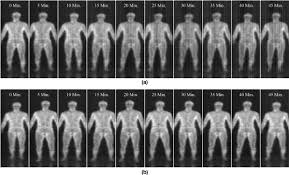
Real-time video-rate passive terahertz imaging systems are highly demanded for practical applications, especially in security checking. Here, we demonstrate a passive video-rate terahertz human body imaging system, which was mainly consisted of a scanning module, a quasi-optical lens, a calibration module and a one-dimensional terahertz detector array. The terahertz waves radiated from human bodies in front of the imager can transmit through a terahertz window into the imager, and were reflected by the scanning module, and then focused on the detector array by the quasi-optical lens. A calibration module was also designed to calibrate the terahertz detectors in real-time without disturbing the imaging process. In combination of the scanning module with the detector array, the imager can obtain a full image of a human body standing at a distance of 1.5 m in front of the imager with a resolution of 1.5 cm and a frame rate of 10 fps. The imaging system can discover suspected dangerous items carried on the human body such as metals, ceramics, powders and liquids. Furthermore, an intelligent terahertz imaging algorithm employing convolutional neural network was also successfully realized based on the terahertz images produced by this system to improve the image quality and mark the detected items automatically. We believe our real-time video-rate terahertz imaging techniques and systems not only have great values for further inspiring developing terahertz imaging systems but also can accelerate the terahertz technology towards more practical applications.

Thursday, November 23, 2017

Abstract-Self-Mixing Spectra of Terahertz Emitters Based on Bi 2 Sr 2 CaCu 2 O 8 + δ Intrinsic Josephson-Junction Stacks


Ya Huang, Hancong Sun, Deyue An, Xianjing Zhou, Min Ji, Fabian Rudau, Raphael Wieland, Johannes S. Hampp, Olcay Kizilaslan, Jie Yuan, Nickolay Kinev, Oleg Kiselev, Valery P. Koshelets, Jun Li, Dieter Koelle, Reinhold Kleiner, Biaobing Jin, Jian Chen, Lin Kang, Weiwei Xu, Huabing Wang, and Peiheng Wu

https://journals.aps.org/prapplied/abstract/10.1103/PhysRevApplied.8.054023

Josephson junctions can serve as mixers for electromagnetic radiation, producing difference frequencies |mfsnfLO| of the signal frequency fs and the local oscillator frequency fLO, where the latter can be provided by ac Josephson currents, and m and n are natural numbers. In order to obtain a better understanding of the purity of the terahertz radiation generated by stacks of intrinsic Josephson junctions (IJJs), we study self-mixing—i.e., fs is also produced by Josephson currents inside the stacks—in the difference-frequency range between 0.1 and 3.0 GHz. Simultaneously, we perform off-chip terahertz emission detection and transport measurements. We find that at high-bias currents, when a hot spot has formed in the stack, the power level of self-mixing can be low and sometimes is even absent at the terahertz emission peak, pointing to a good phase locking among all IJJs. By contrast, at low-bias currents where no hot spot exists, the self-mixing products are pronounced even if the terahertz emission peaks are strong. The mixing products at high operation temperature, at which the temperature variation within the stack is moderate, are minor, indicating that the low junction resistance, perhaps in combination with the lowered Josephson critical current density, may play a similar role for synchronization as the hot spot does at low temperature. While these observations are helpful for the task to synchronize thousands of IJJs, the observation of self-mixing in general may offer a simple method in evaluating the coherence of terahertz radiation produced by the IJJ stacks.