Showing posts with label Christian Nadell. Show all posts

Friday, September 27, 2019

Machine Learning Finds New Metamaterial Designs for Energy Harvesting

Design would enable thermophotovoltaic devices that convert waste heat to electricity


By Ken Kingery

https://pratt.duke.edu/about/news/machine-learning-dielectric-metamaterials?utm_source=miragenews&utm_medium=miragenews&utm_campaign=news

Electrical engineers at Duke University have harnessed the power of machine learning to design dielectric (non-metal) metamaterials that absorb and emit specific frequencies of terahertz radiation. The design technique changed what could have been more than 2000 years of calculation into 23 hours, clearing the way for the design of new, sustainable types of thermal energy harvesters and lighting.
The study was published online on September 16 in the journal Optics Express.
Metamaterials are synthetic materials composed of many individual engineered features, which together produce properties not found in nature through their structure rather than their chemistry. In this case, the terahertz metamaterial is built up from a two-by-two grid of silicon cylinders resembling a short, square Lego.
Adjusting the height, radius and spacing of each of the four cylinders changes the frequencies of light the metamaterial interacts with.
Calculating these interactions for an identical set of cylinders is a straightforward process that can be done by commercial software. But working out the inverse problem of which geometries will produce a desired set of properties is a much more difficult proposition.
Because each cylinder creates an electromagnetic field that extends beyond its physical boundaries, they interact with one another in an unpredictable, nonlinear way.
“If you try to build a desired response by combining the properties of each individual cylinder, you’re going to get a forest of peaks that is not simply a sum of their parts,” said Willie Padilla, professor of electrical and computer engineering at Duke. “It’s a huge geometrical parameter space and you’re completely blind -- there’s no indication of which way to go.”
graphs
When the frequency responses of dielectric metamaterial setups consisting of four small cylinders (blue) and four large cylinders (orange) are combined into a setup consisting of three small cylinders and one large cylinder (red), the resulting response looks nothing like a straightforward combination of the original two.
One way to find the correct combination would be to simulate every possible geometry and choose the best result. But even for a simple dielectric metamaterial where each of the four cylinders can have only 13 different radii and heights, there are 815.7 million possible geometries. Even on the best computers available to the researchers, it would take more than 2,000 years to simulate them all.

To speed up the process, Padilla and his graduate student Christian Nadell turned to machine learning expert Jordan Malof, assistant research professor of electrical and computer engineering at Duke, and Ph.D. student Bohao Huang.
Malof and Huang created a type of machine learning model called a neural network that can effectively perform simulations orders of magnitude faster than the original simulation software. The network takes 24 inputs -- the height, radius and radius-to-height ratio of each cylinder -- assigns random weights and biases throughout its calculations, and spits out a prediction of what the metamaterial’s frequency response spectrum will look like.
First, however, the neural network must be “trained” to make accurate predictions. 
“The initial predictions won’t look anything like the actual correct answer,” said Malof. “But like a human, the network can gradually learn to make correct predictions by simply observing the commercial simulator. The network adjusts its weights and biases each time it makes a mistake and does this repeatedly until it produces the correct answer every time.” 
To maximize the accuracy of the machine learning algorithm, the researchers trained it with 18,000 individual simulations of the metamaterial’s geometry. While this may sound like a large number, it actually represents just 0.0022 percent of all the possible configurations.  After training, the neural network can produce highly accurate predictions in just a fraction of a second.
Even with this success in hand, however, it still only solved the forward problem of producing the frequency response of a given geometry, which they could already do. To solve the inverse problem of matching a geometry to a given frequency response, the researchers returned to brute strength.
Because the machine learning algorithm is nearly a million times faster than the modeling software used to train it, the researchers simply let it solve every single one of the 815.7 million possible permutations. The machine learning algorithm did it in only 23 hours rather than thousands of years.
After that, a search algorithm could match any given desired frequency response to the library of possibilities created by the neural network.
“We’re not necessarily experts on that, but Google does it every day,” said Padilla. “A simple search tree algorithm can go through 40 million graphs per second.”
The researchers then tested their new system to make sure it worked. Nadell hand drew several frequency response graphs and asked the algorithm to pick the metamaterial setup that would best produce each one. He then ran the answers produced through the commercial simulation software to see if they matched up well.
They did.
Graphs with circles at desired property points are matched with lines created by the new machine learning method and the traditional software
The researchers chose arbitrary frequency responses for their machine learning system to find metamaterials to create (circles). The resulting solutions (blue) fit well with both the desired frequency responses and those simulated by commercial software (grey).
With the ability to design dielectric metamaterials in this way, Padilla and Nadell are working to engineer a new type of thermophotovoltaic device, which creates electricity from heat sources. Such devices work much like solar panels, except they absorb specific frequencies of infrared light instead of visible light.

Current technologies radiate infrared light in a much wider frequency range than can be absorbed by the infrared solar cell, which wastes energy. A carefully engineered metamaterial tuned to that specific frequency, however, can emit infrared light in a much narrower band.
“Metal-based metamaterials are much easier to tune to these frequencies, but when metal heats up to the temperatures required in these types of devices, they tend to melt,” said Padilla. “You need a dielectric metamaterial that can withstand the heat. And now that we have the machine learning piece, it looks like this is indeed achievable.”
This research was supported by the Department of Energy (DESC0014372).
CITATION: “Deep Learning for Accelerated All-Dielectric Metasurface Design,” Christian C. Nadell, Bohao Huang, Jordan M. Malof, and Willie J. Padilla. Optics Express, Vol. 27, Issue 20, pp. 27523-27535 (2019). DOI: 10.1364/OE.27.027523

Tuesday, May 9, 2017

Metamaterial modulators enable new terahertz imaging techniques


http://www.spie.org/newsroom/6785-metamaterial-modulators-enable-new-terahertz-imaging-techniques

Frequency- and phase-diverse spatial light modulation can more than double terahertz image acquisition efficiency, effectively parallelizing the single-pixel imaging process.

8 May 2017, SPIE Newsroom. DOI: 10.1117/2.1201612.006785
Most modern imaging systems function in a parallel acquisition scheme.1, 2 For example, the ubiquitous digital optical cameras of today employ arrays of pixels that each detect local light intensity, and simultaneously generate proportional electrical signals to construct an image. However, assembling the large quantities of detectors that are required for parallel imaging is not always feasible for other frequencies of light. In particular, there is a gap in current technology ranging from about 0.1 to 10 terahertz (THz), often referred to as the ‘terahertz gap.’3 Here single-pixel imaging may be advantageous: only one detector is used, with a spatial light modulator (SLM) to serially acquire many measurements of a scene. Metamaterials (i.e., engineered materials) enable the construction of high-performance SLMs because their electromagnetic properties can be designed via unit cell geometry.
Purchase SPIE Field Guide to Optical Fiber TechnologyUntil recently, single-pixel imaging was inherently slow because it necessitates making a number of serial measurements equal to the number of pixels in the final image. Compressive sensing is a prominent approach that seeks to increase acquisition speeds by reducing the number of measurements made by the single pixel detector. However, the image reconstructions from compressive measurements can be computationally expensive (NP-hard).5 Further, the measurement process remains serial, meaning that acquisition time is still directly proportional to the desired image size.
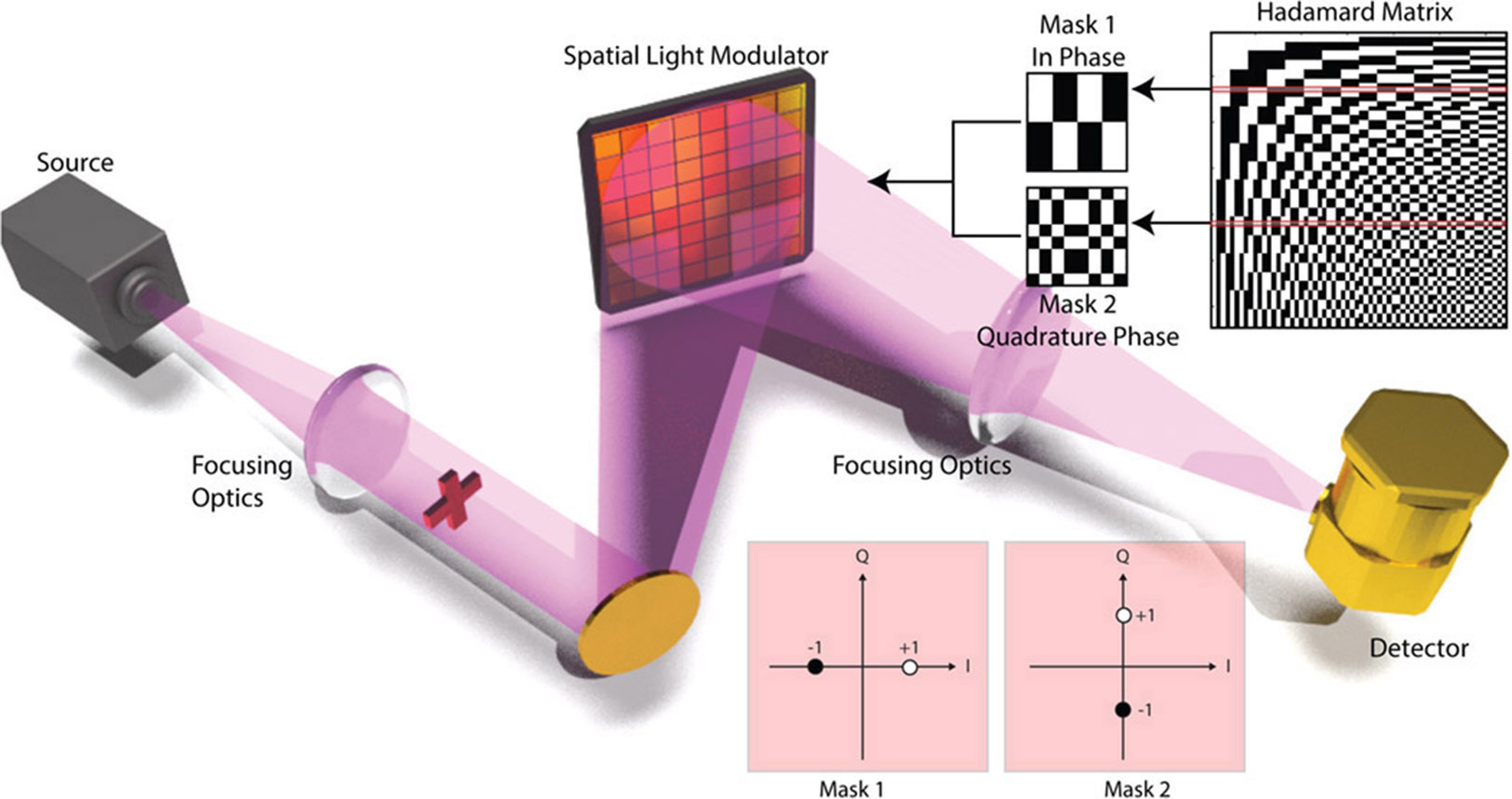
We developed an efficient single-pixel imaging system enabled by a metamaterial SLM6 whose pixels' absorption peak can be dynamically brought high or low via applied bias voltage with great speed and precision. Light from a THz source passes through the object to be imaged and is focused onto the metamaterial SLM (see Figure 1).7 Each pixel oscillates between high and low absorption at frequency fmod with a specific phase, either 0 or π, a technique known in communications engineering as binary phase-shift keying (BPSK).8 The spatial pattern of 0 and π phases—or the ‘mask’—is, in our case, given by a row of a Hadamard matrix, shown to be optimal in single-pixel imaging.9 The light from each SLM pixel is then focused into the single-pixel THz detector, where the summed phase and amplitude of the signal are read by a lock-in amplifier detection scheme.
 
Figure 1. Schematic of the experimental setup for quadrature phase-shift keying (QPSK) imaging. Light from a terahertz (THz) source transmits through an object and is focused onto a spatial light modulator (SLM). Two distinct masks from the Hadamard matrix (mask 1 and mask 2) are encoded simultaneously by the SLM, and light is then refocused into a single-pixel detector.4 The Q and I axes correspond respectively to the quadrature and in-phase components of the QPSK states.
 
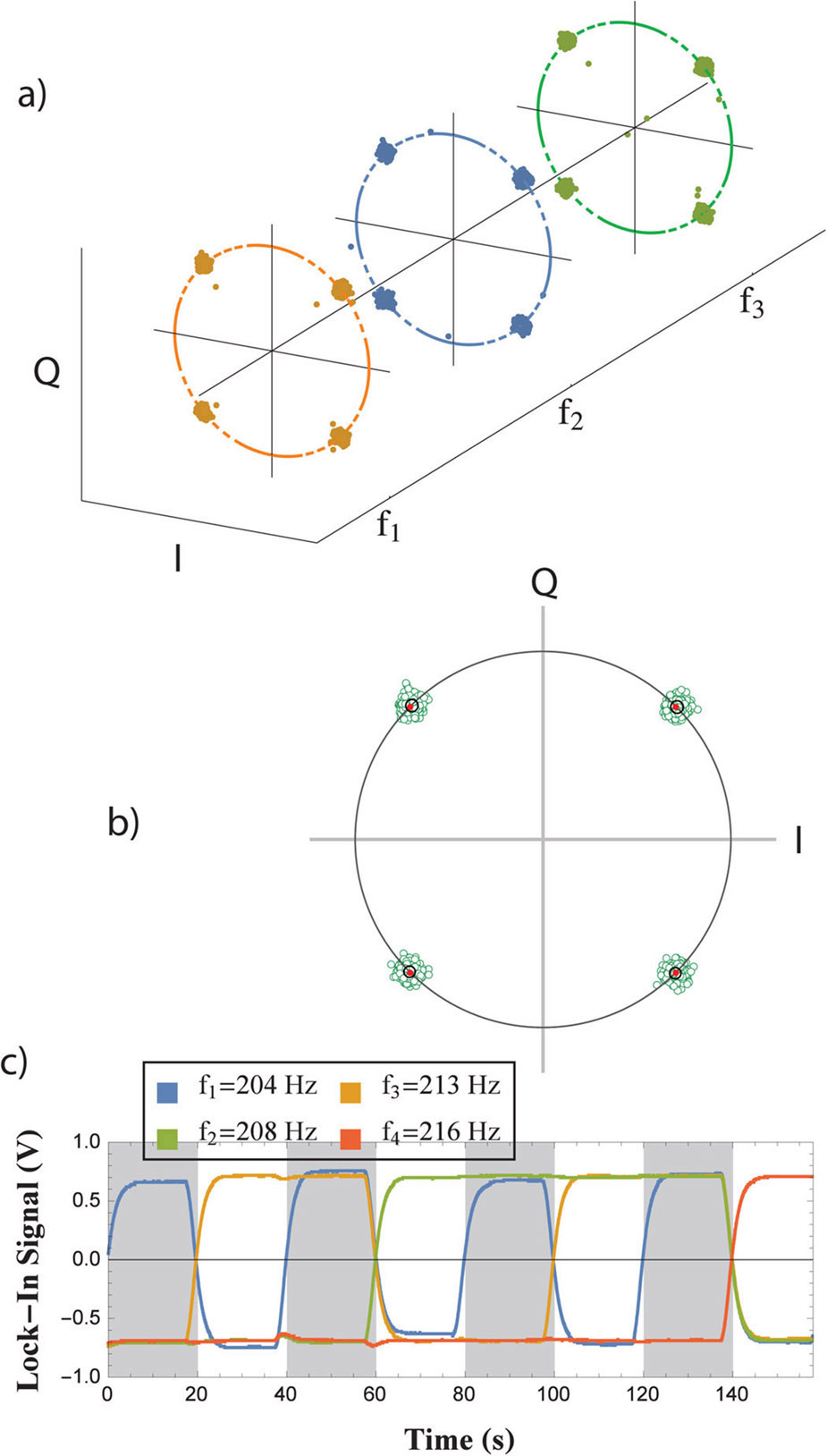
Figure 2. Experimental characterization of advanced modulation states. (a) QPSK states realized simultaneously on three different frequencies (f1f2f3). (b) QPSK states realized for a single frequency shown with mean and standard deviation indicators. (c) Time domain data for different binary phase-shift keying (BPSK) state combinations on four different orthogonal frequency division multiplexing frequencies (f1f2f3f4). Higher-voltage states correspond to πphase, and low-voltage states to - πphase.4,11
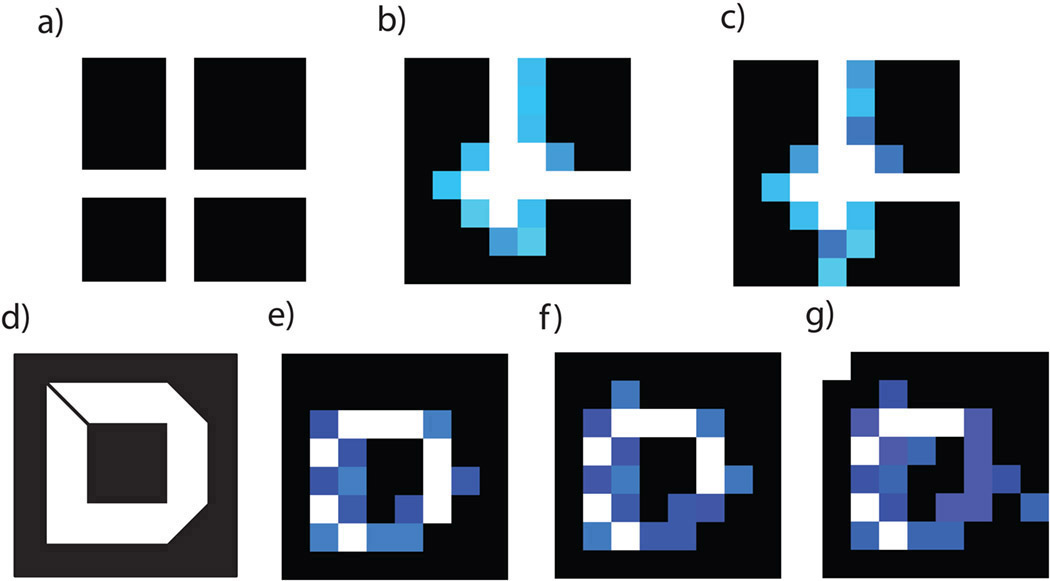
We parallelize the single-pixel imaging process by displaying more than one mask simultaneously, in two different ways.10 First, we use four phase values (π/4, 3π/4, 5π/4, 7π/4) instead of the original two, a method known as quadrature phase-shift keying (QPSK): see Figure 2(b).4 With twice as many phase values, we can display two masks at once and simultaneously measure their results. This deterministically doubles the acquisition speed, since we complete the same number of measurements in half the time. Figure 3(b) and (c) shows the QPSK imaging results.
 
Figure 3. (a) Image of an original cross object aperture and the (b) BPSK and (c) QPSK images acquired with our single-pixel THz imaging system. (d) Image of an original ‘D’ object aperture and the (e) 1-frequency, (f) 2-frequency, and (g) 4-frequency BPSK images acquired with a similar THz imaging system.4, 11
In the second parallelization method, we employ some number of modulation frequencies greater than one.11 These frequencies—four in the case shown in Figure 2(c)—are chosen to be orthogonal in order to minimize interference between them, a technique known as orthogonal frequency division multiplexing (OFDM).12 This allows four masks to be displayed simultaneously, and thus four measurements to be recorded at once via a lock-in detection scheme. This technique therefore yields a fourfold increase in acquisition speed. However, it necessarily spreads the full modulation power of the SLM across several frequencies, so a decrease in signal-to-noise ratio (SNR) is inevitable, as is evident in the imaging results that we obtained: see Figure 3(e–g). On the other hand, this trade of SNR for acquisition speed is made at a constant detector integration time, which can be advantageous in some cases.
The effects of these two parallelization methods combine multiplicatively. By employing the QPSK and OFDM methods together, we achieved a deterministic eightfold increase in acquisition speed. Further, these techniques are completely compatible with compressive sensing approaches.7 Naturally, there is the question of extending these techniques with more frequencies and phase values for even greater acquisition speed. While this is perfectly feasible in the case of OFDM, QPSK is difficult to extend in the context of single-pixel imaging due to the inherent spatial multiplexing of such a system. A phase-sensitive detection scheme must be able to distinguish between measurements of the simultaneous masks, and in the present context this leaves room for only two masks: one encoded in-phase, and one encoded in-quadrature.
The advanced modulation techniques highlighted here are enabled by metamaterial SLMs, and provide a pathway to solving the inherently slow, serial nature of current single-pixel imaging methods. Extensions of QPSK and OFDM to more frequencies and phases have the potential to increase image acquisition speed to a nearly arbitrary degree, limited only by the SNR of the system.13 Improvements to single-pixel methods can help fill the terahertz gap and facilitate related applications in security screening,14all-weather navigation,15 and biosensing.16 Overall, we expect the scalability of metamaterials and of these advanced modulation methods to have a significant impact in imaging fields, particularly those in the IR, far-IR, and millimeter wave regimes. In our future work, we will extend these techniques to small-format detector array systems, as well as hyperspectral and polarimetric imaging.
This research was funded in part by National Science Foundation grant ECCS-1002340 and Office of Naval Research grant N00014-11-1-0864.

Willie Padilla, Christian Nadell
Duke University
Durham, NC
Willie Padilla is a professor in electrical and computer engineering. Currently his research interests involve the THz, IR, and optical properties of metamaterials for spectroscopy, imaging, and energy investigations.
Christian Nadell is a PhD candidate working under Willie Padilla. His research interests involve the study of metamaterials and their THz and IR imaging applications.

References:
1. O. Katz, P. Heidmann, M. Fink, S. Gigan, Non-invasive real-time imaging through scattering layers and around corners via speckle correlations, Nat. Photonics 8(10), p. 784-790, 2014. doi:10.1038/nphoton.2014.189
2. D. J. Larkman, R. G. Nunes, Parallel magnetic resonance imaging, Phys. Med. Biol 52(7), p. R15-R55, 2007. doi:10.1088/0031-9155/52/7/R01
3. C. M. Watts, X. Liu, W. J. Padilla, Metamaterial electromagnetic wave absorbers, Adv. Mater. 24(23), p. OP98-OP120, 2012. doi:10.1002/adma.201200674
4. C. C. Nadell, C. M. Watts, J. A. Montoya, S. Krishna, W. J. Padilla, Single pixel quadrature imaging with metamaterials, Adv. Opt. Mater. 4(1), p. 66-69, 2016. doi:10.1002/adom.201500435
5. T. Strohmer, Measure what should be measured: progress and challenges in compressive sensing, CoRR abs/1210.6730, 2012.
6. D. Shrekenhamer, J. Montoya, S. Krishna, W. J. Padilla, Four-color metamaterial absorber THz spatial light modulator, Adv. Opt. Mater. 1(12), p. 905-909, 2013. doi:10.1002/adom.201300265
7. C. M. Watts, D. Shrekenhamer, J. Montoya, G. Lipworth, J. Hunt, T. Sleasman, S. Krishna, D. R. Smith, W. J. Padilla, Terahertz compressive imaging with metamaterial spatial light modulators, Nat. Photonics 8(8), p. 605-609, 2014. doi:10.1038/nphoton.2014.139
8. J. G. Proakis, M. Salehi, Digital Communications 6, p. 1168, McGraw-Hill Education, 2007.
9. M. Harwit, N. J. A. Sloane, Hadamard Transform Optics, Academic Press, 1979.
10. W. Padilla, C. M. Watts, C. Nadell, J. A. Montoya, S. Krishna, Metamaterial-based single pixel imaging system, Proc. SPIE 9544, p. 95441Q, 2015. doi:10.1117/12.2189836
11. C. M. Watts, C. C. Nadell, J. Montoya, S. Krishna, W. J. Padilla, Frequency-division-multiplexed single-pixel imaging with metamaterials, Optica 3(2), p. 133-138, 2016. doi:10.1364/OPTICA.3.000133
12. R. Prasad, OFDM for Wireless Communication Systems, p. 291, Artech House, 2004.
13. C. E. Shannon, A mathematical theory of communication, Bell Syst. Tech. J. 27, p. 379-423, 1948.
14. K. B. Cooper, R. J. Dengler, N. Llombart, B. Thomas, G. Chattopadhyay, P. H. Siegel, THz imaging radar for standoff personnel screening, IEEE Trans. Terahertz Sci. Technol. 1(1), p. 169-182, 2011.
15. P. Goldsmith, C.-T. Hsieh, G. R. Huguenin, J. Kapitzky, E. Moore, Focal plane imaging systems for millimeter wavelengths, IEEE Trans. Microw. Theory Tech. 41(10), 1993. doi:10.1109/22.247910
16. R. M. Woodward, V. P. Wallace, R. J. Pye, B. E. Cole, D. D. Arnone, E. H. Linfield, M. Pepper, Terahertz pulse imaging of ex vivo basal cell carcinoma, J. Invest. Dermatol. 120(1), p. 72-78, 2003. doi:10.1046/j.1523-1747.2003.12013.x