Showing posts with label Cheng Gong. Show all posts

Tuesday, December 1, 2020

Abstract-Printing special surface components for THz 2D and 3D imaging


Bo Yan, Zhigang Wang, Xing Zhao, Lie Lin, Xiaolei Wang, Cheng Gong,  Weiwei Liu


https://www.nature.com/articles/s41598-020-77998-9

The paper reports an off-axis large focal depth THz imaging system which consists of three 3D printed special surface components (two aspherical mirrors and an axicon). Firstly, the optical design software is used to design and optimize the aspherical parabolic mirror. Secondly, the optimized mirror is prepared by a 3D printing and metal cladding method. Thirdly, a THz axicon is designed for generation of quasi-Bessel Beam and a new geometric theoretical model of oblique incident light for axicon is established. Finally, the imaging system based on the special surface components is constructed. Its maximum diffraction-free distance is about 60 mm, which is 6 times higher than the traditional system. To verify the effectiveness, THz two-dimensional imaging experiments and three-dimensional computed tomography experiment are carried out. The results are consistent with the design and calculations.

Monday, November 11, 2019

Abstract-0.1THz super-resolution imaging based on 3D printed confocal waveguides


Ting Yu, Xu Zuo, Weiwei Liu, Cheng Gong,
Fig. 1. Schematic diagram of a confocal waveguides THz imaging systemFig. 2. (a) the 3D model of the waveguide; (b) E-field intensity distribution in TE11…

https://www.sciencedirect.com/science/article/abs/pii/S0030401819310065

The paper reports a waveguide-based lens-free terahertz (THz) imaging method. It not only inherits the advantages of traditional confocal imaging, but also realizes super-resolution in THz band. The waveguides prepared by a 3D printing and metal-cladding technology can replace the traditional lens to transmit and focus THz wave effectively. For verification, two hollow waveguides (8 mm inner diameter, 60 mm length) were fabricated and a 0.1 THz confocal waveguides imaging system was built. High quality THz images with a minimum resolution of 1.41 mm (less than 1/2 of the wavelength) were obtained by placing the imaging targets at the waveguide’s focus and performing two-dimensional scanning. The focusing mechanism and transmission characteristics of THz in the waveguide are simulated and analyzed. The simulations are in agreement with the experiments.

Wednesday, November 7, 2018

Scientists 3D Print an Effective Terahertz Waveguide


(a) Segments of the hollow waveguide; (b) experimental results of the loss coefficient; (c) mechanical spliced 90 cm hollow waveguide.
https://3dprint.com/229232/scientists-3d-print-effective-terahertz-waveguide/

The terahertz (THz) wave is the electromagnetic radiation at frequencies from 0.1 to 10 THz, which is located between the millimeter wave and the far infrared wave. It has not been fully studied because of a lack of effective means of generation, detection and transmission, so it is referred to as the “Terahertz Gap.” The terahertz wave has a lot of potential in non-destructive imaging, biomedicine and national security and defense, because it has penetrability for most of non-polar materials and does not cause ionization damage while covering the vibration and rotational energy levels of biological macromolecules.
In a paper entitled “A 0.1 THz low-loss 3D printed hollow waveguide,” a group of researchers discusses the use of 3D printing to create THz functional devices, such as terahertz lenses, phase plates, waveguides and more. 3D printing is a low-cost, simple and effective way to create these devices, they point out.
“Therefore, the combination of low-loss dielectric waveguide and low-cost 3D printing will help to break through the bottlenecks and realize THz remote applications,” the researchers state. “The paper focuses on the design, fabrication, and characterization of a novel 0.1 THz low-loss hollow waveguide. Its theoretical loss is as low as 0.009 cm−1 and the measured loss is 0.015 cm−1. The experimental results show that the proposed hollow waveguide not only reduces the transmission loss of the terahertz wave, but also can effectively localize the terahertz field and confine the divergence angle of the terahertz beam.”
The researchers used PLA to create the hollow waveguide. First they needed to 3D print a PLA disk in order to obtain the elecrtromagnetic parameters of the material. The disk was printed on an Ultimaker 3D printer and characterized by terahertz time-domain spectroscopy (THz-TDS).
“After that the design for the hollow waveguide could be started,” the researchers continue. The first step is designing the cross section of the waveguide based on the anti-resonant waveguide model and drawing the cross section’s two-dimensional graph. Secondly, the graph is imported into the finite element simulation software (Comsol Multiphysics) and a larger circle around the cross section is drawn as the perfect matching layer. Thirdly, the different materials and the corresponding refractive index are selected and the design model is meshed. Finally, according to the simulation, the effective refractive index of different modes transmitted in the center air hole of the hollow waveguide can be acquired.”
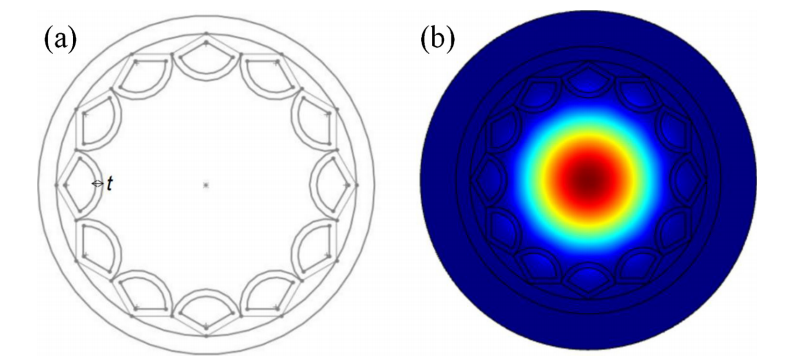
(a) Cross section of the hollow waveguide; (b) HE11 fundamental mode field distribution
The 90-cm-long hollow waveguide was then 3D printed and characterized. To verify the localization effect of the hollow waveguide on THz wave, the researchers measured the THz divergence angle at the end of the waveguide. The measured loss was 0.015 cm−1. The experimental results showed that the hollow waveguide can not only reduce the transmission loss of the terahertz wave in the air, but also effectively localize the terahertz wave. The researchers conclude that remote low-cost THz sensing and imaging can be achieved in the future by the development of flexible and longer hollow waveguides.
Authors of the paper include Pengfei Qi, Weiwei Liu and Cheng Gong.

Tuesday, May 22, 2018

Abstract-An broadband terahertz metamaterial filter based on multiplexed metallic bar resonators


Zijie Dai, Jing Yang, Qiang Su, Pengfei Qi, Dan Lu, Cheng Gong, Lu Sun, and Weiwei Liu

https://www.osapublishing.org/abstract.cfm?uri=CLEO_QELS-2018-JTh2A.178

An ultrabroad terahertz metamaterial filter based on multiplexed metallic bar resonators is designed and fabricated. The bandwidth of terahertz filter can be significantly broadened by the multiplexed configurations.
© 2018 The Author(s)

Monday, March 5, 2018

Abstract-Optical programmable metamaterials


Cheng Gong,  Nan Zhang,  Zijie Dai, Weiwei Liu,

https://www.spiedigitallibrary.org/conference-proceedings-of-spie/10697/106974M/Optical-programmable-metamaterials/10.1117/12.2309751.short


We suggest and demonstrate the concept of optical programmable metamaterials which can configure the device’s electromagnetic parameters by the programmable optical stimuli. In such metamaterials, the optical stimuli produced by a FPGA controlled light emitting diode array can switch or combine the resonance modes which are coupled in. As an example, an optical programmable metamaterial terahertz absorber is proposed. Each cell of the absorber integrates four meta-rings (asymmetric 1/4 rings) with photo-resistors connecting the critical gaps. The principle and design of the metamaterials are illustrated and the simulation results demonstrate the functionalities for programming the metamaterial absorber to change its bandwidth and resonance frequency.

© (2018) COPYRIGHT Society of Photo-Optical Instrumentation Engineers (SPIE). Downloading of the abstract is permitted for personal use only.

Monday, December 12, 2016

Abstract-Tunable reflecting terahertz filter based on chirped metamaterial structure


http://www.nature.com/articles/srep38732
Tunable reflecting terahertz bandstop filter based on chirped metamaterial structure is demonstrated by numerical simulation. In the metamaterial, the metal bars are concatenated to silicon bars with different lengths. By varying the conductivity of the silicon bars, the reflectivity, central frequency and bandwidth of the metamaterial could be tuned. Light illumination could be introduced to change the conductivity of the silicon bars. Numerical simulations also show that the chirped metamaterial structure is insensitive to the incident angle and polarization-dependent. The proposed chirped metamaterial structure can be operated as a tunable bandstop filter whose modulation depth, bandwidth, shape factor and center frequency can be controlled by light pumping.

Wednesday, November 9, 2016

Abstract-Strong Spatial Confinement of Terahertz Wave inside Femtosecond Laser Filament


ACS Photonics, Just Accepted Manuscript
DOI: 10.1021/acsphotonics.6b00512
Publication Date (Web): November 8, 2016
Copyright © 2016 American Chemical Society

In this paper, a new experimental phenomenon is demonstrated. During the femtosecond laser filamentation, the generated terahertz (THz) pulse has been found to be strongly confined inside the plasma channel, reaching a spatial diameter of a few tens of micrometres. It has been attributed to the formation of a plasma negative dielectric waveguide induced by the transverse inhomogeneous plasma density distribution. The new experimental phenomenon will renew the understanding of the THz wave generation and propagation dynamics during the femtosecond laser and air plasma interaction. Due to this strong spatial confinement, THz electric field strength could be enhanced by orders of magnitude, potentially providing a new approach to perform THz nonlinear optics with low laser energy.

Tuesday, September 20, 2016

Abstract-3D printed low-loss THz waveguide based on Kagome photonic crystal structure


Jing Yang, Jiayu Zhao, Cheng Gong, Haolin Tian, Lu Sun, Ping Chen, Lie Lin, and Weiwei Liu

https://www.osapublishing.org/oe/abstract.cfm?uri=oe-24-20-22454


A low-loss hollow core terahertz waveguide based on Kagome photonic crystal structure has been designed and fabricated by 3D printing. The 3D printed waveguide has been characterized by using THz time-domain spectroscopy. The results demonstrate that the obtained waveguide features average power propagation loss of 0.02 cm−1 for 0.2-1.0 THz (the minimum is about 0.002 cm−1 at 0.75 THz). More interesting, it could be simply mechanically spliced without any additional alignment, while maintaining the excellent performance. The 3D printing technique will be a promising solution to fabricate Kagome THz waveguide with well controllable characteristics and low cost.
© 2016 Optical Society of America
Full Article  |  PDF Article

Tuesday, August 30, 2016

Abstract-Broadband terahertz metamaterial absorber based on sectional asymmetric structures


Cheng Gong, Mingzhou Zhan, Jing Yang, Zhigang Wang, Haitao Liu, Yuejin Zhao & Weiwei Liu

http://www.nature.com/articles/srep32466

We suggest and demonstrate the concept and design of sectional asymmetric structures which can manipulate the metamaterial absorber’s working bandwidth with maintaining the other inherent advantages. As an example, a broadband terahertz perfect absorber is designed to confirm its effectiveness. The absorber’s each cell integrates four sectional asymmetric rings, and the entire structure composed of Au and Si3N4 is only 1.9 μm thick. The simulation results show the bandwidth with absorptivity being larger than 90% is extended by about 2.8 times comparing with the conventional square ring absorber. The composable small cell, ultra-thin, and broadband absorption with polarization and incident angle insensitivity will make the absorber suitable for the applications of focal plane array terahertz imaging.