Showing posts with label Baile Zhang. Show all posts

Friday, August 7, 2020

Abstract-Photonic amorphous topological insulator


Peiheng Zhou, Gui-Geng Liu, Xin Ren, Yihao Yang, Haoran Xue, Lei Bi, Longjiang Deng, Yidong Chong, Baile Zhang,

Transition of photonic lattices with increasing disorder


https://www.nature.com/articles/s41377-020-00368-7#:~:text=Photonic%20topological%20insulators%20(PTIs)1,insulator%20materials%20do%20for%20electrons.

The current understanding of topological insulators and their classical wave analogs, such as photonic topological insulators, is mainly based on topological band theory. However, standard band theory does not apply to amorphous phases of matter, which are formed by non-crystalline lattices with no long-range positional order but only short-range order, exhibiting unique phenomena such as the glass-to-liquid transition. Here, we experimentally investigate amorphous variants of a Chern number-based photonic topological insulator. By tuning the disorder strength in the lattice, we demonstrate that photonic topological edge states can persist into the amorphous regime prior to the glass-to-liquid transition. After the transition to a liquid-like lattice configuration, the signatures of topological edge states disappear. This interplay between topology and short-range order in amorphous lattices paves the way for new classes of non-crystalline topological photonic bandgap materials.

Friday, April 17, 2020

Abstract-Terahertz topological photonics for on-chip communication


Xiongbin Yu, Prakash Pitchappa, Julian Webber, Baile Zhang, Masayuki Fujita, Tadao Nagatsuma, Ranjan Singh


https://www.nature.com/articles/s41566-020-0618-9

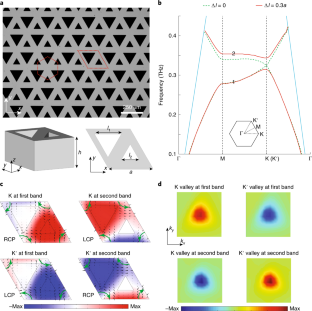
The realization of integrated, low-cost and efficient solutions for high-speed, on-chip communication requires terahertz-frequency waveguides and has great potential for information and communication technologies, including sixth-generation (6G) wireless communication, terahertz integrated circuits, and interconnects for intrachip and interchip communication. However, conventional approaches to terahertz waveguiding suffer from sensitivity to defects and sharp bends. Here, building on the topological phase of light, we experimentally demonstrate robust terahertz topological valley transport through several sharp bends on the all-silicon chip. The valley kink states are excellent information carriers owing to their robustness, single-mode propagation and linear dispersion. By leveraging such states, we demonstrate error-free communication through a highly twisted domain wall at an unprecedented data transfer rate (exceeding ten gigabits per second) that enables real-time transmission of uncompressed 4K high-definition video (that is, with a horizontal display resolution of approximately 4,000 pixels). Terahertz communication with topological devices opens a route towards terabit-per-second datalinks that could enable artificial intelligence and cloud-based technologies, including autonomous driving, healthcare, precision manufacturing and holographic communication.

Tuesday, January 15, 2019

Abstract-Realization of a three-dimensional photonic topological insulator


Yihao Yang, Zhen Gao, Haoran Xue, Li Zhang, Mengjia He, Zhaoju Yang, Ranjan Singh, Yidong Chong, Baile Zhang, Hongsheng Chen
Fig. 2: Sample, experimental setup and measured bulk dispersion of the 3D photonic topological insulator.


https://www.nature.com/articles/s41586-018-0829-0

Confining photons in a finite volume is highly desirable in modern photonic devices, such as waveguides, lasers and cavities. Decades ago, this motivated the study and application of photonic crystals, which have a photonic bandgap that forbids light propagation in all directions. Recently, inspired by the discoveries of topological insulators, the confinement of photons with topological protection has been demonstrated in two-dimensional (2D) photonic structures known as photonic topological insulators, with promising applications in topological lasers and robust optical delay lines. However, a fully three-dimensional (3D) topological photonic bandgap has not been achieved. Here we experimentally demonstrate a 3D photonic topological insulator with an extremely wide (more than 25 per cent bandwidth) 3D topological bandgap. The composite material (metallic patterns on printed circuit boards) consists of split-ring resonators (classical electromagnetic artificial atoms) with strong magneto-electric coupling and behaves like a ‘weak’ topological insulator (that is, with an even number of surface Dirac cones), or a stack of 2D quantum spin Hall insulators. Using direct field measurements, we map out both the gapped bulk band structure and the Dirac-like dispersion of the photonic surface states, and demonstrate robust photonic propagation along a non-planar surface. Our work extends the family of 3D topological insulators from fermions to bosons and paves the way for applications in topological photonic cavities, circuits and lasers in 3D geometries.

Wednesday, April 23, 2014

Letter-Terahertz transparency of optically opaque metallic films


Zhengyong Song1, Zhen Gao1, Youming Zhang1 and Baile Zhang1,2
Hide affiliations
1 Division of Physics and Applied Physics, School of Physical and Mathematical Sciences, Nanyang Technological University - 21 Nanyang Link, Singapore 637371, Singapore
2 Centre for Disruptive Photonic Technologies, Nanyang Technological University - 21 Nanyang Link, Singapore 637371, Singapore 


Letter
Here we present an alternative approach to design a freestanding transparent conducting device for wide-angle and polarization-insensitive incidence of electromagnetic waves at terahertz frequencies. It is realized by depositing periodic metallic patches on top and bottom of the subwavelength metallic mesh. Based on the numerical computations, the deposited metallic patches can suppress the reflection and enhance the transmission. The high transmission of the designed system is attributed to the impedance matching to the vacuum. This design of a transparent conducting device can be useful in applications, such as optoelectronic electrodes and micro-electronic displays, where both high electrical conductivity and high optical transmittance are desirable.