|
A repository & source of cutting edge news about emerging terahertz technology, it's commercialization & innovations in THz devices, quality & process control, medical diagnostics, security, astronomy, communications, applications in graphene, metamaterials, CMOS, compressive sensing, 3d printing, and the Internet of Nanothings. NOTHING POSTED IS INVESTMENT ADVICE! REPOSTED COPYRIGHT IS FOR EDUCATIONAL USE.
Tuesday, December 31, 2013
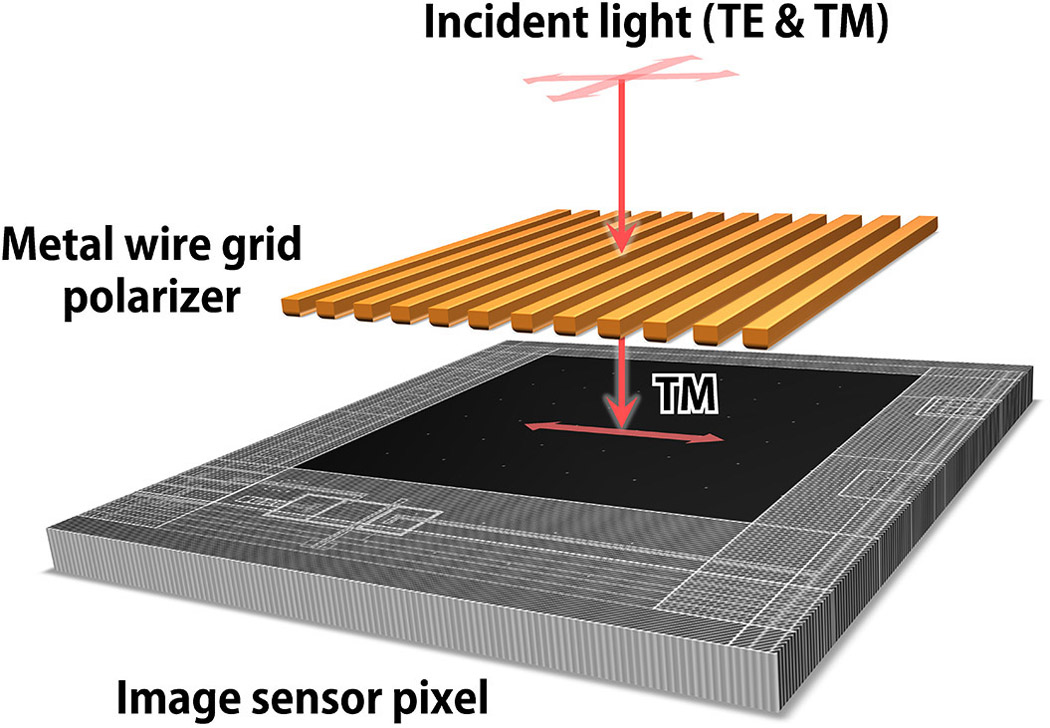
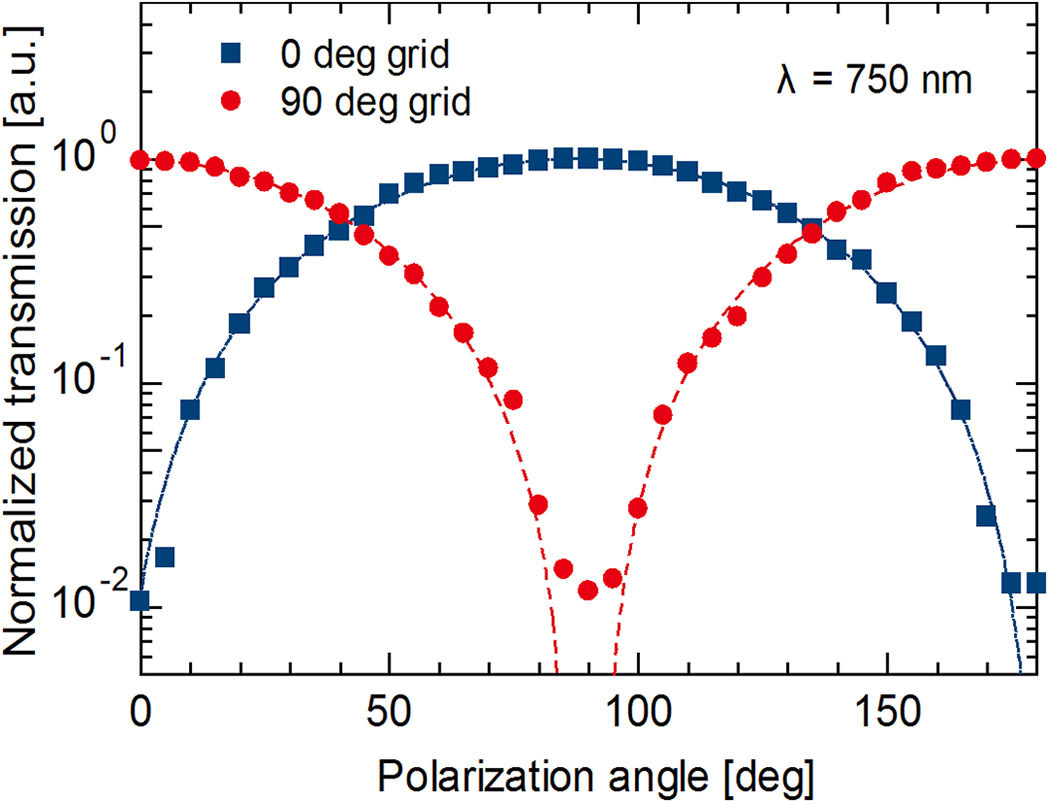
A high-extinction-ratio optical polarizer based on advanced CMOS technology
Graphene-based nano-antennas may enable nanonetworks, terabits-per-second wireless communications
Internet of nanothings" to enable integration into everything, such as biological and chemical nanosensors for advanced health monitoring systems
December 30, 2013
Internet of nanothings (credit: Ian Akyildiz and Josep Jornet)
Georgia Tech engineers have developed a way to use graphene nano-antennas to allow for devices powered by small amounts of scavenged energy.
With antennas made from conventional materials like copper, communication between low-power nanomachines would be virtually impossible. That’s because at that size, antennas normally operate at higher frequencies.
The communications challenge is that at the micron scale, metallic antennas would have to operate at frequencies of hundreds of terahertz*, but their range would be limited by propagation losses to just a few microns (millionths of a meter). And they’d require lots of power — more power than nanomachines are likely to have.
But by taking advantage of the unique electronic properties of graphene, the researchers found, graphene could generate an electronic “surface wave” that would allow nanonetworks of antennas just one micron long and 10 to 100 nanometers wide to do the work of much larger antennas, based on their modeling and simulations.
“We are exploiting the peculiar propagation of electrons in graphene to make a very small antenna that can radiate at much lower frequencies than classical metallic antennas of the same size,” said Ian Akyildiz, a Ken Byers Chair professor in Telecommunications in the School of Electrical and Computer Engineering at the Georgia Institute of Technology.
Schematic shows how surface plasmon polariton (SPP) waves would be formed on the surface of tiny antennas fabricated from graphene. The antennas would be about one micron long and 10 to 100 nanometers wide. (Credit: Ian Akyildiz and Josep Jornet)
“When electrons in graphene are excited by an incoming electromagnetic wave, for instance, they start moving back and forth,” explained Akyildiz. “Because of the unique properties of the graphene, this global oscillation of electrical charge results in a confined electromagnetic wave on top of the graphene layer.”
Known technically as a “surface plasmon polariton” (SPP) wave, the effect will allow the nano-antennas to operate at the low end of the terahertz frequency range, between 0.1 and 10 terahertz — instead of at 150 terahertz with traditional copper antennas at nanoscale sizes. For transmitting, the SPP waves can be created by injecting electrons into the dielectric layer beneath the graphene sheet.
Materials such as gold, silver and other noble metals also can support the propagation of SPP waves, but only at much higher frequencies than graphene. Conventional materials such as copper don’t support the waves.
By allowing electromagnetic propagation at lower terahertz frequencies, the SPP waves require less power — putting them within range of what might be feasible for nanomachines operated by energy harvesting technology pioneered by Zhong Lin Wang, a professor in Georgia Tech’s School of Materials Science and Engineering.
“With this antenna, we can cut the frequency by two orders of magnitude and cut the power needs by four orders of magnitude,” said Jornet. “Using this antenna, we believe the energy-harvesting techniques developed by Dr. Wang would give us enough power to create a communications link between nanomachines.”
“We believe that this is just the beginning of a new networking and communications paradigm based on the use of graphene.”
The researchers are also working on graphene-based nanoscale transceivers and the transmission protocols necessary for communication between nanomachines.
Terabits-per-second wireless networks
The nanomachines in the network that the researchers envision would include several integrated components. In addition to the energy-harvesting nanogenerators, there would be nanoscale sensing, processing and memory technologies, which are under development by other groups. The nanoscale antenna and transceiver work being done at Georgia Tech would allow the devices to communicate the information they sense and process to the outside world.
Wireless-access networks for 5G systems (credit: Ian Akyildiz and Josep Jornet)
Hundreds or thousands of graphene antenna-transceiver sets might also be combined to help full-size cellular phones and Internet-connected laptops communicate faster.
Wireless ultra high speed indoor networks (credit: Ian Akyildiz and Josep Jornet)
“The terahertz band can boost current data rates in wireless networks by more than two orders of magnitude,” Akyildiz noted. “The data rates in current cellular systems are up to one gigabit-per-second in LTE advanced networks or 10 gigabits-per-second in millimeter wave (or 60 gigahertz) systems. We expect data rates on the order of terabits-per-second in the terahertz band.”
The unique properties of graphene are critical to this antenna — and other future electronic devices, Akyildiz says. “Graphene is a very powerful nanomaterial that will dominate our lives in the next half-century,” he said. “The European community will be supporting a very large consortium involving many universities and companies with an investment of one billion euros to conduct research into this material.”
The researchers have so far evaluated numerous nano-antenna designs using modeling and simulation techniques in their laboratory. The next step will be to actually fabricate a graphene nano-antenna and operate it using a transceiver also based on graphene.
Nanorobots for oil reservoir discovery and monitoring (credit: Ian Akyildiz and Josep Jornet)
“Our project shows that the concept of graphene-based nano-antennas is feasible, especially when taking into account very accurate models of electron transport in graphene,” said Akyildiz. “Many challenges remain open, but this is a first step toward creating advanced nanomachines with many applications in the biomedical, environmental, industrial and military fields.”
So what else can we do with graphene nano-antennas and when?
“The applications of this research are twofold,” said researcher Dr. Josep Miquel Jornet, now assistant professor at the State University of New York at Buffalo, in an interview with KurzweilAI. “On one hand, the very small size of the developed graphene-based nano-antennas and nanotransceivers allows them to be embedded into novel nanomachines.”
Biological nanomachiness applications: advanced health systems (credit: Ian Akyildiz and Josep Jornet)
“For example, these can be incorporated into biological and chemical nanosensors to ultimately create Wireless NanoSensor Networks (WNSNs), with applications in advanced health monitoring systems. The size of the individual wireless nanosensor mote would allow the integration of WNSNs in virtually everything, from the fabrics of our clothing to the coating of a vehicle, or even inside the human body.”
Chemical/biological attack prevention (credit: Ian Akyildiz and Josep Jornet)
They could also be used in new biological and chemical hazard detection systems, he said.
“Similarly, the very small size of the graphene-based nano-antennas and nanotransceivers makes them also suitable for Wireless Network-on-Chip (WNoC) applications. For example, very high-speed wireless links across nanoprocessors can enable transformative designs in high-performance large-scale multi-core computing architectures.
Terahertz band communication for small cells in beyond-4G (B4G) cellular systems (credit: Ian Akyildiz and Josep Jornet)
“On the other hand, the proposed graphene-based nano-antennas and nanotransceivers are a potentially enabling technology for ultra-broadband communications in the THz Band. The increasing demand for higher speed wireless communication “anywhere, anytime” has motivated the exploration of higher spectral bands for communication. By moving to the THz Band, very high transmission bandwidths become available (from tens to hundreds of GHz, at least, and up to a few THz).
Wireless high-volume storage transfers (credit: Ian Akyildiz and Josep Jornet)
“For the time being, challenges in the generation and detection of THz Band radiation from compact transceivers have limited the potential of this field. Graphene brings the THz Band one step closer to practical applications in short-range (up to a few meters at most) wireless communication and networks. For example, we can think of ultra-high-speed wireless networks as well as ultra-fast data transfers among nearby devices (e.g., to transfer the content of a blue-ray disk to an iPad would take approximately less than a second).
“The current work is mainly based on novel analytical models as well as accurate simulations. We expect to have a working prototype of the antenna within 6 months to 1 year. In parallel, we are working on the idea of an entire transceiver based on graphene. The commercialization of the technology will still have to wait at least a few years. One of the main challenges is actually the industrial manufacturing of high quality graphene structures, which is needed for practical commercialization.”
The research was supported by the National Science Foundation.
* Frequency in Hz = c/wavelength in meters, where c = 3×10⁸. So for an antenna 1 micron (10-6 meters) long, the resonant frequency would be 3×10¹⁴ or 100 THz.
REFERENCES:
- Ian Akyildiz et al., IEEE Journal of Selected Areas in Communications, in press
Topics: Electronics | Internet/Telecom
Sunday, December 29, 2013
A Roman fresco discovered under a XIX century painting
Terahertz analysis unveiled a hidden image that was never discovered before with other imaging technologies
http://www.digitalmeetsculture.net/article/a-roman-fresco-discovered-under-a-xix-century-painting/
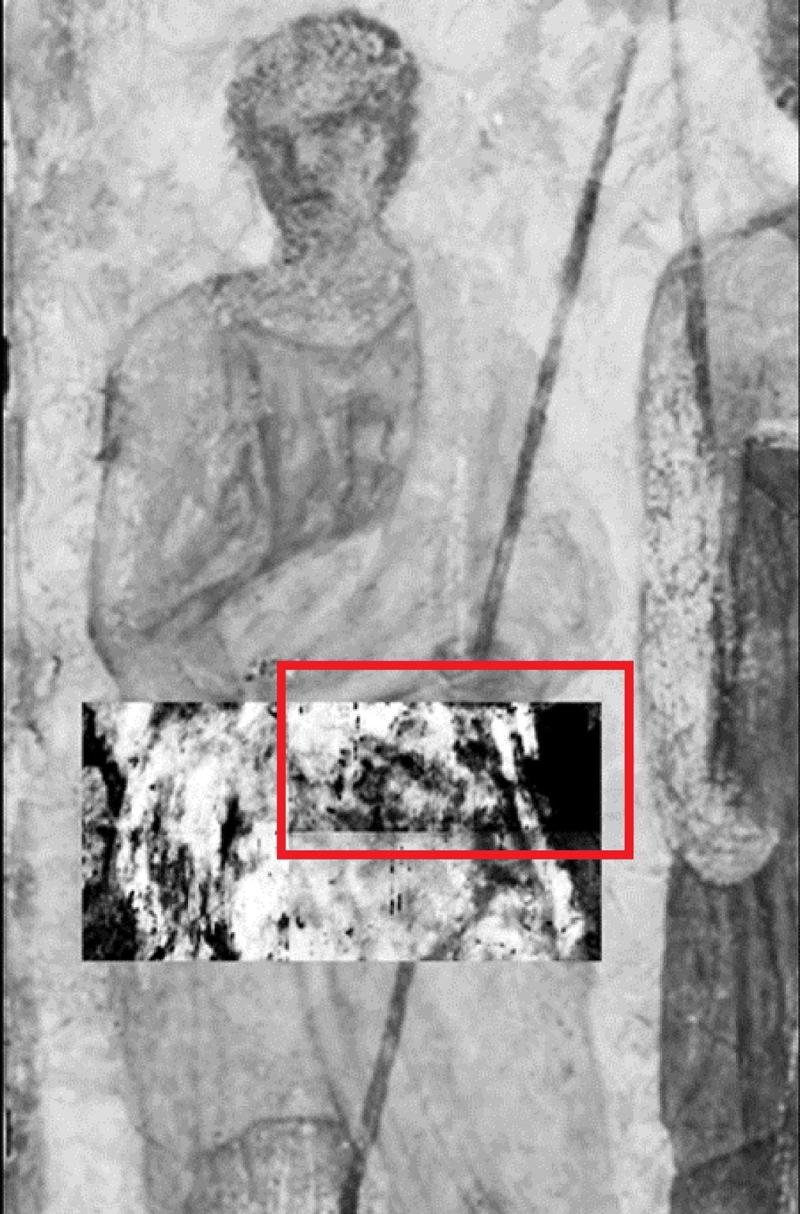
The terahertz technology, also used in airport security scanners, has detectedthe face of an ancient Roman man hidden below the surface of a wall painting in the Louvre Museum in Paris. The nineteenth-century fresco under examination was Trois homes armés de lances, in the Giampietro Campana collection (an Italian art collector in the 1800s who sometimes restored damaged parts in the artworks, or reworked the original), and the analysis with terahertz technology unveiled an authentic Roman fresco that lies under it, which scientists and art historians believe may be thousands of years old. Art historians believe that Trois homes armés de lances was painted after the ancient fresco was removed from its original wall in Italy and entered Campana’s collection.
It is a well-known habit that in the past artists sometimes re-used canvases or covered old paintings with new works, in order to avoid the expense of buying a new canvas or to enhance colors and shapes in a prior composition. J. Bianca Jackson, Ph.D. now at the University of Rochester, who reported on the project, explained how the staff tried with terahertz technology analysis when suspicions that a hidden image might lie beneath Campana’s brushstrokes came out.
“We were amazed, and we were delighted,” said Jackson. “We could not believe our eyes as the image materialized on the screen. Underneath the top painting of the folds of a man’s tunic, we saw an eye, a nose and then a mouth appear. We were seeing what likely was part of an ancient Roman fresco, thousands of years old.”
“Terahertz technology has been in use for some time, especially in quality control in the pharmaceutical industry to assure the integrity of pills and capsules, in biomedical imaging and even in homeland security with those whole-body scanners that see beneath clothing at airport security check points,”said Jackson, “But its use in examining artifacts and artworks is relatively new.”
This research was funded by the EC project CHARISMA and in part byAHRC/EPSRC Science and Heritage Programme; while the research on the possibilities offerd by the use of terahertz technology for heritage investigation is on-going, as witnessed by the recently launched project INSIDDE.
“No previous imaging technique, including almost half a dozen commonly used to detect hidden images below paintings, forged signatures of artists and other information not visible on the surface has revealed a lost image in this fresco,”Jackson said. “This opens to door to wider use of the technology in the world of art, and we also used the method to study a Russian religious icon and the walls of a mud hut in one of humanity’s first settlements in what was ancient Turkey.”
Source: American Chemical Society (ACS) (2013, April 10). Ancient Roman man hidden beneath famouspaintingattheLouvre. ScienceDaily.Retrieved –http://www.sciencedaily.com/releases/2013/04/130410154622.htm
Abstract-The frequency selectivity of double H-shaped metallic structures
Xiaoxia Bu, Guozhong Zhao
Capital Normal Univ. (China)
Proc. SPIE 9043, 2013 International Conference on Optical Instruments and Technology: Optoelectronic Devices and Optical Signal Processing, 90430V (December 23, 2013); doi:10.1117/12.2036478
This paper presents the design and numerical simulation of the double H-shaped metallic periodic structure based on finite difference time domain (FDTD) method in terahertz frequency range. The double H-shaped structure unit cell consists of two H structures overlapped in the same plane. Numerical simulation results show that the double H-shaped structure results in a distinct and strong transmission trap in 0.2~3.0THz range. The position and the full wave at half maximum (FWHM) of transmission trap are changed with different structure size. The surface current distribution of structure is numerical simulated, which clarifies the frequency selection mechanism of the transmission spectra. © (2013) COPYRIGHT Society of Photo-Optical Instrumentation Engineers (SPIE). Downloading of the abstract is permitted for personal use only.
Friday, December 27, 2013
A new way of seeing: Metamaterial lens has ten times more power
http://www.thealmagest.com/new-way-seeing-metamaterial-lens-ten-times-power-2/8427
A lens with ten times the resolution of any current lens, making it a powerful new tool for the biological sciences has been developed by researchers at the University of Sydney.
“This advance means we can unlock previously inaccessible information on the structure of molecules, their chemical make-up and the presence of certain proteins,” said Alessandro Tuniz, lead author of an article on the lens published in Nature Communications.
Tuniz, a postdoctoral associate at the University, said, “This opens up an entirely new tool for biological studies. It could allow earlier skin cancer diagnosis, because smaller melanomas can be recognised. For breast cancer, it can also be used to more accurately check that all traces of a tumour have been cut out during surgery.”
The four member research team from the University’s School of Physics, including Alessandro Tuniz, are all authors on the paper. They created the lens using fibre optic manufacturing technology.
The lens is a metamaterial – a material with completely new properties not found in nature.
Making the lens was not a matter of making a better form of the lenses already in existence but of making a lens which uses light waves in a way not previously possible.
“Creating metamaterials is a cutting-edge area of science with a massive range of potential uses from aerospace to solar power, telecommunications to defence,” said researcher Dr Boris Kuhlmey.
“The major challenge is making these materials on a scale that is useful. This is one of the first times a metamaterial with a real world application, quickly able to be realised, has been feasible. Within the next two to three years, new terahertz microscopes that are ten times more powerful than current ones will be possible using our metamaterial.
“We know of only two or three other cases worldwide, including for wireless internet and MRI applications, where metamaterials could also be put into practice in the next couple of years.”
The potential to create a new high power lens, able to see much finer details than using conventional lenses was spotted almost a decade ago. It has taken until now to make the lens on a useful scale, a thousand times smaller than the early experimental models.
“The difficulty was making large quantities of matter structured on a micrometric scale,” said Alessandro Tuniz.
The new lens, made of plastic and metal, uses terahertz waves, electromagnetic waves with frequencies higher than microwaves but lower than infrared radiation and visible light. It operates in a region of the spectrum where very few other optical tools are available and all of them have limitations, in particular in terms of resolution.
“If we think of this in comparison to an X-ray which allows us to see inside objects at a high resolution but with associated danger from radiation, by contrast our metamaterial lens allows us not only to see through some opaque materials, but also to gather information on their chemical composition, and even information on interaction between certain molecules, without the danger of X-rays,” Tuniz said.
Abstract-Fast and High Dynamic Range Imaging with Superconducting Tunnel Junction Detectors
We have demonstrated a combined test of the submillimeter-wave SIS photon detectors and GaAs-JFET cryogenic integrated circuits. A relatively large background photo-current can be read out by fast-reset integrating amplifiers. An integration time of 1 ms enables fast frame rate readout and large dynamic range imaging, with an expected dynamic range of 8,000 in 1 ms. Ultimate fast and high dynamic range performance of superconducting tunnel junction detectors (STJ) will be obtained when photon counting capabilities are employed. In the terahertz frequencies, when input photon rate of 100 MHz is measured, the photon bunching gives us enough timing resolution to be used as phase information of intensity fluctuation. Application of photon statistics will be a new tool in the terahertz frequency region. The design parameters of STJ terahertz photon counting detectors are discussed.
Wednesday, December 25, 2013
Dr. Daniel Mittleman from Rice University shares his thoughts with blog readers on the Commercialization of Terahertz
My Note: The recognized spokesman for the Terahertz Community is Dr. Daniel Mittleman from Rice University. He is also one of the most helpful, and friendly people I have communicated with regarding THz. Thank you Dr. Mittleman for once again sharing your thoughts.
Hi Randy,
So, I've been thinking a lot these days about the topic of commercialization of terahertz technologies. I believe that the commercial growth of the field is really at a turning point right now, for several reasons.
First, let me explain why I think this.
One reason is the number of companies who are active and visible in the field. To give you an example, I'll describe the growth in one particular trade show, which I think is something of a bellwether. The show associated with the IRMMW-THz conference series has never been particularly large. This conference series has been around for nearly 40 years, and for almost all of that time, there was either no trade show at all or a pretty small one. But, the growth in recent years has been astounding. In 2008, there were 11 companies at the exhibit. In 2010, there were 19. This year in Mainz, there were 31. I am very interested to see what the turnout will be this fall in Tucson (www.irmmw-thz2014.org).
I think that all of this excitement is the result of the confluence of several factors. First, there have been a number of technical breakthroughs which have really had a big impact. Things like the development of terahertz quantum cascade lasers, the advances of CMOS electronics into the terahertz domain, and the continued progress in the packaging and cost reductions for femtosecond lasers have all contributed to real progress and optimism. Second, it seems as if the level of awareness of the potential impact of these technologies has reached a critical mass. We are needing to explain what is terahertz radiation less and less, because more and more people seem to know. And thirdly, there is a growing recognition among industry experts that terahertz technologies will be truly necessary in the not-too-distant future in a number of areas, like for example for short-range high-bandwidth wireless communications.
All of this interest is translating into action. The IEEE has recently converted their terahertz Interest Group to a Study Group, with the charge of beginning the process of developing standards. The Federal Communications Commission is now considering a petition to develop rules for technologies using radiation above 95 GHz. All in all, it is an exciting time to be involved.
Happy holidays, and regards,
Dan
MY Postscript: I followed up my questions with Dr. Mittleman for his specific thoughts on the role time-domain terahertz will play in the commercialization of THz. He was kind enough to provide these follow-up comments:
I'm pretty confident that there are things the time-domain systems can do that no other technique will ever duplicate - things that exploit the very large bandwidth (e.g., broadband spectroscopy or time-of-flight imaging measurements) and things that require signals above 1 THz (CMOS will probably never get up much above 1 THz).
Happy Holidays!
Happy Holidays!
Tuesday, December 24, 2013
Abstract-Monolithic metallic nanocavities for strong light-matter interaction to quantum-well intersubband excitations
A. Benz, S. Campione, S. Liu, I. Montano, J. F. Klem, M. B. Sinclair, F. Capolino, and I. Brener »View Author Affiliations
We present the design, realization and characterization of strong coupling between an intersubband transition and amonolithic metamaterial nanocavity in the mid-infrared spectral range. We use a ground plane in conjunction with a planar metamaterial resonator for full three-dimensional confinement of the optical mode. This reduces the mode volume by a factor of 1.9 compared to a conventional metamaterial resonator while maintaining the same Rabi frequency. The conductive ground plane is implemented using a highly doped n+ layer which allows us to integrate it monolithically into the device and simplify fabrication.
© 2013 Optical Society of America
Abstract-Wavelength-multiplexed quantum networks with ultrafast frequency combs
-
- Renné Medeiros de Araújo,
- Shifeng Jiang,
- Claude Fabre
- & Nicolas Treps
Highly entangled quantum networks (cluster states) lie at the heart of recent approaches to quantum computing1, 2. Yet the current approach for constructing optical quantum networks does so one node at a time3, 4, 5, which lacks scalability. Here, we demonstrate the single-step fabrication of a multimode quantum resource from the parametric downconversion of femtosecond-frequency combs. Ultrafast pulse shaping6 is employed to characterize the comb's spectral entanglement7, 8. Each of the 511 possible bipartitions among ten spectral regions is shown to be entangled; furthermore, an eigenmode decomposition reveals that eight independent quantum channels9(qumodes) are subsumed within the comb. This multicolour entanglement imports the classical concept of wavelength-division multiplexing to the quantum domain by playing upon frequency entanglement to enhance the capacity of quantum-information processing. The quantum frequency comb is easily addressable, robust with respect to decoherence and scalable, which renders it a unique tool for quantum information.
Abstract-The frequency selectivity of double H-shaped metallic structures
Xiaoxia Bu, Guozhong Zhao
Capital Normal Univ. (China)
Proc. SPIE 9043, 2013 International Conference on Optical Instruments and Technology: Optoelectronic Devices and Optical Signal Processing, 90430V (December 23, 2013); doi:10.1117/12.2036478
From Conference Volume 9043
- 2013 International Conference on Optical Instruments and Technology: Optoelectronic Devices and Optical Signal Processing
- Yi Dong; Xiaoyi Bao; Chao Lu; Xiangjun Xin; Scott S. Yam; Xuping Zhang
This paper presents the design and numerical simulation of the double H-shaped metallic periodic structure based on finite difference time domain (FDTD) method in terahertz frequency range. The double H-shaped structure unit cell consists of two H structures overlapped in the same plane. Numerical simulation results show that the double H-shaped structure results in a distinct and strong transmission trap in 0.2~3.0THz range. The position and the full wave at half maximum (FWHM) of transmission trap are changed with different structure size. The surface current distribution of structure is numerical simulated, which clarifies the frequency selection mechanism of the transmission spectra. © (2013) COPYRIGHT Society of Photo-Optical Instrumentation Engineers (SPIE). Downloading of the abstract is permitted for personal use only.
Prof. Sensale Receives NSF CAREER Award
December 23, 2013
A new ECE faculty member, Prof. Berardi Sensale Rodriguez, has received a five-year NSF CAREER Award entitled, “CAREER: THz active metamaterials employing thin-film semiconductors.”
Objective: The objective of this program is to provide a solid foundation for Prof. Sensale’s long-term research goal of developing active solid-state terahertz devices that can be employed in compact, low cost communication and imaging systems. Based on the enhanced light-matter interaction in thin-film semiconductor-based metamaterials, this proposal aims to develop devices for: a) terahertz beam steering, based on the linear properties of these materials, and b) terahertz generation via mixing and/or higher harmonic generation, based on the materials nonlinearities, thereby targeting two of the central limitations in existing terahertz technology.
Intellectual Merit: The intellectual merit is to foster the development of novel terahertz optoelectronic devices, which can form the basis for a wide range of applications. Moreover, these studies are expected to improve the current understanding about the terahertz properties of two thin-film semiconductors: vanadium dioxide and graphene, especially in terms of their non-linear properties. Since both materials can be built on arbitrary substrates, their low cost is expected to lead to market applications. Broader Impact: The broader impacts are to create some of the components necessary to make complex terahertz systems and to make these more readily available. It is expected that the developed technologies will be transformative to a broad range of scientific and application-oriented communities. Moreover, undergraduate and graduate students will be trained in the emergent fields of terahertz and nanomaterials, and they are an integral element of the designed outreach activities to disseminate the new discoveries to the general audience, school teachers and students.
Abstract-Granular Structure Determined by Terahertz Scattering
Philip Born, Nick Rothbart, Matthias Sperl, Heinz-Wilhelm Hübers
(Submitted on 23 Dec 2013)
http://arxiv-web3.library.cornell.edu/abs/1312.6519
Light-scattering in the terahertz region is demonstrated for granular matter. A quantum-cascade laser is used in a benchtop setup to determine the angle-dependent scattering of spherical grains as well as coffee powder and sugar grains. For the interpretation of the form factors for the scattering from single particles one has to go beyond the usual Rayleigh-Gans-Debye theory and apply calculations within Mie theory. In addition to single scattering also collective correlations can be identified and extracted as a static structure factor.
Monday, December 23, 2013
Abstract-Molecular Rotation-Vibration Dynamics of Low-Symmetric Hydrate Crystal in the Terahertz Region
J. Phys. Chem. A, Just Accepted Manuscript
DOI: 10.1021/jp411609t
Publication Date (Web): December 22, 2013
Copyright © 2013 American Chemical Society
The rotational and vibrational dynamics of molecules in copper sulfate pentahydrate crystal are investigated with terahertz dielectric spectra. It is shown that the relaxation-like dielectric dispersion in the low frequency region is related to the reorientation of water molecules under the driving of terahertz electric field, whereas the resonant dispersion can be ascribed to lattice vibration. It is also found that, due to the hydrogen-bond effect, the vibrational mode at about 1.83 THz along [-111] direction softens with decreasing temperature, that is, the crystal expands in this direction when cooled. On the contrary, the mode hardens in the direction perpendicular to [-111] during the cooling process. This contributes to the further understanding of the molecular structure and bonding features of hydrate crystals.
Abstract-On-chip quantum interference between silicon photon-pair sources
Mode of operation, mechanism of photon-pair generation and physical structure of the device.
- J. W. Silverstone,
- D. Bonneau,
- K. Ohira,
- N. Suzuki,
- H. Yoshida,
- N. Iizuka,
- M. Ezaki,
- C. M. Natarajan,
- M. G. Tanner,
- R. H. Hadfield,
- V. Zwiller,
- G. D. Marshall,
- J. G. Rarity,
- J. L. O'Brien
- & M. G. Thompson
Large-scale integrated quantum photonic technologies1, 2 will require on-chip integration of identical photon sources with reconfigurable waveguide circuits. Relatively complex quantum circuits have been demonstrated already1, 2, 3, 4, 5, 6, 7, but few studies acknowledge the pressing need to integrate photon sources and waveguide circuits together on-chip8, 9. A key step towards such large-scale quantum technologies is the integration of just two individual photon sources within a waveguide circuit, and the demonstration of high-visibility quantum interference between them. Here, we report a silicon-on-insulator device that combines two four-wave mixing sources in an interferometer with a reconfigurable phase shifter. We configured the device to create and manipulate two-colour (non-degenerate) or same-colour (degenerate) path-entangled or path-unentangled photon pairs. We observed up to 100.0 ± 0.4% visibility quantum interference on-chip, and up to 95 ± 4% off-chip. Our device removes the need for external photon sources, provides a path to increasing the complexity of quantum photonic circuits and is a first step towards fully integrated quantum technologies.
Subscribe to:
Posts (Atom)