Showing posts with label terahertz plasmonics. Show all posts

Tuesday, May 5, 2020

Abstract-Dynamic Terahertz Plasmonics Enabled by Phase‐Change Materials


Young‐Gyun Jeong, Young‐Mi Bahk,  Dai‐Sik Kim,


https://onlinelibrary.wiley.com/doi/10.1002/adom.201900548

Phase‐change phenomena have been an attractive research theme for decades due to the dynamic transition of material properties providing extraordinary capabilities for versatile optical device applications. Even at the terahertz (THz) frequency regime, phase‐change materials (PCMs) promote the development of dynamic devices, especially when combined with a plasmonic approach delivering strong field enhancement and localization. According to the design of plasmonic metamaterials or hybrid composites, PCMs can actively modulate the electromagnetic properties of THz waves through thermal, electrical, and optical means. In turn, THz waves can affect the PCM properties in the nonlinear regime due to the intense field strength enhancement by plasmonic structures. Here, a few types of PCMs demonstrating promising potential in THz plasmonic applications are introduced. Starting from the best‐known transition metal oxide, vanadium dioxide (VO2), which possesses an insulator‐to‐metal phase transition near room temperature, superconductors, chalcogenides, ferroelectrics, liquid crystals, and liquid metals are covered along with their phase‐change properties and the control mechanisms infused with THz plasmonic applications. The corresponding recent progress presenting how PCMs combined with plasmonic structures can demonstrate effective THz modulation is reviewed. This general overview may provide a better understanding of dynamic THz plasmonics and new ideas for future THz technology.

Monday, March 23, 2020

Abstract-Transforming terahertz plasmonics within subwavelength hole arrays into enhanced terahertz mission via Smith-Purcell effect


Zijia Yu, Yucheng Liu, and Weihao Liu
Schematics of the proposed coherent Smith-Purcell radiation (SPR) transformed from the electron-beam-excited SPs modes on the material surface and within the subwavelength holes. Here ‘SM’ and ‘HM’ denote surface-mode and hole-mode, respectively.
https://www.osapublishing.org/oe/abstract.cfm?uri=oe-28-7-9501

We illustrate the transformation of terahertz plasmonics within an array of rectangular sub-wavelength holes (RSHs) into coherent and enhanced terahertz emission via Smith-Purcell effect. The radiative plasmonic modes within each RSH of the array are successively excited by an free-electron beam, which then generate coherent radiation by constructive interference. Compared with the case without taking plasmonics into consideration, the radiation field intensity is enhanced by more than an order of magnitude, affording a promising way of developing high-power terahertz radiation. We perform detailed analysis of the plasmonic modes within the RSH by using the dielectric waveguide theory, and the results are verified by numerical simulations. The influences of the RSH parameters on the radiation properties are revealed and discussed.
© 2020 Optical Society of America under the terms of the OSA Open Access Publishing Agreement

Wednesday, March 6, 2019

Scientists developed a tunable bio-imaging device using terahertz plasmonics


(a) A photograph of the spiral bull's eye (SBE) structure, (b) a microscope image of the double-corrugated devices, and (c) a scanning electron microscope image of the eight-tip Siemens-star aperture at the center of the SBE structure. CREDIT Scientific Reports
By
 Pranjal Mehar
https://www.techexplorist.com/scientists-developed-tunable-bio-imaging-device-terahertz-plasmonics/21335/
Non-invasive terahertz sensing could be a game-changer for future diagnostics.
Plasmon-based devices are powerful for use in highly sensitive evanescent-field detection and analysis, but they exhibit the problem of limited frequency tunability for fixed structures. This feature causes problems in the multi-frequency investigations required for materials characterization, bio-related research, etc.
In a new study by the Tokyo Tech, scientists have proposed a new device that enables a continuous frequency-tuneable evanescent-field concentration in the terahertz (THz) region with simple operation.
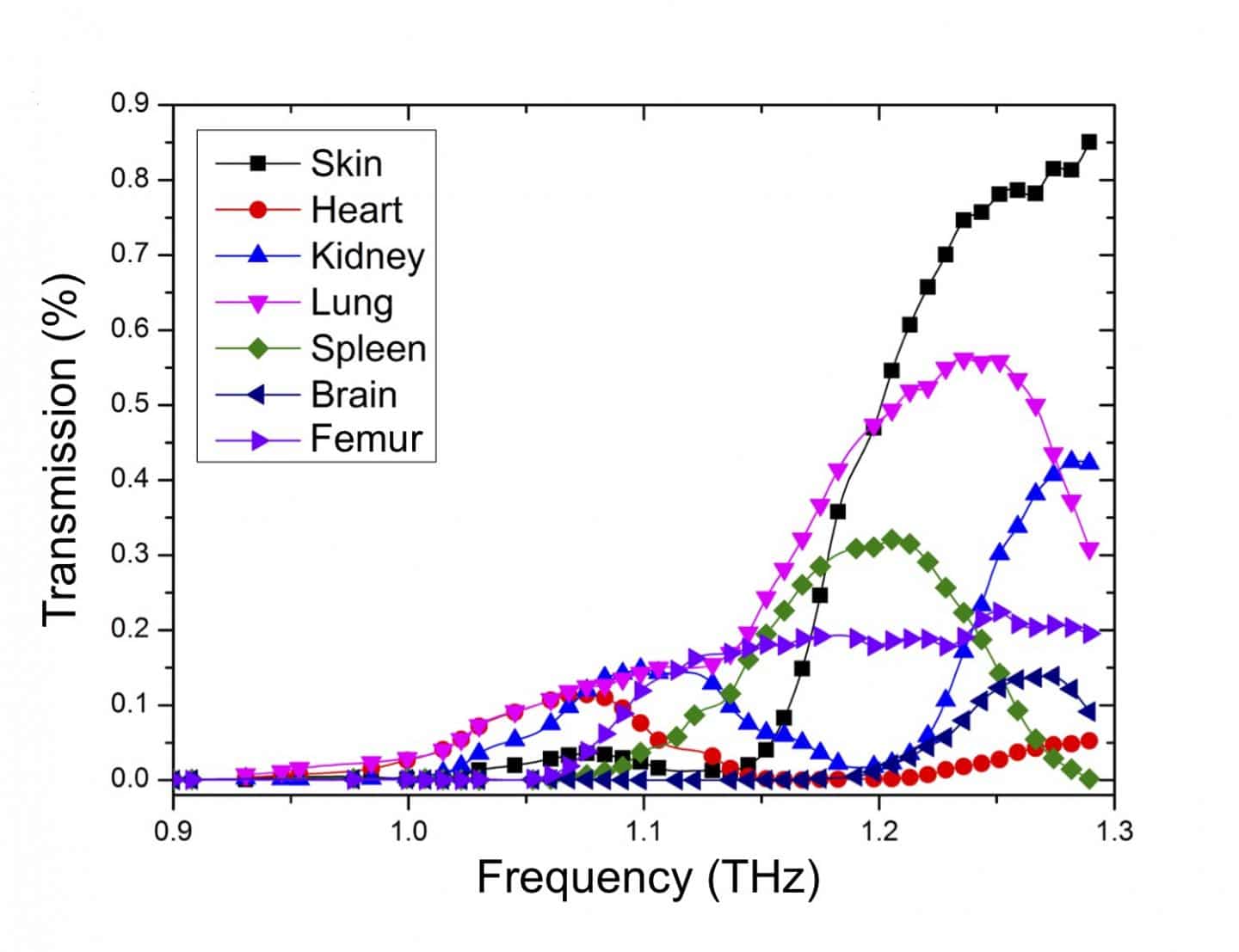
Scientists have developed an easy-to-use, tunable biosensor tailored for the terahertz range. During the experiment, this frequency-tunable plasmonic-based THz device was able to obtain the images of mouse organs. The images verified that the sensor is capable of distinguishing between different tissues.


THz medical examination of sections of mice organ tissues for skin, heart, kidney, lung, spleen, brain, and femur. Transmission spectra were measured by rotating the SBE. The spectra revealed different transmission peaks characteristic of the organ tissues.  CREDIT Scientific Reports
THz medical examination of sections of mice organ tissues for skin, heart, kidney, lung, spleen, brain, and femur. Transmission spectra were measured by rotating the SBE. The spectra revealed different transmission peaks characteristic of the organ tissues.
CREDIT: Scientific Reports

One of the key features of the new device is its spiral bull’s eye (SBE) design. Due to its smoothly varied grooves, the groove period continuously changes with the diameter direction, resulting in continuously frequency-tunable characteristics.
Moreover, the device incorporates a so-called Siemens-star aperture that enables a user-friendly way of selecting the desired frequency by simply changing the rotation of the spiral plasmonic structure.
Yukio Kawano at Tokyo Tech’s Laboratory for Future Interdisciplinary Research of Science and Technology said, “The device also increases the electric field intensity at the subwavelength aperture, thus significantly amplifying the transmission.”


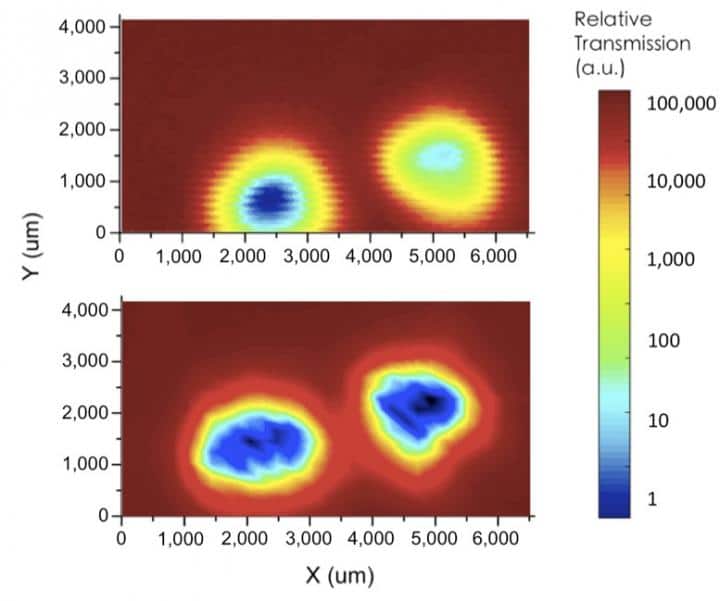
Terahertz mapping of the mouse-tail samples using a conventional setup (upper image) and the SBE (lower image). The hair (yellow and red), skin (light blue), and bone (dark blue) were clearly distinguishable using the SBE.  CREDIT Scientific Reports
Terahertz mapping of the mouse-tail samples using a conventional setup (upper image) and the SBE (lower image). The hair (yellow and red), skin (light blue), and bone (dark blue) were clearly distinguishable using the SBE.
CREDIT
Scientific Reports

To probe further, they also conducted THz mapping of mouse tails. By comparing images obtained with and without the SBE design, the study showed that the former led to a markedly improved ability to distinguish between different tissues such as hair, skin, and bone.
Kawano said, “Further investigations are planned to test the new device using various mouse organ tissues. The findings open up a new direction for plasmonic-based THz imaging of biological samples, which may eventually lead to the development of improved, non-invasive diagnostic imaging tools.”

Thursday, January 11, 2018

Abstract-THz metamaterials and plasmonics using 2D materials & highly conductive transparent oxides


Driven by a myriad of potential applications such as communications, medical imaging, security, spectroscopy, and so on, terahertz (THz) technology has emerged as a rapidly growing technological field during the last three decades. However, since conventional materials typically used in microwave and optical frequencies are lossy or do not effectively respond at these frequencies, it is essential to find or develop novel materials that are suitable for device applications in the THz range. Therefore, there is wide interest in the community in employing novel naturally-occurring materials, such as 2D materials, as well as in designing artificial metamaterial structures for THz applications. Here, we combined both of these approaches so to develop reconfigurable THz devices capable of providing amplitude modulation, phase modulation, and resonance frequency tuning

Wednesday, June 10, 2015

Abstract-Terahertz Plasmonic Field-Induced Conductivity Modulation in Gold


  • A. Y. Elezzabi,
  • P. Maraghechi
  • & S. R. Greig

  • We report the observation of terahertz (THz) electric field induced conductivity modulation in sub-wavelength gold plasmonic media. Through all-THz pump-probe time-resolved transmission spectroscopy, we demonstrate that the presence of induced surface charges influences near-field mediated light propagation. The phenomenon is ascribed to the enhanced metal conductivity due to enhanced surface density of conduction electrons. The surface induced charge dynamics are revealed via phase-dependent time-resolved signatures. The phenomenon is a prelude to a wide class of ultrafast active THz plasmonic devices and paves the way for plasmonic field effects devices, similar to semiconductor ones.

    Friday, March 7, 2014

    Abstract-Terahertz Plasmonic Structures Based on Spatially Varying Conductivities


    1. Barun Gupta1, 
    2. Shashank Pandey1,
    3. Sivaraman Guruswamy2, 
    4. Ajay Nahata1,*
    Article first published online: 7 MAR 2014
    DOI: 10.1002/adom.201400018
    Terahertz plasmonic structures are demonstrated in which the conductivity of the metallic film is varied spatially in order to further enhance the response. Using a commercially available inkjet printer, in which one cartridge is filled with conductive silver ink and a second cartridge is filled with resistive carbon ink, computer generated drawings of plasmonic structures are printed in which the individual printed dots can have differing amounts of the two inks, thereby creating a spatial variation in the conductivity. The silver ink has a DC conductivity that is only a factor of six lower than bulk silver, while the carbon ink acts as a lossy dielectric at THz frequencies. Both inks sinter at room temperature immediately after contact with the plastic film. Using a periodic array of subwavelength apertures as a test structure, patterns printed with different fractional amounts of the two inks show dramatically different enhanced optical transmission properties. These differences arise from changes in the propagation loss properties as a function of conductivity. This data is used to design and fabricate aperture arrays in which the conductivity varies spatially. The resulting plasmonic effect is found to dramatically alter the spatial beam profile of the transmitted THz radiation, as measured by THz imaging.