A repository & source of cutting edge news about emerging terahertz technology, it's commercialization & innovations in THz devices, quality & process control, medical diagnostics, security, astronomy, communications, applications in graphene, metamaterials, CMOS, compressive sensing, 3d printing, and the Internet of Nanothings. NOTHING POSTED IS INVESTMENT ADVICE! REPOSTED COPYRIGHT IS FOR EDUCATIONAL USE.
Showing posts with label security applications. Show all posts
Sunday, March 31, 2019
Abstract-Study of Automatic Detection of Concealed Targets in Passive Terahertz Images for Intelligent Security Screening
Rui Li, Chao Li, Hongwei Li, Shiyou Wu, Guangyou Fang
https://ieeexplore.ieee.org/document/8586961
The automatic extraction of the targets in which we are interested from a given image is the fundamental of the automatic detection and identification for security screening systems based on imaging technologies. Suffering from the comparatively low signal-to-noise ratio (SNR), the automatic detection of targets in a passive terahertz (THz) imaging system facing great challenges, but in urgent necessary. In this paper, a comprehensive method for automatic detection of concealed targets in passive THz image by making the best use of the “block statistics uniformity” properties of the passive images is first studied. A theoretical model for the “featured regions” decomposition based on the minimization of a “fit energy” functional with respect to a “surface function” is established, to overcome the drawbacks of conventional methods with gradient-based edge operators for their unsuccessful application in low SNR passive images with blurred boundaries. Based on earlier theoretical basis and taking advantages of the distinguished contrasts of the convergent “surface function” in different “featured regions,” an automatic detection algorithm with three steps was further developed to automatically extract the number, the locations and the shapes of all the concealed targets, with the shape of each target derived as the contour point series arranged in clockwise direction. With plenty of experimental results in 0.2 THz band, it is found that, the proposed method has high detection accuracy about 95% with quite good realtime performance, even for the single channel proof-of-state system with low SNR. The theorem, algorithm, and results, in this paper, may have important applications in unmanned and intelligent security screening systems without any artificial interventions.
Wednesday, January 24, 2018
Bradfield MP Paul Fletcher gets up close and personal with Lindfield’s CSIRO
https://www.dailytelegraph.com.au/newslocal/north-shore/bradfield-mp-paul-fletcher-gets-up-close-and-personal-with-lindfields-csiro/news-story/ef0c8a3411c4fc83ee5cbe8eb241f746
Doug Conway,
Bradfield MP Paul Fletcher gets shown an Exoflex prototype by Head of Fledge Innovation Gary Jones during a visit to CSIRO at Lindfield. Picture: Joel Carrett
SUPERMAN has been enlisted in the fight against terrorism, thanks to scientists beavering away in quiet, leafy Lindfield.
His powers of X-ray vision are being replicated at the CSIRO facility there in an ambitious project to detect, and ultimately disarm, bombs and other explosive devices.
The three-year, $3.6 million project is being partially funded by a $2.5 million federal grant to CSIRO, working in partnership with UTS and the University of Wollongong.
It aims to produce a light, portable device weighing five to 10 kilos which will allow soldiers to “see” weapons through clothing and to detect explosives in non-metal containers at a safe distance of 30m.
Bradfield MP Paul Fletcher chats with worker Kurnal Radhanpura. Picture: Joel Carrett
“Wouldn’t it be great to be able to give defence personnel Superman’s vision to detect improvised explosive devises in places like Afghanistan? That’s what we are aiming for,” deputy director and science director at CSIRO Manufacturing Dr Cathy Foley said.
The device could also be used in civilian installations such as airports and during emergencies such as when suspect packages are left in trains or other public places.
Dr Foley said such a device “absolutely” could have been used to save countless lives, not only on the battlefield but in terrorist attacks such as the bombing at an Ariana Grande concert in Manchester last year.
“It would have allowed security personnel to pick up explosive material in that backpack,” she said.
Sports stadiums could have such safeguards routinely built into them in future.
“That’s the dream and the vision. It will get there, no doubt,” she said.
The science behind the project involves using the Terahertz spectrum, which provides an imaging “sweet spot” in between higher frequency gamma rays, X-rays and infra-red rays, and lower frequency radio waves and microwaves.
The Terahertz spectrum provides sufficient penetration without being harmful to humans by breaking down cells.
It allows scientists to detect different substances, which all have a different chemical “fingerprint”. The sensor system can see through fabrics, plastics, wood and other non-metals, and could be used in conjunction with existing metal detectors.
“Very few people would realise that we have such a world-class research institution right here in Lindfield,” Bradfield federal Liberal MP Paul Fletcher said.
Friday, September 22, 2017
Electronic terahertz imaging for security applications
Janez Trontelj and Aleksander Sešek
http://spie.org/newsroom/6300-electronic-terahertz-imaging-for-security-applications?SSO=1
A compact system for 2D and 3D sensing has been built using semiconductor and microelectromechanical systems components.
SPIE Newsroom. DOI: 10.1117/2.1201601.006300

The terahertz (THz) frequency band of the electromagnetic spectrum (i.e., below 1THz) is used in security applications mainly for detecting hidden hazardous objects. Barrier materials that hide dangerous items carried by potential terrorists, however, are normally clothes and are semi-transparent to THz waves. There is also a need to investigate the contents of different types of packages, such as those that are shipped by mail or in other cargo transports. In addition, frequencies at the lower end of the THz region (or even lower, at the high end of the microwave range) can be used to detect hidden objects underground, or those that are hidden behind brick or concrete walls.
As well as security applications, THz systems are also of interest for industrial and health purposes.1 Such THz systems—constructed with solid-state, rather than optical, components—have three main parts. First, a THz source for illumination of the scene is required. Second, a THz detector for measurement of the received THz signal must be included. Finally, a signal processing unit is needed to amplify and analyze the input THz signal. There are many fully integrated microwave sources available that provide a suitable drive to a frequency multiplier for these purposes. Moreover, advances in semiconductor technology have led to the promise of integrated devices that operate at frequencies close to 1THz.2, 3
In this work, we present a THz system that is based completely on solid-state electronic components that we have fabricated with a mature, well-proven, stable, and low-cost mass production technology.4 We built our THz source from a solid-state frequency multiplier5, 6 and an integrated microwave source, which exhibits a high frequency stability and low phase noise. The most important parameters that need to be considered for the THz sources are the output power, illumination beam size, and directivity. The latter depends on the chosen THz antennas and lenses, frequency modulation range, and low phase noise. The optimization of these parameters was thus an important part of our THz system development.
The THz system that we have developed operates with a frequency-modulated continuous-wave THz illumination source. The detection principle for our system is based on THz mixing of the illumination beam and the reflected beam from the target. Since there is a difference in the travel length of the two beams, the result of the mixing is a low-frequency beam that is linearly related to the modulation rate. Our system has a modulation rate of 148GHz/s, which produces a low-frequency mixing product of 1kHz per 1m difference in the traveling path of the illumination and reflected beams. We produce the local oscillator (LO) in our THz system with the use of a beam splitter that directs 40% of the transmitted power to the sensor. Our system performance depends critically on this LO generation and its connection to the mixer.
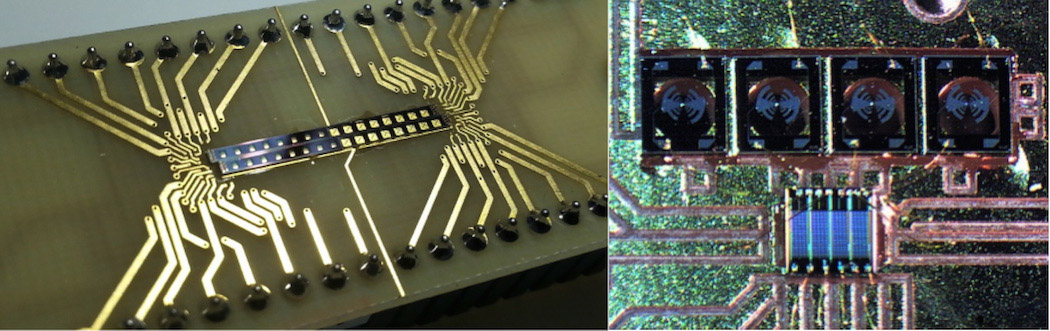
The single most important element of our system is the THz sensor. For this, we use an antenna-coupled nano-bolometer microelectromechanical systems (MEMS) device, which is fabricated in a linear array of eight pixels. We use the sensor to perform signal detection, as well as simultaneous mixing of the LO signal and received signal from the target. To achieve excellent sensitivity and signal-to-noise (S/N) ratios, we suspend the THz sensors in a vacuum. We have thus measured a sensor sensitivity of 1000V/W, with a noise-equivalent power of about 5pW/p Hz. We are able to develop and fabricate narrow-band and wide-band antennas for specific applications. For our sensors, we most often use nano-bolometers with narrow-band antennas (central frequency and bandwidth of 300 and 40GHz, respectively) and wide-band antennas in the 0.1–1THz frequency range. Two 16-pixel THz sensor arrays that operate at 300 and 600GHz, as well as a four-pixel array with an application-specific integrated circuit for front-end signal processing, are shown in Figure 1. Both of these sensor arrays were fabricated using silicon MEMS and a CMOS process. The excellent performance and S/N ratio of our sensors are reflected in the dynamic range we can achieve with our THz system. We obtain a dynamic range of up to 90dB for standoff targets at distances of about 3m, in open fields and harsh atmospheric conditions (e.g., rain, fog, snow).
Figure 1. Photographs of the dual-frequency terahertz (THz) sensor system. Left: Two arrays, each of 16 sensors, which operate at central frequencies of 0.3 and 0.6THz (with bandwidths of 10 and 60GHz, respectively). Right: An array of four wide-band sensors (0.2–1THz), with a dedicated four-channel application-specific integrated circuit for front-end signal processing.
We have used our THz system to acquire the images shown in Figure 2. The 2D image includes information about the intensity of the beam reflected from the object, whereas the 3D image also provides information regarding the object's position in space. From both of these images, much can be learned about the physical and material properties of the target. We use the nano-bolometric quadratic characteristic as a mixer of the transmitted and received THz beams. The resultant signal provides the data required for 2D imaging (i.e., amplitude, and x, y position), as well as the distance of the reflected signal (needed to image the third dimension).
Figure 2. Images obtained with the THz system. Left: A 2D image of a coil wound on a plastic reel and packaged in a box. Right: A 3D THz image of a cigarette lighter that is half-filled with gas (inset shows a photograph of object).
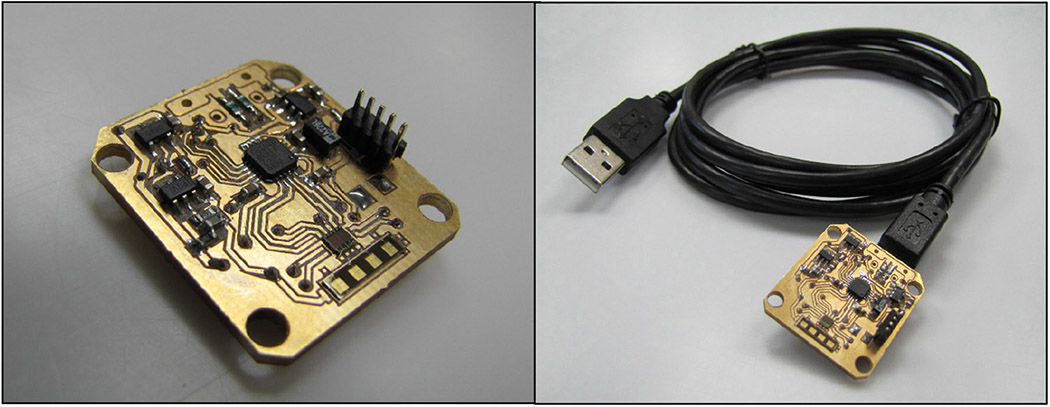
With the high sensitivity of our THz sensor, we can obtain depth resolution down to a few micrometers. This capability therefore opens up a number of applications, e.g., positioning systems and tomography imaging of materials that are transparent or semi-transparent at THz frequencies. Such tomography imaging of objects is illustrated in Figure 3. The objects shown are packaged within visually opaque materials, such as plastic wraps, paperboards, and cartons. Furthermore, we have developed a miniature version of our THz sensor so that it can be easily embedded into larger systems or at a high level of integration within a computer system. Our mini-THz sensor array (see Figure 4) can be used to detect a THz beam or to capture reflection/transmission THz images in real time. It incorporates all the necessary electronics, a data processing module, and a USB-to-serial driver that facilitates the information stream of the captured THz beam.
Figure 3. THz tomography imaging result for several objects that are transparent or semi-transparent at THz frequencies. The objects shown in the upper panel include (top left and bottom right) parts of thin silicon wafers (600μm thick), (bottom left) part of a printed circuit board, and (top and middle right) 1 and 2 Euro cent coins. The green multilayer material—Styrofoam—is transparent to THz radiation. The bottom panel shows the THz tomography image of the various objects packaged within visually opaque materials (i.e., expanded polystyrene, plastic wrap, and carton).
We have developed a new THz imaging system that is built entirely from solid-state electronic components. Our system includes a frequency-modulated continuous-wave THz illumination source and antenna-coupled nano-bolometer MEMS sensors. We can use our system to obtain 2D and 3D images, with excellent sensitivity, S/N ratios, and depth resolution. In addition, we have produced a miniature version of our system, which can be embedded within larger infrastructures. Our THz imaging system is thus suitable for several security applications. Our most important future challenge is to develop a miniature, integrated, and efficient THz source to replace the inefficient frequency multipliers. Our preliminary design for such a source shows promising results.
Janez Trontelj, Aleksander Sešek
Faculty of Electrical EngineeringUniversity of Ljubljana
Ljubljana, Slovenia
Janez Trontelj is a professor and chair of the Microelectronic Technologies and Laboratory for Microelectronics. He is active in the design of magnetic and mechanical microsystems, mainly for the automotive industry. For the last few years, he has led the THz imaging project.
Aleksander Sešek is an assistant in the Laboratory for Microelectronics. He is mainly involved in the design of integrated sensor systems and in the development of THz sensor systems for security, medical, and industrial applications.
References:
1. P. H. Siegel, Terahertz technology, IEEE Trans. Microwave Theory Techn. 50, p. 910-928, 2002.
2. A. Tessmann, A. Leuther, H. Massler, V. Hurm, M. Kuri, M. Zink, M. Riessle, H. P. Stulz, M. Schlechtweg, O. Ambacher, A 600 GHz low-noise amplifier module, IEEE MTT-S Int'l Microwave Symp., 2014. doi:10.1109/MWSYM.2014.6848456
3. J.-M. Rollin, D. Miller, M. Urteaga, Z. M. Griffith, H. Kazemi, A polystrata®820 mW G-band solid state power amplifier, IEEE Compound Semiconductor Integrated Circuit Symp., 2015. doi:10.1109/CSICS.2015.7314481
4. J. Trontelj, A. Sešek, Electronic FM CW THz system for security applications. Presented at SPIE Photonics West 2016.
5. http://vadiodes.com/index.php/en/products/integrated-mixer-amplifier-multiplier-chainIntegrated mixer, amplifier, multiplier chain from VDI. Accessed 24 December 2015.
6. M. Vigilante, P. Reynaert, An E-band low-noise transformer-coupled quadrature VCO in 40 nm CMOS, Euro. Solid State Circuits Conf. 40, p. 423-426, 2014. doi:10.1109/ESSCIRC.2014.6942112
Subscribe to:
Posts (Atom)