Showing posts with label conductivity. Show all posts

Friday, August 17, 2018

A Designed Material Untangles Long-Standing Puzzle

https://als.lbl.gov/a-designed-material-untangles-long-standing-puzzle/

SCIENTIFIC ACHIEVEMENT

The origin of the metal-to-insulator transition in a key material system was revealed by nanostructures designed to decouple simultaneous phase transitions.

SIGNIFICANCE AND IMPACT

This approach could lead to new materials with emergent physics and unique electronic properties, supporting broader research efforts to revolutionize modern electronics.
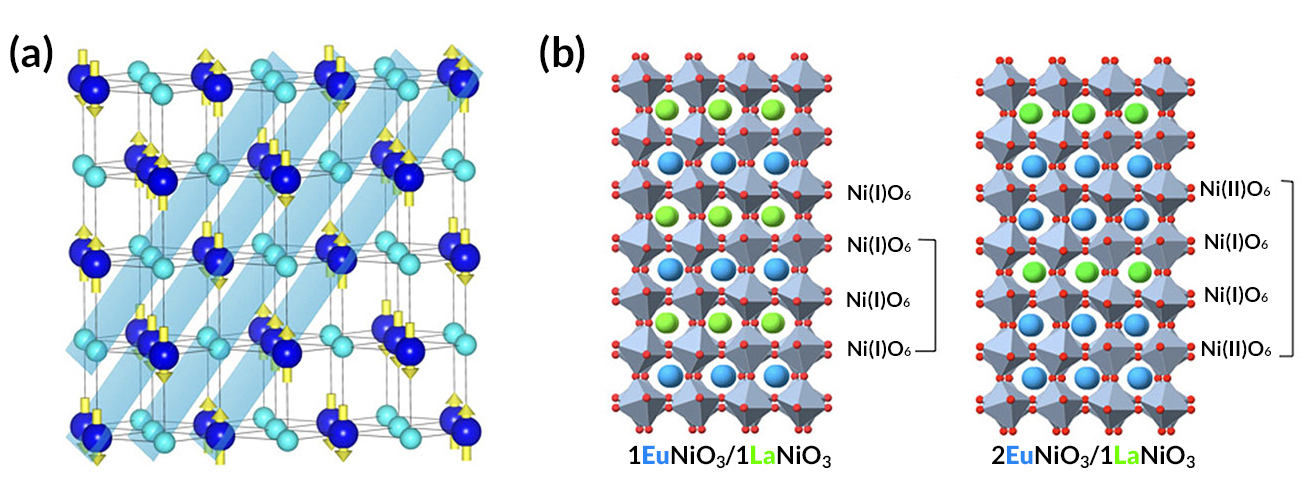
(a) Rare-earth (RE) nickelates (RENiO3) host multiple types of entangled orderings. This illustration depicts a magnetic ordering (spin directions indicated by yellow arrows) and a charge ordering (a checkerboard of two nickel oxidation states, indicated by sphere size and color) in bulk RENiO3 (RE and O atoms omitted for clarity). (b) To selectively suppress the charge-ordering transition, two different RENiO3 materials—EuNiO3 (ENO) and LaNiO3 (LNO)—were combined. The structure on the left, with one ENO layer per LNO layer, supports charge ordering, while the structure on the right, with two ENO layers per LNO layer, does not.

Emergent phenomena

When atoms or molecules assemble to form bulk matter, new properties (such as conductivity and ferromagnetism) that didn’t exist in the constituent parts can emerge from the whole. Similarly, stacking atomically thin layers into nanostructures (heterostructures) can give rise to a rich variety of emergent phases not found in bulk materials.
Materials that exhibit emergent phenomena (“quantum materials”) often feature multiple phases with simultaneous phase transitions. A great deal of effort is currently being expended to disentangle such transitions, to discover what drives them and to ultimately harness them in new materials with desired functionalities. Most of these efforts have relied on external perturbations (light, pressure, etc.) to decouple the transitions. In this work, researchers found a way to do this intrinsically, through layer-by-layer design of stacking sequences with mismatched periodicities.

An archetype of complexity

Rare-earth (RE) nickelates (RENiO3) are prototypical hosts of intertwined phase transitions. They include a metal-to-insulator transition (MIT) and transitions involving antiferromagnetic order and charge order. Charge ordering occurs when a pattern is formed (e.g. stripes or checkerboard) by nickel ions with different oxidation states (differences in the number of local electrons).
Earlier work on the origins of the MIT in such materials had given conflicting results. In this work, researchers attempted to clarify the picture by engineering materials to selectively supress the charge-ordering transition. They combined two different RENiO3 thin-film materials—EuNiO3 (ENO) and LaNiO3 (LNO)—in such a way that the periodicity of the designed structure did not match the periodicity required for stabilizing the charge ordering—a difficult technical challenge requiring subsequent laboratory and synchrotron-based characterization to demonstrate that the proper RE-site ordering was achieved with minimal intermixing.

Resonant soft x-ray diffraction at the ALS
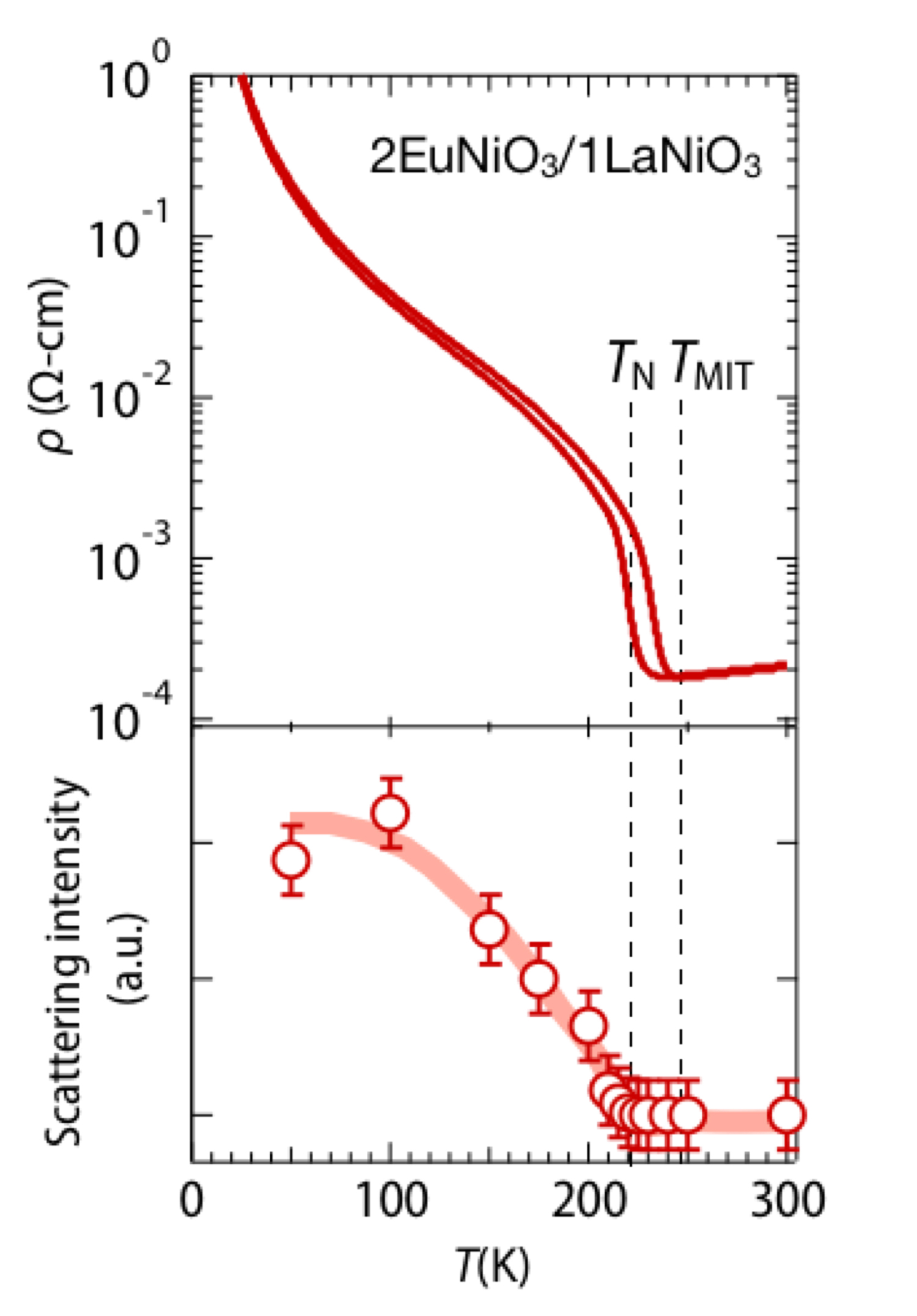
Top: Temperature dependence of resistivity in the mismatched heterostructure. Bottom: Temperature dependence of RSXD peak intensity corresponding to magnetic ordering. There is a finite separation between the metal-to-insulator transition temperature (TMIT) and the magnetic transition (Néel) temperature (TN).
The specific nature of the magnetic ordering and the corresponding transition temperature were revealed by resonant soft x-ray diffraction (RSXD) experiments at ALS Beamline 4.0.2. RSXD probes the periodic order of electronic and magnetic states in a material by diffracting x-rays into patterns characteristic of the electronic order.
The Beamline 4.0.2 scattering endstation is uniquely optimized for RSXD experiments on correlated oxides covering a wide range of scattering geometries and sample temperatures. Moreover, the beamline provides circular as well as variable linear polarization in the important transition-metal L3,2 edges as well as the oxygen K edge, allowing the team to disentangle multiple order parameters.
The ALS experiments showed that, in the heterostructure with mismatched periods, separation between the magnetic-ordering transition temperature and the metal-to-insulator transition temperature was achieved. In addition, experiments performed at the Advanced Photon Source revealed that the charge ordering was indeed suppressed in the mismatched sample. Taken together, the results emphasize that neither magnetic ordering nor charge ordering are necessary for the metal-to-insulator transition, pointing to one particular mechanism (known as the site-selective Mott transition) as being operative.
The researchers expect that this ability to effectively decouple simultaneous ordering phenomena in quantum materials with a simple stacking recipe will spur more discoveries on the nature of entangled orderings and could, in the long term, lead to unique functionalites and emergent physics not seen in bulk systems.

Contacts: Srimanta Middey and Derek Meyers
Researchers: S. Middey (Indian Institute of Science, India); D. Meyers (Brookhaven National Laboratory); M. Kareev, Y. Cao, X. Liu, and J. Chakhalian (Rutgers University); P. Shafer (ALS); and J.W. Freeland, J.-W. Kim, and P.J. Ryan (Argonne National Laboratory).
Funding: Gordon and Betty Moore Foundation; Indian Institute of Science; and U.S. Department of Energy, Office of Science, Basic Energy Sciences Program (DOE BES). Operation of the ALS is supported by DOE BES.
Publication: S. Middey, D. Meyers, M. Kareev, Y. Cao, X. Liu, P. Shafer, J.W. Freeland, J.-W. Kim, P.J. Ryan, and J. Chakhalian, “Disentangled Cooperative Orderings in Artificial Rare-Earth Nickelates,” Phys. Rev. Lett. 120, 156801 (2018), doi:10.1103/PhysRevLett.120.156801.

Saturday, July 7, 2018

Abstract-Conductivity mapping of graphene on polymeric films by terahertz time-domain spectroscopy


Patrick R. Whelan, Deping Huang, David Mackenzie, Sara A. Messina, Zhancheng Li, Xin Li, Yunqing Li, Timothy J. Booth, Peter U. Jepsen, Haofei Shi, Peter Bøggild,

https://www.osapublishing.org/oe/fulltext.cfm?uri=oe-26-14-17748

Fast inline characterization of the electrical properties of graphene on polymeric substrates is an essential requirement for quality control in industrial graphene production. Here we show that it is possible to measure the sheet conductivity of graphene on polymer films by terahertz time-domain spectroscopy (THz-TDS) when all internally reflected echoes in the substrate are taken into consideration. The conductivity measured by THz-TDS is comparable to values obtained from four point probe measurements. THz-TDS maps of 25x30 cm2 area graphene films were recorded and the DC conductivity and carrier scattering time were extracted from the measurements. Additionally, the THz-TDS conductivity maps highlight tears and holes in the graphene film, which are not easily visible by optical inspection.
© 2018 Optical Society of America under the terms of the OSA Open Access Publishing Agreement

Thursday, April 26, 2018

Abstract-Quantized conductance observed during sintering of silver nanoparticles by intense terahertz pulses


Keisuke Takano, Hirofumi Harada, Masashi Yoshimura, Makoto Nakajima,

https://www.researchgate.net/publication/324555773_Quantized_conductance_observed_during_sintering_of_silver_nanoparticles_by_intense_terahertz_pulses

We show that silver nanoparticles, which are deposited on a terahertz-receiving antenna, can be sintered by intense terahertz pulse irradiation. The conductance of the silver nanoparticles between the antenna electrodes is measured under the terahertz pulse irradiation. The dispersant materials surrounding the nanoparticles are peeled off, and conduction paths are created. We reveal that, during sintering, quantum point contacts are formed, leading to quantized conductance between the electrodes with the conductance quantum, which reflects the formation of atomically thin wires. The terahertz electric pulses are sufficiently intense to activate electromigration, i.e., transfer of kinetic energy from the electrons to the silver atoms. The silver atoms move and atomically thin wires form under the intense terahertz pulse irradiation. These findings may inspire nanoscale structural processing by terahertz pulse irradiation.

Sunday, September 10, 2017

Abstract-Epitaxial strain driven crossover from Drude to Drude-Smith terahertz conductivity dynamics in LaNiO3 thin films


,  and 

http://iopscience.iop.org/article/10.1088/1361-648X/aa89be

We investigate the hetero-epitaxial strain driven low-energy charge dynamics in compressive and tensile strained LaNiO3 thin films employing terahertz (THz) time-domain spectroscopy. The complex THz conductivity exhibits a crossover from Drude type metallic behavior for the compressive film to a Drude-Smith type disordered behavior for the tensile film. This demonstration of strain driven crossover in THz conductivity dynamics, while the two films have qualitatively similar dc conductivities, i) brings out the potential of THz technology in distinguishing between similar dc electronic phases and ii) suggests that LaNiO3 under compressive strain is a better candidate for applications as electrodes in oxides electronics.

Thursday, February 25, 2016

Abstract-Design of separately tunable terahertz two-peak absorber based on graphene


  • a Guangxi Colleges and Universities Key Laboratory of Optoelectronic Information Processing, Guilin University of Electronic Technology, Guilin 541004, China
  • b State Key Lab Incubation Base of Photoelectric Technology and Functional Materials, Institute of Photonics & Photon-Technology, Northwest University, Xi’an 710069, China
  • c Guangxi Experiment Center of Information Science, Guilin 541004, China

A separately tunable terahertz (THz) two-peak absorber based on graphene is presented. From bottom to top, the absorber contains four layers, i.e., gold reflector, graphene patch array, polyimide and metal split-ring resonator (SRR) array layer. The controlling voltage is applied between the reflector and two separated surface electrodes to tune the Fermi level of graphene. As a result, these two absorption peaks can be separately tuned by the controlling voltages. The finite integral technique (FIT) is used to study the absorption theory and modulation mechanism. The simulation results show that the absorption of low-frequency and that of high-frequency are 95.5% and 90.0%, respectively. And the maximum modulation depths of them are about 49% and 71%, respectively. Moreover, the absorber is insensitive to polarization and still has good absorption at large angle. The separately tunable THz two-peak absorber offers a new way for the development of frequency selective detectors working in the range of microwave, THz and infrared.