Showing posts with label University of Oxford. Show all posts

Tuesday, October 10, 2017

TARDiS: Terahertz Atmospheric/Astrophysics Radiation Detection in Space


TARDiS will view the present state, and future climate influence of the turbulent upper atmosphere of our planet, and also image regions of deep space tracing the birth of stars and planets and unveil their evolution...
Tardis terahertz atmospheric astrophysics radiation detection in space
Oxford Researchers (led by Prof. Dimitra Rigopoulou) are participating in a project that was selected for funding by the UK Space Agency to deploy an innovative remote sensing instrument that will advance research into Earth Observations (EO) and Astronomy: the Terahertz Atmospheric/Astrophysics Radiation Detection in Space (TARDiS) will view the present state, and future climate influence of the turbulent upper atmosphere of our planet, and also image regions of deep space tracing the birth of stars and planets and unveil their evolution.
The program is funded by UK Space Agency as part of the Human Spaceflight
 and Microgravity Programme in conjunction with a second International Space
Station (ISS) mission for astronaut Tim Peake.
Prof. Rigopoulou (Principal Investigator of FIRSPEX) said: the TARDiS instrument
 is a pathfinder for two new space missions, the Low Cost Upper Atmosphere
Sounder (LOCUS),for Earth Observations and the Far-Infrared Spectroscopic Explorer
 (FIRSPEX) designed to probe the origins of stars and planets in the Universe.
The potential deployment of TARDiS on the ISS is an essential requirement for both
 of these international space missions as it demonstrates the technological readiness
  of the projects. 
The team is led jointly by the University of Oxford and STFC RAL Space, the Open
 University, University of Leeds, University College London, STAR Dundee
and Airbus UK.

Tuesday, March 31, 2015

Synopsis: Making Superconductors Sturdier


Synopsis: Making Superconductors Sturdier


Synopsis Image
Joerg Harms/Max Planck Institute for the Structure and Dynamics of Matter

Proposed Parametric Cooling of Bilayer Cuprate Superconductors by Terahertz Excitation

S. J. Denny, S. R. Clark, Y. Laplace, A. Cavalleri, and D. Jaksch
Published March 31, 2015
Katherine Wright

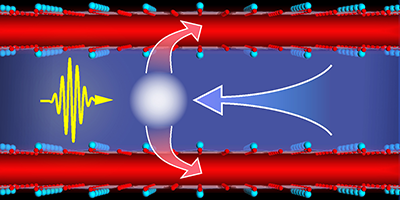
The vanishing resistance of superconductors makes them ideal materials for electrical circuits. However, superconducting materials remain impractical, because of the low temperatures at which they work. This happens because superconducting states are highly susceptible to thermal noise, which disrupts the electronic long-range order needed to maintain superconductivity, inducing a transition to a nonsuperconducting state at the critical temperature. Now Samuel Denny, from the University of Oxford, UK, and colleagues propose that exciting superconductors with pulses of terahertz radiation could allow them to be transiently cooled (much like the laser cooling of atoms), reducing the impact of thermal noise.
The authors consider a model superconducting cuprate material formed of stacked bilayers, where current flows perpendicular to the layers. The material is then subjected to a terahertz electromagnetic wave that excites the material’s vibrational modes (phonons). These, in turn, transfer their excitation to plasmons (collective excitations of the electron plasma), up-converting their frequency. By tuning the terahertz driving frequency, the researchers calculate that this system can be made to work much like a fridge, actively pumping heat out of the low-frequency plasmons. This helps protect the materials’ long-range order from thermal noise and could make superconductivity more “robust.” For instance, more current might be carried through the material without breaking the superconducting state.
The proposed method was studied for superconductors already cooled below their transition temperature and only remains effective for a few picoseconds after terahertz driving has been turned off. But the authors suggest that similar strategies, based on laser-cooling techniques, might one day help increase the critical temperature of a given material.
This research is published in Physical Review Letters.