Philipp Krauspe,a Demetra Tsokkou, Martina Causa', Ester Buchaca-Domingo, Zhuping Fei, Martin Heeney,Natalie Stingelin, Natalie Banerji
 https://pubs.rsc.org/en/Content/ArticleLanding/2018/TA/C8TA08061E#!divAbstract
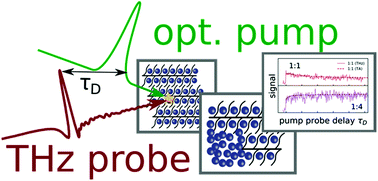
The molecular-level arrangement of the donor and acceptor (i.e. the local morphology) in organic solar cells governs charge separation and charge transport via its effect on the mobility of charges. However, the nanometre-scale mobility in such systems, which can be measured using terahertz (THz) spectroscopy, has been little investigated at relevant low excitation densities, due to extremely weak signals. Here, we study the mobility over short distances and at ultrashort times using time-resolved optical-pump-THz-probe (OPTP) spectroscopy on pBTTT:PCBM blends. This complements our previous results obtained with transient absorption (TA) and electro-modulated differential absorption (EDA) techniques. In the pBTTT:PCBM system, the co-existence of fullerene-/polymer-rich (‘neat’) and co-crystalline (‘intermixed’) regions can be controlled through choice of composition (weight ratio of the two components, use of processing additive). We demonstrate high short-range mobilities that help charges separate, and we show how this mobility of photogenerated charges develops in time, in particular as the charges move between different phase regions of the blend. By reducing the pump fluence below the threshold for nonlinear recombination mechanisms, we access these properties at solar cell operating conditions. Overall, we explain the necessity of different local phases through their influence on charge lifetime and mobility.
https://pubs.rsc.org/en/Content/ArticleLanding/2018/TA/C8TA08061E#!divAbstract
The molecular-level arrangement of the donor and acceptor (i.e. the local morphology) in organic solar cells governs charge separation and charge transport via its effect on the mobility of charges. However, the nanometre-scale mobility in such systems, which can be measured using terahertz (THz) spectroscopy, has been little investigated at relevant low excitation densities, due to extremely weak signals. Here, we study the mobility over short distances and at ultrashort times using time-resolved optical-pump-THz-probe (OPTP) spectroscopy on pBTTT:PCBM blends. This complements our previous results obtained with transient absorption (TA) and electro-modulated differential absorption (EDA) techniques. In the pBTTT:PCBM system, the co-existence of fullerene-/polymer-rich (‘neat’) and co-crystalline (‘intermixed’) regions can be controlled through choice of composition (weight ratio of the two components, use of processing additive). We demonstrate high short-range mobilities that help charges separate, and we show how this mobility of photogenerated charges develops in time, in particular as the charges move between different phase regions of the blend. By reducing the pump fluence below the threshold for nonlinear recombination mechanisms, we access these properties at solar cell operating conditions. Overall, we explain the necessity of different local phases through their influence on charge lifetime and mobility.