Showing posts with label P. Gibbon. Show all posts

Tuesday, June 23, 2015

Abstract-Tunable Circularly Polarized Terahertz Radiation from Magnetized Gas Plasma


W.-M. Wang, P. Gibbon, Z.-M. Sheng, and Y.-T. Li
Phys. Rev. Lett. 114, 253901 – Published 23 June 2015
http://journals.aps.org/prl/abstract/10.1103/PhysRevLett.114.253901
It is shown, by simulation and theory, that circularly or elliptically polarized terahertz radiation can be generated when a static magnetic (B) field is imposed on a gas target along the propagation direction of a two-color laser driver. The radiation frequency is determined by ω2p+ω2c/4+ωc/2, where ωp is the plasma frequency and ωc is the electron cyclotron frequency. With the increase of the B field, the radiation changes from a single-cycle broadband waveform to a continuous narrow-band emission. In high-B-field cases, the radiation strength is proportional to ω2p/ωc. The B field provides a tunability in the radiation frequency, spectrum width, and field strength.
  • Figure
  • Figure
  • Figure
  • Figure
  • Figure

Friday, August 8, 2014

Abstract-Strong, tunable terahertz emission by two-color picosecond laser irradiation


W.-M. Wang, P. Gibbon, Z.-M. Sheng, and Y.-T. Li
It is shown by particle-in-cell simulations that powerful terahertz (THz) radiation can be generated by picosecond (ps) laser pulses below 1014W/cm2 via a two-color laser scheme. At such laser intensities, increasing the laser duration can result in significant enhancement in THz intensities. From 0.03 ps to 0.9 ps the enhancement climbs to nearly 40×before saturating until 2 ps. This demonstrates that low intensity, readily available ps laser technology could be utilized for driving powerful THz sources. By contrast, for laser intensities high enough to completely ionize the gas medium, it is found that the THz emission decreases with increasing pulse duration: optimal conversion is found for few-femtosecond drivers.
DOI: http://dx.doi.org/10.1103/PhysRevA.90.023808
  • Figure
  • Figure
  • Figure
  • Figure
  • Figure
  • Published 7 August 2014
  • Received 6 April 2014
©2014 American Physical Society

Tuesday, September 17, 2013

Powering Up Terahertz Sources

My Note: I just saw this on THz Science and Technology network, via Lakeshore Cryotronics blog.
http://thznetwork.net/index.php/archives/1799


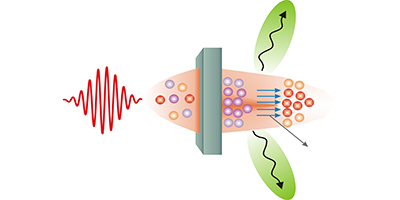
Image courtesy of Amrutha Gopal/Friedrich Schiller University Jena
Published Article:
Observation of Gigawatt-Class THz Pulses from a Compact Laser-Driven Particle Accelerator
A. Gopal, S. Herzer, A. Schmidt, P. Singh, A. Reinhard, W. Ziegler, D. Brömmel, A. Karmakar, P. Gibbon, U. Dillner, T. May, H-G. Meyer, and G. G. Paulus
Terahertz (THz) radiation—the band of frequencies falling between the microwave and visible range—can pass through materials that block light and couple to important rotational, vibrational, or electronic degrees of freedom of solids and molecules. Many applications could take advantage of these properties, from wireless communications to imaging of biomolecules or semiconductor wafers. But a key stumbling block for THz technologies is the development of sufficiently powerful sources. Now, as reported in Physical Review Letters, Amrutha Gopal at the Friedrich Schiller University Jena, Germany, and co-workers have demonstrated a laser-based source that emits short THz pulses with the highest peak power ever recorded in a laboratory.
Presently, the most powerful THz sources are at expensive, large-scale accelerator facilities, which generate THz radiation by bending a beam of relativistic electrons with a magnet. Gopal et al.’s solution instead exploits a high-power laser available at the Friedrich Schiller University Jena. The authors focus the laser’s femtosecond pulses onto micrometer-thick metallic foils. The intense pulses ionize the material, creating hot plasma that emits THz radiation. The setup delivers ten THz pulses per second with a broad spectrum (0.3–30 THz). Since the energy is concentrated in pulses only about half a picosecond long, their peak power is close to a gigawatt.
The scheme also generates a synchronous beam of energetic ions, which suggests an intriguing medical application: the THz beam could be used for detecting cancerous cells on human skin (which reflect THz wavelengths differently than normal cells), while the ions could be directed selectively at such cells for simultaneous treatment. – Matteo Rini

Thursday, August 15, 2013

Observation of Gigawatt-Class THz Pulses from a Compact Laser-Driven Particle Accelerator


A. Gopal1,2,*, S. Herzer1,2, A. Schmidt1, P. Singh1,†, A. Reinhard1, W. Ziegler1, D. Brömmel3, A. Karmakar3,‡, P. Gibbon3, U. Dillner4, T. May4, H-G. Meyer4, and G. G. Paulus1,2 
1Institute of Optics and Quantumelectronics, Friedrich-Schiller-Universität Jena, Max-Wien-Platz 1, 07743 Jena, Germany
2Helmholtz Institute Jena, Fröbelstieg 3, 07743 Jena, Germany
3Forschungzentrum Jülich GmbH, Institute for Advanced Simulation, Jülich Supercomputing Centre, D-52425 Jülich, Germany
4Institut für Photonische Technologien, Postfach 100239, 07702 Jena, Germany

http://prl.aps.org/abstract/PRL/v111/i7/e074802


We report the observation of subpicosecond terahertz (T-ray) pulses with energies ≥460  μJ from a laser-driven ion accelerator, thus rendering the peak power of the source higher even than that of state-of-the-art synchrotrons. Experiments were performed with intense laser pulses (up to 5×10¹⁹  W/cm2) to irradiate thin metal foil targets. Ion spectra measured simultaneously showed a square law dependence of the T-ray yield on particle number. Two-dimensional particle-in-cell simulations show the presence of transient currents at the target rear surface which could be responsible for the strong T-ray emission.
© 2013 American Physical Society
synopsis:
Terahertz (THz) radiation—the band of frequencies falling between the microwave and visible range—can pass through materials that block light and couple to important rotational, vibrational, or electronic degrees of freedom of solids and molecules. Many applications could take advantage of these properties, from wireless communications to imaging of biomolecules or semiconductor wafers. But a key stumbling block for THz technologies is the development of sufficiently powerful sources. Now, as reported in Physical Review Letters, Amrutha Gopal at the Friedrich Schiller University Jena, Germany, and co-workers have demonstrated a laser-based source that emits short THz pulses with the highest peak power ever recorded in a laboratory.
Presently, the most powerful THz sources are at expensive, large-scale accelerator facilities, which generate THz radiation by bending a beam of relativistic electrons with a magnet. Gopal et al.’s solution instead exploits a high-power laser available at the Friedrich Schiller University Jena. The authors focus the laser’s femtosecond pulses onto micrometer-thick metallic foils. The intense pulses ionize the material, creating hot plasma that emits THz radiation. The setup delivers ten THz pulses per second with a broad spectrum (0330 THz). Since the energy is concentrated in pulses only about half a picosecond long, their peak power is close to a gigawatt.
The scheme also generates a synchronous beam of energetic ions, which suggests an intriguing medical application: the THz beam could be used for detecting cancerous cells on human skin (which reflect THz wavelengths differently than normal cells), while the ions could be directed selectively at such cells for simultaneous treatment. – Matteo Rini