Showing posts with label Jing Shi. Show all posts

Friday, January 31, 2020

First successful generation and detection of pure spin currents in antiferromagnetic materials

Mark Sherwin

Photo Credit: 

SONIA FERNANDEZ

https://www.nanowerk.com/nanotechnology-news2/newsid=54458.php
Nanowerk News) For advanced technologies in applications from imaging to communications, the terahertz region of the electromagnetic spectrum is the place to be. Located between the microwave and infrared regions, the terahertz region is being explored by researchers who seek to understand and utilize its particular capabilities.
Terahertz waves, for instance, are capable of rapid transmission of large amounts of data, making them a candidate for “beyond 5G” wireless communications. The waves also are highly sensitive, able to see between layers of biological tissue or other fine materials where conventional (and relatively more harmful) x-rays can’t.
Technologies like ultrafast wireless communication use increasing amounts of energy. Spintronics — the use of the “spin” of an electron, rather than its electric charge — is being vigorously investigated as a way to reduce the amount of energy needed to satisfy society’s increasing demand for bandwidth. To help turbocharge spintronics, condensed matter physicists at UC Santa Barbara and UC Riverside have developed a method for terahertz waves to convert spin excitations into electrical signals.
Their work is published in a paper that appears in the journal Nature ("Spin current from sub-terahertz-generated antiferromagnetic magnons").
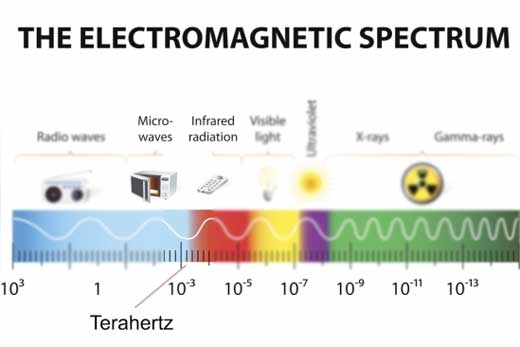
The terahertz region occupies the border between the microwave and infrared regions of the electromagnetic spectrum
The terahertz region occupies the border between the microwave and infrared regions of the
electromagnetic spectrum. (Image: UCSB)
“This has been an extremely rewarding collaboration that combined UC Riverside’s expertise in spintronic materials and devices with our unique instrumentation for terahertz magnetic resonance,” said physicist Mark Sherwin, who directs the Institute for Terahertz Science and Technology on the UCSB campus, where some of the research was conducted.
The finding is based on a magnetic resonance phenomenon in antiferromagnetic materials. Such materials, also called antiferromagnets, offer unique advantages for ultrafast and spin-based nanoscale device applications.
Led by physicist Jing Shi of UC Riverside, the scientists generated a spin current, an important physical quantity in spintronics, in an antiferromagnet and were able to detect it electrically. To accomplish this feat, they used terahertz radiation to pump up magnetic resonance in chromia (chromic oxide) to facilitate its detection.
In ferromagnets, such as a bar magnet, electron spins point in the same direction, up or down, thus providing collective strength to the materials. In antiferromagnets, the atomic arrangement is such that the electron spins cancel each other out, with half of the spins pointing in the opposite direction of the other half, either up or down.
The electron has a built-in spin angular momentum, which can precess — or change the orientation of its rotational axis — the way a spinning top precesses around a vertical axis. When the precession frequency of electrons matches the frequency of electromagnetic waves generated by an external source acting on the electrons, magnetic resonance occurs and is manifested in the form of a greatly enhanced signal that is easier to detect.
In order to generate such magnetic resonance, the team of physicists from UC Riverside and UC Santa Barbara worked with 0.24 terahertz of radiation produced at the ITST’s Terahertz Facilities. This closely matched the precession frequency of electrons in chromia. The magnetic resonance that followed resulted in the generation of a spin current that the researchers converted into a DC voltage.
“We were able to demonstrate that antiferromagnetic resonance can produce an electrical voltage, a spintronic effect that has never been done experimentally before,” said Shi, adding that subterahertz and terahertz radiation are a challenge to detect. Current communication technology uses gigahertz microwaves.
“For higher bandwidth, however, the trend is to move toward terahertz microwaves,” Shi said.
Although antiferromagnets are statically uninteresting, they are dynamically interesting. Electron spin precession in antiferromagnets is much faster than in ferromagnets, resulting in frequencies that are two to three orders of magnitude higher than the frequencies of ferromagnets — thus allowing faster information transmission.
“Spin dynamics in antiferromagnets occur at a much shorter timescale than in ferromagnets, which offers attractive benefits for potential ultrafast device applications,” Shi said.
Antiferromagnets are ubiquitous and more abundant than ferromagnets. Many ferromagnets, such as iron and cobalt, become antiferromagnetic when oxidized. Many antiferromagnets are good insulators with low dissipation of energy.
Shi’s team developed a bilayer structure comprised of chromia, an antiferromagnetic insulator, with a layer of metal on top to serve as the detector to sense signals from chromia. According to the research, the electrons in chromia remain local. What crosses the interface is information encoded in the precessing spins of the electrons.
The researchers addressed spin sensitivity by focusing on platinum and tantalum as metal detectors. If the signal from chromia originates in spin, platinum and tantalum register the signal with opposite polarity. If the signal is caused by heating, however, both metals register the signal with identical polarity.
The technology is patent pending.

Tuesday, January 28, 2020

Abstract-Spin current from sub-terahertz-generated antiferromagnetic magnons


Spin dynamics in antiferromagnets has much shorter timescales than in ferromagnets, offering attractive properties for potential applications in ultrafast devices. However, spin-current generation via antiferromagnetic resonance and simultaneous electrical detection by the inverse spin Hall effect in heavy metals have not yet been explicitly demonstrated. Here we report sub-terahertz spin pumping in heterostructures of a uniaxial antiferromagnetic Cr2O3 crystal and a heavy metal (Pt or Ta in its β phase). At 0.240 terahertz, the antiferromagnetic resonance in Cr2O3 occurs at about 2.7 tesla, which excites only right-handed magnons. In the spin-canting state, another resonance occurs at 10.5 tesla from the precession of induced magnetic moments. Both resonances generate pure spin currents in the heterostructures, which are detected by the heavy metal as peaks or dips in the open-circuit voltage. The pure-spin-current nature of the electrically detected signals is unambiguously confirmed by the reversal of the voltage polarity observed under two conditions: when switching the detector metal from Pt to Ta, reversing the sign of the spin Hall angle, and when flipping the magnetic-field direction, reversing the magnon chirality. The temperature dependence of the electrical signals at both resonances suggests that the spin current contains both coherent and incoherent magnon contributions, which is further confirmed by measurements of the spin Seebeck effect and is well described by a phenomenological theory. These findings reveal the unique characteristics of magnon excitations in antiferromagnets and their distinctive roles in spin–charge conversion in the high-frequency regime.

Monday, January 27, 2020

Detection of Terahertz Electromagnetic Waves Could Revolutionize Electronics


https://scitechdaily.com/detection-of-terahertz-electromagnetic-waves-could-revolutionize-electronics/

University of California Riverside-led research has applications in ultrafast and spin-based nanoscale devices.

A team of physicists has discovered an electrical detection method for terahertz electromagnetic waves, which are extremely difficult to detect. The discovery could help miniaturize the detection equipment on microchips and enhance sensitivity.
Terahertz is a unit of electromagnetic wave frequency: One gigahertz equals 1 billion hertz; 1 terahertz equals 1,000 gigahertz. The higher the frequency, the faster the transmission of information. Cell phones, for example, operate at a few gigahertz.
The finding, reported today in Nature, is based on a magnetic resonance phenomenon in anti-ferromagnetic materials. Such materials, also called antiferromagnets, offer unique advantages for ultrafast and spin-based nanoscale device applications.
The researchers, led by physicist Jing Shi of the University of California, Riverside, generated a spin current, an important physical quantity in spintronics, in an antiferromagnet and were able to detect it electrically. To accomplish this feat, they used terahertz radiation to pump up magnetic resonance in chromia to facilitate its detection.
Jing Shi is a professor in the Department of Physics and Astronomy at UC Riverside.
 Credit: I. Pittalwala, UC Riverside.

In ferromagnets, such as a bar magnet, electron spins point in the same direction, up or down, thus providing collective strength to the materials. In antiferromagnets, the atomic arrangement is such that the electron spins cancel each other out, with half of the spins pointing in the opposite direction of the other half, either up or down.

The electron has a built-in spin angular momentum, which can precess the way a spinning top precesses around a vertical axis. When the precession frequency of electrons matches the frequency of electromagnetic waves generated by an external source acting on the electrons, magnetic resonance occurs and is manifested in the form of a greatly enhanced signal that is easier to detect.
“The generation of terahertz microwaves is not difficult, but their detection is. Our work has now provided a new pathway for terahertz detection on a chip.” — Jing Shi
In order to generate such magnetic resonance, the team of physicists from UC Riverside and UC Santa Barbara worked with 0.24 terahertz of radiation produced at the Institute for Terahertz Science and Technology’s Terahertz Facilities at the Santa Barbara campus. This closely matched the precession frequency of electrons in chromia. The magnetic resonance that followed resulted in the generation of a spin current that the researchers converted into a DC voltage.
“We were able to demonstrate that antiferromagnetic resonance can produce an electrical voltage, a spintronic effect that has never been experimentally done before,” said Shi, a professor in the Department of Physics and Astronomy.
Shi, who directs Department of Energy-funded Energy Frontier Research Center Spins and Heat in Nanoscale Electronic Systems, or SHINES, at UC Riverside, explained subterahertz and terahertz radiation are a challenge to detect. Current communication technology uses gigahertz microwaves.
“For higher bandwidth, however, the trend is to move toward terahertz microwaves,” Shi said. “The generation of terahertz microwaves is not difficult, but their detection is. Our work has now provided a new pathway for terahertz detection on a chip.”
Although antiferromagnets are statically uninteresting, they are dynamically interesting. Electron spin precession in antiferromagnets is much faster than in ferromagnets, resulting in frequencies that are two-three orders of magnitude higher than the frequencies of ferromagnets — thus allowing faster information transmission.
“Spin dynamics in antiferromagnets occur at a much shorter timescale than in ferromagnets, which offers attractive benefits for potential ultrafast device applications,” Shi said.
Antiferromagnets are ubiquitous and more abundant than ferromagnets. Many ferromagnets, such as iron and cobalt, become antiferromagnetic when oxidized. Many antiferromagnets are good insulators with low dissipation of energy. Shi’s lab has expertise in making ferromagnetic and antiferromagnetic insulators.
Shi’s team developed a bilayer structure comprised of chromia, an antiferromagnetic insulator, with a layer of metal on top of it to serve as the detector to sense signals from chromia.
Shi explained that electrons in chromia remain local. What crosses the interface is information encoded in the precessing spins of the electrons.
“The interface is critical,” he said. “So is spin sensitivity.”
The researchers addressed spin sensitivity by focusing on platinum and tantalum as metal detectors. If the signal from chromia originates in spin, platinum and tantalum register the signal with opposite polarity. If the signal is caused by heating, however, both metals register the signal with identical polarity.
“This is the first successful generation and detection of pure spin currents in antiferromagnetic materials, which is a hot topic in spintronics,” Shi said. “Antiferromagnetic spintronics is a major focus of SHINES.”
The technology has been disclosed to UCR Technology Commercialization, assigned UC case number 2019-105, and is patent pending.
Shi was joined in the study by Junxue Li, Ran Cheng, Mark Lohmann, Wei Yuan, Mohammed Aldosary, and Peng Wei of UC Riverside; and C. Blake Wilson, Marzieh Kavand, Nikolay Agladze, and Mark S. Sherwin at UC Santa Barbara.
The research at UC Riverside was supported by SHINES.

Friday, March 25, 2016

Abstract-Longitudinal field characterization of converging terahertz vortices with linear and circular polarizations


Xinke Wang, Jing Shi, Wenfeng Sun, Shengfei Feng, Peng Han, Jiasheng Ye, and Yan Zhang
Linearly and circularly polarized terahertz (THz) vortex beams are generated by adopting a THz quarter wave plate and spiral phase plates with topological charges 1 and 2. Taking advantage of a THz digital holographic imaging system, longitudinal components of THz vortices with different polarizations and topological charges are coherently measured and systemically analyzed in a focusing condition. The application potential of circularly polarized THz vortex beams in microscopy is experimentally demonstrated and the transformation between the spin angular momentums and orbital angular momentums of THz waves is also checked. Modified Richards-Wolf vector diffraction integration equations are applied to successfully simulate experimental phenomena.
© 2016 Optical Society of America
Full Article  |  PDF Article

Monday, January 26, 2015

Researchers make magnetic graphene 10 hours ago


Researchers make magnetic graphene

Graphene is a one-atom thick sheet of carbon atoms arranged in a hexagonal lattice. UC Riverside physicists have found a way to induce magnetism in graphene while also preserving graphene's electronic properties. Credit: Shi Lab, UC Riverside.

http://phys.org/news/2015-01-magnetic-graphene.html#jCp

Graphene, a one-atom thick sheet of carbon atoms arranged in a hexagonal lattice, has many desirable properties. Magnetism alas is not one of them. Magnetism can be induced in graphene by doping it with magnetic impurities, but this doping tends to disrupt graphene's electronic properties.
Now a team of physicists at the University of California, Riverside has found an ingenious way to induce magnetism in  while also preserving graphene's electronic properties. They have accomplished this by bringing a graphene sheet very close to a magnetic insulator - an electrical insulator with magnetic properties.
"This is the first time that graphene has been made magnetic this way," said Jing Shi, a professor of physics and astronomy, whose lab led the research. "The magnetic graphene acquires new  so that new quantum phenomena can arise. These properties can lead to new electronic devices that are more robust and multi-functional."
The finding has the potential to increase graphene's use in computers, as in computer chips that use electronic spin to store data.
Study results appeared online earlier this month in Physical Review Letters.
The magnetic insulator Shi and his team used was yttrium iron garnet grown by laser  in his lab. The researchers placed a single-layer graphene sheet on an atomically smooth layer of yttrium iron garnet. They found that yttrium iron garnet magnetized the graphene sheet. In other words, graphene simply borrows the  from yttrium iron garnet.
Magnetic substances like iron tend to interfere with graphene's electrical conduction. The researchers avoided those substances and chose yttrium iron garnet because they knew it worked as an electric insulator, which meant that it would not disrupt graphene's electrical transport properties. By not doping the graphene sheet but simply placing it on the layer of yttrium iron garnet, they ensured that graphene's excellent electrical transport properties remained unchanged.
In their experiments, Shi and his team exposed the graphene to an . They found that graphene's Hall voltage - a voltage in the perpendicular direction to the current flow - depended linearly on the magnetization of yttrium iron garnet (a phenomenon known as the anomalous Hall effect, seen in magnetic materials like iron and cobalt). This confirmed that their  had turned magnetic.
More information: Physical Review Letters, journals.aps.org/prl/abstract/… ysRevLett.114.016603


Read more at: http://phys.org/news/2015-01-magnetic-graphene.html#jCp