Showing posts with label Giovanni Cirmi. Show all posts

Tuesday, February 9, 2021

Abstract-µJ-level multi-cycle terahertz generation in a periodically poled Rb:KTP crystal


Wenlong Tian, Giovanni Cirmi, Halil T. Olgun, Patrick Mutter, Carlota Canalias, Andrius Zukauskas, Lu Wang, Elias Kueny, Frederike Ahr, Anne-Laure Calendron, Fabian Reichert, Kore Hasse, Yi Hua, Damian N. Schimpf, Hüseyin Çankaya, Mikhail Pergament, Michael Hemmer, Nicholas Matlis, Valdas Pasiskevicius, Fredrik Laurell, Franz X. Kärtner


https://www.osapublishing.org/ol/abstract.cfm?uri=ol-46-4-741

We demonstrate multi-cycle terahertz (MC-THz) generation in a 15.5 mm long periodically poled rubidium (Rb)-doped potassium titanyl phosphate (Rb:PPKTP) crystal with a poling period of 300 µm. By cryogenically cooling the crystal to 77 K, up to 0.72 µJ terahertz energy is obtained at a frequency of 0.5 THz with a 3 GHz bandwidth. A maximum internal optical-to-terahertz conversion efficiency of 0.16% is achieved, which is comparable with results achieved using periodically poled lithium niobate crystal. Neither photorefractive effects nor damage was observed with up to 900mJ/cm2, showing the great potential of Rb:PPKTP for multi-millijoule-level MC-THz generation.

© 2021 Optical Society of America

Wednesday, August 2, 2017

Efficient terahertz generation for table top free electron laser


In a recent paper in JPhysB, published as part of our Emerging Leaders special issue, Giovanni Cirmi describes the first experimental results in the direction of a terahertz-cascaded optical parametric amplifier, a new technique which can exploit spectral cascading to generate narrowband terahertz radiation with few percent optical-to-terahertz conversion efficiency.  We asked them to explain their work for us:
Free electron lasers (FELs) have allowed in the last years several discoveries in physics, chemistry and biology. FELs produce X-ray radiation emitted by electrons which are accelerated by radio frequency radiation of typically 10-cm wavelength. Due to the long wavelength of such radiation, current FELs are large scale facilities (100 m – km long) and have a high need for power or energy.
Millimeter-wave or terahertz radiation has become of crucial importance in the last decades for spectroscopy and imaging. It is natural to ask whether one can use multi-cycle terahertz radiation to accelerate electrons for table-top FELs (TTFELs) since the size of the accelerator should scale with the wavelength. TTFELs might be able to produce attosecond pulses and can be distributed to small scale scientific laboratories at much lower cost albeit also lower X-ray flux, but still sufficient for many experiments.
Measured output spectrum of a THz-COPA showing at least 5 cascaded orders.
However, millijoule-level multi-cycle terahertz radiation is needed; therefore the scientific community has investigated methods to efficiently produce terahertz radiation with present lasers. In this paper, we review cascaded nonlinear methods that have been investigated in the past by other research groups, and introduce our idea of cascaded optical parametric amplification for terahertz generation (THz-COPA), which promises to generate the required terahertz radiation with few percent efficiency. Reaching high efficiencies is a fundamental step forward towards the construction of THz-driven TTFELs.
The work presented in the paper was mainly carried on in the Ultrafast Optics and X-rays group at the Center for Free Electron Laser Science (CFEL), led by Prof. Franz X. Kärtner. The group develops novel coherent light sources with spectra ranging from X-rays to terahertz, femtosecond and attosecond timing distribution systems for large scale FEL facilities, high-energy laser amplifiers, high-energy sub-cycle optical parametric synthesizers used in high-order harmonic generation, attosecond pulse generation, and coherent free-electron sources. These sources are applied to strong-field physics and attosecond science.
About the author:
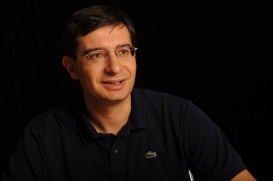
Dr Giovanni Cirmi
Dr Giovanni Cirmi
Giovanni Cirmi has been working on several projects related to ultrafast nonlinear optics, the generation of carrier-envelope phase stable high-energy femtosecond visible and infrared pulses via optical parametric (chirped pulse) amplification, high harmonic generation, time-resolved femtosecond spectroscopy and coherent control. At the moment, his interests are the generation of high-energy sub-optical-cycle pulses via optical parametric synthesis and high-energy terahertz generation.
Ultrafast Optics at CFEL/DESY
Giovanni Cirmi received his M.Sc. in electronic engineering in 2005 and his Ph.D. with honors in physics in 2009, from Politecnico di Milano, Italy. He was granted two ‘Progetto Rocca‘ fellowships at Massachusetts Institute of Technology, USA. In 2012 he joined the Ultrafast Optics group at CFEL/DESY (Hamburg, Germany), where he is team leader in the area ‘Femtosecond optics/OPAs’.

Sunday, August 7, 2016

Abstract-Cascaded parametric amplification for highly efficient terahertz generation


Koustuban Ravi, Michael Hemmer, Giovanni Cirmi, Fabian Reichert, Damian N. Schimpf, Oliver D. Mücke, and Franz X. Kärtne

A highly efficient, practical approach to high-energy multi-cycle terahertz (THz) generation based on spectrally cascaded optical parametric amplification (THz-COPA) is introduced. Feasible designs are presented that enable the THz wave, initially generated by difference frequency generation between a narrowband optical pump and optical seed (0.1–10% of pump energy), to self-start a cascaded (or repeated) energy downconversion of pump photons in a single pass through a single crystal. In cryogenically cooled, periodically poled lithium niobate, unprecedented energy conversion efficiencies >8%achievable with existing pump laser technology are predicted using realistic simulations. The calculations account for cascading effects, absorption, dispersion, and laser-induced damage. Due to the simultaneous, couplednonlinear evolution of multiple phase-matched three-wave mixing processes, THz-COPA exhibits physics distinctly different from conventional three-wave mixing parametric amplifiers. This, in turn, governs optimal phase-matching conditions, evolution of optical spectra, and limitations of the nonlinear process. Circumventing these limitations is shown to yield conversion efficiencies 10%.
© 2016 Optical Society of America
Full Article  |  PDF Article

Thursday, September 11, 2014

Abstract-Terahertz generation in lithium niobate driven by Ti:sapphire laser pulses and its limitations


Xiaojun Wu, Sergio Carbajo, Koustuban Ravi, Frederike Ahr, Giovanni Cirmi, Yue Zhou, Oliver D. Mücke, and Franz X. Kärtner  »View Author Affiliations
http://www.opticsinfobase.org/ol/abstract.cfm?uri=ol-39-18-5403
Optics Letters, Vol. 39, Issue 18, pp. 5403-5406 (2014)
http://dx.doi.org/10.1364/OL.39.005403


We experimentally investigate the limits of 800-nm-to-terahertz (THz) energy conversion in lithium niobate at room temperature driven by amplified Ti:sapphire laser pulses with tilted pulse front. The influence of the pump central wavelength, pulse duration, and fluence on THz generation is studied. We achieved a high peak efficiency of 0.12% using transform limited 150 fs pulses and observed saturation of the optical-to-THz conversion efficiency at a fluence of 15mJ/cm2 for this pulse duration. We experimentally identify two main limitations for the scaling of optical-to-THz conversion efficiencies: (i) the large spectral broadening of the optical pump spectrum in combination with large angular dispersion of the tilted pulse front and (ii) free-carrier absorption of THz radiation due to multi-photon absorption of the 800 nm radiation.
© 2014 Optical Society of America