Showing posts with label Fabrisonic. Show all posts

Friday, December 13, 2019

FABRISONIC (AND LUNA INNOVATIONS) EMBEDS SENSORS IN NASA’S ROCKET FUEL PIPING USING 3D PRINTING


https://3dprintingindustry.com/news/fabrisonic-embeds-sensors-in-nasas-rocket-fuel-piping-using-3d-printing-166314/


Ohio-based solid-state metal 3D printing specialist Fabrisonic, and optical sensor specialist Luna Innovations, have collaborated a3 D printed sensor project for NASA.
The team was contracted to help gather data in cryogenic fuel pipes for rocket test stands at NASA Stennis Space Center. Leveraging the capabilities of its patented Ultrasonic Additive Manufacturing technology (UAM) technology, Fabrisonic was able to 3D print sensors directly into the wall of an existing NASA pipe. This has helped to increase the fidelity of the data gathered from within the fuel piping. 
Fabrisonic Ultrasonic Additive Manufacturing. Photo by Michael Petch
Ultrasonic Additive Manufacturing technology
UAM technology is a metal 3D printing process that constructs objects through ultrasonically welding a succession of metal tapes into a 3D shape. As the metal object is built up, a CNC machine is used to finish its internal and external surfaces, creating a detailed shape. This hybrid additive-subtractive manufacturing process was patented by Fabrisonic in 2017, and is marketed in the SonicLayer line of 3D printers. At RAPID + TCT in May 2019, Fabrisonic debuted its latest UAM system, the SonicLayer 1200. UAM technology has been used in a number of applications as well. Most notably it was leveraged to create heat exchanger devices that passed NASA’s quality control tests for use on the outside of Mars rovers.
Fabrisonic has worked with both NASA and Luna Innovations on a number of occasions. Headquartered in Virginia, Luna Innovations is primarily focused on developing products that can be used to measure, monitor, protect and improve processes to enhance the safety, security, and connectivity of people. Its product offering therefore ranges fiber-optic and ultrasonic sensors to nanomedicines and advanced materials. 
The company previously partnered with Fabrisonic to to manufacture smart structures made of metals for the defense and medical industries. Recently, in October 2019, the two companies also partnered to build a Smart Baseplate for Laser Powder Bed Fusion (LPBF) additive manufacturing processes. 
The SonicLayer 1200. Photo via Fabrisonic.
3D printing sensors into rocket fuel plumbing
NASA wanted to collect data from its cryogenic fuel pipes to better understand how its engines were behaving. It was therefore necessary to gather data on pressure and temperature gradients inside of their fuel piping closer to the test article. NASA usually mounts sensors on the outside of its piping using elbows and ports, and although this communicates some amount of data, it is often limited. The agency has also experimented by placing sensors directly into the flow path using pass-throughs in the existing pipe, but this can disrupt the fuel stream and create uncertainty within the measurements. 
Fabrisonic and Luna Innovations were able to overcome NASA’s dilemma by integrating sensors within the pipe’s walls using UAM technology. As it is a solid-state manufacturing process, it is possible to embed wires, fibers, and sensors into a metallic substrate during UAM 3D printing. This can provide various advantages, for example, it allows sensors to operate in more aggressive environments, or closer to where the relevant data is needed.  
As such, Fabrison embedded a suite of fiber-optic sensors provided by Luna Innovations in one place within the walls of the pipe, therefore providing a much clearer picture of thermal and pressure gradients in the piping since no ports are required. Fiber-based sensors were chosen due to their smaller size and ability to collect data over the entire length of the fiber. 
The “SensePipe” from Fabrisonic. Photo via Fabrisonic.

.Only a portion of the pipe was 3D printed in order to cut down on costs. Using an existing pipe, the team milled a flat section into its outer diameter to create a landing strip for embedding the fiber-optics, with a small groove cut for each fiber. After inserting the fibers, Fabrisonic printed additional material over the landing strip, which was then machined to remove excess material. 
The pipe was tested at various pressures and temperatures to calibrate the sensor, including boiling the pipe in water and filling it with liquid nitrogen. Throughout the tests, the pipe continued to provide reliable data. Moving on, Fabrisonic is now working on 3D printing a larger pipe section for use at NASA Stennis Space Center.

Saturday, April 27, 2019

OT- Luna Blog-What if you Could Monitor your Additive Manufacturing Process In Situ?


https://lunainc.com/uaminsitu/

A recent presentation at the Additive Manufacturing Users Group explored how Luna Innovations and Fabrisonic have been been collaborating on 3D printed “smart structures” to answer this question. A joint team is working with the Defense Logistics Agency to create a smart baseplate capable of measuring strain and temperature during a Powder Bed Fusion (PBF) build.


Learn More in the Technical Paper: Building Fiber Optic Strain Sensors into Metal Components

Ultrasonic Additive Manufacturing (UAM), a solid state metal 3D printing technology that occurs at very low temperatures, was used to print metal plates with embedded fiber optic sensors. These specialized sensors can be used to measure strain and temperature anywhere along the length of a single fiber. The combination of solid state 3D printing and High Definition Fiber Optic Sensing (HD-FOS) is being used to create smart baseplates for PBF machines. 
Under this program, the team has embedded a matrix of sensor fibers into the top .080″ of PBF baseplates. These instrumented plates were placed into a PBF machine as the starting point of a powder build. The PBF team was able collect hundreds of strain and temperature data points in real time during the build. The goal of this project is to improve methodology for PBF processes by learning to anticipate potential issues and to calibrate process models.

Tuesday, December 11, 2018

Fabrisonic and Luna Innovations Making 3D Printed Smart Structures with Embedded Fiber Optic Sensors


by 

https://3dprint.com/231495/fabrisonic-luna-3d-print-smart-structures-with-embedded-fiber-optic-sensors/

Ohio company Fabrisonic is well-known in the industry for its hybrid metal 3D printing process, called Ultrasonic Additive Manufacturing (UAM), which uses high frequency ultrasonic vibrations to merge layers of metal foil together in a solid-state. Now, it’s collaborating with optical measurement technology leader Luna Innovations to make 3D printed smart structures.
The collaborative team will use these structures to answer questions such as finding a critical component’s exact strain during operation, and determining if improvements are possible by monitoring an additive manufacturing process in situ.
“Fabrisonic has commercialized a new metal 3D printing process, which occurs at very low temperatures, allowing the team to easily embed Luna fiber optic sensors into solid metal parts,” Fabrisonic’s president and CEO Mark Norfolk wrote. “With complementary technologies, Luna and Fabrisonic’s “smart structures” can be used to collect data for health monitoring and high fidelity command/control as well as for basic science and research.”
The SBIR/STTR program recently awarded the joint Fabrisonic and Luna Innovations team two separate research contracts, which will both focus on embedding sensors into key 3D printed parts in order to deliver important data from inside the components.
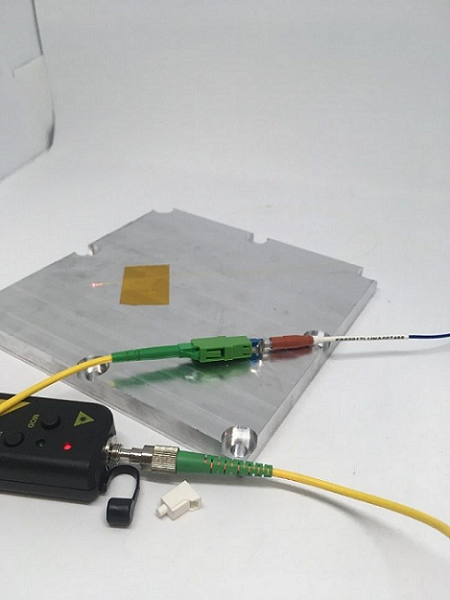
Metal build plate with embedded fiber optic sensors, which will be installed in a PBF 3D printer to study the process and quantify quality metrics.
The first research contract will focus on Fabrisonic and Luna developing a smart pipe for fuel systems at NASA. The program will use the pipe for fuel systems which will integrate Luna’s strain sensors into a 3D printed pipe wall to measure such things as heat flux, temperature, and pressure. The strain sensing fibers will be embedded into pipes made of stainless steel and aluminum, which will allow for the “continuous monitoring of strain in the pipe wall.”
Once the fibers have been embedded, Fabrisonic and Luna will seal and cyclically pressure the pipe in order to collect data. After successful calibration, the 3D printed pipe with integral sensing will make it possible for the team to achieve real-time telemetry of temperatures and pressure at multiple important points in NASA’s fuel systems.
The second contract involves the team using Fabrisonic’s UAM process to create a smart baseplate for laser powder bed fusion 3D printers with the Defense Logistics Agency (DLA). Fabrisonic will embed proprietary fibers from Luna into solid metal instrumented plates, which will be placed into a 3D printer to serve as a powder build’s beginning point.
Then, the team will use the Luna ODiSl measurement system, which measures the residual strain on complex surfaces of 3D printed components, in order to collect hundreds of temperature and strain data points during the build in real time. The ultimate project goal is to improve the overall methodology for powder bed fusion 3D printing processes, in addition to determining how to properly measure capability and anticipate any possible issues before they occur.
Additionally, the team at Fabrisonic and Luna is working with multiple other partners in order to embed fiber optic sensors in highly demanding environments, such as nuclear reactors.
To learn more about how Fabrisonic’s patented solid state UAM metal 3D printing process can be used to integrate fiber optic strain sensors and other temperature-sensitive components directly into dense metal, you can download and read a new technical paper, titled “Building Fiber Optic Strain Sensor into Metal Components,” that was written Dr. Adam Hehr, a Research Engineer at Fabrisonic.