Showing posts with label terahertz wireless transmission. Show all posts

Tuesday, April 28, 2020

Abstract-Single-shot link discovery for terahertz wireless networks


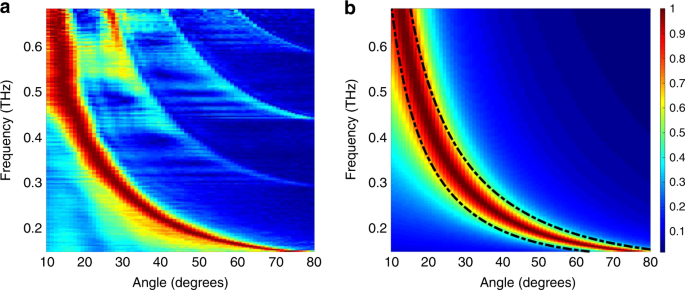
The spectrum of emitted radiation vs. emission angle.
https://www.nature.com/articles/s41467-020-15761-4

Of the many challenges in building a wireless network at terahertz frequencies, link discovery remains one of the most critical and least explored. In a network of mobile receivers using narrow directional beams, how do the nodes rapidly locate each other? This direction information is crucial for beam forming and steering, which are fundamental operations for maintaining link quality. As the carrier frequency increases into the terahertz range, the conventional methods used by existing networks become prohibitively time-consuming, so an alternative strategy is required. Using a leaky-wave antenna with a broadband transmitter, we demonstrate a single-shot approach for link discovery which can be accomplished much more rapidly. Our method relies on measurements of the width of a broad spectrum, and does not require any information about the phase of the received signal. This protocol, which relies on a detailed understanding of the radiation from leaky-wave devices, offers a realistic approach for enabling mobility in directional networks.

Researchers solve 'link discovery' problem for terahertz data networks

Radiation of varying frequencies emanate from a leaky waveguide at different angles. This rainbow of frequencies is the basis for a link discovery system for future terahertz data networks.CREDIT Mittleman Lab / Knightly Lab
https://www.eurekalert.org/pub_releases/2020-04/bu-rs042320.php

PROVIDENCE, R.I. [Brown University] -- When someone opens a laptop, a router can quickly locate it and connect it to the local Wi-Fi network. That ability is a basic element of any wireless network known as link discovery, and now a team of researchers has developed a means of doing it with terahertz radiation, the high-frequency waves that could one day make for ultra-fast wireless data transmission.
Because of their high frequency, terahertz waves can carry hundreds of times more data than the microwaves used to carry our data today. But that high frequency also means that terahertz waves propagate differently than microwaves. Whereas microwaves emanate from a source in an omni-directional broadcast, terahertz waves propagate in narrow beams.
"When you're talking about a network that's sending out beams, it raises a whole myriad of questions about how you actually build that network," said Daniel Mittleman, a professor in Brown's School of Engineering. "One of those questions is how does an access point, which you can think of as a router, find out where client devices are in order to aim a beam at them. That's what we're thinking about here."
In a paper published in Nature Communications, researchers from Brown and Rice University showed that a device known as a leaky waveguide can be used for link discovery at terahertz frequencies. The approach enables link discovery to be done passively, and in one shot.
The concept of a leaky waveguide is simple. It's just two metal plates with a space between them where radiation can propagate. One of the plates has a narrow slit cut into it, which allows a little bit of the radiation to leak out. This new research shows the device can be used for link discovery and tracking by exploiting one of its underlying properties: that different frequencies leak out of the slit at different angles.
"We input a wide range of terahertz frequencies into this waveguide in a single pulse, and each one leaks out simultaneously at a different angle," said Yasaman Ghasempour, a graduate student at Rice and co-author on the study. "You can think of it like a rainbow leaking out, with each color represents a unique spectral signature corresponding to an angle."
Now imagine a leaky waveguide placed on an access point. Depending upon where a client device is relative to the access point, it's going to see a different color coming out of the waveguide. The client just sends a signal back to the access point that says, "I saw yellow," and now the access point knows exactly where the client is, and can continue tracking it.
"It is not just about discovering the link once," Yasaman said. "In fact, the direction of transmission needs to be continually adjusted as the client moves. Our technique allows for ultra-fast adaptation which is the key to achieving seamless connectivity."
The setup also uses a leaky waveguide on the client side. On that side, the range of frequencies received through the slit in the waveguide can be used to determine the position of the router relative to the local rotation of the device -- like when someone swivels their chair while using a laptop.
Mittleman says that finding a novel way to make link discovery work in the terahertz realm is important because existing protocols for link discovery in microwaves simply won't work for terahertz signals. Even the protocols that have been developed for burgeoning 5G networks, which are much more directional than standard microwaves, aren't feasible for terahertz. That's because as narrow as 5G beams are, they're still around 10 times wider than the beams in a terahertz network.
"I think some people have assumed that since 5G is somewhat directional, this problem had been solved, but the 5G solution simply isn't scalable," Mittleman said. "A whole new idea is needed. This is one of those fundamental protocol pieces that you need to start building terahertz networks."

Friday, May 31, 2019

Fraunhofer breaks new ground with 4K over THz transmission


FRAUNHOFER HHI AND IAF DEMONSTRATE THE FIRST WIRELESS REAL-TIME VIDEO TRANSMISSION USING TERAHERTZ

http://www.inavateonthenet.net/news/article/fraunhofer-breaks-new-ground-with-4k-over-thz-transmission

The Fraunhofer Heinrich Hertz Institute HHI has announced that 4K video has been sent in real-time over a wireless Terahertz (THz) link for the first time.
Headquartered in Berlin, the institute develops wireless transmission systems claimed to go beyond the capabilities of 5G. THz is said to support “significantly” higher data transmission rates than current 5G mobile wireless technologies. 

Researchers of the department Photonic Networks and Systems, in collaboration with the Fraunhofer Institute for Applied Solid State Physics IAF, succeeded in transmitting a 4K video in real-time over a wireless THz link. A wireless transmission capacity of 100 Gbit/s was demonstrated. 

Dr Robert Elschner, head of internal Terahertz research activities at the Fraunhofer HHI Photonic Networks and Systems department, said: "We were able to achieve stable, continuous operation of the system for more than 70 hours. This is a significant milestone for wireless Terahertz technology." 

The components at the heart of the transmission system are fast, III-V semiconductor-based integrated circuits from Fraunhofer IAF, as well as a high-performance Terahertz modem from Fraunhofer HHI. The transmission used a carrier frequency of 300 GHz across 60cm. 

Dr Colja Schubert, head of the responsible research group "Submarine and Core Systems" at Fraunhofer HHI, said the rate and distance of transmission can be increased further: "It should be possible to realize data rates of 400 Gbit/s and more over short distances. Using optimised antennas, we'll be able to span distances of up to 1 km."

Friday, October 20, 2017

Abstract-120 Gb/s Multi-Channel THz Wireless Transmission and THz Receiver Performance Analysis


Shi Jia,  Xianbin Yu,   Hao Hu,  Jinlong Yu, Toshio Morioka,  Peter U. Jepsen,  Leif K. Oxenløwe,


http://ieeexplore.ieee.org/document/7803602/

A photonic multi-channel terahertz (THz) wireless transmission system in the 350-475 GHz band is experimentally demonstrated. The employment of six THz carriers modulated with 10 Gbaud Nyquist quadrature phase-shift keying baseband signal per carrier results in an overall capacity of up to 120 Gb/s. The THz carriers with high-frequency stability and low phase noise are generated based on photonic photomixing of 25-GHz spaced six optical tones and a single optical local oscillator derived from a same optical frequency comb in an ultrabroadband uni-travelling carrier photodiode. The bit-error-rate performance below the hard decision forward error correction threshold of 3.8×10⁻³ for all the channels is successfully achieved after wireless delivery. Furthermore, we also investigate the influence of the harmonic spurs in a THz receiver on the performance of transmission system, and the experimental results suggest more than 30 dB spur suppression ratio in downconverted intermediate frequency signals for obtaining less than 1 dB interference.

Friday, September 29, 2017

U. researchers to begin first tests of ultra-fast wireless communication


Terahertz frequencies could increase data speeds, sync connected home technologies


http://www.browndailyherald.com/2017/09/27/u-researchers-begin-first-tests-ultra-fast-wireless-communication/

Your memes may be capable of downloading even faster — although you might have to wait a generation or two for the technology.
The Federal Communications Commission has approved the University as the first testing site for wireless communication using ultra-fast terahertz frequencies, which could bring in a new era of rapid communication.
Consumers currently only use Terahertz waves, sometimes called T-rays, very rarely in technological applications. Neither a high-frequency wave like visible light nor a low-frequency wave like microwaves, T-rays don’t have many obvious applications. Though they cannot be detected by the human eye, they are not a small enough wavelength to easily pass data through large objects.
Today, data on a 4G device is transmitted using gigahertz waves, which have a smaller frequency than Terahertz waves and cannot transmit as much data. Data speeds are currently limited to a maximum of around 400 megabytes per second.
As more everyday objects are connected to the web and take up bandwidth, a new way to transmit data is needed, said Professor Michael Shur of Rensselaer Polytechnic Institute, a researcher in the field. Terahertz technology could be used to facilitate communications between your computer, fridge, phone, thermostat and any other household appliances.
Daniel Mittleman, professor of engineering and the principal investigator for Brown’s research lab on Terahertz, imagines that in the future, someone might be able to approach a kiosk equipped with terahertz technology where a user could download an 8K movie in a second, he said.
Mittleman is “one of the internationally recognized leaders in terahertz research,” Shur said. 
In an experiment using a terahertz multiplexer, which sends multiple signals along a single channel, researchers in Mittleman’s lab were able to transmit data at around 50 gigabytes per second, roughly 120 times faster than current speeds.
At first, Mittleman was not sure his request to test the waves on campus would be successful. “We wanted to push the FCC to think about it. People in Japan, Europe and China are already testing these frequencies, and we wanted the FCC to respond,” Mittleman said.
Mittleman’s group will begin outdoor tests this fall, sending data wirelessly in various locations around campus. While the experiments will begin in good weather, the group hopes to test different weather conditions and situations to see how the terahertz waves are affected, Mittleman said.
While some in the field have said that terahertz communication is impossible in the rain due to the way it interacts with the waves, Mittleman thinks otherwise. “We are going to prove them wrong,” he said.
Mittleman’s research group continues to publish work around terahertz waves, focusing on areas such as terahertz radiation and spectroscopy to study nano-materials.

Monday, February 6, 2017

Terahertz wireless could make spaceborne satellite links as fast as fiber-optic links


Terahertz wireless links to spaceborne satellites could make gigabit-per-second connection speeds available to anyone anytime, anywhere on the face of the earth, on the ground or in flight.

https://eurekalert.org/pub_releases/2017-02/hu-twc020317.php

Hiroshima, Japan--Hiroshima University, National Institute of Information and Communications Technology, and Panasonic Corporation announced the development of a terahertz (THz) transmitter capable of transmitting digital data at a rate exceeding 100 gigabits (= 0.1 terabit) per second over a single channel using the 300-GHz band. This technology enables data rates 10 times or more faster than that offered by the fifth-generation mobile networks (5G), expected to appear around 2020. Details of the technology will be presented at the International Solid-State Circuits Conference (ISSCC) 2017 to be held from February 5 to February 9 in San Francisco, California [1].
The THz band is a new and vast frequency resource expected to be used for future ultrahigh-speed wireless communications. The research group has developed a transmitter that achieves a communication speed of 105 gigabits per second using the frequency range from 290 GHz to 315 GHz. This range of frequencies are currently unallocated but fall within the frequency range from 275 GHz to 450 GHz, whose usage is to be discussed at the World Radiocommunication Conference (WRC) 2019 under the International Telecommunication Union Radiocommunication Section (ITU-R). Last year, the group demonstrated that the speed of a wireless link in the 300-GHz band could be greatly enhanced by using quadrature amplitude modulation (QAM) [2]. This year, they showed six times higher per-channel data rate, exceeding 100 gigabits per second for the first time as an integrated-circuit-based transmitter. At this data rate, the whole content on a DVD (digital versatile disk) can be transferred in a fraction of a second.
"This year, we developed a transmitter with 10 times higher transmission power than the previous version's. This made the per-channel data rate above 100 Gbit/s at 300 GHz possible," said Prof. Minoru Fujishima, Graduate School of Advanced Sciences of Matter, Hiroshima University. "We usually talk about wireless data rates in megabits per second or gigabits per second. But we are now approaching terabits per second using a plain simple single communication channel. Fiber optics realized ultrahigh-speed wired links, and wireless links have been left far behind. Terahertz could offer ultrahigh-speed links to satellites as well, which can only be wireless. That could, in turn, significantly boost in-flight network connection speeds, for example. Other possible applications include fast download from contents servers to mobile devices and ultrafast wireless links between base stations," said Prof. Fujishima. "Another, completely new possibility offered by terahertz wireless is high-data-rate minimum-latency communications. Optical fibers are made of glass and the speed of light slows down in fibers. That makes fiber optics inadequate for applications requiring real-time responses. Today, you must make a choice between 'high data rate' (fiber optics) and 'minimum latency' (microwave links). You can't have them both. But with terahertz wireless, we could have light-speed minimum-latency links supporting fiber-optic data rates," he added. The research group plans to further develop 300-GHz ultrahigh-speed wireless circuits.
###
This work was supported by the R&D on Wireless Transceiver Systems with CMOS Technology in 300-GHz Band, as part of an R&D program on Key Technology in Terahertz Frequency Bands of the Ministry of Internal Affairs and Communications, Japan.
References [1] K. Takano, S. Amakawa, K. Katayama, S. Hara, R. Dong, A. Kasamatsu, I. Hosako, K. Mizuno, K. Takahashi, T. Yoshida, M. Fujishima, "A 105Gb/s 300GHz CMOS Transmitter," International Solid-State Circuits Conference (ISSCC) 2017.
[2] K. Katayama, K. Takano, S. Amakawa, S. Hara, A. Kasamatsu, K. Mizuno, K. Takahashi, T. Yoshida, M. Fujishima, "A 300GHz 40nm CMOS Transmitter with 32-QAM 17.5Gb/s/ch Capability over 6 Channels," International Solid-State Circuits Conference (ISSCC) 2016.
Media Contacts: Hiroshima University Public Relations Group Email: koho@office.hiroshima-u.ac.jp
National Institute of Information and Communications Technology Press Office, Public Relations Department Tel: +81-(0)42-327-6923 E-mail: publicity@nict.go.jp
Panasonic Corporation Public Relations Department Tel: +81-(0)3-3574-5664 Fax: +81-(0)3-3574-5699

Tuesday, December 15, 2015

Researchers develop key component for terahertz wireless

Covering all the anglesTerahertz waves leak out of a small slit in the antenna at different angles, depending on frequency. The receiver can be tuned to select one angle, plucking a single data channel from a stream containing many channels.Mittleman lab/Brown University
https://news.brown.edu/articles/2015/09/terahertz


Terahertz waves, operating at a much higher frequency than microwaves, could one day be used to carry data many times faster than today’s cellular and Wi-Fi networks. More work needs to be done before terahertz technology is deployed, but a Brown-led research team has made progress on one important part: multiplexing and de-multiplexing a terahertz stream.

PROVIDENCE, R.I. [Brown University] — Terahertz radiation could one day provide the backbone for wireless systems that can deliver data up to one hundred times faster than today’s cellular or Wi-Fi networks. But there remain many technical challenges to be solved before terahertz wireless is ready for prime time.
Researchers from Brown University have taken a major step toward addressing one of those challenges. They’ve developed what they believe to be the first system for multiplexing terahertz waves. Multiplexers are devices that enable separate streams of data to travel through a single medium. It’s the technology that makes it possible for a single cable to carry multiple TV channels or for a fiber optic line to carry thousands of phone calls at the same time.
“Any terahertz communications application is going to need some form of multiplexing and demultiplexing,” said Daniel Mittleman, professor of engineering at Brown and senior author of a paper describing the new device. “This is, to our knowledge, the first time anyone has demonstrated a viable strategy for multiplexing in the terahertz range.”
The research was published September 14 in Nature Photonics.
Today’s cellular and Wi-Fi networks rely on microwaves to carry voice conversations and data. But the increasing demands for data transfer are quickly becoming more than microwaves can handle. Terahertz waves have a much higher frequency and therefore more potential bandwidth. Scientists and engineers have only recently begun exploring the potential of terahertz waves, however. As a result, many of the components for a terahertz wireless network — including multiplexers — have not yet been developed.
The multiplexer that Mittleman and his colleagues have been working on makes use of what’s known as a leaky wave antenna. In this case, the antenna is made from two metal plates placed in parallel to form a waveguide. One of the plates has a small slit in it. As terahertz waves travel down the waveguide, some of the radiation leaks out of the slit. It turns out that terahertz waves leak out a different angles depending on their frequency.
“That means if you put in 10 different frequencies between the plates — each of them potentially carrying a unique data stream — they’ll come out at 10 different angles,” Mittleman said. “Now you’ve separated them and that’s demultiplexing.”
On the other end, a receiver could be tuned to accept radiation at a particular angle, thus receiving data from only one stream.
“We think it’s definitely a reasonable solution to meet the needs of a terahertz communication network,” said Nicholas Karl, a graduate student at Brown and the paper’s lead author. Karl led the experiments on the device with fellow graduate student Robert McKinney. Other authors on the study are Rajind Mendis, a research professor at Brown, and Yasuaki Monnai from Keio University in Tokyo.
One of the advantages to the approach, the researchers say, is that by adjusting the distance between the plates, it’s possible to adjust the spectrum bandwidth that can be allocated to each channel. That could be especially useful when such a device is deployed for use in a data network.
“For example, if one user suddenly needs a ton of bandwidth, you can take it from others on the network who don’t need as much just by changing the plate spacing at the right location,” Mittleman said.
The group plans to continue its work to refine the device. A research group from Osaka University is collaborating with Mittleman’s group to implement the device in a prototype terahertz network they’re building.
“This is a first-generation, proof-of-concept device,” Karl said. “There are still things we can do to improve it and we’ll continue to study it.”
Mittleman hopes that the work will challenge other researchers to start developing components for terahertz networks.
“The biggest impact this may have is it may just be the kick that people need to start thinking about this issue,” Mittleman said. “That means they’ll start coming up with clever ideas that are entirely different from this one.”
The work was supported by the National Science Foundation and the W.M. Keck Foundation.
Contact: Kevin Stacey   401-863-3766

Thursday, June 11, 2015

Terahertz wireless link matching optical speed tested by IEMN


http://www.eeherald.com/section/news/owns20150611002.html\

French research laboratory Institute of Electronics, Microelectronics and Nanotechnology (IEMN) was able to successfully demonstrate high-speed wireless communication data at a transmission speeds of 400 GHz using advanced signal coding (up to QAM-16) and key advanced THz devices. 

IEMN has combined both optical coherent technologies as well as terahertz transmitters and receivers to achieve this record-breaking wireless communication demonstration. Speed such as these brings wireless close to optical in data speeds. A 32 Gbits per second signal was sent over distance of 25 m in this demonstration

"As we have shown in this demonstration, the gap between the worlds of fiber-optics and radio can be bridged using photonic-based THz circuits," said Guillaume Ducournau, an assistant professor at IEMN/CNRS/University Lille 1 working on THz communication systems. "Based on this first demonstration, the way forward for real-life THz communication systems is now open." 
IEMN is a major French laboratory, with ~500 people working on micro-nanoelectronics, MEMS, optics and acoustics. 

Monday, December 22, 2014

Abstract-Frequency-reconfigurable terahertz wireless transmission using an optical frequency comb based on radio-over-fiber technology


Chan Zhang
Beijing Jiaotong University, Institute of Lightwave Technology, Key Laboratory of All Optical Network and Advanced Telecommunication Network of EMC, Beijing, 100044, China
Tigang Ning, Jing Li, Chao Li, Shaoshuo Ma
Beijing Jiaotong University, Institute of Lightwave Technology, Key Laboratory of All Optical Network and Advanced Telecommunication Network of EMC, Beijing, 100044, China
Opt. Eng. 53(12), 126111 (Dec 19, 2014). doi:10.1117/1.OE.53.12.126111
History: Received July 25, 2014; Accepted November 24, 2014

http://opticalengineering.spiedigitallibrary.org/article.aspx?articleid=2086715&resultClick=1

Abstract.  We propose a prototype for frequency-reconfigurable terahertz (THz) wireless transmission using an optical comb based on radio-over-fiber technology. In the proposal, an electro-absorption modulator (EAM) followed by a phase modulator and an intensity modulator are used to generate a flat optical comb with a tunable frequency spacing. Then, a different THz signal can be generated by photo-mixing of optical two-tone signals from the comb lines. In the scheme, we obtain 46 comb lines within a 1-dB power deviation with an interval of about 10 GHz, and a THz up to 440 GHz is obtained. Moreover, a much higher bandwidth can be easily reached by adjusting the driving signal of the EAM. The feasibility and tunability of the proposed scheme are confirmed by the simulations. This method shows a simple cost-efficient configuration and good performance over long-distance delivery.