Showing posts with label ALMA. Show all posts

Monday, July 16, 2018

Abstract-Overview of the East Asia ALMA development program


S. Asayama,  A. Gonzalez, H. Kiuchi,  T. Kojima, M. Kroug,  W. Shan,  G. Kosugi; D. Iono,  S. Iguchi

https://www.spiedigitallibrary.org/conference-proceedings-of-spie/10708/1070837/Overview-of-the-East-Asia-ALMA-development-program/10.1117/12.2313367.short


ALMA has already produced many impressive and scientifically compelling results. However, continuous technical upgrades and development are key for ALMA to continue to lead astronomical research through the 2020-2030 decade and beyond. The East Asia ALMA development program consists of the execution of short term projects, and the planning and initial studies for longer term developments that are essential for future upgrades. We present an overview of all these ongoing East Asia ALMA development projects and upgrade studies, which aim to maintain and even increase the outstanding scientific impact of ALMA in the near future and over the coming decades.

© (2018) COPYRIGHT Society of Photo-Optical Instrumentation Engineers (SPIE). Downloading of the abstract is permitted for personal use only.


Friday, September 26, 2014

Interstellar molecules are branching out: Detection of iso-propyl cyanide with ALMA


The image shows dust and molecules in the central region of our galaxy. The background image shows the dust emission in a combination of data obtained with the APEX telescope and the Planck space observatory at a wavelength around 860 micrometers. The organic molecule iso-propyl cyanide with a branched carbon backbone (i-C3H7CN, left) as well as its straight-chain isomer normal-propyl cyanide (n-C3H7CN, right) were both detected with the Atacama large millimeter/submillimeter array in the star-forming region Sgr B2, about 300 light years away from the Galactic center Sgr A*. Credit: MPIfR/A. Weiss (background image), University of Cologne/M. Koerber (molecular models), MPIfR/A. Belloche (montage)
:
http://phys.org/news/2014-09-interstellar-molecules-iso-propyl-cyanide-alma.html#jCp

Scientists from the Max Planck Institute for Radio Astronomy, Cornell University, and the University of Cologne have for the first time detected a carbon-bearing molecule with a "branched" structure in interstellar space. The molecule, iso-propyl cyanide (i-C3H7CN), was discovered in a giant gas cloud called Sagittarius B2, a region of ongoing star formation close to the center of our galaxy that is a hot-spot for molecule-hunting astronomers. The branched structure of the carbon atoms within the iso-propyl cyanide molecule is unlike the straight-chain carbon backbone of other molecules that have been detected so far, including its sister molecule normal-propyl cyanide. The discovery of iso-propyl cyanide opens a new frontier in the complexity of molecules found in regions of star formation, and bodes well for the presence of amino acids, for which this branched structure is a key characteristic. The results are published in this week's issue of Science.

While various types of molecules have been detected in space, the kind of hydrogen-rich, carbon-bearing (organic) molecules that are most closely related to the ones necessary for life on Earth appear to be most plentiful in the gas clouds from which new stars are being formed. "Understanding the production of organic material at the early stages of  is critical to piecing together the gradual progression from simple molecules to potentially life-bearing chemistry," says Arnaud Belloche from the Max Planck Institute for Radio Astronomy, the lead author of the paper.
The search for molecules in  began in the 1960's, and around 180 different molecular species have been discovered so far. Each type of molecule emits light at particular wavelengths, in its own characteristic pattern, or spectrum, acting like a fingerprint that allows it to be detected in space using radio telescopes.
Until now, the organic molecules discovered in star-forming regions have shared one major structural characteristic: they each consist of a "backbone" of carbon atoms that are arranged in a single and more or less straight chain. The new molecule discovered by the team, iso-propyl cyanide, is unique in that its underlying carbon structure branches off in a separate strand. "This is the first ever interstellar detection of a molecule with a branched carbon backbone," says Holger Müller, a spectroscopist at the University of Cologne and co-author on the paper, who measured the spectral fingerprint of the molecule in the laboratory, allowing it to be detected in space.
But it is not just the structure of the molecule that surprised the team - it is also plentiful, at almost half the abundance of its straight-chain sister molecule, normal-propyl cyanide (n-C3H7CN), which the team had already detected using the single-dish radio telescope of the Institut de Radioastronomie Millimétrique (IRAM) a few years ago. "The enormous abundance of iso-propyl cyanide suggests that branched molecules may in fact be the rule, rather than the exception, in the ," says Robin Garrod, an astrochemist at Cornell University and a co-author of the paper.

Interstellar molecules are branching out: Detection of iso-propyl cyanide with ALMA
The central region of the Milky Way above the antennas of the ALMA observatory. The direction to the Galactic center is halfway between Antares, the brightest star visible in the picture and the tip of an ALMA antenna in the foreground (second from right). Credit: Y. Beletsky (LCO)/ESO
The team used the Atacama Large Millimeter/submillimeter Array (ALMA), in Chile, to probe the molecular content of the star-forming region Sagittarius B2 (Sgr B2). This region is located close to the Galactic Center, at a distance of about 27,000 light years from the Sun, and is uniquely rich in emission from complex interstellar organic molecules. "Thanks to the new capabilities offered by ALMA, we were able to perform a full spectral survey toward Sgr B2 at wavelengths between 2.7 and 3.6 mm, with sensitivity and spatial resolution ten times greater than our previous survey," explains Belloche. "But this took only a tenth of the time." The team used this spectral survey to search systematically for the fingerprints of new interstellar molecules. "By employing predictions from the Cologne Database for Molecular Spectroscopy, we could identify emission features from both varieties of propyl cyanide," says Müller. As many as 50 individual features for i-propyl cyanide and even 120 for n-propyl cyanide were unambiguously identified in the ALMA spectrum of Sgr B2. The two molecules, each consisting of 12 atoms, are also the joint-largest molecules yet detected in any star-forming region.
The team constructed computational models that simulate the chemistry of formation of the molecules detected in Sgr B2. In common with many other complex organics, both forms of propyl cyanide were found to be efficiently formed on the surfaces of interstellar dust grains. "But," says Garrod, "the models indicate that for molecules large enough to produce branched side-chain structure, these may be the prevalent forms. The detection of the next member of the alkyl cyanide series, n-butyl cyanide (n-C4H9CN), and its three branched isomers would allow us to test this idea".
"Amino acids identified in meteorites have a composition that suggests they originate in the interstellar medium," adds Belloche. "Although no interstellar  have yet been found, interstellar chemistry may be responsible for the production of a wide range of important complex molecules that eventually find their way to planetary surfaces."
"The detection of iso-propyl  tells us that amino acids could indeed be present in the interstellar medium because the side-chain structure is a key characteristic of these ", says Karl Menten, director at MPIfR and head of its Millimeter and Submillimeter Astronomy research department. "Amino acids have already been identified in meteorites and we hope to detect them in the interstellar medium in the future", he concludes.
More information: "Detection of a branched alkyl molecule in the interstellar medium: i-propyl cyanide," by A. Belloche et al. Sciencewww.sciencemag.org/lookup/doi/… 1126/science.1256678

Wednesday, August 27, 2014

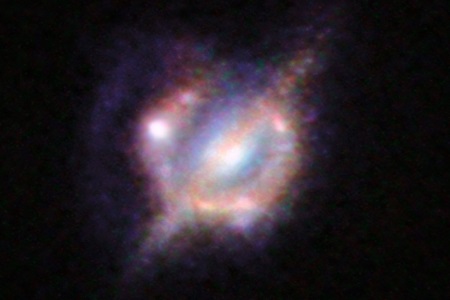
Best View Yet Of Merging Galaxies in Distant Universe

http://www.photonicsonline.com/doc/best-view-merging-galaxies-universe-0001

eso1426a
ALMA applies methods of Sherlock Holmes
Using the Atacama Large Millimeter/submillimeter Array (ALMA), and many other telescopes on the ground and in space, an international team of astronomers has obtained the best view yet of a collision that took place between two galaxies when the Universe was only half its current age. They enlisted the help of a galaxy-sized magnifying glass to reveal otherwise invisible detail. These new studies of the galaxy H-ATLAS J142935.3-002836 have shown that this complex and distant object looks like the well-known local galaxy collision, the Antennae Galaxies.
The famous fictional detective Sherlock Holmes used a magnifying lens to reveal barely visible but important evidence. Astronomers are now combining the power of many telescopes on Earth and in space [1] with a vastly larger form of cosmic lens to study a case of vigorous star formation in the early Universe.
“While astronomers are often limited by the power of their telescopes, in some cases our ability to see detail is hugely boosted by natural lenses, created by the Universe,” explains lead author Hugo Messias of the Universidad de Concepción (Chile) and the Centro de Astronomia e Astrofísica da Universidade de Lisboa (Portugal). “Einstein predicted in his theory of general relativity that, given enough mass, light does not travel in a straight line but will be bent in a similar way to light refracted by a normal lens.”
These cosmic lenses are created by massive structures like galaxies and galaxy clusters, which deflect the light from objects behind them due to their strong gravity — an effect, called gravitational lensing. The magnifying properties of this effect allow astronomers to study objects which would not be visible otherwise and to directly compare local galaxies with much more remote ones, seen when the Universe was significantly younger.
But for these gravitational lenses to work, the lensing galaxy, and the one far behind it, need to be very precisely aligned.
“These chance alignments are quite rare and tend to be hard to identify,” adds Hugo Messias, “but, recent studies have shown that by observing at far-infrared and millimetre wavelengths we can find these cases much more efficiently.”
H-ATLAS J142935.3-002836 (or just H1429-0028 for short) is one of these sources and was found in the Herschel Astrophysical Terahertz Large Area Survey (H-ATLAS). Although very faint in visible light pictures, it is among the brightest gravitationally lensed objects in the far-infrared regime found so far, even though we are seeing it at a time when the Universe was just half its current age.
Probing this object was at the limit of what is possible, so the international team of astronomers started an extensive follow-up campaign using the most powerful telescopes — both on the ground as well as in space — including the NASA/ESA Hubble Space Telescope, ALMA, the Keck Observatory, the Karl Jansky Very Large Array (JVLA), and others. The different telescopes provided different views, which could be combined to get the best insight yet into the nature of this unusual object.
The Hubble and Keck images revealed a detailed gravitationally-induced ring of light around the foreground galaxy. These high resolution images also showed that the lensing galaxy is an edge-on disc galaxy — similar to our galaxy, the Milky Way — which obscures parts of the background light due to the large dust clouds it contains.
But this obscuration is not a problem for ALMA and the JVLA, since these two facilities observe the sky at longer wavelengths, which are unaffected by dust. Using the combined data the team discovered that the background system was actually an ongoing collision between two galaxies. From this point on, ALMA and the JVLA started to play a key role in further characterising this object.
In particular, ALMA traced carbon monoxide, which allows detailed studies of star formation mechanisms in galaxies. The ALMA observations also allowed the motion of the material in the more distant object to be measured. This was essential to show that the lensed object is indeed an ongoing galactic collision forming hundreds of new stars each year, and that one of the colliding galaxies still shows signs of rotation; an indication that it was a disc galaxy just before this encounter.
The system of these two colliding galaxies resembles an object that is much closer to us: the Antennae Galaxies. This is a spectacular collision between two galaxies, which are believed to have had a disc structure in the past. While the Antennae system is forming stars at a rate of only a few tens of the mass of our Sun each year, H1429-0028 turns more than 400 times the mass of the Sun of gas into new stars each year.
Rob Ivison, ESO’s Director of Science and a co-author of the new study, concludes: “ALMA enabled us to solve this conundrum because it gives us information about the velocity of the gas in the galaxies, which makes it possible to disentangle the various components, revealing the classic signature of a galaxy merger. This beautiful study catches a galaxy merger red handed as it triggers an extreme starburst.”
[1] Among the armada of instruments that were used to provide evidence to help unravel the mysteries of this case were no fewer than three ESO telescopes — ALMA, APEX and VISTA. The other telescopes and surveys that were brought to bear were: the NASA/ESA Hubble Space Telescope, the Gemini South telescope, the Keck-II telescope, the NASA Spitzer Space Telescope, the Jansky Very Large Array, CARMA, IRAM and SDSS and WISE.
The Atacama Large Millimeter/submillimeter Array (ALMA), an international astronomy facility, is a partnership of Europe, North America and East Asia in cooperation with the Republic of Chile. ALMA is funded in Europe by the European Southern Observatory (ESO), in North America by the U.S. National Science Foundation (NSF) in cooperation with the National Research Council of Canada (NRC) and the National Science Council of Taiwan (NSC) and in East Asia by the National Institutes of Natural Sciences (NINS) of Japan in cooperation with the Academia Sinica (AS) in Taiwan. ALMA construction and operations are led on behalf of Europe by ESO, on behalf of North America by the National Radio Astronomy Observatory (NRAO), which is managed by Associated Universities, Inc. (AUI) and on behalf of East Asia by the National Astronomical Observatory of Japan (NAOJ). The Joint ALMA Observatory (JAO) provides the unified leadership and management of the construction, commissioning and operation of ALMA.
This research was presented in a paper entitled “Herschel-ATLAS and ALMA HATLAS J142935.3-002836, a lensed major merger at redshift 1.027”, by Hugo Messias et al., to appear online on 26 August 2014 in the journal Astronomy & Astrophysics.
The team is composed of Hugo Messias (Universidad de Concepción, Barrio Universitario, Chile; Centro de Astronomia e Astrofísica da Universidade de Lisboa, Portugal), Simon Dye (School of Physics and Astronomy, University of Nottingham, UK), Neil Nagar (Universidad de Concepción, Barrio Universitario, Chile), Gustavo Orellana (Universidad de Concepción, Barrio Universitario, Chile), R. Shane Bussmann (Harvard-Smithsonian Center for Astrophysics, USA), Jae Calanog (Department of Physics & Astronomy, University of California, USA), Helmut Dannerbauer (Universität Wien, Institut für Astrophysik, Austria), Hai Fu (Astronomy Department, California Institute of Technology, USA), Edo Ibar (Pontificia Universidad Católica de Chile, Departamento de Astronomía y Astrofísica, Chile), Andrew Inohara (Department of Physics & Astronomy, University of California, USA), R. J. Ivison (Institute for Astronomy, University of Edinburgh, Royal Observatory, UK; ESO, Garching, Germany), Mattia Negrello (INAF, Osservatorio Astronomico di Padova, Italy), Dominik A. Riechers (Astronomy Department, California Institute of Technology, USA; Department of Astronomy, Cornell University, USA), Yun-Kyeong Sheen (Universidad de Concepción, Barrio Universitario, Chile), Simon Amber (The Open University, Milton Keynes, UK), Mark Birkinshaw (H. H. Wills Physics Laboratory, University of Bristol, UK; Harvard-Smithsonian Center for Astrophysics, USA), Nathan Bourne (School of Physics and Astronomy, University of Nottingham, UK), Dave L. Clements (Astrophysics Group, Imperial College London, UK), Asantha Cooray (Department of Physics & Astronomy, University of California, USA; Astronomy Department, California Institute of Technology, USA), Gianfranco De Zotti (INAF, Osservatorio Astronomico di Padova, Italy), Ricardo Demarco (Universidad de Concepción, Barrio Universitario, Chile), Loretta Dunne (Department of Physics and Astronomy, University of Canterbury, New Zealand; Institute for Astronomy, University of Edinburgh, Royal Observatory, UK), Stephen Eales (School of Physics and Astronomy, Cardiff University,UK), Simone Fleuren (School of Mathematical Sciences, University of London, UK), Roxana E. Lupu (Department of Physics and Astronomy, University of Pennsylvania, USA), Steve J. Maddox (Department of Physics and Astronomy, University of Canterbury, New Zealand; Institute for Astronomy, University of Edinburgh, Royal Observatory, UK), Michał J. Michałowski (Institute for Astronomy, University of Edinburgh, Royal Observatory, UK), Alain Omont (Institut d’Astrophysique de Paris, UPMC Univ. Paris, France), Kate Rowlands (School of Physics & Astronomy, University of St Andrews, UK), Dan Smith (Centre for Astrophysics Research, Science & Technology Research Institute, University of Hertfordshire, UK), Matt Smith (School of Physics and Astronomy, Cardiff University,UK) and Elisabetta Valiante (School of Physics and Astronomy, Cardiff University, UK).
About ESO
ESO is the foremost intergovernmental astronomy organisation in Europe and the world’s most productive ground-based astronomical observatory by far. It is supported by 15 countries: Austria, Belgium, Brazil, the Czech Republic, Denmark, France, Finland, Germany, Italy, the Netherlands, Portugal, Spain, Sweden, Switzerland and the United Kingdom. ESO carries out an ambitious programme focused on the design, construction and operation of powerful ground-based observing facilities enabling astronomers to make important scientific discoveries. ESO also plays a leading role in promoting and organising cooperation in astronomical research. ESO operates three unique world-class observing sites in Chile: La Silla, Paranal and Chajnantor. At Paranal, ESO operates the Very Large Telescope, the world’s most advanced visible-light astronomical observatory and two survey telescopes. VISTA works in the infrared and is the world’s largest survey telescope and the VLT Survey Telescope is the largest telescope designed to exclusively survey the skies in visible light. ESO is the European partner of a revolutionary astronomical telescope ALMA, the largest astronomical project in existence. ESO is currently planning the 39-metre European Extremely Large optical/near-infrared Telescope, the E-ELT, which will become “the world’s biggest eye on the sky”.
SOURCE: ESO

Monday, September 2, 2013

Astronomy: World's First Interferometric Image at 500 GHz With ALMA Band 8 Receivers


Planetary Nebula NGC 6302. The right image is the composite of ALMA Band 8 (yellow) and the Hubble Space Telescope (gray). Upper left image is the whole view of NGC 6302 taken by the Hubble Space Telescope. Lower left panel shows the line profile of atomic carbon. (Credit: ALMA (ESO/NAOJ/NRAO), NASA/ESA Hubble Space Telescope)

Sep. 2, 2013 — ALMA opens another window to the universe in the 500 GHz frequency band. Astronomers successfully synthesized the distribution of atomic carbon around a planetary nebula NGC 6302 in test observations with the ALMA Band 8 receiver, developed by the National Astronomical Observatory of Japan (NAOJ). This is the first 500 GHz band astronomical image captured by a radio interferometer with unprecedentedly high resolution.
ALMA has 10 receiver bands to cover a wide range of observing frequency. All antennas are equipped with dedicated receivers for each frequency band. NAOJ assumes the development of three bands: Band 4 (receiving frequency: 125 to 163 GHz, millimeter-wave); Band 8 (385 to 500 GHz, submillimeter-wave); and Band 10 (787 to 950 GHz, Terahertz-wave).
The frequency band observable with the Band 8 receiver covers a wide range of radio emission lines from various atoms and molecules. Among them, one of the most attractive targets for many astronomers is the emission from atomic carbon at 492 GHz. What can we expect to see from it?The main component of the cosmic gas is hydrogen. The abundance of carbon is only 1/3000 of that of hydrogen, although carbon is the third most abundant element in the universe. The cosmic gas can be classified into three groups by its temperature and density; "plasma cloud" (number density of plasma particles: 0.01 per 1 cm3, temperature: several million degrees Celsius), "atomic cloud" (number density of atom: 10 per 1 cm3, temperature: -160 degrees Celsius), and "molecular cloud" (number density of molecule: 10000 per 1 cm3, temperature: -- 260 degrees Celsius). Dense regions of atomic cloud grow into molecular cloud, and molecular cloud with increased density becomes a seedbed of stars. On the other hand, molecules composing molecular cloud dissociate into atoms when exposed to intense ultraviolet light. Detailed study of the distributions of atomic cloud and molecular cloud gives us insights into the evolution of cosmic gas. In particular, observation of carbon atom is important not only in studying the distribution and characteristics of atomic cloud, but also in exploring chemistry in the universe because various complex molecules are formed from chemical reactions between carbon atom and other atoms such as oxygen and hydrogen.
So far, observations in the 500 GHz band, including emission line from cosmic carbon atom, have been made with single dish radio telescopes such as the University of Tokyo's Mt. Fuji Submillimeter Telescope and Caltech Submillimeter Observatory. The typical spatial resolution of those observations is 15 arcseconds or larger (1 arcsecond corresponds to 1/3600 of 1 degree), which is far worse than the resolution of existing 8-meter class optical telescopes (0.1 arcsecond). ALMA is the first radio interferometer which allows observations in this frequency range with remarkably improved resolution compared to single dish telescopes. This time, the Band 8 receivers were installed in five 7-m antennas developed by Japan and achieved a high resolution of 3.5 arcseconds. By installing the receiver into all the ALMA antennas, the resolution becomes even better by 400 times. Astronomers around the world have high expectations for observations with Band 8.
Yutaro Sekimoto, an associate professor at NAOJ and the leader of the Band 8 receiver development team at the NAOJ's Advanced Technology Center says "I deeply appreciate long and hard efforts of all staff to realize ALMA observation of carbon atom. I expect further ALMA observations will unveil the evolution process of interstellar matter." Naohisa Sato, a member of the development team, says "We went through difficult times during receiver production phase. We made a number of adjustments and replacements to achieve required performance for every receiver. I am really happy with this successful result."
NGC 6302 is a planetary nebula, which is in the final stage of the life of a star with a mass several times that of the Sun. Visible light image shows a bipolar shape of gas ejected from the dying star. ALMA with the Band 8 receivers targeted at the center of the nebula and revealed that the distribution of carbon atom is concentrated in a small part, which is similar to a dust and gas disk around the central star that has been found by previous observations with other telescopes. Further observations of carbon atom with better resolution will give us more detailed view of the chemical environment in the nebula.

Thursday, March 29, 2012

Terahertz market set to diversify and accelerate

The ALMA telescope project will soon be completed but new applications will more than compensate, says BCC Research
Terahertz market set to diversify and accelerate
ALMA has been a significant driver of the total THz sector
The total market for terahertz systems was worth $83.7 million at the end of 2011, according to a new report from Massachusetts-based BCC Research, of which the bulk was associated with ALMA, the Atacama Large Millimeter/submillimeter Array under construction in Chile. As that project winds down, more diverse applications will start to appear, and the total market for the THz technology is set to expand over the coming years.
ALMA, an internationally funded observatory located 5000 meters above sea level, is said to be the largest and most complex astronomical project currently in progress. It will eventually feature an array of 66 radio antennae, scanning the sky at wavelengths between 0.3 to 9.6 mm. The telescope produced its first images in October 2011, even though only around one-third of the intended antennae are currently up and running.
The scale of the ALMA installation has meant that much of last year's total market for THz systems was closely linked to the astronomical imaging work underway there, according to BCC's figures. The same was true in 2010, when the market was worth a similar $82.8 million.
ALMA is due to be completed by the end of 2012, but new applications for THz systems will arise in the second half of the decade, taking up any slack and expanding the total market.
BCC expects that applications in public safety and security will help to grow the overall THz market to $125.5 million in 2016, and accelerating diversification in the second half of the decade should push that figure to an impressive $565 million by 2021.
Within those totals, BCC predicts that the THz imaging sector will grow slightly from $73 million in 2011 to $74.2 million in 2016, before expanding much more rapidly to $243.8 million by 2021. By then other sensors, such as THz biochips and moisture detectors, are likely to account for more than 30 percent of the total THz market, compared to their minimal presence today. Computer-related devices, primarily high-performance computer interconnects, should capture another 12 percent, and communications devices will account a further 10 percent.
Consequently the overall THz sector is expected to show a compound annual growth rate of 8.4 percent over the first half of the decade, before accelerating to a CAGR of more than 35 percent between 2016 and 2021.
Terahertz Radiation Systems: Technologies and Global Markets, report ref IAS029, will be published by BCC Research in February 2012.
• An indication of where THz technology might be headed came with the announcement by Technische Universität Darmstadt of a transmitter generating what is claimed to be the highest frequency ever attained by a microelectronic device. A team at TU Darmstadt’s Institute for Microwave Technology and Photonics used a resonance tunnel diode, designed in such a way that electromagnetic waves generated within a terahertz oscillator were repeatedly amplified rather than attenuated, to achieve a frequency of 1.111 THz. The same design principle should be able to generate frequencies up to 3 THz, according to the team.
• As evidence of the current market for THz imaging, Advanced Photonix has announced the sale of its T-Ray 4000 system to two companies in the Fortune 100 list. One customer is using the system to develop the quality control protocol for a packaged nutritional supplement product, while the other is using it to develop process and quality control protocols for inspection of its products. Both customers plan to deploy multiple systems on the manufacturing floor in the future, according to Advanced Photonix.

Tuesday, January 17, 2012

Terahertz market set to diversify and accelerate


16 Jan 2012 http://optics.org/news/3/1/16
The ALMA telescope project will soon be completed but new applications will more than compensate, says BCC Research
ALMA has been a significant driver of the total THz sector
The total market for terahertz systems was worth $83.7 million at the end of 2011, according to a new report from Massachusetts-based BCC Research, of which the bulk was associated with ALMA, the Atacama Large Millimeter/submillimeter Array under construction in Chile. As that project winds down, more diverse applications will start to appear, and the total market for the THz technology is set to expand over the coming years.
ALMA, an internationally funded observatory located 5000 meters above sea level, is said to be the largest and most complex astronomical project currently in progress. It will eventually feature an array of 66 radio antennae, scanning the sky at wavelengths between 0.3 to 9.6 mm. The telescope produced its first images in October 2011, even though only around one-third of the intended antennae are currently up and running.
The scale of the ALMA installation has meant that much of last year's total market for THz systems was closely linked to the astronomical imaging work underway there, according to BCC's figures. The same was true in 2010, when the market was worth a similar $82.8 million.
ALMA is due to be completed by the end of 2012, but new applications for THz systems will arise in the second half of the decade, taking up any slack and expanding the total market.
BCC expects that applications in public safety and security will help to grow the overall THz market to $125.5 million in 2016, and accelerating diversification in the second half of the decade should push that figure to an impressive $565 million by 2021.
Within those totals, BCC predicts that the THz imaging sector will grow slightly from $73 million in 2011 to $74.2 million in 2016, before expanding much more rapidly to $243.8 million by 2021. By then other sensors, such as THz biochips and moisture detectors, are likely to account for more than 30 percent of the total THz market, compared to their minimal presence today. Computer-related devices, primarily high-performance computer interconnects, should capture another 12 percent, and communications devices will account a further 10 percent.
Consequently the overall THz sector is expected to show a compound annual growth rate of 8.4 percent over the first half of the decade, before accelerating to a CAGR of more than 35 percent between 2016 and 2021.
Terahertz Radiation Systems: Technologies and Global Markets, report ref IAS029, will be published by BCC Research in February 2012.
• An indication of where THz technology might be headed came with the announcement by Technische Universität Darmstadt of a transmitter generating what is claimed to be the highest frequency ever attained by a microelectronic device. A team at TU Darmstadt’s Institute for Microwave Technology and Photonics used a resonance tunnel diode, designed in such a way that electromagnetic waves generated within a terahertz oscillator were repeatedly amplified rather than attenuated, to achieve a frequency of 1.111 THz. The same design principle should be able to generate frequencies up to 3 THz, according to the team.
• As evidence of the current market for THz imaging, Advanced Photonix has announced the sale of its T-Ray 4000 system to two companies in the Fortune 100 list. One customer is using the system to develop the quality control protocol for a packaged nutritional supplement product, while the other is using it to develop process and quality control protocols for inspection of its products. Both customers plan to deploy multiple systems on the manufacturing floor in the future, according to Advanced Photonix.

Friday, November 18, 2011

Revolution in Astrochemistry through THz spectrosopy


Newswise — November 17, 2011 — Astronomy has always been about finding our place in the universe, about seeking origins. A new international astronomical observatory called ALMA will bring new insights to our understanding of the farthest reaches of space and answers to our most fundamental questions as to how the universe evolved and became what it is, and how the building blocks of life began.
University of Virginia astronomers and chemists are at the forefront of this adventure.
"We really are poised to lead the way on a hugely important aspect of this venture, which is to better understand the chemistry of the universe," said astronomer Kelsey Johnson of U.Va.'s College of Arts & Sciences, who chairs ALMA's science advisory committee. "Astrochemistry is an emerging field on the cusp of revolution, and U.Va. scientists have anticipated this and prepared for it."
ALMA is the Atacama Large Millimeter/submillimeter Array, a new $1.3 billion radio telescope in the high desert of Chile. Decades in planning and years in construction, ALMA is the most technologically advanced astronomical observatory ever built, far exceeding the capabilities of any other, including the Hubble Space Telescope.
"It's really going to not only enhance our view of the universe, but also change the way we view it. The new science is going to be astounding," Johnson said.
ALMA made its first observations on Sept. 30, streaming startling images and reams of new data to scientists around the world. When construction is fully complete in 2013, the observatory will consist of 66 radio antennas configured to provide the observational capabilities of a single massive antenna that otherwise would be impossible to build.
The United States has contributed nearly $500 million to its development through the National Science Foundation-funded National Radio Astronomy Observatory, headquartered on the U.Va. Grounds in Charlottesville.
"U.Va. is uniquely positioned to establish an international leadership role in ALMA science," said U.Va. chemist Brooks Pate, also from the College, who leads a multidisciplinary effort in the chemistry of the universe at the University. "We have a world-class team of chemists, astronomers, physicists and engineers to direct the science, make observations, collect data and sort through it to bring new understanding to the makings of the universe."
ALMA will provide chemists and astronomers with high-resolution images of the way molecules are distributed in the universe. This will help scientists develop a new and essentially first-time understanding of space chemistry – how the original simple elements of hydrogen and helium formed into more complex elements, how the chemistry of stars spread out across the universe and how planets formed, including Earth.
"We've really only obtained hints, up to this point, of the chemical processes that led to life on this planet," Pate said. "ALMA will allow us to move beyond our understanding of Earthbound chemistry to the very source chemistry in the universe that led to everything else, including amino acids, the precursors to DNA and life."
To further its pursuit of this understanding, U.Va. hired two astrochemists to sort through and give meaning to the mass of data that has begun to stream in from ALMA.
One is Eric Herbst, a preeminent pioneer in the emerging field of astrochemistry, who came to U.Va. earlier this year as the Commonwealth Professor of Chemistry from a distinguished career at The Ohio State University. He holds joint appointments in the chemistry, astronomy and physics departments. The other is Karin Oberg, currently a Hubble Postdoctoral Fellow at the Harvard-Smithsonian Center for Astrophysics, who will be appointed to the astronomy and chemistry departments.
"The chemistry of space is why we are here," Herbst noted. "The exotic chemistry out there relates to the everyday chemistry here, and so there is a lot to learn from astrochemistry about how all of this came together, from the stars to the planets. With ALMA we hope to identify regions of space with water, complex and pre-biotic molecules" – or molecules, like amino acids, that are building blocks for life.
Pate adds that areas of astrochemistry that currently are under speculation, such as how exotic molecules are formed, will now be tested, analyzed and re-evaluated. New understandings will emerge.
"We might begin to see the chemical processes that allowed for the forming of life on this planet, and can look to regions of space where the same conditions may be occurring or have already occurred," Pate said. "We hope to identify regions where there may be other life."
"There will be exponential growth in knowledge," Herbst added. "At present we can't identify a large fraction of the molecules in space. There are missing chunks of fundamental knowledge, and we're going to begin to fill in those gaps. There is so much new chemistry to learn."
One of the biggest challenges facing researchers will be sorting through the reams of data that will stream in non-stop from ALMA. "Extracting the scientific content of the enormous data set will push the technological limits of large-scale computing and require scientists to develop new software tools to rapidly analyze data sets that are too large to directly view," Pate said.
He noted that the development of ALMA has been a driver for major technological advances in the field of terahertz spectroscopy, a rapidly moving field with deep connections to the science and technology community in Charlottesville. Solid-state terahertz devices are needed for ALMA's spectrographs for chemical sensing and imaging.
In addition to the National Radio Astronomy Observatory engineers who have designed and assembled ALMA's detectors, U.Va. electrical and computer engineering professors Art Lichtenberger and Robert Weikle, in the School of Engineering and Applied Science, are developing new devices for the emerging field of terahertz spectroscopy and imaging. Charlottesville-based Virginia Diodes Inc., a company that grew from the research program of U.Va. electrical and chemical engineering professor Thomas Crowe, is a world leader in the commercialization of solid-state terahertz light sources and detectors. The National Ground Intelligence Center and the Defense Intelligence Agency facility in Charlottesville also are users of this technology.
"Charlottesville is uniquely poised to become the leading research and development commercialization center for terahertz technology, and this should lead to local jobs in high-tech fields," Pate said.
ALMA research also will spin off public outreach and K-12 education initiatives. High-resolution images and findings from ALMA science will be used to educate the public on the newly discovered wonders of space, and the University will develop outreach programs to the local community and schools to highlight ways that Charlottesville is shaping up to be a premier national center for breakthroughs in our understanding of our place in the universe.