A repository & source of cutting edge news about emerging terahertz technology, it's commercialization & innovations in THz devices, quality & process control, medical diagnostics, security, astronomy, communications, applications in graphene, metamaterials, CMOS, compressive sensing, 3d printing, and the Internet of Nanothings. NOTHING POSTED IS INVESTMENT ADVICE! REPOSTED COPYRIGHT IS FOR EDUCATIONAL USE.
Showing posts with label Tatsuo Itoh. Show all posts
Wednesday, February 14, 2018
Abstract-Metasurface terahertz laser with electronically-controlled polarization
Daguan Chen, Luyao Xu, Christopher A. Curwen, Mohammad Memarian, John L. Reno, Tatsuo Itoh, Benjamin S. Williams,
http://ieeexplore.ieee.org/document/8083356/
We report a terahertz metasurface quantum-cascade VECSEL laser without moving parts that can electronically switch between near-orthogonal linearly polarized output. It exhibits excellent beam pattern, single-mode operation, and power up to 93 mW at 77 K.
Wednesday, April 19, 2017
UCLA-led team develops technique to control laser polarization
Artist’s depiction of the laser polarization metasurface that can tune the laser’s polarization state purely electronically, without any moving parts
The approach operates purely electronically, without any moving parts
Matthew Chin
A research team led by UCLA electrical engineers has developed a new technique to control the polarization state of a laser that could lead to a new class of powerful, high-quality lasers for use in medical imaging, chemical sensing and detection, or fundamental science research.
Think of polarized sunglasses, which help people see more clearly in intense light. Polarizing works by filtering visible light waves to allow only waves that have their electric field pointing in one specific direction to pass through, which reduces brightness and glare.
Like brightness and color, polarization is a fundamental property of light that emerges from a laser. The traditional way to control the polarization of a laser was to use a separate component like a polarizer or a waveplate. To change its polarization, the polarizer or waveplate must be physically rotated, a slow process that results in a physically larger laser system.
The team from the UCLA Henry Samueli School of Engineering and Applied Science developed a specialized artificial material, a type of “metasurface,” that can tune the laser’s polarization state purely electronically, without any moving parts. The research was published in Optica. The breakthrough advance was applied to a class of lasers in the terahertz range of frequencies on the electromagnetic spectrum, which lies between microwaves and infrared waves.
“While there are a few ways to quickly switch polarization in the visible spectrum, in the terahertz range there is currently a lack of good options,” said Benjamin Williams, associate professor of electrical engineering and the principal investigator of the research. “In our approach, the polarization control is built right into the laser itself. This allows a more compact and integrated setup, as well as the possibility for very fast electronic switching of the polarization. Also, our laser efficiently generates the light into the desired polarization state — no laser power is wasted generating light in the wrong polarization.”
Terahertz radiation penetrates many materials, such as dielectric coatings, paints, foams, plastics, packaging materials, and more without damaging them, Williams said.
“So some applications include non-destructive evaluation in industrial settings, or revealing hidden features in the study of art and antiquities,” said Williams, who directs the Terahertz Devices and Intersubband Nanostructures Laboratory. “For example, our laser could be used for terahertz imaging, where the addition of polarization contrast may help to uncover additional information in artwork, such as improved edge detection for hidden defects or structures.”
The work is based on the group’s recent development of the world’s first vertical-external-cavity surface-emitting laser, or VECSEL, that operates in the terahertz range.
Their new metasurface covers an area of 2 square millimeters and has a distinct zigzag pattern of wire antennas running across its surface. An electric current runs through the wires, selectively energizing particular segments of the laser material, which allows a user to change and customize the polarization state as needed.
The lead authors of the research are electrical engineering graduate student Luyao Xu and electrical engineering undergraduate student Daguan Chen. Other authors include electrical engineering graduate student Christopher Curwen; Mohammad Memarian, a postdoctoral scholar in UCLA’s microwave electronics lab; John Reno of Sandia National Laboratories; and UCLA electrical engineering professor Tatsuo Itoh, who holds the Northrop Grumman Chair in Engineering.
The research was supported by the National Science Foundation and NASA.
Friday, March 11, 2016
Abstract-Terahertz quantum cascade VECSEL
Luyao Xu, Christopher A. Curwen, Philip W. C. Hon, Tatsuo Itoh, Benjamin S. Williams
Univ. of California, Los Angeles (United States)
Proc. SPIE 9734, Vertical External Cavity Surface Emitting Lasers (VECSELs) VI, 97340G (March 10, 2016); doi:10.1117/12.2213230
Vertical-external-cavity surface-emitting lasers (VECSELs) have been successfully used in the visible and near-infrared to achieve high output power with excellent Gaussian beam quality. However, the concept of VECSEL has been impossible to implement for quantum-cascade (QC) lasers due to the "intersubband selection rule". We have recently demonstrated the first VECSEL in the terahertz range. The enabling component for the QC-VECSEL is an amplifying metasurface reflector composed of a sparse array of metallic sub-cavities, which allows the normally incident radiation to interact with the electrically pumped QC gain medium. In this work, we presented multiple design variations based on the first demonstrated THz QC-VECSEL, regarding the lasing frequencies, the output coupler and the intra-cavity aperture. Our work on THz QC-VECSEL initiates a new approach towards achieving scalable output power in combination with a diffraction-limited beam pattern for THz QC-lasers. The design variations presented in this work further demonstrate the practicality and potential of VECSEL approach to make ideal terahertz QC-laser sources.
© (2016) COPYRIGHT Society of Photo-Optical Instrumentation Engineers (SPIE). Downloading of the abstract is permitted for personal use only.
Thursday, August 22, 2013
Active terahertz waveguides based on transmission-line metamaterials
Benjamin S. Williams, Amir Ali Tavallaee, Philip Hon and Tatsuo Itoh
The demonstration of a 1D left-handed metamaterial waveguide for terahertz quantum-cascade lasers opens the door to new techniques for beam steering and shaping.
22 August 2013, SPIE Newsroom. DOI: 10.1117/2.1201308.005081
Electromagnetic metamaterials are artificial structures that can be engineered to exhibit customizable or conventionally unobtainable electromagnetic properties, such as propagation with near-zero or even negative refractive index. In a material with a negative index, the flow of energy is opposite to the movement of the wavefronts, an effect known as backward-wave or left-handed propagation (so named because the electric field, magnetic field, and wavevector form a left-handed triple). At IR and optical frequencies, left-handed materials can be made by incorporating plasmonic structures into a dielectric. Provided the size and periodicity of the structures is sufficiently small compared to the wavelength, waves propagate as if the medium were uniform with new values for the refractive index (or other bulk properties). Current research in this area investigates electromagnetic metamaterials for novel antenna concepts, sub-wavelength resonators and waveguides, superlenses that beat the diffraction limit, and even cloaking from electromagnetic radiation.
Our research group has been working on methods to apply metamaterial concepts to the terahertz (THz) frequency range, where the wavelength is approximately a hundred times longer than in the visible. The novelty in our work is the combination of metamaterial-inspired waveguides with a THz quantum-cascade laser-gain medium. In this way, stimulated emission of THz photons from intraband transitions in the gallium-arsenide-based medium compensates for losses and allows active devices.1
To design and describe the metamaterial waveguide, we adopt the transmission-line formalism, where negative and zero-index propagation are modeled by the introduction of additional lumped element capacitance and inductance into the series and shunt branches of the transmission line.2Where a conventional transmission line has series inductance LR and shunt capacitance CR, a metamaterial line is modeled by adding series capacitance CL and shunt inductance LL (the subscripts L and R stand for left-handed and right-handed propagation, respectively). We can adapt this scheme to THz quantum-cascade devices, which are fabricated into a metal-dielectric-metal waveguide. Figure 1 shows the calculated dispersion relation for a typical design with left-handed propagation below about 2.6THz and right-handed propagation above 2.6THz: a composite right-/left-handed (CRLH) metamaterial waveguide. At 2.6THz, the dispersion relation crosses between the two types of propagation, without a stopband, while maintaining non-zero group velocity. Such a condition is referred to as balanced and results from proper engineering of the effective capacitance and inductance on the transmission line.
Figure 1. Calculated dispersion relation for a balanced terahertz (THz) metamaterial waveguide exhibiting left-handed (LH) and right-handed (RH) propagation. GaAs: Gallium arsenide. AlGaAs: Aluminum gallium arsenide. p: Unit cell size.
The key advance in this recent work is the inclusion of 200nm-size gaps in the top metallization of the waveguide: see Figure 2. These gaps play the role of a series capacitance in the transmission-line model for the waveguide, and are the key feature that enables left-handed propagation. We demonstrated the existence of left-handed propagation indirectly by using a section of the CRLH metamaterial waveguide as a leaky-wave coupling antenna for a THz quantum-cascade laser. The laser feeds the antenna with the THz signal, which is then radiated into the far-field at an angle that depends on the THz frequency and its location on the dispersion diagram. While propagation in the right-handed region will result in a beam angled in the forward direction, propagation in the left-handed region generates a beam angled in the backward direction (off normal). Propagation with a zero effective index (β=0) gives a beam directed in the surface normal direction. Therefore, by measuring the far-field beam pattern and the radiation frequency, we can reconstruct the dispersion relation: see Figure 1. We recently observed a backward-directed beam for the first time, demonstrating the existence of left-handed propagation.3
Figure 2. Image of a composite right-/left-handed metamaterial waveguide implemented in a THz quantum-cascade (QC) metal-metal waveguide. The dielectric of this ‘transmission line’ is made up of active THz QC gain material grown in GaAs/AlGaAs quantum wells. The inset image shows a close-up of 200nm gaps in the metallization that create the series capacitance CL and enable left-handed propagation. Cx, Lx: Capacitors, inductors (where x denotes R or L). Cu: Copper. Cr: Chromium. Au: Gold.
Beyond this proof of principle, we now have access to a wide array of microwave circuit, antenna, and metamaterial design techniques that can be applied to THz lasers. For example, such a metamaterial antenna could be used to steer a beam between the forward and backward directions (depending on the exact frequency). Or, if we can develop dynamic control of the circuit elements, tunable resonators and phase shifters become possible. Our future work focuses on using these design techniques to create a new class of lasers with flexible and dynamic control of spectral and radiation properties, including beam shaping and steering, wavelength tuning, and polarization state.
Benjamin S. Williams, Amir Ali Tavallaee, Philip Hon, Tatsuo Itoh
University of California at Los Angeles
Los Angeles, CA
References:
1. B. S. Williams, Terahertz quantum-cascade lasers, Nat. Photon. 1, p. 517-525, 2007.
2. A. Lai, C. Caloz, T. Itoh, Composite right/left-handed transmission line metamaterials,IEEE Microw. Mag. 5, p. 34-50, 2004.
3. A. A. Tavallaee, P. W. C. Hon, Q.-S. Chen, T. Itoh, B. S. Williams, Active terahertz quantum-cascade composite right/left handed metamaterial, Appl. Phys. Lett. 102, p. 021103, 2013.
|
Wednesday, January 16, 2013
Abstract-Active terahertz quantum-cascade composite right/left-handed metamaterial
http://apl.aip.org/resource/1/applab/v102/i2/p021103_s1?isAuthorized=no
Amir A. Tavallaee1,2, Philip W. C. Hon1, Qi-Sheng Chen3, Tatsuo Itoh1, and Benjamin S. Williams1,2
1Electrical Engineering Department, University of California, Los Angeles, California 90095, USA
2California NanoSystems Institute, University of California, Los Angeles, California 90095, USA
3Northrop Grumman Aerospace Systems, Redondo Beach, California 90278, USA
View Map2California NanoSystems Institute, University of California, Los Angeles, California 90095, USA
3Northrop Grumman Aerospace Systems, Redondo Beach, California 90278, USA
(Received 31 October 2012; accepted 19 December 2012; published online 14 January 2013)
-
Alerts
-
Tools
-
Share
We report the demonstration of a composite right/left-handed (CRLH) metamaterial waveguide for terahertz quantum-cascade (QC) lasers. By incorporating gap capacitors (∼ 250 nm) in the top metallization of a metal-metal waveguide operating in a higher order lateral mode, we have realized a CRLH transmission line that supports traveling modes with negative effective phase indices (i.e., left-handed or backward-wave propagation). The CRLH metamaterial waveguide is employed as an active leaky-wave antenna for a terahertz QC-laser. Directional single-lobed beams launched in the backwards direction at angles of −4° and −63° were experimentally observed at excitation frequencies 2.59 and 2.48 THz, respectively.
Monday, February 13, 2012
Abstract: Terahertz composite right-left handed transmission-line metamaterial waveguides
We report terahertz metamaterial waveguides based on the concept of composite right/left-handed transmission-lines. The waveguides are implemented in a metal-insulator-metal geometry fabricated with spin-coated Benzocyclobutene and contact photolithography. Angle-resolved reflection spectroscopy shows strong resonant absorption features corresponding to both right-handed and left-handed (backward wave) propagating modes within the leaky-wave bandwidth. Tuning of the waveguide dispersion is achieved by varying the effective lumped element series capacitance. The experimental results are in good agreement with full-wave finite element method simulations as well as an intuitive transmission-line circuit model.
© 2012 American Institute of Physics
Monday, April 11, 2011
Metamaterial concepts applied to terahertz-laser waveguides
Benjamin S. Williams, Amir Ali Tavallaee, Philip Hon and Tatsuo Itoh
A terahertz quantum-cascade laser with a transmission-line metamaterial coupler antenna offers an intermediate step toward a zero-index laser.
11 April 2011, SPIE Newsroom. DOI: 10.1117/2.1201103.003597
Researchers have devoted considerable recent effort to development of ‘electromagnetic metamaterials.’ Such materials can be engineered to exhibit customizable or conventionally unobtainable electromagnetic properties, including propagation with near-zero or even negative refractive index (i.e., backward wave propagation). This is typically done by incorporating lumped inductive or capacitive elements (or, at optical frequencies, plasmonic or dielectric elements) on length scales that are sufficiently smaller than the wavelength so that the medium appears homogeneous. Electromagnetic metamaterials are currently being used to investigate and implement novel antenna concepts, subwavelength resonators and waveguides, superlenses that beat the diffraction limit, and even electromagnetic cloaking.
A particular challenge is coping with the absorption that accompanies the various metallic inclusions. One approach offsets these losses by incorporating a source of gain into the metamaterial structure. For example, an active photonic material can provide gain through stimulated emission of photons.1 The terahertz frequency range is particularly well suited for investigation of active photonic metamaterials, since metal is still a relatively good conductor, inductor-capacitor circuit elements can be fabricated using contact photolithography, and photonic gain is available through intersubband transitions in terahertz quantum-cascade (QC)-laser material.
Our group has proposed an approach to develop planar metamaterial waveguides that are suitable for integration with QC-laser material.2 It is adapted from the transmission-line formalism where negative and zero-index propagation can be modeled by introduction of additional lumped-element capacitance and inductance into the series and shunt branches of the transmission line (see Figure 1).3 Figure 2 shows the calculated dispersion relation for a typical balanced design. This can be readily applied to terahertz QC devices, which are typically fabricated into a double-metal waveguide that is similar in form to microstrip transmission line. Gallium arsenide (GaAs)/aluminum GaAs multiple quantum wells comprise the dielectric of the transmission line and provide amplification through stimulated emission of terahertz photons.4
Figure 1. (a) Schematic of a candidate quantum-cascade (QC)-laser double-metal metamaterial waveguide, where gold contacts and ground plane are indicated in yellow. (b) 1D transmission-line metamaterial obtained by incorporating both shunt and series inductors and capacitors. THz: Terahertz. GaAs: Gallium arsenide. AlGaAs: Aluminum GaAs. Cx, Lx: Capacitors, inductors (where x denotes R or L). ℏωLO: Stimulated emission energy.
Figure 2. Typical calculated dispersion relation for a balanced terahertz metamaterial waveguide exhibiting backward (at frequencies f < f0) and forward wave propagation at (f > f0), as well as zero-index propagation at f0.
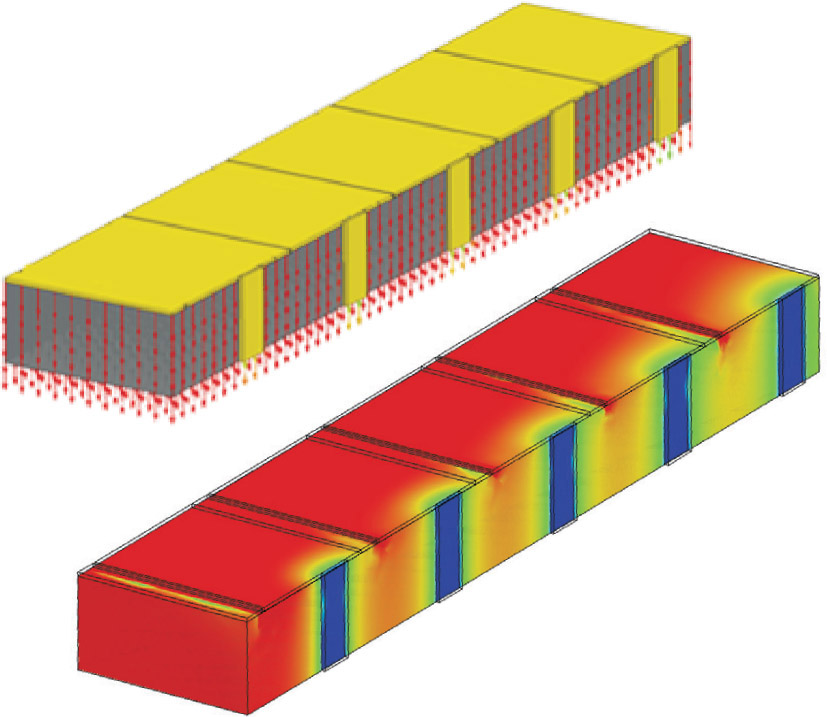
One device proposed by our group is a metamaterial ‘zero-index laser.’ This laser cavity is designed to oscillate in a mode with a zero phase index at frequency f0 and, as such, exhibits a uniform mode in the longitudinal direction. Figure 3 shows the associated calculated electric-field pattern. This is very different from a conventional laser cavity in which the laser mode exhibits a sinusoidal standing-wave pattern and, hence, interacts nonuniformly with the gain medium. For this reason, a zero-index laser may be useful to suppress spatial-hole burning, a common phenomenon in lasers that can cause undesirable multimode oscillation. Other applications include traveling-wave metamaterial antennas that radiate with high efficiency and directivity in the forward and backward directions (depending on the exact frequency). The ability to engineer the beam and radiative coupling efficiencies would benefit terahertz QC-lasers in particular, since double-metal waveguides have notoriously poor beam patterns and coupling efficiencies.
Figure 3. Full-wave simulation of electric-field vectors and intensity in zero-index laser cavity oscillating at frequency f0. Note the uniformity of the electric field in the longitudinal direction.
Since the amount of gain provided by the QC-laser material is limited, the success of this approach depends on designs that minimize losses. Our full-wave electromagnetic simulations indicate that while the ohmic and radiative losses are larger than in conventional terahertz QC lasers, they are not insurmountable. As an intermediate step toward a zero-index laser, we have demonstrated that a section of metamaterial waveguide can be used as a coupling antenna when fed by the signal from an adjacent, conventional terahertz QC-laser. The metamaterial section is active—i.e., gain is available to provide amplification to the signal injected from the master oscillator—and a directional beam (in one direction) is obtained in the forward direction.
Our next step is to demonstrate backward-wave operation from these antennas and optimize the designs to reduce losses so that a zero-index laser can be realized. However, in general, use of transmission-line metamaterial concepts is useful for designing laser waveguides and resonators with engineered phase characteristics. These techniques have the potential to allow design of lasers with flexible control of spectral and radiation properties, including beam shaping and steering, wavelength tuning, and polarization control.
Benjamin S. Williams, Amir Ali Tavallaee, Philip Hon, Tatsuo Itoh
University of California at Los AngelesLos Angeles, CA
References:
1. T. A. Klar, A. V. Kildishev, V. P. Drachev, V. M. Shalaev, Negative-index metamaterials: going optical, IEEE J. Sel. Top. Quant. Electron. 12, pp. 1106-1115, 2006.
2. A. A. Tavallaee, P. Hon, K. Mehta, T. Itoh, B. S. Williams, Zero-index terahertz quantum-cascade metamaterial lasers, IEEE J. Quant. Electron. 46, pp. 1091-1098, 2010.
3. A. Lai, C. Caloz, T. Itoh, Composite right/left-handed transmission line metamaterials, IEEE Microw. Mag., pp. 34-50, 2004.
4. B. S. Williams, Terahertz quantum cascade lasers, Nat. Photon. 1, pp. 517-524, 2007.
Subscribe to:
Posts (Atom)