Showing posts with label Yasaman Ghasempour. Show all posts

Tuesday, May 4, 2021

Abstract-Line-of-sight and non-line-of-sight links for dispersive terahertz wireless networks


Publisher Logo
 

Yasaman Ghasempour,  Yasith Amarasinghe, Chia-Yi Yeh, Edward Knightly,  Daniel M. Mittleman, 

An illustration showing different frequencies (represented by “colors”) emitting at different angles by a leaky waveguide excited by a broadband input signal. The plot shows the peak frequency (in GHz) that emits at each angle (in degrees). (b) Our experimental setup including a pulse source and detector, a custom-built leaky waveguide, and motorized rotation and translation stages to investigate different multipath configurations and RX orientations.

https://aip.scitation.org/doi/abs/10.1063/5.0039262

Despite the rapidly growing interest in exploiting millimeter and terahertz waves for wireless data transfer, the role of reflected non-line-of-sight (NLOS) paths in wireless networking is one of the least explored questions. In this paper, we investigate the idea of harnessing these specular NLOS paths for communication in directional networks at frequencies above 100 GHz. We explore several illustrative transmitter architectures, namely, a conventional substrate-lens dipole antenna and a leaky-wave antenna. We investigate how these high-gain directional antennas offer both new challenges and new opportunities for exploiting NLOS paths. Our results demonstrate the sensitivity to antenna alignment, power spectrum variations, and the disparity in supported bandwidth of various line-of-sight (LOS) and reflected path configurations. We show that NLOS paths can, under certain circumstances, offer even higher data rates than the conventional LOS path. This result illustrates the unique opportunities that distinguish THz wireless systems from those that operate at lower frequencies.
This work was supported by the U.S. National Science Foundation and Army Research Lab (ARL).

Tuesday, April 28, 2020

Abstract-Single-shot link discovery for terahertz wireless networks


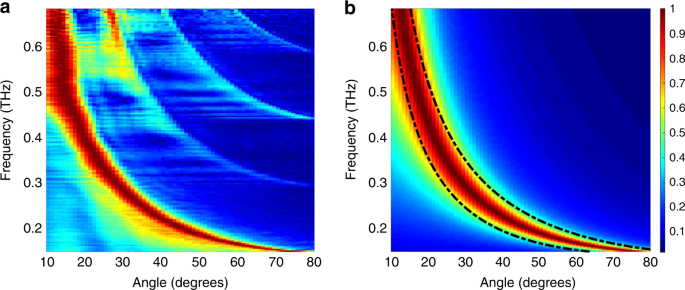
The spectrum of emitted radiation vs. emission angle.
https://www.nature.com/articles/s41467-020-15761-4

Of the many challenges in building a wireless network at terahertz frequencies, link discovery remains one of the most critical and least explored. In a network of mobile receivers using narrow directional beams, how do the nodes rapidly locate each other? This direction information is crucial for beam forming and steering, which are fundamental operations for maintaining link quality. As the carrier frequency increases into the terahertz range, the conventional methods used by existing networks become prohibitively time-consuming, so an alternative strategy is required. Using a leaky-wave antenna with a broadband transmitter, we demonstrate a single-shot approach for link discovery which can be accomplished much more rapidly. Our method relies on measurements of the width of a broad spectrum, and does not require any information about the phase of the received signal. This protocol, which relies on a detailed understanding of the radiation from leaky-wave devices, offers a realistic approach for enabling mobility in directional networks.

Researchers solve 'link discovery' problem for terahertz data networks

Radiation of varying frequencies emanate from a leaky waveguide at different angles. This rainbow of frequencies is the basis for a link discovery system for future terahertz data networks.CREDIT Mittleman Lab / Knightly Lab
https://www.eurekalert.org/pub_releases/2020-04/bu-rs042320.php

PROVIDENCE, R.I. [Brown University] -- When someone opens a laptop, a router can quickly locate it and connect it to the local Wi-Fi network. That ability is a basic element of any wireless network known as link discovery, and now a team of researchers has developed a means of doing it with terahertz radiation, the high-frequency waves that could one day make for ultra-fast wireless data transmission.
Because of their high frequency, terahertz waves can carry hundreds of times more data than the microwaves used to carry our data today. But that high frequency also means that terahertz waves propagate differently than microwaves. Whereas microwaves emanate from a source in an omni-directional broadcast, terahertz waves propagate in narrow beams.
"When you're talking about a network that's sending out beams, it raises a whole myriad of questions about how you actually build that network," said Daniel Mittleman, a professor in Brown's School of Engineering. "One of those questions is how does an access point, which you can think of as a router, find out where client devices are in order to aim a beam at them. That's what we're thinking about here."
In a paper published in Nature Communications, researchers from Brown and Rice University showed that a device known as a leaky waveguide can be used for link discovery at terahertz frequencies. The approach enables link discovery to be done passively, and in one shot.
The concept of a leaky waveguide is simple. It's just two metal plates with a space between them where radiation can propagate. One of the plates has a narrow slit cut into it, which allows a little bit of the radiation to leak out. This new research shows the device can be used for link discovery and tracking by exploiting one of its underlying properties: that different frequencies leak out of the slit at different angles.
"We input a wide range of terahertz frequencies into this waveguide in a single pulse, and each one leaks out simultaneously at a different angle," said Yasaman Ghasempour, a graduate student at Rice and co-author on the study. "You can think of it like a rainbow leaking out, with each color represents a unique spectral signature corresponding to an angle."
Now imagine a leaky waveguide placed on an access point. Depending upon where a client device is relative to the access point, it's going to see a different color coming out of the waveguide. The client just sends a signal back to the access point that says, "I saw yellow," and now the access point knows exactly where the client is, and can continue tracking it.
"It is not just about discovering the link once," Yasaman said. "In fact, the direction of transmission needs to be continually adjusted as the client moves. Our technique allows for ultra-fast adaptation which is the key to achieving seamless connectivity."
The setup also uses a leaky waveguide on the client side. On that side, the range of frequencies received through the slit in the waveguide can be used to determine the position of the router relative to the local rotation of the device -- like when someone swivels their chair while using a laptop.
Mittleman says that finding a novel way to make link discovery work in the terahertz realm is important because existing protocols for link discovery in microwaves simply won't work for terahertz signals. Even the protocols that have been developed for burgeoning 5G networks, which are much more directional than standard microwaves, aren't feasible for terahertz. That's because as narrow as 5G beams are, they're still around 10 times wider than the beams in a terahertz network.
"I think some people have assumed that since 5G is somewhat directional, this problem had been solved, but the 5G solution simply isn't scalable," Mittleman said. "A whole new idea is needed. This is one of those fundamental protocol pieces that you need to start building terahertz networks."

Friday, January 17, 2020

Presentation and Abstract-Wireless Systems for Joint Communication and Sensing in Terahertz Spectrum


Yasaman Ghasempour
Ph.D. Candidate
Rice University
Event Date:January 22, 2020
Time:10:30 am
Location:MSEE 239
School or Program:Electrical and Computer Engineering
Abstract
On one side, millimeter-wave and terahertz bands are emerging as the most promising solution to meet the data-rate and latency demands of future wireless applications, including virtual reality and autonomous cars. On the other side, the large spectral availability, together with the mm-scale wavelength, opens the opportunity of ubiquitous and high-resolution sensing. My research builds a foundation for joint communication and sensing in such high-frequency regimes yielding a paradigm shift in the design and development of future wireless systems.
In this talk, I will present the world’s first single-shot and single-antenna motion-sensing system in THz bands. We demonstrate a novel node architecture exploiting a single leaky-wave antenna, which is primarily used for beam steering in THz networks. I will explain how we leverage this device’s spatial-spectral characteristics in new ways to enable motion sensing functionalities with a single THz pulse transmission. I will then discuss the opportunities offered by this platform to enhance next-generation communication in unprecedented ways. In particular, we tackle the mobility, blockage, and scalability challenges of highly directional THz networks by efficiently adapting steering direction.
Finally, I will share with you some of the exciting research directions I would like to pursue in the future. I am broadly interested in exploring novel fundamental concepts and new devices that enable sensing functionality jointly with networking in a broad scope of applications. This interdisciplinary research direction incorporators advancements such as applied physics, machine learning, robotics, and wireless networking.
Bio
Yasaman Ghasempour is currently a Ph.D. Candidate in Electrical and Computer Engineering at Rice University. She received her Master’s degree in Electrical and Computer Engineering from Rice University and her Bachelor’s degree in Electrical Engineering from Sharif University of Technology in Iran. Her research interests include wireless communication and sensing, with a focus on emerging millimeter-wave and terahertz spectrum. She has published in top-tier IEEE and ACM conferences and journals and has been named an EECS rising star in 2019. She is also the recipient of Texas Instruments Distinguished Fellowship among multiple IEEE/ACM societies awards.
Host
Prof. Sanjay Rao, sanjay@purdue.edu