Showing posts with label J. Bianca Jackson. Show all posts

Thursday, January 19, 2017

Abstract-Contrast in Terahertz Images of Archival Documents—Part I: Influence of the Optical Parameters from the Ink and Support

http://link.springer.com/article/10.1007/s10762-016-0351-0

This study aims to objectively inform curators when terahertz time-domain (TD) imaging set in reflection mode is likely to give well-contrasted images of inscriptions in a complex archival document and is a useful non-invasive alternative to current digitisation processes. To this end, the dispersive refractive indices and absorption coefficients from various archival materials are assessed and their influence on contrast in terahertz images from historical documents is explored. Sepia ink and inks produced with bistre or verdigris mixed with a solution of Arabic gum or rabbit skin glue are unlikely to lead to well-contrasted images. However, dispersions of bone black, ivory black, iron gall ink, malachite, lapis lazuli, minium and vermilion are likely to lead to well-contrasted images. Inscriptions written with lamp black, carbon black and graphite give the best imaging results. The characteristic spectral signatures from iron gall ink, minium and vermilion pellets between 5 and 100 cm−1 relate to a ringing effect at late collection times in TD waveforms transmitted through these pellets. The same ringing effect can be probed in waveforms reflected from iron gall, minium and vermilion ink deposits at the surface of a document. Since TD waveforms collected for each scanning pixel can be Fourier-transformed into spectral information, terahertz TD imaging in reflection mode can serve as a hyperspectral imaging tool. However, chemical recognition and mapping of the ink is currently limited by the fact that the morphology of the document influences more the terahertz spectral response of the document than the resonant behaviour of the ink.

Saturday, November 12, 2016

Abstract-Terahertz frequency-wavelet domain deconvolution for stratigraphic and subsurface investigation of art painting


Junliang Dong, J. Bianca Jackson, Marcello Melis, David Giovanacci, Gillian C. Walker, Alexandre Locquet, John W. Bowen, and D. S. Citrin

https://www.osapublishing.org/oe/abstract.cfm?uri=oe-24-23-26972

Terahertz frequency-wavelet deconvolution is utilized specifically for the stratigraphic and subsurface investigation of art paintings with terahertz reflective imaging. In order to resolve the optically thin paint layers, a deconvolution technique is enhanced by the combination of frequency-domain filtering and stationary wavelet shrinkage, and applied to investigate a mid-20th century Italian oil painting on paperboard, After Fishing, by Ausonio Tanda. Based on the deconvolved terahertz data, the stratigraphy of the painting including the paint layers is reconstructed and subsurface features are clearly revealed, demonstrating that terahertz frequency-wavelet deconvolution can be an effective tool to characterize stratified systems with optically thin layers.
© 2016 Optical Society of America
Full Article  |  PDF Article

Tuesday, January 5, 2016

Success for cutting edge cultural artefact imaging technique


Terahertz imaging technology has the potential to help conservationists and academics better understand the history behind cultural artefacts.

http://cordis.europa.eu/news/rcn/124539_en.html

The EU-funded TISCH project has demonstrated that terahertz imaging and spectroscopy can be a viable, non-destructive and non-invasive tool to aid the retrieval and analysis of images of obscured features of artwork. Through a Marie Curie Postdoctoral Research Fellowship, Dr Bianca Jackson from the University of Reading in the UK was able to apply this technique to inspect layers of paint, detect structural defects in ceramics and image the physical structure of paintings and manuscripts.

‘Institutions that carry out cultural heritage research don't have a lot of extra money for emerging technology, but they do have the hearts and minds of the people – folks love to talk about what is being done with technology to better understand the mysterious Mona Lisa, or whether or not a sarcophagus contains Queen Neferititi,’ says Jackson. ‘So one of best ways to reduce costs and increase the accessibility of terahertz technology to open up new and interesting areas of applied research.’

In the last 15 years there has been exponential growth in terahertz technology and applied research, along with increasing interest from the pharmaceutical, biomedical, security and aerospace industries. ‘In the US, 9/11 and the Columbia disaster lead to a large influx of research funding, which has helped to drive this growth,’ explains Jackson.

However, the cost of terahertz systems is still much higher than other well-established technologies, which is why further applied research is needed. Furthermore, terahertz spectroscopic imaging has only been used in the field of cultural heritage over the last five years or so, and as a result, its utility to conservation has not been extensively demonstrated.

In order to address this, Jackson examined the walls of several European churches in England, France and Latvia, where centuries-old paintings were hidden behind many layers of plaster and plain paint. ‘We use a time-domain terahertz system, which has a pulse that allowed us to separate out the signals from the top and sub-surface layers,’ she explains. ‘This enabled us to find some designs behind some perfectly plain white walls.’

Jackson also scanned a Palaeolithic wall etching of a bird obscured by flow rock and investigated heritage conservation-friendly materials that can be safely applied to works in order to improve the signal to noise quality of the terahertz image. ‘Most recently, we started working with the Tate Museum to use terahertz imaging to diagnose flawed areas of ceramic glaze on outdoor sculptures left out in the rain,’ she adds. ‘While the TISCH project is almost finished, I’m very excited about the implications of our work with the Tate.’

Jackson is confident that the TISCH project represents a positive step forward, with similar cultural heritage projects also now coming on line. ‘Horizon 2020 is funding a project called IPERION CH, through which there is a great programme called MOLAB (short for mobile laboratory) that is accepting proposals for research using various advanced diagnostic technologies for cultural heritage,’ she says. ‘Recently, they added terahertz time-domain spectroscopy and imaging as an option. I've been encouraging interested conservators to apply for MOLAB access, and I’ve been offering my aid.’

For further information please visit:
University of Reading website

Source: Based on an interview with the project coordinator.

Monday, October 13, 2014

Abstract-Terahertz pulse imaging in archaeology


The work presented in this paper was performed at the Oriental Institute at the University of Chicago, on objects from their permanent collection: an ancient Egyptian bird mummy and three ancient Sumerian corroded copper-alloy objects. We used a portable, fiber-coupled terahertz (THz) time-domain spectroscopic imaging system, which allowed us to measure specimens in both transmission and reflection geometry, and present time- and frequency-based image modes. The results confirm earlier evidence that THz imaging can provide complementary information to that obtainable from X-ray computed tomography (XRCT) scans of mummies, giving better visualisation of low density regions. In addition, we demonstrated that THz imaging can distinguish mineralized layers in metal artifacts.

Tuesday, February 11, 2014

Abstract-Terahertz time-domain imaging of hidden defects in wooden artworks: application to a Russian icon painting


Anton S. Skryl, J. Bianca Jackson, Michael I. Bakunov, Michel Menu, and Gerard A. Mourou  »View Author Affiliations
http://www.opticsinfobase.org/ao/abstract.cfm?uri=ao-53-6-1033
Applied Optics, Vol. 53, Issue 6, pp. 1033-1038 (2014)
http://dx.doi.org/10.1364/AO.53.001033
We use terahertz time-domain imaging and time-of-flight tomography to examine subsurface defects in an early-19th-century Russian icon painting. In the transmission geometry, we distinguish between native wood and higher-absorption knotted wood. In reflection, we identify a void in the wood filled with foreign filler material. By using time-of-flight tomographic analysis, we ascertain the depth of burial of the defects. This information helps us to identify the cause of surface faults in the painting, thus allowing the conservators to choose an adequate restoration strategy.
© 2014 Optical Society of America

Sunday, December 29, 2013

A Roman fresco discovered under a XIX century painting


Terahertz analysis unveiled a hidden image that was never discovered before with other imaging technologies
http://www.digitalmeetsculture.net/article/a-roman-fresco-discovered-under-a-xix-century-painting/

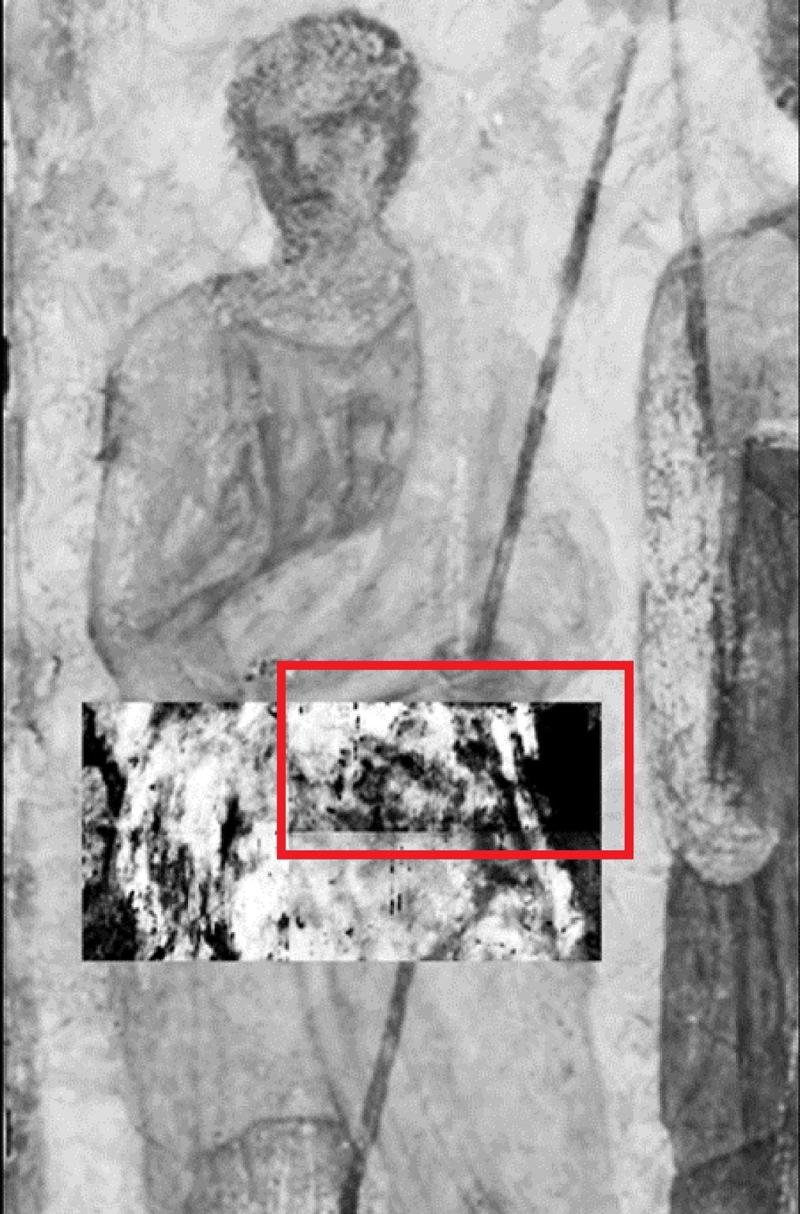
The terahertz technology, also used in airport security scanners, has detectedthe face of an ancient Roman man hidden below the surface of a wall painting in the Louvre Museum in Paris. The nineteenth-century fresco under examination was Trois homes armés de lances, in the Giampietro Campana collection (an Italian art collector in the 1800s who sometimes restored damaged parts in the artworks, or reworked the original), and the analysis with terahertz technology unveiled an authentic Roman fresco that lies under it, which scientists and art historians believe may be thousands of years old. Art historians believe that Trois homes armés de lances was painted after the ancient fresco was removed from its original wall in Italy and entered Campana’s collection.
130410154622-large
It is a well-known habit that in the past artists sometimes re-used canvases or covered old paintings with new works, in order to avoid the expense of buying a new canvas or to enhance colors and shapes in a prior composition. J. Bianca Jackson, Ph.D. now at the University of Rochester, who reported on the project, explained how the staff tried with terahertz technology analysis when suspicions that a hidden image might lie beneath Campana’s brushstrokes came out.
“We were amazed, and we were delighted,” said Jackson. “We could not believe our eyes as the image materialized on the screen. Underneath the top painting of the folds of a man’s tunic, we saw an eye, a nose and then a mouth appear. We were seeing what likely was part of an ancient Roman fresco, thousands of years old.”
“Terahertz technology has been in use for some time, especially in quality control in the pharmaceutical industry to assure the integrity of pills and capsules, in biomedical imaging and even in homeland security with those whole-body scanners that see beneath clothing at airport security check points,”said Jackson, “But its use in examining artifacts and artworks is relatively new.”
This research was funded by the EC project CHARISMA and in part byAHRC/EPSRC Science and Heritage Programme; while the research on the possibilities offerd by the use of terahertz technology for heritage investigation is on-going, as witnessed by the recently launched project INSIDDE.
“No previous imaging technique, including almost half a dozen commonly used to detect hidden images below paintings, forged signatures of artists and other information not visible on the surface has revealed a lost image in this fresco,”Jackson said. “This opens to door to wider use of the technology in the world of art, and we also used the method to study a Russian religious icon and the walls of a mud hut in one of humanity’s first settlements in what was ancient Turkey.”
Source: American Chemical Society (ACS) (2013, April 10). Ancient Roman man hidden beneath famouspaintingattheLouvre. ScienceDaily.Retrieved –http://www.sciencedaily.com/releases/2013/04/130410154622.htm

Wednesday, April 10, 2013

Revealing hidden artwork with airport security full-body-scanner technology


http://phys.org/news/2013-04-revealing-hidden-artwork-airport-full-body-scanner.html

In the latest achievement in efforts to see what may lie underneath the surface of great works of art, scientists today described the first use of an imaging technology like that used in airport whole-body security scanners to detect the face of an ancient Roman man hidden below the surface of a wall painting in the Louvre Museum in Paris.

They described unveiling the image, which scientists and art historians say may be thousands of years old, during the 245th National Meeting & Exposition of the American Chemical Society.


 J. Bianca Jackson, Ph.D., who reported on the project, explained that it involved a fresco, which is a mural or painting done on a wall after application of fresh plaster. In a fresco, the artist's paint seeps into the wet plaster and sets as the plaster dries. The painting becomes part of the wall. The earliest known frescoes date to about 1500 B.C. and were found on the island of Crete in Greece.

 "No previous imaging technique, including almost half a dozen commonly used to detect hidden images below paintings, forged signatures of artists and other information not visible on the surface has revealed a lost image in this fresco," Jackson said. "This opens to door to wider use of the technology in the world of art, and we also used the method to study a Russian religious icon and the walls of a mud hut in one of humanity's first settlements in what was ancient Turkey." 

The technology is a new addition to the palette that art conservators and scientists use to see below the surface and detect changes, including fake signatures and other alterations in a painting. Termed terahertz spectroscopy, it uses beams of electromagnetic radiation that lie between microwaves, like those used in kitchen ovens, and the infrared rays used in TV remote controls. This radiation is relatively weak, does not damage paintings and does not involve exposure to harmful radiation. 

"Terahertz technology has been in use for some time, especially in quality control in the pharmaceutical industry to assure the integrity of pills and capsules, in biomedical imaging and even in homeland security with those whole-body scanners that see beneath clothing at airport security check points," said Jackson, who is now with the University of Rochester. "But its use in examining artifacts and artworks is relatively new." 

Artists, including some of the great masters, sometimes re-used canvases, wiping out the initial image or covered old paintings with new works. They often did this in order to avoid the expense of buying a new canvas or to enhance colors and shapes in a prior composition. Frescoes likewise got a refresh, especially when the originals faded, owners tired of the image on the wall or property changed hands.

The scientists turned to terahertz technology when suspicions surfaced that a hidden image might lie beneath the brushstrokes of a precious 19th century fresco, Trois hommes armés de lances, in the Louvre's Campana collection. Giampietro Campana was an Italian art collector in the 1800s whose treasures are now on display in museums around the world. When Campana acquired a work of art, he sometimes restored damaged parts or reworked the original. Art historians believe that Campana painted Trois hommes armés de lances after the fresco was removed from its original wall in Italy and entered his collection.

 Jackson said that Campana's painting in itself is valuable, and the terahertz revelations may have added value by showing that an authentic Roman fresco lies under it. 

To search for a hidden image, Jackson and colleagues, including Gerard Mourou, Ph.D., of Ècole Polytechnique, and , Ph.D., of the Centre de Recherche et de Restauration des Musées de France, and Vincent Detalle, of the Laboratoire Recherche des Monuments Historiques, probed it with terahertz technology. The process is slow, requiring a few hours to analyze a section the size of a sheet of paper.

 "We were amazed, and we were delighted," said Jackson. "We could not believe our eyes as the image materialized on the screen. Underneath the top painting of the folds of a man's tunic, we saw an eye, a nose and then a mouth appear. We were seeing what likely was part of an ancient Roman fresco, thousands of years old."

 Who is the man in the fresco? An imperial Roman senator? A patrician? A plebian? A great orator? A ruler who changed the course of history? Or just a wealthy, egotistical landowner who wanted to admire his image on the wall? 

Jackson is leaving those questions to art historians. The team already has moved ahead and used terahertz technology to study a Russian religious icon and the walls of a mud hut in one of the earliest known human settlements in what now is the country of Turkey.

 More information: Abstract

 Terahertz pulse imaging and spectroscopy is emerging as a tool of high potential for the nondestructive investigation of historical artworks, architecture and archaeological objects for the purpose of research and conservation. We studied a section of the fresco Trois hommes armés de lances from the Louvre's Campana collection using time-domain terahertz imaging. The top painting is 19th C, while the support is composed of wall sections recovered from Roman ruins. No previous technique, including X-ray radiography, XRF, infrared photography, infrared reflectometry and UV florescence, has produced an image of a lost fresco beneath the painting. A composite of the photograph of the section and the composite terahertz image reveals a face hidden beneath the 1st man's drape. Other examples of this application will also be presented, including a Russian icon, a wall painting from the Riga Dom cathedral and a Neolithic site from Catalhoyuk Turkey

My note: see related earlier story-http://terahertztechnology.blogspot.com/2010/08/advanced-photonix-sells-t-4000-to.html