Showing posts with label Huaiwu Zhang. Show all posts

Friday, August 21, 2020

Abstract-Ti3C2Tx MXene Sponge Composite as Broadband Terahertz Absorber


Wenchao Shui, Jianmin Li,  Hao Wang, Yang Xing, Yilei Li, Qinghui Yang, Xu Xiao, Qiye Wen, Huaiwu Zhang


https://onlinelibrary.wiley.com/doi/abs/10.1002/adom.202001120

Terahertz (THz) absorption technology is promising in radar stealth, electromagnetic interference (EMI) shielding, and the upcoming 6G communication. However, the most popular metamaterial‐based THz absorbers suffer from complex fabrication process and/or narrowband characteristics. Here, a broadband, lightweight, and hydrophobic THz absorber is realized based on Ti3C2Tx MXene sponge foam (MSF) that is obtained by using a dip‐coating method. Due to the macroscopic impedance matching to free space and various microscopic morphologies of metallic Ti3C2Tx flakes inside porous architecture, the obtained MSF, with only 2 mm thickness, shows almost no THz reflection (minimum ≈ 0.00003%) and high THz absorption over 99.99% under the 100% qualified frequency bandwidth ranging from 0.3 to 1.65 THz. The new strategy of combining large‐pore‐size porous architecture with MXene‐like 2D metallic flakes paves a way to achieving high performance THz absorber with minimal thickness, which is of significance in electromagnetic stealth, shielding, and beyond.

Friday, July 6, 2018

Abstract-Semiconductor terahertz modulator arrays: the size and edge effect


Tianlong Wen, Chong Zhang, Xiaochen Zhang, Yulong Liao, Quanjun Xiang, Qiye Wen, Dainan Zhang, Yuanpeng Li, Huaiwu Zhang, Yulan Jing, and Zhiyong Zhong


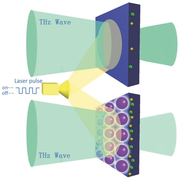
A terahertz spatial modulator is the critical component for active terahertz imaging using compressive sensing. Here small silicon pieces were put in arrays on flexible polymer substrate to fabricate semiconductor terahertz spatial modulators. By doing this, the inter-diffusion of photo-generated charge carriers is prevented for better resolution, and flexibility is achieved. Since the size of silicon is comparable to the wavelength of the terahertz wave, and the dielectric properties of the gap are very different from silicon, the optical modulation of each element is very different from the large silicon. In this Letter, the terahertz wave interaction and optical modulation of the small silicon are systematically studied by time domain spectroscopy. Notably, a strong resonance-like absorption peak was observed in a transmittance spectrum for the small silicon due to the size and edge effect. The spatial modulation of the terahertz wave was also compared between the silicon array and the large silicon samples.
© 2018 Optical Society of America

Tuesday, May 16, 2017

Abstract-Manufacturing and terahertz wave modulation properties of graphene/Y3Fe5O12/Si hybrid nanostructures


  • a Department of Electrical and Computer Engineering, University of Delaware, Newark, Delaware, 19716, USA
  • b State Key Laboratory of Electronic Films and Integrated Devices, University of Electronic Science and Technology of China, Chengdu, 610054, China
http://www.sciencedirect.com/science/article/pii/S1359836816319539

In this paper, graphene/Bi:YIG(50 nm)/p-Si hybrid nanostructured graphene field effect transistors (GFETs) were fabricated at the first time. A 50 nm Bi-doped Y3Fe5O12 (Bi: YIG) garnet film was deposited using a vacuum RF sputtering technique, forming a nanometer thick high-K gate layer. With reduced Coulomb impurity scattering and cavity effect, a significantly improved modulation depth of 15% and modulation speed of 200 kHz have been successfully achieved with the YIG based GFETs. Moreover, since YIG is a magnetic insulator, we characterized and discussed the possibility of magnetic control of these graphene/Bi:YIG/p-Si hybrid structured THz modulators. A 7% enhancement of THz transmittance with applying an in-plane 22 Oe magnetic field has been revealed in the hybrid nanostructure, which provides a new route to realize electrical/magnetic functional modulators. The results show that graphene/Y3Fe5O12/Si hybrid nanostructures with good THz modulation performances have great potential for THz nondestructive evaluation as well as imaging applications.

Saturday, April 15, 2017

Abstract-Enhanced Terahertz Radiation Generation of Photoconductive Antennas Based on Manganese Ferrite Nanoparticles


This paper presents a significant effect of manganese ferrite nanoparticles (MnFe2O4 NPs) on the increase of the surface photoconductivity of semiconductors. Herein, the optical characterization of photo-excited carriers of silicon coated with MnFe2O4 NPs was studied by using THz time-domain spectroscopy (THz-TDs). We observed that silicon coated with MnFe2O4 NPs provided a significantly enhanced attenuation of THz radiation in comparison with bare silicon substrates under laser irradiation. The experimental results were assessed in the context of a surface band structure model of semiconductors. In addition, photoconductive antennas coated with MnFe2O4 NPs significantly improved the efficiency of THz radiation generation and signal to noise ratio of the THz signal. This work demonstrates that coating with MnFe2O4 NPs could improve the overall performance of THz systems, and MnFe2O4 NPs could be further used for the implementation of novel optical devices.

Tuesday, September 13, 2016

Abstract-Enhanced Optical Modulation Depth of Terahertz Waves by Self-Assembled Monolayer of Plasmonic Gold Nanoparticles


http://onlinelibrary.wiley.com/doi/10.1002/adom.201600248/abstract

Ultra-large-area self-assembled mono­layers of gold nanoparticles are coated on the intrinsic silicon to boost the generation of electron–hole pairs upon laser illumination. As a result, larger optical modulation depth of terahertz wave can be obtained by the monolayer coated silicon in comparison with the bare silicon.

Sunday, February 2, 2014

Abstract-Miniaturized and dual-band metamaterial absorber with fractal Sierpinski structure


Yanbing Ma, Huaiwu Zhang, Yuanxun Li, and Yicheng Wang

We report on the design, characteristics, and measurements of a terahertz (THz) metamaterial absorber (MA) based on fractal Sierpinski curves. By applying the fractal structure as the top resonators array, a more compact unit cell with a size reduction of 42% and dual-frequency operation has been achieved as an advantage over the conventional square-shaped MA. In addition, due to the rotationally symmetric structure, the fractal absorber is polarization insensitive and can perform well at a wide range of incident angles. Both the effective medium theory and the multireflection interference theory have been employed to investigate the underlying physical mechanism of the proposed THz MA, and it is found that the latter theory is not applicable for explaining the absorption mechanism of our investigated structure. The THz MA was measured in the case of 30° oblique incidence under TE polarization, and two absorption peaks have been observed at 0.2 and 0.58 THz with absorptivities of 91% and 92.2%, respectively. A microwave MA based on the same Sierpinski structure has also been demonstrated to validate the performance of the fractal MA at various incident angles, and good agreements between the full-wave simulation and experimental results have been achieved.
© 2014 Optical Society of America

Thursday, August 16, 2012

Abstract-Damping modulated terahertz emission of ferromagnetic films excited by ultrafast laser pulses


APL Nameplate
Jian Shen1,2, Xin Fan2, Zhiyuan Chen2, Matthew F. DeCamp2, Huaiwu Zhang1, and John Q. Xiao2
1State Key Laboratory of Electronic Films and Integrated Devices, University of Electronic Science and Technology of China, Chengdu 610054, People's Republic of China 
2Department of Physics and Astronomy, University of Delaware, Newark, Delaware 19716, USA 
Ultrafast demagnetization processes in ferromagnetic films have been shown to produce terahertz (THz) emission. We present an experimental demonstration that, following ultrafast optical excitation, the magnitude of terahertz electromagnetic pulses emitted from a ferromagnetic film is proportional to the Gilbert damping constant, which is conventionally used to describe the damping of magnetization precession. The damping of a ferromagnetic thin film is tuned by using an adjacent nonmagnetic layer, which does not change the magnetization and anisotropy of the ferromagnetic film, allowing an unambiguous determination of the relationship between the THz emission and the damping constant.
© 2012 American Institute of Physics