Showing posts with label Edward Knightly. Show all posts

Tuesday, May 4, 2021

Abstract-Line-of-sight and non-line-of-sight links for dispersive terahertz wireless networks


Publisher Logo
 

Yasaman Ghasempour,  Yasith Amarasinghe, Chia-Yi Yeh, Edward Knightly,  Daniel M. Mittleman, 

An illustration showing different frequencies (represented by “colors”) emitting at different angles by a leaky waveguide excited by a broadband input signal. The plot shows the peak frequency (in GHz) that emits at each angle (in degrees). (b) Our experimental setup including a pulse source and detector, a custom-built leaky waveguide, and motorized rotation and translation stages to investigate different multipath configurations and RX orientations.

https://aip.scitation.org/doi/abs/10.1063/5.0039262

Despite the rapidly growing interest in exploiting millimeter and terahertz waves for wireless data transfer, the role of reflected non-line-of-sight (NLOS) paths in wireless networking is one of the least explored questions. In this paper, we investigate the idea of harnessing these specular NLOS paths for communication in directional networks at frequencies above 100 GHz. We explore several illustrative transmitter architectures, namely, a conventional substrate-lens dipole antenna and a leaky-wave antenna. We investigate how these high-gain directional antennas offer both new challenges and new opportunities for exploiting NLOS paths. Our results demonstrate the sensitivity to antenna alignment, power spectrum variations, and the disparity in supported bandwidth of various line-of-sight (LOS) and reflected path configurations. We show that NLOS paths can, under certain circumstances, offer even higher data rates than the conventional LOS path. This result illustrates the unique opportunities that distinguish THz wireless systems from those that operate at lower frequencies.
This work was supported by the U.S. National Science Foundation and Army Research Lab (ARL).

Tuesday, April 28, 2020

Abstract-Single-shot link discovery for terahertz wireless networks


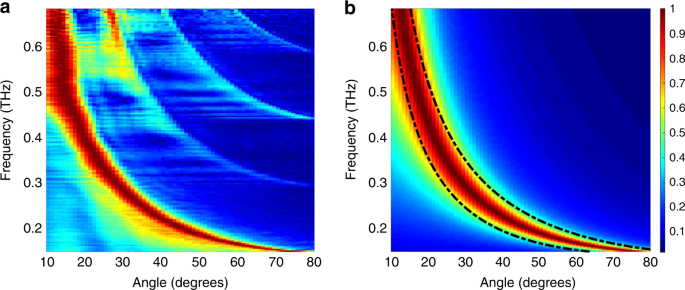
The spectrum of emitted radiation vs. emission angle.
https://www.nature.com/articles/s41467-020-15761-4

Of the many challenges in building a wireless network at terahertz frequencies, link discovery remains one of the most critical and least explored. In a network of mobile receivers using narrow directional beams, how do the nodes rapidly locate each other? This direction information is crucial for beam forming and steering, which are fundamental operations for maintaining link quality. As the carrier frequency increases into the terahertz range, the conventional methods used by existing networks become prohibitively time-consuming, so an alternative strategy is required. Using a leaky-wave antenna with a broadband transmitter, we demonstrate a single-shot approach for link discovery which can be accomplished much more rapidly. Our method relies on measurements of the width of a broad spectrum, and does not require any information about the phase of the received signal. This protocol, which relies on a detailed understanding of the radiation from leaky-wave devices, offers a realistic approach for enabling mobility in directional networks.

Wednesday, October 31, 2018

Study exposes security vulnerabilities in terahertz data links


InterceptedA new study shows that it's possible to steal data undetected from terahertz wireless links even though those links involved beam transmissions from transmitter to receiver.Mittleman Lab / Brown University
https://news.brown.edu/articles/2018/10/thzsecurity
Terahertz radiation may one day be used in wireless data networks that are many times faster than today's microwave networks. The conventional wisdom in the research community has been that, in addition to greater speed, terahertz data links would also have an inherent immunity to eavesdropping. Unlike microwaves, which travel in wide-angle broadcasts, terahertz waves travel directly from transmitter to receiver in narrow beams. The assumption was that it would be impossible to for an eavesdropper to intercept a terahertz signal without blocking some or all of the beam, which would be easily detected by an intended receiver. But new research finds that a clever eavesdropper can indeed steal terahertz signals undetected. In order for a link to be reliable, the beam's diameter must be slightly larger than the aperture of the receiver. That leaves a sliver of signal available for an attacker to steal without casting a shadow in a receiver. Credit: Mittleman lab / Brown University

Scientists have assumed that future terahertz data links would have an inherent immunity to eavesdropping, but new research shows that’s not necessarily the case.
PROVIDENCE, R.I. [Brown University] — A new study shows that terahertz data links, which may play a role in ultra-high-speed wireless data networks of the future, aren’t as immune to eavesdropping as many researchers have assumed. The research, published in the journal Nature, shows that it is possible for a clever eavesdropper to intercept a signal from a terahertz transmitter without the intrusion being detected at the receiver.
“The conventional wisdom in the terahertz community has been that it’s virtually impossible to spy on a terahertz data link without the attack being noticed,” said Daniel Mittleman, a professor in Brown University’s School of Engineering and a coauthor of the research. “But we show that undetected eavesdropping in the terahertz realm is easier than most people had assumed and that we need to be thinking about security issues as we think about designing network architectures.”
Because of its higher frequency, terahertz radiation can carry up to 100 times more data than the microwaves used in wireless communication today, which makes terahertz an attractive option for use in future wireless networks. Along with enhanced bandwidth, it has also been generally assumed that the way in which high-frequency waves propagate would naturally enhance security. Unlike microwaves, which propagate in wide-angle broadcasts, terahertz waves travel in narrow, very directional beams.
“In microwave communications, an eavesdropper can put an antenna just about anywhere in the broadcast cone and pick up the signal without interfering with the intended receiver,” Mittleman said. “Assuming that the attacker can decode that signal, they can then eavesdrop without being detected. But in terahertz networks, the narrow beams would mean that an eavesdropper would have to place the antenna between the transmitter and receiver. The thought was that there would be no way to do that without blocking some or all of the signal, which would make an eavesdropping attempt easily detectable by the intended receiver.”
Mittleman and colleagues from Brown, Rice University and the University at Buffalo set out to test that notion. They set up a direct line-of-site terahertz data link between a transmitter and receiver, and experimented with devices capable of intercepting signal. They were able show several strategies that could steal signal without being detected — even when the data-carrying beam is very directional, with a cone angle of less than 2 degrees (in contrast to microwave transmission, where the angle is often as large as 120 degrees).  
One set of strategies involves placing objects at the very edge of a beam that is capable of scattering a tiny portion of the beam. In order for a data link to be reliable, the diameter of the beam must be slightly larger than the aperture of the receiver. That leaves a sliver of signal for an attacker to work with without casting a detectable shadow on the receiver.
The researchers showed that a flat piece of metal could redirect a portion of the beam to a secondary receiver operated by an attacker. The researchers were able to acquire a usable signal at the second receiver with no significant loss of power at the primary receiver.
The team showed an even more flexible approach (from the attacker’s perspective) by using a metal cylinder in the beam instead of a flat plate.
“Cylinders have the advantage that they scatter light in all directions, giving an attacker more options in setting up a receiver,” said Josep Jornet, an assistant professor of electrical engineering at Buffalo and a study co-author. “And given the physics of terahertz wave propagation, even a very small cylinder can significantly scatter the signal without blocking the line-of-sight path.”
The researchers went on to demonstrate another type of attack involving a lossless beam splitter that would also be difficult, if not impossible, to detect. The beam splitter placed in front of a transmitter would enable an attacker to steal just enough to be useful, yet not so much that it would set off alarm bells among network administrators.
The bottom line, the researchers say, is that while there are inherent security enhancements associated with terahertz links in comparison with lower frequencies, these security improvements are still far from foolproof.
“Securing wireless transmission from eavesdroppers has been a challenge since the days of Marconi,” said Edward Knightly, professor of electrical and computer engineering at Rice University and a study coauthor. “While terahertz bands take a huge leap in this direction, we unfortunately found that a determined adversary can still be effective in intercepting the signal.”
The research was funded in part by the National Science Foundation, the Army Research Office, the Air Force Office of Scientific Research, and the W. M. Keck Foundation. Other coauthors on the paper were Jianjun Ma, Rabi Shrestha and Jacob Adelberg from Brown University; Chia-Yi Yeh and Edward Knightly from Rice University; and Zahed Hossain from Buffalo.

Tuesday, June 24, 2014

Terahertz tech gets a major push at Rice

Mike Williams
http://news.rice.edu/2014/06/24/terahertz-tech-gets-a-major-push-at-rice-2/

Keck Foundation grant to Rice University bolsters cutting-edge research for communications, imaging

Rice University scientists have received a grant to develop terahertz-based technology that could enable a dramatic advance in wireless communications and other disciplines.

The $1 million grant by the W.M. Keck Foundation will let them tackle some of the knotty problems barring them from using the largely untapped terahertz region of the electromagnetic spectrum. Rice will supplement the grant with a $1.5 million commitment.
Chip on a coin
Chips the size of the one displayed above, which put out the shortest pulse ever generated by such a device, will be packaged into arrays that can steer terahertz beams. Click on the photo for a larger version. Photo by Jeff Fitlow
Potential benefits include much faster cellphone networks as well as sensors and detectors that may revolutionize medical imaging, security screening and manufacturing quality control.
Terahertz waves, which occupy the band from about 1 millimeter to 100 micrometers, are unique in the spectrum because few have figured out how to bend them to their purposes, said Daniel Mittleman, a professor of electrical and computer engineering and principal investigator on the project.
Longer waves power microwave ovens and radar; shorter waves include infrared and ultraviolet light, the visible spectrum and X-rays. While they don’t pass easily through water, or even travel long distances in the atmosphere, many non-metallic materials are transparent to terahertz. This unique feature opens the door for many interesting applications, such as detecting chemicals and hidden explosives.
“Terahertz technologies have been on the horizon for a long time, but people have only been thinking about specific applications seriously for a few years,” Mittleman said. “But there is such potential. For example, there are famous diagrams that show that the demand for wireless bandwidth is growing exponentially, and that six or eight years from now we’ll need tens or maybe 100 gigahertz of bandwidth. We’re nowhere near that now with existing wireless networks (which use a part of the spectrum well below terahertz frequencies).” Current phones only achieve hundreds of megabits per second even under the most ideal conditions, he said.
“If you want a higher data rate, you have to go to a higher carrier frequency. But almost all of the frequencies above what we use now are already claimed by someone and regulated,” he said.

Rice scientist Aydin Babakhani, left, one of four university researchers who have won a new grant to develop new terahertz technologies, shows a microchip that put out the shortest pulse ever measured from such a small device. The chip designed by Babakhani and graduate student Mahdi Assefzadeh, right, is seen as a step toward the ability to use terahertz for wireless communications and other applications. Photo by Jeff Fitlow
Until you get up into the terahertz range. The band between microwave and infrared offers a wide-open frontier, and a unique collection of talent at Rice is eager to explore it, Mittleman said. “We have some innovative approaches, and the combination of expertise we have is fairly unusual,” he said.
Co-investigators on the project are Junichiro Kono, a professor of electrical and computer engineering and of physics and astronomy; Edward Knightly, a professor of electrical and computer engineering and of computer science; and Aydin Babakhani, an assistant professor of electrical and computer engineering.
Mittleman’s research centers on devices like a terahertz version of Rice’s single-pixel camera and metamaterials that offer the possibility of high-speed modulation of terahertz beams. Kono specializes in the creation of advanced terahertz detectors that take advantage of Rice’s unique position as a world leader in carbon nanotechnology. Knightly, as director of Rice’s Wireless Networks Group, is a pioneer in the development of new wireless technologies. And Babakhani, director of the Rice Integrated Systems and Circuits laboratory and a winner of a DARPA Young Faculty Award in 2012, designs millimeter-wave and terahertz integrated circuits and antennas for communications, radar, medical imaging and biosensing.
Terahertz signals can help identify substances from the way they interact with the beams, but the beams themselves don’t travel as far in air as microwave signals. And there are other problems, primary among them the lack of a powerful, portable and practical source of terahertz.
The Rice team expects to chip away at those problems. Babakhani and his team have already developed a silicon-based microchip that puts out the shortest pulse ever generated by such a device, an 8-picosecond impulse radiator that won the best paper award at the recent IEEE International Microwave Symposium. While it’s not in the terahertz range, it could get there with the assistance of graphene, said Mittleman, who also serves as director of Rice’s Richard E. Smalley Institute for Nanoscale Science and Technology.
“Aydin thinks the power can scale,” he said. “We want to combine what Jun has done with the optical nonlinearities of graphene to frequency-double or triple it up to the range we need.”
Small, fast, inexpensive chips that can not only send and receive terahertz beams but also steer them are necessary for future wireless applications, Mittleman said. “We’re going to need lots of them, on the order of 100,000 of them to cover a city the size of New York, as opposed to the several thousand cell towers they use now.”
Chip schematic
The world's smallest terahertz-enabled chip, similar to this one developed in the Rice lab of Aydin Babakhani, may be critical to the success of next-generation communications networks. Click on the photo for a larger version. Courtesy of the Rice Integrated Systems and Circuits lab
Babakhani’s speck-sized chips hold the key to steerable terahertz beams. “We’ve already demonstrated beam steering with two chips about 10 centimeters apart,” he said. “The timing synchronization between them is almost perfect. Now we’re looking at combining a signal from many chips with timing accuracy of a couple of hundred femtoseconds.” A femtosecond is one millionth of one billionth of a second.
Wireless terahertz communications would require new and smarter network architecture. Current cellular systems have to imperceptibly switch between users to keep the signals from interfering with each other, Knightly said, but that will no longer be an issue in a network that sends data through a narrow beam that tracks the user.
“With terahertz, we’ll have to coordinate distributed antennas, users and highly directional links, all wirelessly. This is a true paradigm shift requiring us to rethink the basic principles of wireless networking.” Knightly said.
Leaping the hurdles associated with wireless will help the team on other projects that require strong, dependable terahertz sources and detectors. Mittleman’s experience with the terahertz single-pixel camera and Kono’s carbon nanotube-based detectors hint at the possibility of multispectral terahertz imaging. A super spectrometer would be particularly useful for security screening of people and containers.
Kono’s successful efforts to detect and manipulate terahertz using graphene and carpets of nanotubes has inspired visions of many potential applications, he said. “Several pieces of the terahertz puzzle have reached a moderate level of maturity, but these pieces have emerged from diverse disciplines ranging from material science to optoelectronics to signal processing. The ultimate goal of our research is to fully eliminate the terahertz ‘technology gap.’”
Kono said the researchers intend to develop materials and build devices, but also aim to deepen their understanding of the physics and chemistry at the boundaries of electronics and optics.
“The great thing about the experimental capabilities we have right now is that, in terms of spectrum, we’re attacking the problems from above and below,” Knightly said. “Below terahertz are millimeter wave and 60 gigahertz technologies, and we have experimental state-of-the-art devices at those frequencies in our labs.
“From above, we have prototypes in the visible light range that, from a networking point of view, have characteristics like line-of-sight and short range in common with terahertz. With these and other fundamental advances, we’re very well positioned to realize our goals.”