Showing posts with label optical spectroscopy. Show all posts

Tuesday, June 2, 2020

Abstract-Proposal for Plasmon Spectroscopy of Fluctuations in Low-Dimensional Superconductors


V. M. Kovalev and I. G. Savenko
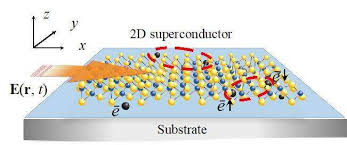


We propose to employ an optical spectroscopy technique to monitor the superconductivity and properties of superconductors in the fluctuating regime. This technique is operational close to the plasmon resonance frequency of the material, and it intimately connects with the superconducting fluctuations slightly above the critical temperature Tc. We find the Aslamazov-Larkin corrections to ac linear and dc nonlinear electric currents in a generic two-dimensional superconductor exposed to an external longitudinal electromagnetic field. First, we study the plasmon resonance of normal electrons near Tc, taking into account their interaction with superconducting fluctuations, and show that fluctuating Cooper pairs reveal a redshift of the plasmon dispersion and an additional mechanism of plasmon scattering, which surpasses both the electron-impurity and the Landau dampings. Second, we demonstrate the emergence of a drag effect of superconducting fluctuations by the external field resulting in considerable, experimentally measurable corrections to the electric current in the vicinity of the plasmon resonance.
  • Figure
  • Figure

Thursday, January 30, 2014

Abstract & Presentation -University of Minnesota - Exploring the fundamental time and length scales of Strongly Correlated Electron Materials


Speaker: Mengkun Liu, UC-San Diego


Thursday, January 30th 2014 -
1:25 pm:
Condensed Matter Seminar in 210 Physics


ABSTRACT: In strongly correlated electron materials (CEMs), the delicate interplay between spin, charge, and lattice degrees of freedom often leads to extremely rich phase diagrams exhibiting intrinsic phase inhomogeneities. The key to studying and disentangling such complexities usually lies in characterization and control of these materials at their fundamental energy, time and length scales. Using the prototypical correlated insulator vanadium dioxide (VO2) as a case study, I will show in this talk that ultrafast and ultrasmall optical spectroscopy offers unique insights into this electronic/structural interplay with unprecedented spatial and temporal resolutions. Specifically, with scanning near-field infrared microscopy we resolved the long-lasting enigma of electronic anisotropy in VO2 and revealed three distinct stages of the insulator to metal transition (IMT) at nanoscopic length scales. Using ultrafast terahertz pump terahertz probe spectroscopy we have also unambiguously demonstrated that the IMT occurs at picosecond time scales via electric field-induced electron liberation. These results set the stage for future spectroscopic investigations to access the fundamental time and length scales of CEMs.