Showing posts with label superconductivity. Show all posts

Tuesday, June 2, 2020

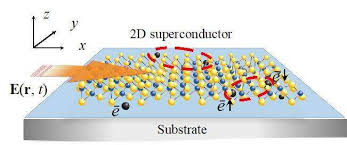
Abstract-Proposal for Plasmon Spectroscopy of Fluctuations in Low-Dimensional Superconductors


V. M. Kovalev and I. G. Savenko


We propose to employ an optical spectroscopy technique to monitor the superconductivity and properties of superconductors in the fluctuating regime. This technique is operational close to the plasmon resonance frequency of the material, and it intimately connects with the superconducting fluctuations slightly above the critical temperature Tc. We find the Aslamazov-Larkin corrections to ac linear and dc nonlinear electric currents in a generic two-dimensional superconductor exposed to an external longitudinal electromagnetic field. First, we study the plasmon resonance of normal electrons near Tc, taking into account their interaction with superconducting fluctuations, and show that fluctuating Cooper pairs reveal a redshift of the plasmon dispersion and an additional mechanism of plasmon scattering, which surpasses both the electron-impurity and the Landau dampings. Second, we demonstrate the emergence of a drag effect of superconducting fluctuations by the external field resulting in considerable, experimentally measurable corrections to the electric current in the vicinity of the plasmon resonance.
  • Figure
  • Figure

Sunday, August 5, 2018

Abstract-Time-resolved collapse and revival of the Kondo state near a quantum phase transition


C. Wetli, S. Pal, J. Kroha, K. Kliemt, C. Krellner, O. Stockert, H. v. Löhneysen,  M. Fiebig,

https://www.nature.com/articles/s41567-018-0228-3

One of the most successful paradigms of many-body physics is the concept of quasiparticles: excitations in strongly interacting matter behaving like weakly interacting particles in free space. Quasiparticles in metals are very robust objects. Nevertheless, when a system’s ground state undergoes a qualitative change at a quantum critical point (QCP)1, the quasiparticles may disintegrate and give way to an exotic quantum-fluid state of matter. The nature of this breakdown is intensely debated2,3,4,5, because the emergent quantum fluid dominates material properties up to high temperatures and might even be related to the occurrence of superconductivity in some compounds6. Here we trace the dynamics of heavy-fermion quasiparticles in CeCu6−xAux and monitor their evolution towards the QCP in time-resolved experiments, supported by many-body calculations. A terahertz pulse disrupts the many-body heavy-fermion state. Under emission of a delayed, phase-coherent terahertz reflex the heavy-fermion state recovers, with a coherence time 100 times longer than typically associated with correlated metals7,8. The quasiparticle weight collapses towards the QCP, yet its formation temperature remains constant—phenomena believed to be mutually exclusive. Coexistence in the same experiment calls for revisions in our view on quantum criticality.

Tuesday, June 5, 2018

Abstract-Terahertz-light quantum tuning of a metastable emergent phase hidden by superconductivity


X.Yang, C. Vaswani, C. Sundahl, M. Mootz, P. Gagel, L. Luo, J. H. Kang, P. P. Orth, I. E. Perakis, C. B. Eom, J. Wang,

https://www.nature.com/articles/s41563-018-0096-3

Sudden’ quantum quench and prethermalization have become a cross-cutting theme for discovering emergent states of matter. Yet this remains challenging in electron matter, especially superconductors. The grand question of what is hidden underneath superconductivity (SC) appears universal, but poorly understood. Here we reveal a long-lived gapless quantum phase of prethermalized quasiparticles (QPs) after a single-cycle terahertz (THz) quench of a Nb3Sn SC gap. Its conductivity spectra is characterized by a sharp coherent peak and a vanishing scattering rate that decreases almost linearly towards zero frequency, which is most pronounced around the full depletion of the condensate and absent for a high-frequency pump. Above a critical pump threshold, such a QP phase with coherent transport and memory persists as an unusual prethermalization plateau, without relaxation to normal and SC thermal states for an order of magnitude longer than the QP recombination and thermalization times. Switching to this metastable ‘quantum QP fluid’ signals non-thermal quench of coupled SC and charge-density-wave (CDW)-like orders and hints quantum control beneath the SC.

Monday, June 4, 2018

Physicists use terahertz flashes to uncover new state of matter hidden by superconductivity


https://www.news.iastate.edu/news/2018/06/04/terahertzflashes

Jigang Wang of Iowa State and the Ames Laboratory led experiments that switched on a hidden state of matter in a superconductive alloy. Larger photo. Photo by Christopher Gannon.
AMES, Iowa – Using the physics equivalent of the strobe photography that captures every twitch of a cheetah in full sprint, researchers have used ultrafast spectroscopy to visualize electrons interacting as a hidden state of matter in a superconductive alloy.
It takes intense, single-cycle pulses of photons – flashes – hitting the cooled alloy at terahertz speed – trillions of cycles per second – to switch on this hidden state of matter by modifying quantum interactions down at the atomic and subatomic levels.
And then it takes a second terahertz light to trigger an ultrafast camera to take images of the state of matter that, when fully understood and tuned, could one day have implications for faster, heat-free, quantum computing, information storage and communication.
The discovery of this new switching scheme and hidden quantum phase was full of conceptual and technical challenges.
To find new, emergent electron states of matter beyond solids, liquids and gases, today’s condensed matter physicists can no longer fully rely on traditional, slow, thermodynamic tuning methods such as changing temperatures, pressures, chemical compositions or magnetic fields, said Jigang Wang, an Iowa State University professor of physics and astronomy and a faculty scientist at the U.S. Department of Energy’s Ames Laboratory.
“The grand, open question of what state is hidden underneath superconductivity is universal, but poorly understood,” Wang said. “Some hidden states appear to be inaccessible with any thermodynamic tuning methods.”
The new quantum switching scheme developed by the researchers (they call it terahertz light-quantum-tuning) uses short pulses of trillionths of a second at terahertz frequency to selectively bombard, without heating, superconducting niobium-tin, which at ultracold temperatures can conduct electricity without resistance. The flashes suddenly switch the model compound to a hidden state of matter.
The scientific journal Nature Materials has just published a paper describing the discovery. Wang is corresponding author. Leading authors are Xu Yang and Chirag Vaswani, Iowa State graduate students in physics and astronomy. (See sidebar for other co-authors.)
In most cases, exotic states of matter such as the one described in this research paper are unstable and short-lived. In this case, the state of matter is metastable, meaning it doesn’t decay to a stable state for an order of magnitude longer than other, more typical transient states of matter.
The fast speed of the switch to a hidden quantum state likely has something to do with that.
“Here, the quantum quench (change) is so fast, the system is trapped in a strange ‘plateau’ and doesn’t know how to go back,” Wang said. “With this fast-quench, yet non-thermal system, there’s no normal place to go.”
A remaining challenge for the researchers is to figure out how to control and further stabilize the hidden state and determine if it is suitable for quantum logic operations, Wang said. That could allow researchers to harness the hidden state for practical functions such as quantum computing and for fundamental tests of bizarre quantum mechanics.
It all starts with the researchers’ discovery of a new quantum switching scheme that gives them access to new and hidden states of matter.
Said Wang: “We are creating and controlling a new quantum matter that can’t be achieved by any other means.”

Wednesday, January 31, 2018

Presentation and Abstract-Terahertz Light-Quantum-Tuning of a Metastable Correlated Phase Hidden by Superconductivity


Presenter:

Jigang Wang
(Ames Lab of US DOE,, Iowa State Univ)

11:15 AM–2:15 PM, Wednesday, March 7, 2018
LACC Room: 502A

Author:

Jigang Wang
(Ames Lab of US DOE,, Iowa State Univ)


“Sudden” quantum quench and prethermalization have emerged as a cross-cutting theme
for discovering emergent states of matter, such as quantum criticality and generalized Gibbs
ensembles of cold atoms, quark-gluon plasmas, or phase transitions in the early universe.
Yet this remains challenging in electron matter, especially superconductors (SC), despite
recent progress. The grand open question of what is hidden underneath the “SC dome”
occurring in several quantum materials appears to be universal, yet the new, even thermodynamically
forbidden states have been unexplored by quantum quench of the SC. Here we reveal a hidden quantum phase of prethermalized, gapless electron fluid, which evolves
following single-cycle, resonant terahertz quench of the SC gap above a critical fluence.
Its “non-Fermi-liquid” conductivity is characterized by a sharp coherent peak and a vanishing
scattering rate, most pronounced around full depletion of the SC condensate, which
is absent for high frequency pump and decreases almost linearly at low frequency. Above
threshold, such quantum behaviors with memory persist as an unusual prethermalization
plateau, without relaxation to normal metallic or SC states for order of magnitude longer
than the quasi-particle energy relaxation times. Switching to such a metastable quantum
fluid signals a dynamic coexistence of SC and hidden electronic orders, and
implies novel organization principles beneath superconductivity.
*This work is in collaboration with X. Yang, C. Vaswani, C. Sundahl, M. Mootz, P. Gagel, L. Luo, J. H. Kang, P. P. Orth, I. E. Perakis, C. B. Eom.
Work at Iowa State University was supported by the Army Research office under
award W911NF-15-1-0135 (THz quantum spectroscopy).

Sunday, November 5, 2017

Abstract-Gauge-invariant theory of quasiparticle and condensate dynamics in response to terahertz optical pulses in superconducting semiconductor quantum wells. II. ( s + p )-wave superconductivity in the strong spin-orbit coupling limit


T. Yu and M. W. Wu


We investigate the quasiparticle and condensate dynamics in response to the terahertz (THz) optical pulses in the strong spin-orbit-coupled (s+p)-wave superconducting semiconductor quantum wells by using the gauge-invariant optical Bloch equations in the quasiparticle approximation. Both the dynamics of triplet and singlet superconductivity are studied in response to the THz optical pulses. Specifically, for the triplet superconductivity, we predict that in the (s+p)-wave superconducting (100) quantum wells, with the vector potential parallel to the quantum wells, the optical field can cause the total spin polarization of Cooper pairs, oscillating with the frequency of the optical field. The direction of the total Cooper-pair spin polarization is shown to be parallel to the vector potential. For the singlet superconductivity, we show that due to the large spin-orbit coupling in InSb (100) quantum wells, there exist two Fermi surfaces including the inner and outer ones. In this specific configuration, the superconducting momentum can be tuned to be larger than the inner Fermi momentum but smaller than the outer one. We find that in this regime, the dynamics of the Higgs mode and charge imbalance shows different features in comparison with the conventional s-wave case.
  • Figure
  • Figure
  • Figure
  • Figure
  • Figure
  • Figure

Friday, January 20, 2017

Graphene’s sleeping superconductivity awakens


Since its discovery in 2004, scientists have believed that graphene may have the innate ability to superconduct. Now Cambridge researchers have found a way to activate that previously dormant potential.

https://www.cam.ac.uk/research/news/graphenes-sleeping-superconductivity-awakens

Researchers have found a way to trigger the innate, but previously hidden, ability of graphene to act as a superconductor – meaning that it can be made to carry an electrical current with zero resistance.
The finding, reported in Nature Communications, further enhances the potential of graphene, which is already widely seen as a material that could revolutionise industries such as healthcare and electronics. Graphene is a two-dimensional sheet of carbon atoms and combines several remarkable properties; for example, it is very strong, but also light and flexible, and highly conductive.
Since its discovery in 2004, scientists have speculated that graphene may also have the capacity to be a superconductor. Until now, superconductivity in graphene has only been achieved by doping it with, or by placing it on, a superconducting material - a process which can compromise some of its other properties.
But in the new study, researchers at the University of Cambridge managed to activate the dormant potential for graphene to superconduct in its own right. This was achieved by coupling it with a material called praseodymium cerium copper oxide (PCCO).
Superconductors are already used in numerous applications. Because they generate large magnetic fields they are an essential component in MRI scanners and levitating trains. They could also be used to make energy-efficient power lines and devices capable of storing energy for millions of years.
Superconducting graphene opens up yet more possibilities. The researchers suggest, for example, that graphene could now be used to create new types of superconducting quantum devices for high-speed computing. Intriguingly, it might also be used to prove the existence of a mysterious form of superconductivity known as “p-wave” superconductivity, which academics have been struggling to verify for more than 20 years.
The research was led by Dr Angelo Di Bernardo and Dr Jason Robinson, Fellows at St John’s College, University of Cambridge, alongside collaborators Professor Andrea Ferrari, from the Cambridge Graphene Centre; Professor Oded Millo, from the Hebrew University of Jerusalem, and Professor Jacob Linder, at the Norwegian University of Science and Technology in Trondheim.
“It has long been postulated that, under the right conditions, graphene should undergo a superconducting transition, but can’t,” Robinson said. “The idea of this experiment was, if we couple graphene to a superconductor, can we switch that intrinsic superconductivity on? The question then becomes how do you know that the superconductivity you are seeing is coming from within the graphene itself, and not the underlying superconductor?”
Similar approaches have been taken in previous studies using metallic-based superconductors, but with limited success. “Placing graphene on a metal can dramatically alter the properties so it is technically no longer behaving as we would expect,” Di Bernardo said. “What you see is not graphene’s intrinsic superconductivity, but simply that of the underlying superconductor being passed on.”
PCCO is an oxide from a wider class of superconducting materials called “cuprates”. It also has well-understood electronic properties, and using a technique called scanning and tunnelling microscopy, the researchers were able to distinguish the superconductivity in PCCO from the superconductivity observed in graphene.
Superconductivity is characterised by the way the electrons interact: within a superconductor electrons form pairs, and the spin alignment between the electrons of a pair may be different depending on the type - or “symmetry” - of superconductivity involved. In PCCO, for example, the pairs’ spin state is misaligned (antiparallel), in what is known as a “d-wave state”.
By contrast, when graphene was coupled to superconducting PCCO in the Cambridge-led  experiment, the results suggested that the electron pairs within graphene were in a p-wave state. “What we saw in the graphene was, in other words, a very different type of superconductivity than in PCCO,” Robinson said. “This was a really important step because it meant that we knew the superconductivity was not coming from outside it and that the PCCO was therefore only required to unleash the intrinsic superconductivity of graphene.”
It remains unclear what type of superconductivity the team activated, but their results strongly indicate that it is the elusive “p-wave” form. If so, the study could transform the ongoing debate about whether this mysterious type of superconductivity exists, and – if so – what exactly it is.
In 1994, researchers in Japan fabricated a triplet superconductor that may have a p-wave symmetry using a material called strontium ruthenate (SRO). The p-wave symmetry of SRO has never been fully verified, partly hindered by the fact that SRO is a bulky crystal, which makes it challenging to fabricate into the type of devices necessary to test theoretical predictions.
“If p-wave superconductivity is indeed being created in graphene, graphene could be used as a scaffold for the creation and exploration of a whole new spectrum of superconducting devices for fundamental and applied research areas,” Robinson said. “Such experiments would necessarily lead to new science through a better understanding of p-wave superconductivity, and how it behaves in different devices and settings.”
The study also has further implications. For example, it suggests that graphene could be used to make a transistor-like device in a superconducting circuit, and that its superconductivity could be incorporated into molecular electronics. “In principle, given the variety of chemical molecules that can bind to graphene’s surface, this research can result in the development of molecular electronics devices with novel functionalities based on superconducting graphene,” Di Bernardo added.
The study, p-wave triggered superconductivity in single layer graphene on an electron-doped oxide superconductor, is published in Nature Communications. (DOI: 101038/NCOMMS14024). 

Tuesday, September 6, 2016

Terahertz analytics for better plasmas


By Hamish Johnston in Beijing
Today was the last day of the Fall Meeting of the Chinese Physical Society here in Beijing and this morning I grabbed a coffee with Yutong Li and Giuqian Liao. I was hoping to learn more about their work that we covered in May in “Coherent terahertz radiation created in laser plasmas“.
Their technique involves firing a powerful laser pulse at a thin metal foil. This creates a plasma in which electrons are accelerated to high energies before bursting out of the foil. When they emerge, coherent terahertz radiation is given off.
Having a practical source of coherent terahertz radiation would be a boon to physicists studying materials such as superconductors and graphene. And Li told me that a pulse-driven system would allow “pump and probe” experiments to be done.
But before that can happen, the technique must be refined. One area for improvement is the collimation of the terahertz radiation, which is currently emitted over a wide range of angles. Li says that it may be possible to have the radiation focused into a better-collimated beam by using a curved target rather than a flat film.
However, making a better terahertz source is not their priority at the moment. Li, who works at the Institute of Physics of the Chinese Academy of Sciences in Beijing, and Liao (who has just moved to Shanghai) are working on ways to determine the properties of electrons in the plasma using the emitted terahertz radiation. Li says that such analytics could be particularly useful to physicists working on “fast ignition fusion”. This aims to achieve nuclear fusion by firing an ultrashort, extremely powerful laser pulse at a compressed sample of hydrogen.

Wednesday, May 18, 2016

Abstract-Anomalous gap-edge dissipation in disordered superconductors on the brink of localization


Bing Cheng, Liang Wu, N. J. Laurita, Harkirat Singh, Madhavi Chand, Pratap Raychaudhuri, and N. P. Armitage

https://journals.aps.org/prb/accepted/6307cY98Z8e1bc50801465e805c29452f5d55bb8f

Superconductivity in disordered systems close to an incipient localization transition has been an area of investigation for many years, but many fundamentally important aspects are still not understood. It has been noted that in such highly disordered superconductors, anomalous spectral weight develops in their conductivity near and below the superconducting gap energy. In this work we investigate the low frequency conductivity in disordered superconducting NbN thin films close to the localization transition with time-domain terahertz spectroscopy. In the normal state, strong deviations from the Drude form due to incipient localization are found. In the superconducting state we find substantial spectral weight at frequencies well below the superconducting gap scale derived from tunneling. We analyze this spectral weight in the context of a model of disorder induced broadening of the quasiparticle density of states. We find that aspects of the optical and tunneling data can be consistently modeled in terms of this effect of mesoscopic disorder, showing that in this disorder and frequency range, quasiparticle effects and not collective modes are the source of low energy absorption. Interestingly, we also find that as a function of frequency the optical conductivity recovers to the normal state value much faster than any model predicts. This points to the non-trivial interplay of superconductivity and disorder close to localization.

Saturday, June 14, 2014

Abstract-Superconductivity Induced Transparency in Terahertz Metamaterials


Plasmonic analogue of Electromagnetically Induced Transparency is activated and tuned in the terahertz (THz) range in asymmetric metamaterials fabricated out of high critical temperature (Tc) superconductor thin films. The asymmetric design provides a near-field coupling between a superradiant and a subradiant plasmonic mode, which has been widely tuned through superconductivity and monitored by Fourier Transform Infrared spectroscopy. The sharp transparency window which appears in the extinction spectrum exhibits a relative modulation up to 50% activated by temperature change. The interplay between ohmic and radiative damping, which can be independently tuned and controlled, allows for engineering the electromagnetically induced transparency of the metamaterial far beyond the current state-of-the-art, which relies on standard metals or low-Tc superconductors.