Showing posts with label Semyon Germanskiy. Show all posts

Monday, December 14, 2020

Abstract-Grating-Graphene Metamaterial as a Platform for Terahertz Nonlinear Photonics


Jan-Christoph Deinert, David Alcaraz Iranzo, Raúl Pérez, Xiaoyu Jia, Hassan A. Hafez, Igor Ilyakov, Nilesh Awari, Min Chen, Mohammed Bawatna, Alexey N. Ponomaryov, Semyon Germanskiy, Mischa Bonn, Frank H.L. Koppens, Dmitry Turchinovich, Michael Gensch, Sergey Kovalev,  Klaas-Jan Tielrooij 


https://pubs.acs.org/doi/full/10.1021/acsnano.0c08106

Nonlinear optics is an increasingly important field for scientific and technological applications, owing to its relevance and potential for optical and optoelectronic technologies. Currently, there is an active search for suitable nonlinear material systems with efficient conversion and a small material footprint. Ideally, the material system should allow for chip integration and room-temperature operation. Two-dimensional materials are highly interesting in this regard. Particularly promising is graphene, which has demonstrated an exceptionally large nonlinearity in the terahertz regime. Yet, the light–matter interaction length in two-dimensional materials is inherently minimal, thus limiting the overall nonlinear optical conversion efficiency. Here, we overcome this challenge using a metamaterial platform that combines graphene with a photonic grating structure providing field enhancement. We measure terahertz third-harmonic generation in this metamaterial and obtain an effective third-order nonlinear susceptibility with a magnitude as large as 3 × 10⁻⁸ m2/V2, or 21 esu, for a fundamental frequency of 0.7 THz. This nonlinearity is 50 times larger than what we obtain for graphene without grating. Such an enhancement corresponds to a third-harmonic signal with an intensity that is 3 orders of magnitude larger due to the grating. Moreover, we demonstrate a field conversion efficiency for the third harmonic of up to ∼1% using a moderate field strength of ∼30 kV/cm. Finally, we show that harmonics beyond the third are enhanced even more strongly, allowing us to observe signatures of up to the ninth harmonic. Grating-graphene metamaterials thus constitute an outstanding platform for commercially viable, CMOS-compatible, room-temperature, chip-integrated, THz nonlinear conversion applications.

Monday, May 18, 2020

Abstract-Non-perturbative terahertz high-harmonic generation in the three-dimensional Dirac semimetal Cd3As2


Sergey Kovalev, Renato M. A. Dantas, Semyon Germanskiy, Jan-Christoph Deinert, Bertram Green, Igor Ilyakov, Nilesh Awari, Min Chen, Mohammed Bawatna, Jiwei Ling, Faxian Xiu, Paul H. M. van Loosdrecht, Piotr Surówka, Takashi Oka,  Zhe Wang, 

figure2

https://www.nature.com/articles/s41467-020-16133-8

Harmonic generation is a general characteristic of driven nonlinear systems, and serves as an efficient tool for investigating the fundamental principles that govern the ultrafast nonlinear dynamics. Here, we report on terahertz-field driven high-harmonic generation in the three-dimensional Dirac semimetal Cd3As2 at room temperature. Excited by linearly-polarized multi-cycle terahertz pulses, the third-, fifth-, and seventh-order harmonic generation is very efficient and detected via time-resolved spectroscopic techniques. The observed harmonic radiation is further studied as a function of pump-pulse fluence. Their fluence dependence is found to deviate evidently from the expected power-law dependence in the perturbative regime. The observed highly non-perturbative behavior is reproduced based on our analysis of the intraband kinetics of the terahertz-field driven nonequilibrium state using the Boltzmann transport theory. Our results indicate that the driven nonlinear kinetics of the Dirac electrons plays the central role for the observed highly nonlinear response.

Tuesday, May 12, 2020

Abstract-Phase-resolved Higgs response in superconducting cuprates

https://www.nature.com/articles/s41467-020-15613-1

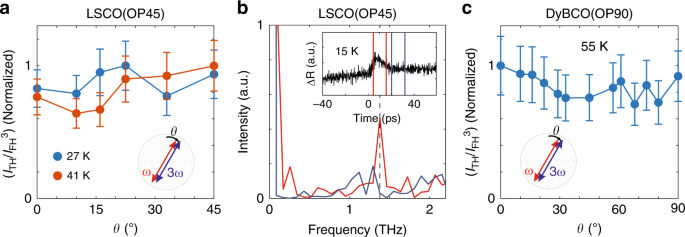
In high-energy physics, the Higgs field couples to gauge bosons and fermions and gives mass to their elementary excitations. Experimentally, such couplings can be inferred from the decay product of the Higgs boson, i.e., the scalar (amplitude) excitation of the Higgs field. In superconductors, Cooper pairs bear a close analogy to the Higgs field. Interaction between the Cooper pairs and other degrees of freedom provides dissipation channels for the amplitude mode, which may reveal important information about the microscopic pairing mechanism. To this end, we investigate the Higgs (amplitude) mode of several cuprate thin films using phase-resolved terahertz third harmonic generation (THG). In addition to the heavily damped Higgs mode itself, we observe a universal jump in the phase of the driven Higgs oscillation as well as a non-vanishing THG above Tc. These findings indicate coupling of the Higgs mode to other collective modes and potentially a nonzero pairing amplitude above Tc.