https://www.nature.com/articles/s41467-020-15613-1
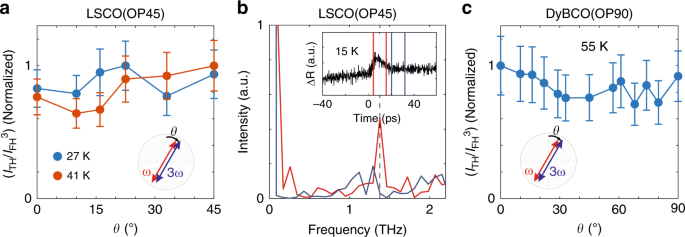
In high-energy physics, the Higgs field couples to gauge bosons and fermions and gives mass to their elementary excitations. Experimentally, such couplings can be inferred from the decay product of the Higgs boson, i.e., the scalar (amplitude) excitation of the Higgs field. In superconductors, Cooper pairs bear a close analogy to the Higgs field. Interaction between the Cooper pairs and other degrees of freedom provides dissipation channels for the amplitude mode, which may reveal important information about the microscopic pairing mechanism. To this end, we investigate the Higgs (amplitude) mode of several cuprate thin films using phase-resolved terahertz third harmonic generation (THG). In addition to the heavily damped Higgs mode itself, we observe a universal jump in the phase of the driven Higgs oscillation as well as a non-vanishing THG above Tc. These findings indicate coupling of the Higgs mode to other collective modes and potentially a nonzero pairing amplitude above Tc.
A repository & source of cutting edge news about emerging terahertz technology, it's commercialization & innovations in THz devices, quality & process control, medical diagnostics, security, astronomy, communications, applications in graphene, metamaterials, CMOS, compressive sensing, 3d printing, and the Internet of Nanothings. NOTHING POSTED IS INVESTMENT ADVICE! REPOSTED COPYRIGHT IS FOR EDUCATIONAL USE.
Showing posts with label Kota Katsumi. Show all posts
Tuesday, May 12, 2020
Abstract-Phase-resolved Higgs response in superconducting cuprates
Thursday, November 23, 2017
;Abstract-Higgs mode in the d-wave superconductor Bi2Sr2CaCu2O8+x driven by an intense terahertz pulse
Kota Katsumi, Naoto Tsuji, Yuki I. Hamada, Ryusuke Matsunaga, John Schneeloch, Ruidan D. Zhong, Genda. D. Gu, Hideo Aoki, Yann Gallais, Ryo Shimano
We investigated the terahertz (THz)-pulse driven nonlinear response in the d-wave cuprate superconductor Bi2Sr2CaCu2O8+x (Bi2212) using a THz pump near-infrared probe scheme in the time domain. We have observed an oscillatory behavior of the optical reflectivity that follows the THz electric field squared and is strongly enhanced below Tc. The corresponding third-order nonlinear effect exhibits both A1g and B1g symmetry components, which are decomposed from polarization-resolved measurements. Comparison with a BCS calculation of the nonlinear susceptibility indicates that the A1g component is associated with the Higgs mode of the d-wave order parameter.
Subscribe to:
Posts (Atom)

