Showing posts with label Jan-Christoph Deinert. Show all posts

Wednesday, April 14, 2021

Abstract-Electrical tunability of terahertz nonlinearity in graphene


 Sergey Kovalev,  Hassan A. Hafez, Klaas-Jan Tielrooij, Jan-Christoph Deinert, Igor Ilyakov, Nilesh Awari,  David Alcaraz. Karuppasamy Soundarapandian, David Saleta, Semyon Germanskiy, Min Chen, Mohammed Bawatna, Bertram Green, Frank H. L. Koppens, Martin Mittendorff, Mischa Bonn, Michael Gensch, Dmitry Turchinovich, 


https://advances.sciencemag.org/content/7/15/eabf9809

Graphene is conceivably the most nonlinear optoelectronic material we know. Its nonlinear optical coefficients in the terahertz frequency range surpass those of other materials by many orders of magnitude. Here, we show that the terahertz nonlinearity of graphene, both for ultrashort single-cycle and quasi-monochromatic multicycle input terahertz signals, can be efficiently controlled using electrical gating, with gating voltages as low as a few volts. For example, optimal electrical gating enhances the power conversion efficiency in terahertz third-harmonic generation in graphene by about two orders of magnitude. Our experimental results are in quantitative agreement with a physical model of the graphene nonlinearity, describing the time-dependent thermodynamic balance maintained within the electronic population of graphene during interaction with ultrafast electric fields. Our results can serve as a basis for straightforward and accurate design of devices and applications for efficient electronic signal processing in graphene at ultrahigh frequencies.

Tuesday, December 22, 2020

New material system to convert and generate terahertz waves developed


https://www.sciencedaily.com/releases/2020/12/201218112511.htm

On the electromagnetic spectrum, terahertz light is located between infrared radiation and microwaves. It holds enormous potential for tomorrow's technologies: Among other things, it might succeed 5G by enabling extremely fast mobile communications connections and wireless networks. The bottleneck in the transition from gigahertz to terahertz frequencies has been caused by insufficiently efficient sources and converters. A German-Spanish research team with the participation of the Helmholtz-Zentrum Dresden-Rossendorf (HZDR) has now developed a material system to generate terahertz pulses much more effectively than before. It is based on graphene, i.e., a super-thin carbon sheet, coated with a metallic lamellar structure. The research group presented its results in the journal ACS Nano.

Some time ago, a team of experts working on the HZDR accelerator ELBE were able to show that graphene can act as a frequency multiplier: When the two-dimensional carbon is irradiated with light pulses in the low terahertz frequency range, these are converted to higher frequencies. Until now, the problem has been that extremely strong input signals, which in turn could only be produced by a full-scale particle accelerator, were required to generate such terahertz pulses efficiently."This is obviously impractical for future technical applications," explains the study's primary author Jan-Christoph Deinert of the Institute of Radiation Physics at HZDR. "So, we looked for a material system that also works with a much less violent input, i.e., with lower field strengths."

For this purpose, HZDR scientists, together with colleagues from the Catalan Institute of Nanoscience and Nanotechnology (ICN2), the Institute of Photonic Sciences (ICFO), the University of Bielefeld, TU Berlin and the Mainz-based Max Planck Institute for Polymer Research, came up with a new idea: the frequency conversion could be enhanced enormously by coating the graphene with tiny gold lamellae, which possess a fascinating property: "They act like antennas that significantly amplify the incoming terahertz radiation in graphene," explains project coordinator Klaas-Jan Tielrooij from ICN2. "As a result, we get very strong fields where the graphene is exposed between the lamellae. This allows us to generate terahertz pulses very efficiently."

Surprisingly effective frequency multiplication

To test the idea, team members from ICN2 in Barcelona produced samples: First, they applied a single graphene layer to a glass carrier. On top, they vapor-deposited an ultra-thin insulating layer of aluminum oxide, followed by a lattice of gold strips. The samples were then taken to the TELBE terahertz facility in Dresden-Rossendorf, where they were hit with light pulses in the low terahertz range (0.3 to 0.7 THz). During this process, the experts used special detectors to analyze how effectively the graphene coated with gold lamellae can multiply the frequency of the incident radiation.

"It worked very well," Sergey Kovalev is happy to report. He is responsible for the TELBE facility at HZDR. "Compared to untreated graphene, much weaker input signals sufficed to produce a frequency-multiplied signal." Expressed in numbers, just one-tenth of the originally required field strength was enough to observe the frequency multiplication. And at technologically relevant low field strengths, the power of the converted terahertz pulses is more than a thousand times stronger thanks to the new material system. The wider the individual lamellae and the smaller the areas of graphene that are left exposed, the more pronounced the phenomenon. Initially, the experts were able to triple the incoming frequencies. Later, they attained even larger effects -- fivefold, sevenfold, and even ninefold increases in the input frequency.

Compatible with chip technology

This offers a very interesting prospect, because until now, scientists have needed large, complex devices such as accelerators or large lasers to generate terahertz waves. Thanks to the new material, it might also be possible to achieve the leap from gigahertz to terahertz purely with electrical input signals, i.e., with much less effort. "Our graphene-based metamaterial would be quite compatible with current semiconductor technology," Deinert emphasizes. "In principle, it could be integrated into ordinary chips." He and his team have proven the feasibility of the new process -- now implementation in specific assemblies may become possible.

The potential applications could be vast: Since terahertz waves have higher frequencies than the gigahertz mobile communications frequencies used today, they could be used to transmit significantly more wireless data -- 5G would become 6G. But the terahertz range is also of interest to other fields -- from quality control in industry and security scanners at airports to a wide variety of scientific applications in materials research, for example.


Story Source:

Materials provided by Helmholtz-Zentrum Dresden-RossendorfNote: Content may be edited for style and length.


Journal Reference:

  1. Jan-Christoph Deinert, David Alcaraz Iranzo, Raúl Pérez, Xiaoyu Jia, Hassan A. Hafez, Igor Ilyakov, Nilesh Awari, Min Chen, Mohammed Bawatna, Alexey N. Ponomaryov, Semyon Germanskiy, Mischa Bonn, Frank H.L. Koppens, Dmitry Turchinovich, Michael Gensch, Sergey Kovalev, Klaas-Jan Tielrooij. Grating-Graphene Metamaterial as a Platform for Terahertz Nonlinear PhotonicsACS Nano, 2020; DOI: 10.1021/acsnano.0c08106

Monday, December 14, 2020

Abstract-Grating-Graphene Metamaterial as a Platform for Terahertz Nonlinear Photonics


Jan-Christoph Deinert, David Alcaraz Iranzo, Raúl Pérez, Xiaoyu Jia, Hassan A. Hafez, Igor Ilyakov, Nilesh Awari, Min Chen, Mohammed Bawatna, Alexey N. Ponomaryov, Semyon Germanskiy, Mischa Bonn, Frank H.L. Koppens, Dmitry Turchinovich, Michael Gensch, Sergey Kovalev,  Klaas-Jan Tielrooij 


https://pubs.acs.org/doi/full/10.1021/acsnano.0c08106

Nonlinear optics is an increasingly important field for scientific and technological applications, owing to its relevance and potential for optical and optoelectronic technologies. Currently, there is an active search for suitable nonlinear material systems with efficient conversion and a small material footprint. Ideally, the material system should allow for chip integration and room-temperature operation. Two-dimensional materials are highly interesting in this regard. Particularly promising is graphene, which has demonstrated an exceptionally large nonlinearity in the terahertz regime. Yet, the light–matter interaction length in two-dimensional materials is inherently minimal, thus limiting the overall nonlinear optical conversion efficiency. Here, we overcome this challenge using a metamaterial platform that combines graphene with a photonic grating structure providing field enhancement. We measure terahertz third-harmonic generation in this metamaterial and obtain an effective third-order nonlinear susceptibility with a magnitude as large as 3 × 10⁻⁸ m2/V2, or 21 esu, for a fundamental frequency of 0.7 THz. This nonlinearity is 50 times larger than what we obtain for graphene without grating. Such an enhancement corresponds to a third-harmonic signal with an intensity that is 3 orders of magnitude larger due to the grating. Moreover, we demonstrate a field conversion efficiency for the third harmonic of up to ∼1% using a moderate field strength of ∼30 kV/cm. Finally, we show that harmonics beyond the third are enhanced even more strongly, allowing us to observe signatures of up to the ninth harmonic. Grating-graphene metamaterials thus constitute an outstanding platform for commercially viable, CMOS-compatible, room-temperature, chip-integrated, THz nonlinear conversion applications.

Tuesday, May 19, 2020

Higgs Spectroscopy: A new method to measure superconductors


http://www.labnews.co.uk/article/2030590/higgs-spectroscopy-a-new-method-to-measure-superconductors

 by Sarah Lawton

Monday, May 18, 2020

Abstract-Non-perturbative terahertz high-harmonic generation in the three-dimensional Dirac semimetal Cd3As2


Sergey Kovalev, Renato M. A. Dantas, Semyon Germanskiy, Jan-Christoph Deinert, Bertram Green, Igor Ilyakov, Nilesh Awari, Min Chen, Mohammed Bawatna, Jiwei Ling, Faxian Xiu, Paul H. M. van Loosdrecht, Piotr Surówka, Takashi Oka,  Zhe Wang, 

figure2

https://www.nature.com/articles/s41467-020-16133-8

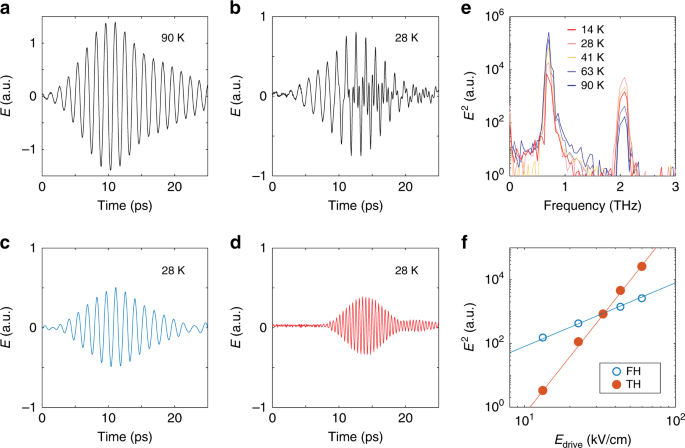
Harmonic generation is a general characteristic of driven nonlinear systems, and serves as an efficient tool for investigating the fundamental principles that govern the ultrafast nonlinear dynamics. Here, we report on terahertz-field driven high-harmonic generation in the three-dimensional Dirac semimetal Cd3As2 at room temperature. Excited by linearly-polarized multi-cycle terahertz pulses, the third-, fifth-, and seventh-order harmonic generation is very efficient and detected via time-resolved spectroscopic techniques. The observed harmonic radiation is further studied as a function of pump-pulse fluence. Their fluence dependence is found to deviate evidently from the expected power-law dependence in the perturbative regime. The observed highly non-perturbative behavior is reproduced based on our analysis of the intraband kinetics of the terahertz-field driven nonequilibrium state using the Boltzmann transport theory. Our results indicate that the driven nonlinear kinetics of the Dirac electrons plays the central role for the observed highly nonlinear response.

Tuesday, May 12, 2020

Abstract-Phase-resolved Higgs response in superconducting cuprates

https://www.nature.com/articles/s41467-020-15613-1

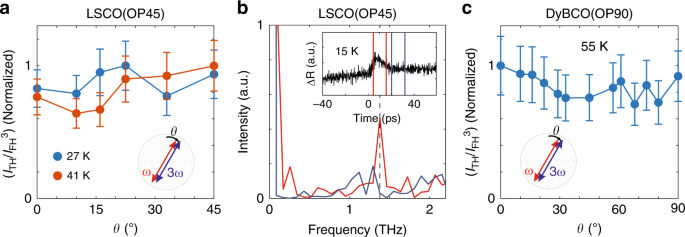
In high-energy physics, the Higgs field couples to gauge bosons and fermions and gives mass to their elementary excitations. Experimentally, such couplings can be inferred from the decay product of the Higgs boson, i.e., the scalar (amplitude) excitation of the Higgs field. In superconductors, Cooper pairs bear a close analogy to the Higgs field. Interaction between the Cooper pairs and other degrees of freedom provides dissipation channels for the amplitude mode, which may reveal important information about the microscopic pairing mechanism. To this end, we investigate the Higgs (amplitude) mode of several cuprate thin films using phase-resolved terahertz third harmonic generation (THG). In addition to the heavily damped Higgs mode itself, we observe a universal jump in the phase of the driven Higgs oscillation as well as a non-vanishing THG above Tc. These findings indicate coupling of the Higgs mode to other collective modes and potentially a nonzero pairing amplitude above Tc.

Saturday, May 9, 2020

A closer look at superconductors


figure1

A new measuring method helps understand the physics of high-temperature superconductivity


From sustainable energy to quantum computers: high-temperature superconductors have the potential to revolutionize today's technologies. Despite intensive research, however, we still lack the necessary basic understanding to develop these complex materials for widespread application. "Higgs spectroscopy" could bring about a watershed as it reveals the dynamics of paired electrons in superconductors.
High-temperature superconductors have the potential to revolutionize today's technologies. 'Higgs spectroscopy' could bring about a watershed as it reveals the dynamics of paired electrons in superconductors. Remarkably, the dynamics also reveal typical precursors of superconductivity even above the critical temperature at which the materials investigated attain superconductivity.


An international research consortium centered around the Helmholtz-Zentrum Dresden-Rossendorf (HZDR) and the Max Planck Institute for Solid State Research (MPI-FKF) is now presenting the new measuring method in the journal Nature Communications. Remarkably, the dynamics also reveal typical precursors of superconductivity even above the critical temperature at which the materials investigated attain superconductivity.
Superconductors transport electric current without a loss of energy. Utilizing them could dramatically reduce our energy requirements -- if it weren't for the fact that superconductivity requires temperatures of -140 degrees Celsius and below. Materials only 'turn on' their superconductivity below this point. All known superconductors require elaborate cooling methods, which makes them impractical for everyday purposes. There is promise of progress in high temperature superconductors such as cuprates -- innovative materials based on copper oxide. The problem is that despite many years of research efforts, their exact mode of operation remains unclear. Higgs spectroscopy might change that.
Higgs spectroscopy allows new insights into high-temperature superconductivity
"Higgs spectroscopy offers us a whole new 'magnifying glass' to examine the physical processes," Dr. Jan-Christoph Deinert reports. The researcher at the HZDR Institute of Radiation Physics is working on the new method alongside colleagues from the MPI-FKF, the Universities of Stuttgart and Tokyo, and other international research institutions. What the scientists are most keen to find out is how electrons form pairs in high-temperature superconductors.
In superconductivity, electrons combine to create "Cooper pairs," which enables them to move through the material in pairs without any interaction with their environment. But what makes two electrons pair up when their charge actually makes them repel each other? For conventional superconductors, there is a physical explanation: "The electrons pair up because of crystal lattice vibrations," explains Prof. Stefan Kaiser, one of the main authors of the study, who is researching the dynamics in superconductors at MPI-FKF and the University of Stuttgart. One electron distorts the crystal lattice, which then attracts the second electron. For cuprates, however, it has so far been unclear which mechanism acts in the place of lattice vibrations. "One hypothesis is that the pairing is due to fluctuating spins, i.e. magnetic interaction," Kaiser explains. "But the key question is: Can their influence on superconductivity and in particular on the properties of the Cooper pairs be measured directly?"
At this point "Higgs oscillations" enter the stage: In high-energy physics, they explain why elementary particles have mass. But they also occur in superconductors, where they can be excited by strong laser pulses. They represent the oscillations of the order parameter -- the measure of a material's superconductive state, in other words, the density of the Cooper pairs. So much for the theory. A first experimental proof succeeded a few years ago when researchers at the University of Tokyo used an ultrashort light pulse to excite Higgs oscillations in conventional superconductors -- like setting a pendulum in motion. For high-temperature superconductors, however, such a one-off pulse is not enough, as the system is damped too much by interactions between the superconducting and non-superconducting electrons and the complicated symmetry of the ordering parameter.
Terahertz light source keeps the system oscillating
Thanks to Higgs spectroscopy, the research consortium around MPI-FKF and HZDR has now achieved the experimental breakthrough for high-temperature superconductors. Their trick was to use a multi-cyclic, extremely strong terahertz pulse that is optimally tuned to Higgs oscillation and can maintain it despite the damping factors -- continuously prodding the metaphorical pendulum. With the high-performance terahertz light source TELBE at HZDR, the researchers are able to send 100,000 such pulses through the samples per second. "Our source is unique in the world due to its high intensity in the terahertz range combined with a very high repetition rate," Deinert explains. "We can now selectively drive Higgs oscillations and measure them very precisely."
This success is owed to close cooperation between theoretical and experimental scientists. The idea was hatched at MPI-FKF; the experiment was conducted by the TELBE team, led by Dr. Jan-Christoph Deinert and Dr. Sergey Kovalev at HZDR under then group leader Prof. Michael Gensch, who is now researching at the German Aerospace Center and TU Berlin: "The experiments are of particular importance for the scientific application of large-scale research facilities in general. They demonstrate that a high-power terahertz source such as TELBE can handle a complex investigation using nonlinear terahertz spectroscopy on a complicated series of samples, such as cuprates."
That is why the research team expects to see high demand in the future: "Higgs spectroscopy as a methodological approach opens up entirely new potentials," explains Dr. Hao Chu, primary author of the study and postdoc at the Max Planck-UBC-UTokyo Center for Quantum Materials. "It is the starting point for a series of experiments that will provide new insights into these complex materials. We can now take a very systematic approach."
Just above the critical temperature: Where does superconductivity start?
Conducting several series of measurements, the researchers first proved that their method works for typical cuprates. Below the critical temperature, the research team was not only able to excite Higgs oscillations, but also proved that a new, previously unobserved excitation interacts with the Cooper pairs' Higgs oscillations. Further experiments will have to reveal whether these interactions are magnetic interactions, as is fiercely debated in expert circles. Furthermore, the researchers saw indications that Cooper pairs can also form above the critical temperature, albeit without oscillating together. Other measuring methods have previously suggested the possibility of such early pair formation. Higgs spectroscopy could support this hypothesis and clarify when and how the pairs form and what causes them to oscillate together in the superconductor.

Tuesday, September 11, 2018

Abstract-Extremely efficient terahertz high-harmonic generation in graphene by hot Dirac fermions


Hassan A. Hafez, Sergey Kovalev, Jan-Christoph Deinert, Zoltán Mics, Bertram Green, Nilesh Awari, Min Chen, Semyon Germanskiy, Ulf Lehnert, Jochen Teichert, Zhe Wang, Klaas-Jan Tielrooij, Zhaoyang Liu, Zongping Chen, Akimitsu Narita, Klaus Müllen, Mischa Bonn, Michael Gensch,  Dmitry Turchinovich

https://www.nature.com/articles/s41586-018-0508-1

Multiple optical harmonic generation—the multiplication of photon energy as a result of nonlinear interaction between light and matter—is a key technology in modern electronics and optoelectronics, because it allows the conversion of optical or electronic signals into signals with much higher frequency, and the generation of frequency combs. Owing to the unique electronic band structure of graphene, which features massless Dirac fermions, it has been repeatedly predicted that optical harmonic generation in graphene should be particularly efficient at the technologically important terahertz frequencies. However, these predictions have yet to be confirmed experimentally under technologically relevant operation conditions. Here we report the generation of terahertz harmonics up to the seventh order in single-layer graphene at room temperature and under ambient conditions, driven by terahertz fields of only tens of kilovolts per centimetre, and with field conversion efficiencies in excess of 10−3, 10−4 and 10−5 for the third, fifth and seventh terahertz harmonics, respectively. These conversion efficiencies are remarkably high, given that the electromagnetic interaction occurs in a single atomic layer. The key to such extremely efficient generation of terahertz high harmonics in graphene is the collective thermal response of its background Dirac electrons to the driving terahertz fields. The terahertz harmonics, generated via hot Dirac fermion dynamics, were observed directly in the time domain as electromagnetic field oscillations at these newly synthesized higher frequencies. The effective nonlinear optical coefficients of graphene for the third, fifth and seventh harmonics exceed the respective nonlinear coefficients of typical solids by 7–18 orders of magnitude. Our results provide a direct pathway to highly efficient terahertz frequency synthesis using the present generation of graphene electronics, which operate at much lower fundamental frequencies of only a few hundreds of gigahertz.