Showing posts with label Michele Tamagnone. Show all posts

Monday, April 29, 2019

The first laser radio transmitter


This device uses a frequency comb laser to emit and modulate microwaves wirelessly. The laser uses different frequencies of light beating together to generate microwave radiation. The researchers used this phenomenon to send a song wirelessly to a receiver.
Credit: Image courtesy of Marco Piccardo/Harvard SEAS
https://www.sciencedaily.com/releases/2019/04/190425104238.htm
You've never heard Dean Martin like this.
Researchers from the Harvard John A. Paulson School of Engineering and Applied Sciences transmitted a recording of Martin's classic "Volare" wirelessly via a semiconductor laser -- the first time a laser has been used as a radio frequency transmitter.
In a paper published in the Proceedings of the National Academy of Sciences, the researchers demonstrated a laser that can emit microwaves wirelessly, modulate them, and receive external radio frequency signals.
"The research opens the door to new types of hybrid electronic-photonic devices and is the first step toward ultra-high-speed Wi-Fi," said Federico Capasso, the Robert L. Wallace Professor of Applied Physics and Vinton Hayes Senior Research Fellow in Electrical Engineering, at SEAS and senior author of the study.
This research builds on previous work from the Capasso Lab. In 2017, the researchers discovered that an infrared frequency comb in a quantum cascade laser could be used to generate terahertz frequencies, the submillimeter wavelengths of the electromagnetic spectrum that could move data hundreds of times faster than today's wireless platforms. In 2018, the team found that quantum cascade laser frequency combs could also act as integrated transmitters or receivers to efficiently encode information.
Now, the researchers have figured out a way to extract and transmit wireless signals from laser frequency combs.
Unlike conventional lasers, which emit a single frequency of light, laser frequency combs emit multiple frequencies simultaneously, evenly spaced to resemble the teeth of a comb. In 2018, the researchers discovered that inside the laser, the different frequencies of light beat together to generate microwave radiation. The light inside the cavity of the laser caused electrons to oscillate at microwave frequencies -- which are within the communications spectrum.
"If you want to use this device for Wi-Fi, you need to be able to put useful information in the microwave signals and extract that information from the device," said Marco Piccardo, a postdoctoral fellow at SEAS and first author of the paper.
The first thing the new device needed to transmit microwave signals was an antenna. So, the researchers etched a gap into the top electrode of the device, creating a dipole antenna (like the rabbit ears on the top of an old TV). Next, they modulated the frequency comb to encode information on the microwave radiation created by the beating light of the comb. Then, using the antenna, the microwaves are radiated out from the device, containing the encoded information. The radio signal is received by a horn antenna, filtered and sent to a computer.
The researchers also demonstrated that the laser radio could receive signals. The team was able to remotely control the behavior of the laser using microwave signals from another device.
"This all-in-one, integrated device holds great promise for wireless communication," said Piccardo. "While the dream of terahertz wireless communication is still a ways away, this research provides a clear roadmap showing how to get there."
The Harvard Office of Technology Development has protected the intellectual property relating to this project and is exploring commercialization opportunities.
This research was co-authored by Michele Tamagnone, Benedikt Schwarz, Paul Chevalier, Noah A. Rubin, Yongrui Wang, Christine A. Wang, Michael K. Connors, Daniel McNulty and Alexey Belyanin. It was supported in part by the National Science Foundation.

Monday, June 18, 2018

Squeezing light at the nanoscale


https://www.nanowerk.com/nanotechnology-news/newsid=50446.ph

Nanowerk News) Researchers at the Harvard John A. Paulson School of Engineering and Applied Sciences (SEAS) have developed a new technique to squeeze infrared light into ultra-confined spaces, generating an intense, nanoscale antenna that could be used to detect single biomolecules.
The researchers harnessed the power of polaritons, particles that blur the distinction between light and matter. This ultra-confined light can be used to detect very small amounts of matter close to the polaritons. For example, many hazardous substances, such as formaldehyde, have an infrared signature that can be magnified by these antennas. The shape and size of the polaritons can also be tuned, paving the way to smart infrared detectors and biosensors.
The research is published in Science Advances ("Ultra-confined mid-infrared resonant phonon polaritons in van der Waals nanostructures").
Oscillating Polaritons
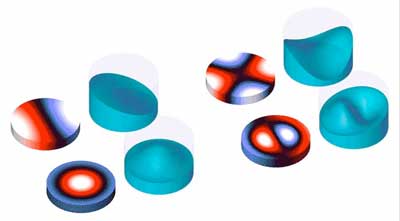
Nano-discs act as micro-resonators, trapping infrared photons and generating polaritons. When illuminated with infrared light, the discs concentrate light in a volume thousands of times smaller than is possible with standard optical materials. At such high concentrations, the polaritons oscillate like water sloshing in a glass, changing their oscillation depending on the frequency of the incident light. (Image: Harvard SEAS)
"This work opens up a new frontier in nanophotonics," said Federico Capasso, the Robert L. Wallace Professor of Applied Physics and Vinton Hayes Senior Research Fellow in Electrical Engineering, and senior author of the study. "By coupling light to atomic vibrations, we have concentrated light into nanodevices much smaller than its wavelength, giving us a new tool to detect and manipulate molecules."
Polaritons are hybrid quantum mechanical particles, made up of a photon strongly coupled to vibrating atoms in a two-dimensional crystal.
"Our goal was to harness this strong interaction between light and matter and engineer polaritons to focus light in very small spaces," said Michele Tamagnone, postdoctoral fellow in Applied Physics at SEAS and co-first author of the paper.
The researchers built nano-discs -- the smallest about 50 nanometers high and 200 nanometers wide -- made of two-dimensional boron nitride crystals. These materials act as micro-resonators, trapping infrared photons and generating polaritons. When illuminated with infrared light, the discs were able to concentrate light in a volume thousands of times smaller than is possible with standard optical materials, such as glass.
At such high concentrations, the researchers noticed something curious about the behavior of the polaritons: they oscillated like water sloshing in a glass, changing their oscillation depending on the frequency of the incident light.
"If you tip a cup back-and-forth, the water in the glass oscillates in one direction. If you swirl your cup, the water inside the glass oscillates in another direction. The polaritons oscillate in a similar way, as if the nano-discs are to light what a cup is to water," said Tamagnone.
Unlike traditional optical materials, these boron nitride crystals are not limited in size by the wavelength of light, meaning there is no limit to how small the cup can be. These materials also have tiny optical losses, meaning that light confined to the disc can oscillate for a long time before it settles, making the light inside even more intense.
The researchers further concentrated light by placing two discs with matching oscillations next to each other, trapping light in the 50-nanometer gap between them and creating an infrared antenna. As light concentrates in smaller and smaller volumes, its intensity increases, creating optical fields so strong they can exert measurable force on nearby particles.
"These light-induced forces serve also as one our detection mechanisms," said Antonio Ambrosio, a principal scientist at Harvard's Center for Nanoscale Systems. "We observed this ultra-confined light by the motion it induces on an atomically sharp tip connected to a cantilever."
A future challenge for the Harvard team is to optimize these light nano-concentrators to achieve intensities high enough to enhance the interaction with a single molecule to detectable values.
Source: By Leah Burrows, Harvard John A. Paulson School of Engineering and Applied Sciences

Saturday, June 16, 2018

Abstract-Graphene Reflectarray Metasurface for Terahertz Beam Steering and Phase Modulation


We report a THz reflectarray metasurface which uses graphene as active element to achieve beam steering, shaping and broadband phase modulation. This is based on the creation of a voltage controlled reconfigurable phase hologram, which can impart different reflection angles and phases to an incident beam, replacing bulky and fragile rotating mirrors used for terahertz imaging. This can also find applications in other regions of the electromagnetic spectrum, paving the way to versatile optical devices including light radars, adaptive optics, electro-optical modulators and screens.

Wednesday, April 6, 2016

Abstract-Near optimal graphene terahertz non-reciprocal isolator


http://www.nature.com/ncomms/2016/160406/ncomms11216/abs/ncomms11216.html

Isolators, or optical diodes, are devices enabling unidirectional light propagation by using non-reciprocal optical materials, namely materials able to break Lorentz reciprocity. The realization of isolators at terahertz frequencies is a very important open challenge made difficult by the intrinsically lossy propagation of terahertz radiation in current non-reciprocal materials. Here we report the design, fabrication and measurement of a terahertz non-reciprocal isolator for circularly polarized waves based on magnetostatically biased monolayer graphene, operating in reflection. The device exploits the non-reciprocal optical conductivity of graphene and, in spite of its simple design, it exhibits almost 20dB of isolation and only 7.5dB of insertion loss at 2.9THz. Operation with linearly polarized light can be achieved using quarter-wave plates as polarization converters. These results demonstrate the superiority of graphene with respect to currently used terahertz non-reciprocal materials and pave the way to a novel class of optimal non-reciprocal devices.

Graphene is both transparent and opaque to radiation


IMAGE: THREE LAYERS OF GRAPHENE ARE USED TO FILTER OUT UNWANTED ELECTROMAGNETIC RADIATION IN THE TERAHERTZ FREQUENCY RANGE. 
CREDIT: ALAIN HERZOG / EPFL
Graphene ensures data fidelity for future wireless device
ECOLE POLYTECHNIQUE FÉDÉRALE DE LAUSANNE
EPFL and UNIGE scientists have developed a microchip using graphene that could help wireless telecommunications share data at a rate that is ten times faster than currently possible. The results are published today in Nature Communications.
"Our graphene based microchip is an essential building block for faster wireless telecommunications in frequency bands that current mobile devices cannot access," says EPFL scientist Michele Tamagnone.
Graphene acts like polarized sunglasses
Their microchip works by protecting sources of wireless data -- which are essentially sources of invisible radiation -- from unwanted radiation, ensuring that the data remain intact by reducing source corruption.
They discovered that graphene can filter out radiation in much the same way as polarized glasses. The vibration of radiation has an orientation. Like polarized glasses, their graphene-based microchip makes sure that radiation that only vibrates a certain way gets through. In this way, graphene is both transparent and opaque to radiation, depending on the orientation of vibration and signal direction. The EPFL scientists and their colleagues from Geneva used this property to create a device known as an optical isolator.
Faster Uploads in the Terahertz Bandwidth
Moreover, their microchip works in a frequency band that is currently empty, called the Terahertz gap.
Wireless devices work today by transmitting data in the Gigahertz range or at optical frequencies. This is imposed by technological constraints, leaving the potential of the Terahertz band currently unexploited for data transmission.
But if wireless devices could use this Terahertz bandwidth, your future mobile phone could potentially send or receive data tens of times faster than now, meaning better sound quality, better image quality and faster uploads.
The graphene-based microchip brings this Terahertz technology a step closer to reality. This discovery addresses an important challenge that was so far unsolved due to lacking technologies, confirming once more the extraordinary physical properties of graphene.
###
This joint project between EPFL and the University of Geneva was funded by the European Graphene Flagship project and by the Swiss National Science Foundation.
Disclaimer: AAAS and EurekAlert! are not responsible for the accuracy of news releases posted to EurekAlert! by contributing institutions or for the use of any information through the EurekAlert system.