Showing posts with label polariton. Show all posts

Monday, June 18, 2018

Squeezing light at the nanoscale


https://www.nanowerk.com/nanotechnology-news/newsid=50446.ph

Nanowerk News) Researchers at the Harvard John A. Paulson School of Engineering and Applied Sciences (SEAS) have developed a new technique to squeeze infrared light into ultra-confined spaces, generating an intense, nanoscale antenna that could be used to detect single biomolecules.
The researchers harnessed the power of polaritons, particles that blur the distinction between light and matter. This ultra-confined light can be used to detect very small amounts of matter close to the polaritons. For example, many hazardous substances, such as formaldehyde, have an infrared signature that can be magnified by these antennas. The shape and size of the polaritons can also be tuned, paving the way to smart infrared detectors and biosensors.
The research is published in Science Advances ("Ultra-confined mid-infrared resonant phonon polaritons in van der Waals nanostructures").
Oscillating Polaritons
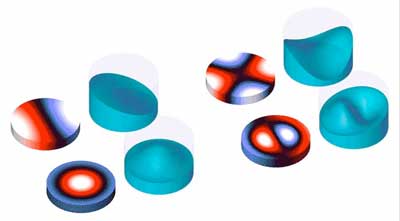
Nano-discs act as micro-resonators, trapping infrared photons and generating polaritons. When illuminated with infrared light, the discs concentrate light in a volume thousands of times smaller than is possible with standard optical materials. At such high concentrations, the polaritons oscillate like water sloshing in a glass, changing their oscillation depending on the frequency of the incident light. (Image: Harvard SEAS)
"This work opens up a new frontier in nanophotonics," said Federico Capasso, the Robert L. Wallace Professor of Applied Physics and Vinton Hayes Senior Research Fellow in Electrical Engineering, and senior author of the study. "By coupling light to atomic vibrations, we have concentrated light into nanodevices much smaller than its wavelength, giving us a new tool to detect and manipulate molecules."
Polaritons are hybrid quantum mechanical particles, made up of a photon strongly coupled to vibrating atoms in a two-dimensional crystal.
"Our goal was to harness this strong interaction between light and matter and engineer polaritons to focus light in very small spaces," said Michele Tamagnone, postdoctoral fellow in Applied Physics at SEAS and co-first author of the paper.
The researchers built nano-discs -- the smallest about 50 nanometers high and 200 nanometers wide -- made of two-dimensional boron nitride crystals. These materials act as micro-resonators, trapping infrared photons and generating polaritons. When illuminated with infrared light, the discs were able to concentrate light in a volume thousands of times smaller than is possible with standard optical materials, such as glass.
At such high concentrations, the researchers noticed something curious about the behavior of the polaritons: they oscillated like water sloshing in a glass, changing their oscillation depending on the frequency of the incident light.
"If you tip a cup back-and-forth, the water in the glass oscillates in one direction. If you swirl your cup, the water inside the glass oscillates in another direction. The polaritons oscillate in a similar way, as if the nano-discs are to light what a cup is to water," said Tamagnone.
Unlike traditional optical materials, these boron nitride crystals are not limited in size by the wavelength of light, meaning there is no limit to how small the cup can be. These materials also have tiny optical losses, meaning that light confined to the disc can oscillate for a long time before it settles, making the light inside even more intense.
The researchers further concentrated light by placing two discs with matching oscillations next to each other, trapping light in the 50-nanometer gap between them and creating an infrared antenna. As light concentrates in smaller and smaller volumes, its intensity increases, creating optical fields so strong they can exert measurable force on nearby particles.
"These light-induced forces serve also as one our detection mechanisms," said Antonio Ambrosio, a principal scientist at Harvard's Center for Nanoscale Systems. "We observed this ultra-confined light by the motion it induces on an atomically sharp tip connected to a cantilever."
A future challenge for the Harvard team is to optimize these light nano-concentrators to achieve intensities high enough to enhance the interaction with a single molecule to detectable values.
Source: By Leah Burrows, Harvard John A. Paulson School of Engineering and Applied Sciences

Tuesday, August 23, 2016

Light and matter merge in quantum coupling


Rice physicists probe photon-electron interactions in vacuum cavity experiments 

Mike Williams
Where light and matter intersect, the world illuminates. Where light and matter interact so strongly that they become one, they illuminate a world of new physics, according to Rice University scientists.
Rice physicists are closing in on a way to create a new condensed matter state in which all the electrons in a material act as one by manipulating them with light and a magnetic field. The effect made possible by a custom-built, finely tuned cavity for terahertz radiation shows one of the strongest light-matter coupling phenomena ever observed.

Rice graduate student Xinwei Li, with physicist Junichiro Kono, prepares a sample for a cavity quantum electrodynamics experiment. They are part of a team probing the boundaries of light-matter interactions as they bridge traditional condensed matter physics and cavity-based quantum optics. Photo by Jeff Fitlow
The work by Rice physicist Junichiro Kono and his colleagues is described in Nature Physics. It could help advance technologies like quantum computers and communications by revealing new phenomena to those who study cavity quantum electrodynamics and condensed matter physics, Kono said.
Condensed matter in the general sense is anything solid or liquid, but condensed matter physicists study forms that are much more esoteric, like Bose-Einstein condensates. A Rice team was one of the first to make a Bose-Einstein condensate in 1995 when it prompted atoms to form a gas at ultracold temperatures in which all the atoms lose their individual identities and behave as a single unit.
The Kono team is working toward something similar, but with electrons that are strongly coupled, or “dressed,” with light. Qi Zhang, a former graduate student in Kono’s group and lead author of the paper, designed and constructed an extremely high-quality cavity to contain an ultrathin layer of gallium arsenide, a material they’ve used to study superfluorescence. By tuning the material with a magnetic field to resonate with a certain state of light in the cavity, they prompted the formation of polaritons that act in a collective manner.
“This is a nonlinear optical study of a two-dimensional electronic material,” said Zhang, who based his Ph.D. thesis on the work. “When you use light to probe a material’s electronic structure, you’re usually looking for light absorption or reflection or scattering to see what’s happening in the material. That light is just a weak probe and the process is called linear optics.


A method created at Rice University closes the gap between light and matter and may help advance technologies like quantum computers and communications. The lab designed and built a high-quality cavity to contain an ultrathin layer of gallium arsenide. By tuning the material with a magnetic field to resonate with a certain state of light in the cavity, they prompted the formation of polaritons that act in a collective manner. Click on the image for a larger version. Illustration by Qi Zhang
“Nonlinear optics means light does something to the material,” he said. “Light is not a small perturbation anymore; it couples strongly with the material. As you change the coupling strength, things change in the material. What we’re doing is the extreme case of nonlinear optics, where the light and matter are coupled so strongly that we don’t have light and matter anymore. We have something in between, called a polariton.”
The researchers employed a parameter known as vacuum Rabi splitting to measure the strength of the light-matter coupling. “In more than 99 percent of previous studies of light-matter coupling in cavities, this value is a negligibly small fraction of the photon energy of the light used,” said Xinwei Li, a co-author and graduate student in Kono’s group. “In our study, vacuum Rabi splitting is as large as 10 percent of the photon energy. That puts us in the so-called ultrastrong coupling regime.
“This is an important regime because, eventually, if the vacuum Rabi splitting becomes larger than the photon energy, the matter goes into a new ground state. That means we can induce a phase transition, which is an important element in condensed matter physics,” he said.
Phase transitions are transitions between states of matter, like ice to water to vapor. The specific transition Kono’s team is looking for is the superradiant phase transition in which the polaritons go into an ordered state with macroscopic coherence.


Rice graduate student Xinwei Li, left, and Professor Junichiro Kono. Photo by Jeff Fitlow
Kono said the amount of terahertz light put into the cavity is very weak. “What we depend on is the vacuum fluctuation. Vacuum, in a classical sense, is an empty space. There’s nothing. But in a quantum sense, a vacuum is full of fluctuating photons, having so-called zero-point energy. These vacuum photons are actually what we are using to resonantly excite electrons in our cavity.
“This general subject is what’s known as cavity quantum electrodynamics (QED),” Kono said. “In cavity QED, the cavity enhances the light so that matter in the cavity resonantly interacts with the vacuum field. What is unique about solid-state cavity QED is that the light typically interacts with this huge number of electrons, which behave like a single gigantic atom.”
He said solid-state cavity QED is also key for applications that involve quantum information processing, like quantum computers. “The light-matter interface is important because that’s where so-called light-matter entanglement occurs. That way, the quantum information of matter can be transferred to light and light can be sent somewhere.
“For improving the utility of cavity QED in quantum information, the stronger the light-matter coupling, the better, and it has to use a scalable, solid-state system instead of atomic or molecular systems,” he said. “That’s what we’ve achieved here.”
The high-quality gallium arsenide materials used in the study were synthesized via molecular beam epitaxy by John Reno of Sandia National Laboratories and John Watson and Michael Manfra of Purdue University, all co-authors of the paper. Weil Pan of Sandia National Laboratories and Rice graduate student Minhan Lou, who participated in sample preparation and transport and terahertz measurements, are also co-authors.
Zhang is now the Alexei Abrikosov Postdoctoral Fellow at Argonne National Laboratory. Kono is a Rice professor of electrical and computer engineering, of physics and astronomy and of materials science and nanoengineering. Li received a “Best First-Year Research Award” from Rice’s Department of Electrical and Computer Engineering for his work on the project.
The research was supported by the National Science Foundation, U.S. Department of Energy, Lockheed Martin Corp. and the W.M. Keck Foundation.
- See more at: http://news.rice.edu/2016/08/22/light-and-matter-merge-in-quantum-coupling-2/#sthash.PW4Qrxie.dpuf

Tuesday, June 10, 2014

Abstract-Room Temperature Electrically Injected Polariton Laser


Room Temperature Electrically Injected Polariton Laser

Pallab Bhattacharya, Thomas Frost, Saniya Deshpande, Md Zunaid Baten, Arnab Hazari, and Ayan Das
Published June 10, 2014

http://physics.aps.org/synopsis-for/10.1103/PhysRevLett.112.236802

Polariton lasers are more efficient than conventional lasers because they work through spontaneous rather than stimulated emission. In a step towards making these devices more practical, researchers announce in Physical Review Letters the first electrically powered, room-temperature polariton laser. This development may eventually lead to low-power polariton lasers being used as optical switches or compact terahertz radiation sources.
A polariton is a quasiparticle that results from a coupling between a photon and an electron-hole pair (an “exciton”) in a semiconductor material. In 1996, researchers realized that—under certain conditions—polaritons will condense into a single quantum state, from which they will spontaneously emit coherent, monochromatic light (i.e., laser light). In contrast to stimulated lasing, the polariton emitters do not need to be constantly pumped up into excited states (so-called population inversion). As a consequence, polariton lasers begin lasing at a relatively low threshold power.
Experimental realizations of polariton lasers have so far required either low temperatures or a pump laser to create the initial polaritons. Pallab Bhattacharya and his colleagues at the University of Michigan, Ann Arbor, have developed a laser that works at room temperature and is powered by electricity. The device consists of a thin strip of gallium nitride (GaN) semiconductor, sandwiched between stacks of metal oxide mirrors. When electric current enters such a microcavity, it can generate polaritons. But unlike previous designs in which electricity passed through or around the high-resistance mirrors, the team injects current orthogonally to the microcavity’s emitting direction, thus avoiding overheating the device and destroying the lasing. The researchers observed laser light emission at a threshold current density of 169 amps per centimeter squared, which is almost a factor of 100 less than for conventional GaN-based lasers. – Michael Schirber