A repository & source of cutting edge news about emerging terahertz technology, it's commercialization & innovations in THz devices, quality & process control, medical diagnostics, security, astronomy, communications, applications in graphene, metamaterials, CMOS, compressive sensing, 3d printing, and the Internet of Nanothings. NOTHING POSTED IS INVESTMENT ADVICE! REPOSTED COPYRIGHT IS FOR EDUCATIONAL USE.
Showing posts with label terahertz electronics. Show all posts
Showing posts with label terahertz electronics. Show all posts
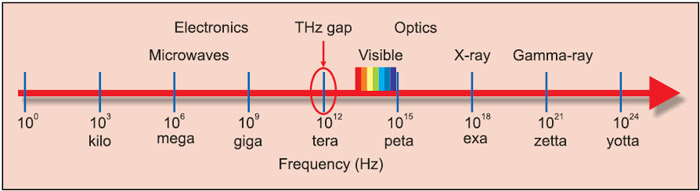
In the opening sections of this book, terahertz waves (sometimes abbreviated THz waves) were briefly introduced as waves with frequencies in the range between 300 GHz and 3 THz, situated directly above the millimeter-wave range in the frequency spectrum. Although it is “millimeter-waves” that appear in the title of this book, the discussions on the topics explored in the previous six chapters would be incomplete without at least a one-chapter-long discussion on the part of the spectrum that has emerged as a natural extension of the said millimeter-wave spectrum.
The terahertz (THz)
region, which is based on 1THz frequency, separates electronics from photonics
and has been difficult to access for ages. Semiconductor electronics
cannot handle frequencies equal to or greater than 100GHz due to various
transport-time related limitations. In other hand, photonics devices fail to
work below 10THz as photon’s energy significantly drops to thermal energy. Terahertz
Electronics (TE) is a new technology that extends
the range of electronics into the THz-frequency region.
The
Terahertz Gap
The main goal of Terahertz Electronics is to build a bridge
between low-frequency “Electronics” and high-frequency “Photonics”. Since
these devices use photon-electron particle interactions, as photon energy “hv”
decreases below thermal energy “kT”, the device ceases to operate efficiently
unless it is cooled down. At the low-frequency end, electronics cannot operate
above 100GHz as transport time is dependent on drift and diffusion speeds of
electrons/holes. As a result, a large region between 100GHz and 10THz remained
inaccessible. Terahertz Electronics solves this problem efficiently by cleverly
incorporating electronics with photonics.
Terahertz electronics
technology offers practical applications in high-speed data transfer, THz imaging,
and highly-integrated radar and communication systems. Surprisingly
enough, It does not use semiconductors. Instead, it is based on
metal-insulator tunneling structures to form diodes for detectors and
ultra-high-speed transistors for oscillator based transmitters.
One drawback of the
Terahertz Electronics is, it requires high-frequency radiation sources. Lack of
a small, low-cost, moderate-power THz source is one of the main reasons that
THz applications have not fully materialized yet. Scientists are trying to find
a solution to this problem. They created a compact device that can lead to
portable, battery-operated sources of THz radiation. This new solid-state
T-ray source uses high-temperature superconducting crystals that contain stacks
of Josephson junctions. So, even a small voltage, around
two millivolts per junction, can induce frequencies in the THz range.
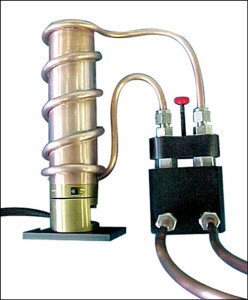
Mercury
arc lamps generate light in terahertz
TE devices are
extremely fast and they are made entirely of thin-film materials—metals and
insulator. Hence, it is possible to fabricate Terahertz Electronics devices on
top of complementary metal oxide semiconductor (CMOS) circuitry—a technology for
creating integrated-circuits circuitry or on an extensive variety of substrate
materials. In TE devices, charge transport through the junction occurs via
electron tunneling. Further research and development will make Terahertz
Electronics a reality in not-so-distant future.
PCT Reference: Application Number:PCT/EP2012/072247 ; Publication Number: Click to see the data
IPC:
H01L 33/00 G21G 4/06 H01L 29/16
Applicants:
UNIVERSITÄT AUGSBURG
Inventors:
Mikhailov Sergey
Priority Data:
11192457.7 07.12.2011 EP
Title:
(EN)GRAPHENE-BASED NANODEVICES FOR TERAHERTZ ELECTRONICS
The invention refers to a nanodevice for generating electromagnetic radiation in the terahertz frequency range, the nanodevice comprising a substrate (3) made of a dielectric material, a first graphene layer (1) arranged on the substrate (3), having a first longitudinal end being electrically connected with a source contact (source 1) and having a second longitudinal end being connected with a drain contact (drain 1), an electrically conducting layer (2) having a periodic grating structure with grating stripes (6) extending substantially in transversal direction (y), and a dielectric layer (4) arranged between the first graphene layer (1) and the conducting layer (2).