Showing posts with label Josephson junction. Show all posts

Wednesday, September 20, 2017

TERAHERTZ ELECTRONICS – WAY TO BRIDGE THE LARGELY-UNTAPPED REGION BETWEEN 100GHZ AND 10THZ


http://www.electronics-lab.com/terahertz-electronics-way-bridge-largely-untapped-region-100ghz-10thz/


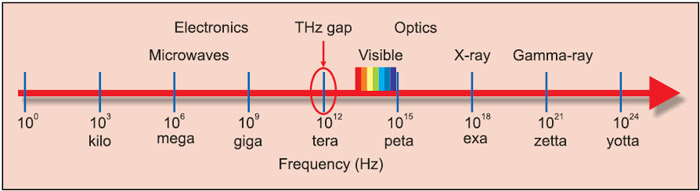
The terahertz (THz) region, which is based on 1THz frequency, separates electronics from photonics and has been difficult to access for ages. Semiconductor electronics cannot handle frequencies equal to or greater than 100GHz due to various transport-time related limitations. In other hand, photonics devices fail to work below 10THz as photon’s energy significantly drops to thermal energy. Terahertz Electronics (TE) is a new technology that extends the range of electronics into the THz-frequency region.


The Terahertz Gap
The main goal of Terahertz Electronics is to build a bridge between low-frequency “Electronics” and high-frequency “Photonics”. Since these devices use photon-electron particle interactions, as photon energy “hv” decreases below thermal energy “kT”, the device ceases to operate efficiently unless it is cooled down. At the low-frequency end, electronics cannot operate above 100GHz as transport time is dependent on drift and diffusion speeds of electrons/holes. As a result, a large region between 100GHz and 10THz remained inaccessible. Terahertz Electronics solves this problem efficiently by cleverly incorporating electronics with photonics.
Terahertz electronics technology offers practical applications in high-speed data transfer, THz imaging, and highly-integrated radar and communication systems. Surprisingly enough, It does not use semiconductors. Instead, it is based on metal-insulator tunneling structures to form diodes for detectors and ultra-high-speed transistors for oscillator based transmitters.
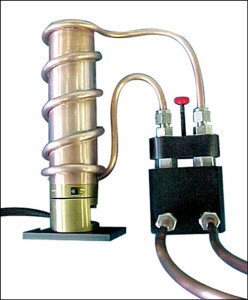
One drawback of the Terahertz Electronics is, it requires high-frequency radiation sources. Lack of a small, low-cost, moderate-power THz source is one of the main reasons that THz applications have not fully materialized yet. Scientists are trying to find a solution to this problem. They created a compact device that can lead to portable, battery-operated sources of THz radiation. This new solid-state T-ray source uses high-temperature superconducting crystals that contain stacks of Josephson junctions. So, even a small voltage, around two millivolts per junction, can induce frequencies in the THz range.


Mercury arc lamps generate light in terahertz


TE devices are extremely fast and they are made entirely of thin-film materials—metals and insulator. Hence, it is possible to fabricate Terahertz Electronics devices on top of complementary metal oxide semiconductor (CMOS) circuitry—a technology for creating integrated-circuits circuitry or on an extensive variety of substrate materials. In TE devices, charge transport through the junction occurs via electron tunneling. Further research and development will make Terahertz Electronics a reality in not-so-distant future.


Tuesday, September 19, 2017

Abstract-Terahertz Josephson spectral analysis and its applications


A V Snezhko, I I Gundareva, M V Lyatti, O Y Volkov, V V Pavlovskiy, U Poppe, Y Y Divin

http://iopscience.iop.org/article/10.1088/1361-6668/aa5ab5

Principles of Hilbert-transform spectral analysis (HTSA) are presented and advantages of the technique in the terahertz (THz) frequency range are discussed. THz HTSA requires Josephson junctions with high values of characteristic voltages I c R n and dynamics described by a simple resistively shunted junction (RSJ) model. To meet these requirements, [001]- and [100]-tilt YBa2Cu3O7−x bicrystal junctions with deviations from the RSJ model less than 1% have been developed. Demonstrators of Hilbert-transform spectrum analyzers with various cryogenic environments, including integration into Stirling coolers, are described. Spectrum analyzers have been characterized in the spectral range from 50 GHz to 3 THz. Inside a power dynamic range of five orders, an instrumental function of the analyzers has been found to have a Lorentz form around a single frequency of 1.48 THz with a spectral resolution as low as 0.9 GHz. Spectra of THz radiation from optically pumped gas lasers and semiconductor frequency multipliers have been studied with these spectrum analyzers and the regimes of these radiation sources were optimized for a single-frequency operation. Future applications of HTSA will be related with quick and precise spectral characterization of new radiation sources and identification of substances in the THz frequency range.

Tuesday, December 9, 2014

Abstract-Imaging of local temperature distributions in mesas of high-Tc superconducting terahertz sources


M Tsujimoto, H Kambara, Y Maeda, Y Yoshioka, Y Nakagawa and I Kakeya
http://iopscience.iop.org/1742-6596/568/2/022048
Department of Electronic Science and Engineering, Kyoto University, Kyoto, Japan 

Stacks of intrinsic Josephson junctions in high-Tc superconductors are a promising source of intense, continuous, and monochromatic terahertz waves. In this paer, we establish a fluorescence-based temperature imaging system to directly image the surface temperature on a Bi2Sr2CaCu2O8+δ mesa sample. Intense terahertz emissions are observed in both high- and low-bias regimes, where the mesa voltage satisfies the cavity resonance condition. In the high- bias regime, the temperature distributions are shown to be inhomogeneous with a considerable temperature rise. In contrast, in the low-bias regime, the distributions are rather uniform and the local temperature is close to the bath temperature over the entire sample.

Sunday, July 27, 2014

Abstract-Intrinsic Josephson junctions in the iron-based multi-band superconductor (V2Sr4O6)Fe2As2


In layered superconductors, Josephson junctions may be formed within the unit cell123 as a result of sufficiently low inter-layer coupling. These intrinsic Josephson junction (iJJ) systems4 have attracted considerable interest for their application potential in quantum computing as well as efficient sources of THz radiation, closing the famous ‘THz gap’5. So far, iJJ have been demonstrated in single-band, copper-based high-Tc superconductors, mainly in Bi–Sr–Ca–Cu–O (refs 678). Here we report clear experimental evidence for iJJ behaviour in the iron-based superconductor (V2Sr4O6)Fe2As2. The intrinsic junctions are identified by periodic oscillations of the flux-flow voltage on increasing a well-aligned in-plane magnetic field9. The periodicity is explained by commensurability effects between the Josephson vortex lattice and the crystal structure, which is a hallmark signature of Josephson vortices confined into iJJ stacks1011. This finding adds the pnictide (V2Sr4O6)Fe2As2 to the copper-based iJJ materials of interest for Josephson junction applications. In particular, novel devices based on multi-band Josephson coupling may be realized.

Monday, July 15, 2013

Abstract-Modeling the linewidth dependence of coherent terahertz emission from intrinsic Josephson junction stacks in the hot-spot regime


Recently it has been found that, when operated at large input power, the linewidth of terahertz radiation emitted from intrinsic Josephson junction stacks can be as narrow as some megahertz. In this high-bias regime a hot spot coexists with regions which are still superconducting. Surprisingly, the linewidth was found to decrease with increasing bath temperature. We present a simple model describing the dynamics of the stack in the presence of a hot spot by two parallel arrays of pointlike Josephson junctions and an additional shunt resistor in parallel. Heat diffusion is taken into account by thermally coupling all elements to a bath at temperature T_b. We present current-voltage characteristics of the coupled system and calculations of the linewidth of the radiation as a function of T_b. In the presence of a spatial gradient of the junction parameters critical current and resistance, the linewidth deceases with increasing T_b, similar to the experimental observation.