Showing posts with label backward-wave oscillator. Show all posts

Friday, February 1, 2019

Abstract-Tunable Backward Terahertz-wave Parametric Oscillation


Kouji Nawata, Yu Tokizane, Yuma Takida,  Hiroaki Minamide,


https://www.nature.com/articles/s41598-018-37068-7

Backward optical parametric oscillation has attracted attention for cavityless spectral narrowband generation based on perfect photon conversion. Few demonstrations have shown its potential from the aspect of nonlinear photonics; therefore, the mechanisms of momentum conservation among interacting light waves have been concealed by the restricted configuration under the phase-matching condition of periodically poled structures. Here, we unveil a tunable mechanism in the terahertz region by active control of the phase-matching condition. The tunability of backward terahertz-wave parametric oscillation is investigated using a quasi-collinear phase-matching model and its frequency range from the sub-terahertz to terahertz region is identified. Transform-limited terahertz-wave pulse is achieved simply by installing a device on the pump propagating line with no cavity. Moreover, the cascading terahertz-wave generation enhances the photon conversion efficiency, thus making nonlinear optics and its applications more promising. The results highlight new capabilities for using modern ferroelectric materials and encourage further research on nonlinear optics.

Friday, December 7, 2018

Abstract-Theoretical Study of a 0.22 THz Backward Wave Oscillator Based on a Dual-Gridded, Carbon-Nanotube Cold Cathode


Qingyun Chen,  Xuesong Yuan,   Matthew T. Cole, Yu Zhang , Lin Meng,  Yang Yan

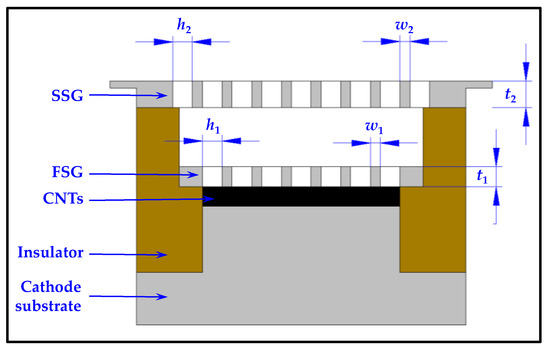
Figure 1. Schematic of the dual-gridded field emission structure based on carbon nanotube (CNT) cold cathode. SSG: second separating grid; FSG: first separating grid.


 https://www.mdpi.com/2076-3417/8/12/2462/htm


The carbon nanotube (CNT) cold cathode is an attractive choice for millimeter and terahertz vacuum electronic devices owning to its unique instant switch-on and high emission current density. A novel, dual-gridded, field emission architecture based on a CNT cold cathode is proposed here. CNTs are synthesized directly on the cathode surface. The first separating grid is attached to the CNT cathode surface to shape the CNT cathode array. The second separating grid is responsible for controlled extraction of electrons from the CNT emitters. The cathode surface electric field distribution has been improved drastically compared to conventional planar devices. Furthermore, a high-compression-ratio, dual-gridded, CNT-based electron gun has been designed to further increase the current density, and a 21 kV/50 mA electron beam has been obtained with beam transparency of nearly 100%, along with a compression ratio of 39. A 0.22 THz disk-loaded waveguide backward wave oscillator (BWO) based on this electron gun architecture has been realized theoretically with output power of 32 W. The results indicate that higher output power and higher frequency terahertz BWOs can be made using advanced, nanomaterial-based cold cathodes.

Monday, May 28, 2018

Abstract-Experimental Demonstration of a 0.34-THz Backward-Wave Oscillator With a Sinusoidally Corrugated Slow-Wave Structure


Linlin Hu,  Rui Song, Guowu Ma,  Yi Jiang,  Wenqiang Lei, Fanbao Meng, Hongbin Chen

https://ieeexplore.ieee.org/document/8303760/

The design and experimental demonstration of a 0.34-THz backward-wave oscillator (BWO) with a sinusoidally corrugated circular waveguide is presented. The dimensions of the sinusoidally corrugated structure are at the submillimeter scale. Particle-in-cell simulations have predicted that this miniature slow-wave structure (SWS) should be capable of 0.34-THz radiation. The miniature SWS was successfully fabricated using high precision computer numerical control machining and electric discharge machining. In experimental tests, the resulting BWO produced pulse radiation with a peak RF power of ~600 kW and a pulsewidth of 1.66 ns when driven by a 100-kV, 900-A weakly relativistic electron beam. The measured frequency was in the range of 0.32–0.36 THz and the device achieved stable operation at a pulse repetition rate of 10 Hz. We describe the experimental measurement methods of pulsewidth, frequency, and power for the high-power nanosecond terahertz signal. The work is a proof-of-principle demonstration of BWO frequency extension to above 300 GHz through structure miniaturization and precision machining.

Wednesday, April 25, 2018

Abstract-Study on Operation of Oversized Backward Wave Oscillator for Broadband Terahertz Radiation


Min Thu San,  Kazuo Ogura,  Kazuki Kubota,  Yuta Annaka,   Kiyoyuki Yambe,  Akira Sugawara,

https://ieeexplore.ieee.org/document/8280548/

We studied the operation of an oversized backward wave oscillator driven by an electron beam with energy less than 100 keV for terahertz radiation. Cylindrical slow wave structures (SWSs) with rectangular corrugations and annular electron beam are used to generate broadband terahertz radiation. The starting conditions for intense terahertz radiation are examined by varying the beam parameter and the SWS length. Operation frequencies in the range of 0.26-0.34 THz and 0.31-0.39 THz are obtained using two types of SWSs with different corrugation amplitudes. The obtained maximum output power is at the kilowatt level. Characteristics of the beam instabilities in the terahertz-SWSs are examined by comparison between the experimental and numerical results.

Friday, March 30, 2018

Abstract-Simulation study of a high-order mode terahertz radiation source based on an orthogonal grating waveguide and multiple sheet electron beams


G. X. Shu, G. Liu, and Z. F. Qian

https://www.osapublishing.org/oe/abstract.cfm?uri=oe-26-7-8040


Generally, it is difficult for the common backward wave oscillator (BWO) to produce powerful THz radiation when the operating frequency increases to a high level such as over 1 THz due to the very small structural dimensions. The concept of generating powerful THz radiation from the interaction between high-order mode THz wave and multiple sheet electron beams is a promising solution to address the issue. For the high-order mode operation, a novel orthogonal grating waveguide is proposed, which is relatively ease of fabrication compared with the overmoded structure based on the double staggered grating waveguide. A high-order mode BWO based on the orthogonal grating waveguide and multiple sheet electron beams is studied by simulations. Particle-in-cell simulations show that the BWO can provide over 1.08 W power in the frequency range of 1.18-1.30 THz. Such a methodology opens up a new way to extend the BWO’s operating frequency to a higher level and provides a potential solution for developing compact powerful THz radiation sources with wide tunable bandwidth.
© 2018 Optical Society of America under the terms of the OSA Open Access Publishing Agreement

Tuesday, January 16, 2018

Abstract-Continuous-wave Y-band planar BWO with wide tunable bandwidth


Hongzhu Xi, Jianguo Wang, Zhaochang He, Gang Zhu, Yue Wang, Hao Wang, Zaigao Chen, Rong Li , Luwei Liu

https://www.nature.com/articles/s41598-017-18740-w

A high performance continuous-wave (CW) backward wave oscillator (BWO) with planar slow wave structure (SWS) and sheet electron beam in Y-band is presented in this paper. The mode selection is discussed by studying the dispersion curve of SWSs, distributions of the electric field, and particle-in-cell simulation results, showing that the designed BWO operates in the fundamental mode TM11. The planar SWSs are fabricated by using the UV-LIGA technology with the processing error less than 0.003 mm. The electron gun can provide the 2.5 mm × 0.14 mm sheet electron beam with maximum current density of 57 A/cm2 at the CW mode. Experimental results show that the developed BWO can operate in the fundamental mode TM11 and generate the state-of-art output power of 182 mW at the frequency of 0.3426 THz with a large frequency tuning range from 0.318 THz to 0.359 THz.

Tuesday, January 9, 2018

Solid-state physics offers insights into dielectric properties of biomaterials

MOSCOW INSTITUTE OF PHYSICS AND TECHNOLOGY
Some of the experimental data were obtained using a terahertz spectrometer based on backward-wave oscillators. (Credit MIPT Press Office)

https://www.eurekalert.org/pub_releases/2018-01/miop-spo010918.php

A team of Russian, Czech and German researchers gained a new perspective on the properties of three materials of biological origin. Besides two reference materials with well-studied properties -- serum albumin and cytochrome C -- the researchers looked at the extracellular matrix of the Shewanella oneidensis MR-1 bacterium, which is used in biofuel cells. The team measured the materials' dynamic conductivity and dielectric permittivity in a wide range of frequencies and temperatures. To interpret their findings, the researchers used theoretical approaches and concepts from condensed matter physics. The paper detailing the study was published in the journal Scientific Reports.
"So far, the formalism of condensed matter physics has only found limited use in classical biochemistry and biophysics. As a result, certain interesting effects evade our attention," says Konstantin Motovilov, senior research scientist at the Laboratory of Terahertz Spectroscopy at Moscow Institute of Physics and Technology (MIPT). "When we do make use of this language, we acquire new ways of modeling observed phenomena and describing biological structures. In our paper, we characterize the behavior of proteins, considered as classical amorphous semiconductors, with the help of the formalism of condensed matter physics."
Before discussing the study, here is a quick example of how solid-state physics explains the electrical properties of different materials.
There are in fact multiple mechanisms of electrical conductivity. For each, there is a corresponding theory that describes the properties of certain materials. For example, the conductivity in metals is adequately explained by the Drude theory. In the theory, there is no interaction between the conduction electrons, which are assumed to only occasionally collide with crystal lattice, impurities, and defects. Electrical conductivity is the inverse of electrical resistivity. Conductivity indicates how easy it is for an electric current to pass through a given material. Within the Drude model, this property does not depend strongly on frequency up to the frequency of the collisions between charge carriers and lattice or impurities. However, there is a large group of conductive materials that do not fit this description. Yet their behavior in an external electromagnetic field is quite interesting. Among them are glasses, ionic conductors, and amorphous semiconductors.
To qualitatively describe the electrical properties of such materials, another theory was proposed about 40 years ago by Andrzej Karol Jonscher, an English physicist. According to his theory, charge carriers -- electrons, for example -- can adequately be considered as free at room temperature, provided the alternating current frequency does not exceed several megahertz. Under these conditions, the Drude model is applicable and conductivity is nearly constant, i.e., it does not depend on the frequency of the external field. If, however, the frequency is higher, this description is no longer valid and there is an increase in conductivity proportional to a certain power -- which is close to 0.8 -- of frequency. The same effect is observed for materials that are gradually cooled, even if the frequency is kept constant.
Interestingly, different materials exhibit quite similar behavior in that regard. Moreover, if you restate the dependences -- say, talk about the ratio between direct current (static) conductivity and alternating current conductivity, as opposed to conductivity as such -- the relations for all materials turn out to be identical, revealing the so-called Universal Dielectric Response (UDR). This curious phenomenon was thoroughly investigated in a study that examined the conduction in glasses and other amorphous materials, offering new insights into their structure and properties.
The authors of the paper showed that Jonscher's law for conductivity applies to three organic materials. Among them, two are well-known reference proteins: bovine serum albumin and bovine heart cytochrome C. Their structural, physical, and chemical properties have been investigated in detail, so the researchers used them as reference materials.
In addition, they examined the extracellular matrix and filaments (EMF) of the Shewanella oneidensis MR-1 bacterium, which can produce electricity in biological fuel cells. S. oneidensis has been used in many studies with a focus on alternative energy sources, so its electrical properties are of interest to both researchers and engineers. In 2010, a team of researchers based in the United States and Canada showed that the bacterium's extracellular appendages behave a lot like p-type semiconductors. The electrical properties of S. oneidensis MR-1 have nevertheless not been studied in detail. The recently published paper is an attempt to remedy that.
The authors measured the conductivity of the materials, as well as the energy losses in a frequency range from 1 hertz to 1.5 terahertz, or trillion hertz, for temperatures from -260 to 40 degrees Celsius. (Strictly speaking, the energy losses are given by the imaginary part of the complex dielectric permittivity.) Next, the researchers measured the direct current conductivity of EMF for temperatures from zero to 40 C, as well as the temperature dependence of their heat capacity. For each of the three materials, water content and ion concentration were also determined.
To do this, the researchers pressed the substances into pellets using a 1-centimeter mold. They then applied electrodes to the faces of the pellets to pass alternating current through them in order to measure the electrical conductivity and dielectric permittivity of the materials in the 1-300 million hertz range. For higher frequencies, this approach does not work, so for the 30-1,500 gigahertz, or billion hertz, range, the team obtained the spectra of complex dielectric permittivity using quasioptical terahertz spectroscopy. No measurements were made in the intermediate frequency range.
It turned out that at room temperature, EMF conductivity is nearly constant, and when the frequency is increased above several million hertz, or several megahertz, the conductivity is proportional to a certain power -- which is close to 1 -- of the frequency. Cytochrome C did not exhibit such behavior unless the frequency was low and the temperature high. In the case of albumin, it was not observed at all. This suggests that different conductivity mechanisms are at play in these materials. It is likely that EMF has nearly free charges at room temperature -- just like in the Drude model -- whereas albumin does not have them and cytochrome C is a mixed bag.
The dependence observed by the researchers can be explained in terms of the individual properties of the materials. Both cytochrome C and albumin are regular proteins. Although these materials do have some free charges, these are not nearly as many as it would be necessary to justify the Drude model. Comparing the conductivity in EMF to that in metals (conductors) is more realistic, as free charges are more easily generated in these molecules. However, a comparison even more valid would be that with a solution of table salt, which has a high concentration of free ions.
Naturally, a complete description is more complex and would require us to take the water content of materials and other factors into account. For instance, because EMF contains significant amounts of loosely bound water, its conductivity grows quadratically at temperatures of about -250 C and frequencies on the order of 100 billion hertz (sub-terahertz terahertz range). Temperatures that low cause the bulk water in the material to freeze, and high frequencies mean that the dielectric properties resulting from water dipole dynamics become non-negligible. The other materials, too, exhibit deviations from Jonscher's predictions, but they are not as dramatic.
The authors have thus clearly shown the powerful methodology and instrumentation of condensed matter physics to be effective for fundamental research into the electrodynamics of biological objects. The next step could involve the application to biomaterials research of the wide range of other theories and models that have been effectively used by the physics community for many decades.

Wednesday, March 27, 2013

Abstract-High power wideband gyrotron backward wave oscillator operating towards the terahertz region


W. He, C. R. Donaldson, L. Zhang, K. Ronald, P. McElhinney, and A. W. Cross
http://prl.aps.org/accepted/fa07cYcdM9c12133c6286d9809d8d09987fde325b
Experimental results are presented of the first successful gyrotron backward wave oscillator (gyro-BWO) with continuous frequency tuning near the low terahertz region. A helically corrugated interaction region (HCIR) was used to allow efficient interaction over a wide frequency band at the second harmonic of the electron cyclotron frequency without parasitic output. The gyro-BWO generated a maximum output power of 12 kW when driven by a 40 kV, 1.5 A, annular-shaped large-orbit electron beam and achieved a frequency tuning band of 88-102.5 GHz by adjusting the cavity magnetic field. The performance of the gyro-BWO is consistent with 3D particle-in-cell (PIC) numerical simulations

Friday, November 30, 2012

Terahertz Imaging System Uses BWO As Source


An imaging system based on transmission and reflection modes in the terahertz region has been developed by using a backward-wave oscillator (BWO) as its source, a Golay-Cell as the detector, and an oscilloscope as a data acquisition unit.
Much research has shown that terahertz waves can penetrate a number of materials while generating images with high spatial resolution. A number of these terahertz imaging solutions rely on continuous-wave radiation sources like a backward-wave oscillator (BWO). BWOs offer high output power, good wave-front quality, working-wavelength tunability, and a high signal-to-noise ratio. At China’s Southeast University, a continuous-wave (CW) terahertz imaging system using a BWO as source, a Golay-Cell as a detector, and an oscilloscope as a data-acquisition unit has been developed by Gang Chen, Jie Pei, Fei Yang, Xiao Yang Zhou, Z.L. Sun, and Tie Jun Cui.
The system’s software, which is based on the oscilloscope, is designed to control object movement as well as the capture and display of continuous terahertz-wave image data. To show the system’s validity at room temperature, the team tested the imaging of different objects at 450 and 890 GHz. The system was affected by humidity, thickness, and material properties. In addition, imaging resolution was discovered to be better as incident frequency increased. The translation step also impacted imaging, showing that the appropriate frequency and translation step must be chosen to meet practical imaging requirements. See “Terahertz-Wave Imaging System Based On Backward Wave Oscillator,” IEEE Transactions On Terahertz Science And Technology, Sept. 2012, p. 504.