A repository & source of cutting edge news about emerging terahertz technology, it's commercialization & innovations in THz devices, quality & process control, medical diagnostics, security, astronomy, communications, applications in graphene, metamaterials, CMOS, compressive sensing, 3d printing, and the Internet of Nanothings. NOTHING POSTED IS INVESTMENT ADVICE! REPOSTED COPYRIGHT IS FOR EDUCATIONAL USE.
We conducted a pilot clinical study to investigate ex vivo fresh human blood from 93 patients with coronary heart disease (CHD). The results indicated that terahertz (THz) time-domain spectroscopy (TDS) can be used to quantify triglyceride (TG) levels in human blood. Based on the TG concentrations and corresponding THz absorption coefficients, the Pearson correlation analysis demonstrated that the THz absorption coefficients have a significant negative linear correlation with TG concentration. Comparisons between the THz measurements at 0.2 THz and an automatic biochemical analyzer were performed using an additional 20 blood samples, and the results confirmed that the relative error was less than 15%. Our ex vivo human blood study indicates that the THz technique can be used to assess blood TG levels in clinical diagnostic practice.
Carbon nanotube (CNT) cold cathodes are proving to be compelling candidates for miniaturized terahertz (THz) vacuum electronic devices (VEDs) owning to their superior field-emission (FE) characteristics. Here, we report on the development of a multi-sheet beam CNT cold cathode electron optical system with concurrently high beam current and high current density. The microscopic FE characteristics of the CNT film emitter is captured through the development of an empirically derived macroscopic simulation model which is used to provide representative emission performance. Through parametrically optimized macroscale simulations, a five-sheet-beam triode electron gun has been designed, and has been shown to emit up to 95 mA at 3.2 kV. Through careful engineering of the electron gun geometric parameters, a low-voltage compact THz radiation source operating in high-order TM5,1mode is investigated to improve output power and suppress mode competition. Particle in cell (PIC) simulations show the average output power is 33 W at 0.1 THz, and the beam–wave interaction efficiency is approximately 10%
Qingyun Chen, Xuesong Yuan, Matthew T. Cole, Yu Zhang , Lin Meng, Yang Yan
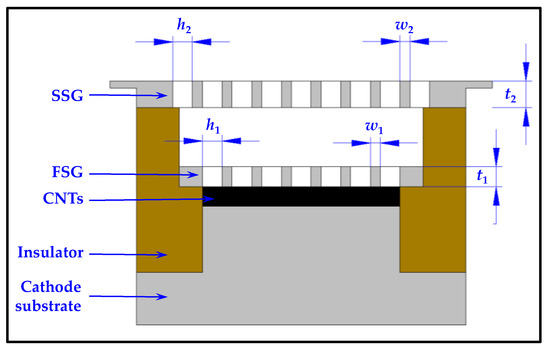
Figure 1. Schematic of the dual-gridded field emission structure based on carbon nanotube (CNT) cold cathode. SSG: second separating grid; FSG: first separating grid.
The carbon nanotube (CNT) cold cathode is an attractive choice for millimeter and terahertz vacuum electronic devices owning to its unique instant switch-on and high emission current density. A novel, dual-gridded, field emission architecture based on a CNT cold cathode is proposed here. CNTs are synthesized directly on the cathode surface. The first separating grid is attached to the CNT cathode surface to shape the CNT cathode array. The second separating grid is responsible for controlled extraction of electrons from the CNT emitters. The cathode surface electric field distribution has been improved drastically compared to conventional planar devices. Furthermore, a high-compression-ratio, dual-gridded, CNT-based electron gun has been designed to further increase the current density, and a 21 kV/50 mA electron beam has been obtained with beam transparency of nearly 100%, along with a compression ratio of 39. A 0.22 THz disk-loaded waveguide backward wave oscillator (BWO) based on this electron gun architecture has been realized theoretically with output power of 32 W. The results indicate that higher output power and higher frequency terahertz BWOs can be made using advanced, nanomaterial-based cold cathodes.
Rice's SECARS molecular sensor contains an optical amplifier made of four gold discs arranged in a diamond-shaped pattern. A two-coherent-laser setup amplifies the optical signatures of molecules in the center of the structure as much as 100 billion times. Credit: Y. Zhang/Rice University
(Phys.org) —Nanophotonics experts at Rice University have created a unique sensor that amplifies the optical signature of molecules by about 100 billion times. Newly published tests found the device could accurately identify the composition and structure of individual molecules containing fewer than 20 atoms.
"Ours and other research groups have been designing single-molecule sensors for several years, but this new approach offers advantages over any previously reported method," said LANP Director Naomi Halas, the lead scientist on the study. "The ideal single-molecule sensor would be able to identify an unknown molecule—even a very small one—without any prior information about that molecule's structure or composition. That's not possible with current technology, but this new technique has that potential."
The optical sensor uses Raman spectroscopy, a technique pioneered in the 1930s that blossomed after the advent of lasers in the 1960s. When light strikes a molecule, most of its photons bounce off or pass directly through, but a tiny fraction—fewer than one in a trillion—are absorbed and re-emitted into another energy level that differs from their initial level. By measuring and analyzing these re-emitted photons through Raman spectroscopy, scientists can decipher the types of atoms in a molecule as well as their structural arrangement.
Scientists have created a number of techniques to boost Raman signals. In the new study, LANP graduate student Yu Zhang used one of these, a two-coherent-laser technique called "coherent anti-Stokes Raman spectroscopy," or CARS. By using CARS in conjunction with a light amplifier made of four tiny gold nanodiscs, Halas and Zhang were able to measure single molecules in a powerful new way. LANP has dubbed the new technique "surface-enhanced CARS," or SECARS.
Yu Zhang
"The two-coherent-laser setup in SECARS is important because the second laser provides further amplification," Zhang said. "In a conventional single-laser setup, photons go through two steps of absorption and re-emission, and the optical signatures are usually amplified around 100 million to 10 billion times. By adding a second laser that is coherent with the first one, the SECARS technique employs a more complex multiphoton process."
Zhang said the additional amplification gives SECARS the potential to address most unknown samples. That's an added advantage over current techniques for single-molecule sensing, which generally require a prior knowledge about a molecule's resonant frequency before it can be accurately measured.
Another key component of the SECARS process is the device's optical amplifier, which contains four tiny gold discs in a precise diamond-shaped arrangement. The gap in the center of the four discs is about 15 nanometers wide. Owing to an optical effect called a "Fano resonance," the optical signatures of molecules caught in that gap are dramatically amplified because of the efficient light harvesting and signal scattering properties of the four-disc structure.
Fano resonance requires a special geometric arrangement of the discs, and one of LANP's specialties is the design, production and analysis of Fano-resonant plasmonic structures like the four-disc "quadrumer." In previous LANP research, other geometric disc structures were used to create powerful optical processors.
Zhang said the quadrumer amplifiers are a key to SECARS, in part because they are created with standard e-beam lithographic techniques, which means they can be easily mass-produced.
"A 15-nanometer gap may sound small, but the gap in most competing devices is on the order of 1 nanometer," Zhang said. "Our design is much more robust because even the smallest defect in a one-nanometer device can have significant effects. Moreover, the larger gap also results in a larger target area, the area where measurements take place. The target area in our device is hundreds of times larger than the target area in a one-nanometer device, and we can measure molecules anywhere in that target area, not just in the exact center."
Halas, the Stanley C. Moore Professor in Electrical and Computer Engineering and a professor of biomedical engineering, chemistry, physics and astronomy at Rice, said the potential applications for SECARS include chemical and biological sensing as well as metamaterials research. She said scientific labs are likely be the first beneficiaries of the technology.
"Amplification is important for sensing small molecules because the smaller the molecule, the weaker the optical signature," Halas said. "This amplification method is the most powerful yet demonstrated, and it could prove useful in experiments where existing techniques can't provide reliable data."