24 March 2014, SPIE Newsroom. DOI: 10.1117/2.1201403.005401
Optical frequency combs are innovative tools that link radio and optical frequencies to enable measurement of the latter. The ‘comb’ is a set of lines that read out when coherent light pulses create a broad spectrum. Applications include spectroscopy and optical frequency metrology, where a series of comb modes serve as frequency markers that are traceable to a microwave frequency standard.1 For broadband spectroscopy, combs can achieve high spectral resolution and accuracy across a wide spectrum. However, the resolution of many spectrometers, including Fourier transform, is insufficient to resolve each mode because these are distributed too densely.
Recently, a dual-comb approach has unlocked further potential for broadband spectroscopy by providing a comb-mode-resolved spectrum.2However, the spectral sampling interval is limited to the comb mode spacing, rather than the comb mode spectral linewidth, because of the discrete mode distribution. To enhance the spectral sampling density, we filled the comb mode gaps by interleaving additional frequency marks.3
An optical comb in the terahertz (THz) region is a harmonic (or component) comb of the laser repetition frequency.2 Therefore, we can tune the absolute frequency of each comb mode by changing the repetition frequency. If we incrementally shift the mode-resolved spectrum frequency at an interval equal to the linewidth and all of the resulting comb spectra are overlaid in the spectral domain, we can completely remove the frequency gaps of the original comb. In this way, we have achieved a spectrally interleaved or gapless THz comb.
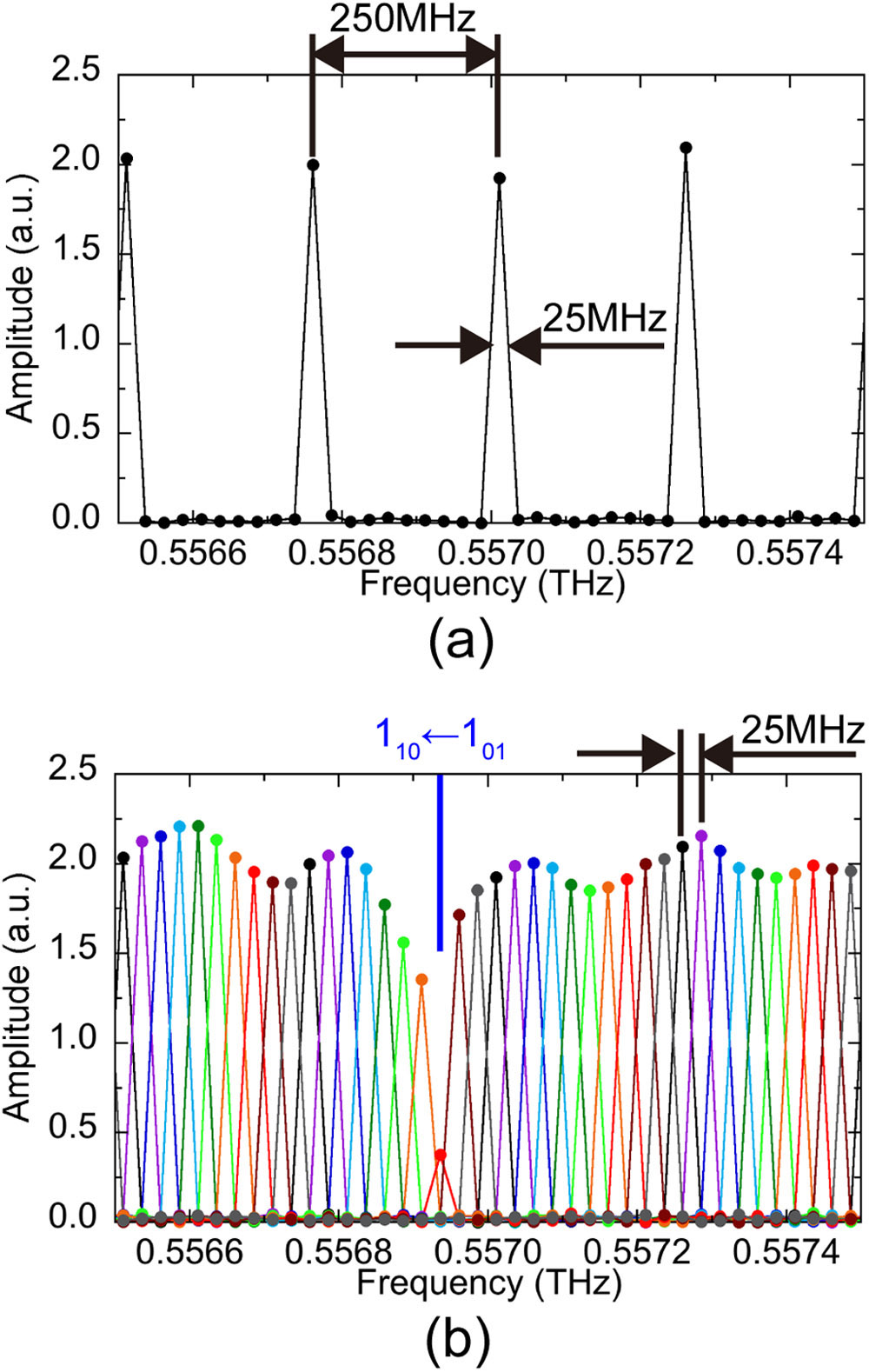
To assess our system's capacity to resolve fine spectral signatures, we measured the rotational transition 110←101 of low-pressure water-vapor molecules at 0.557THz. The gas sample has an expected pressure-broadening linewidth of 23MHz. Figure 1(a) shows the amplitude spectrum before spectral interleaving. The comb modes had a frequency gap of 250MHz and a linewidth of 25MHz. This mode gap was exactly equal to the laser repetition frequency, whereas the mode linewidth here was determined by the reciprocal of the measurement time window in the temporal waveform of the pulsed THz electric field for Fourier transform. The amplitude spectrum did not indicate the spectral shape of the absorption line because of the excessively coarse distribution of the comb modes compared with the narrow absorption linewidth.
Next, we demonstrated spectral interleaving across the absorption line at 0.557THz. We repeated 10 times incremental increases of the mode spacing at an interval of mode linewidth: see Figure 1(b). We filled the frequency gaps between the comb modes in Figure 1(a) by interleaving additional frequency marks, achieving a gapless THz comb. As a result, a sharp spectral dip with a linewidth of 24MHz clearly appeared at the position of the water absorption line. This linewidth is consistent with that of the expected pressure broadening (23MHz). The result indicated that the increased spectral sampling density in the gapless THz comb enhanced the spectral accuracy and resolution of the gas spectroscopy to the level of the comb mode linewidth from the comb mode spacing.

Figure 1. Amplitude spectra of the original terahertz (THz) comb (a) and the gapless THz comb (b) around 0.557THz after passing through low-pressure water vapor contained in a gas cell. a.u.: Arbitrary units.
In summary, to achieve a spectral sampling density equal to the linewidth of each comb mode, we successfully interleaved frequency gaps between THz modes using swept dual THz combs. This is the first demonstration of overcoming the inherent limitation in THz combs, namely, the excessively discrete distribution of the comb modes limiting the fine spectral sampling for broadband spectroscopy. The rotational transitions enable particularly rich spectral fingerprints in the THz region, and THz radiation is insensitive to scattering in the optical region. The gapless THz comb enables accurate discrimination of densely distributed absorption lines, even when the target gases are mixed with aerosols, smoke, dust, clouds, or soot: for example, gas analysis in smoke or a sooty flame.
In future, we would seek to achieve a gapless optical comb by sweeping not only the repetition frequency but also the carrier-envelope-offset frequency (the rate at which the peak of the carrier frequency shifts from the peak of the pulse envelope with each pulse). This would enable us to generate an optical comb that is uniformly gapless over the full spectral range.
This work was supported by Collaborative Research Based on Industrial Demand from the Japan Science and Technology Agency.
Takeshi Yasui
Institute of Technology and Science
The University of Tokushima
Tokushima, Japan
and
Graduate School of Engineering Science
Osaka University
Osaka, Japan
and
ERATO Intelligent Synthesizer Project, JST
Tokyo, Japan
Yi-Da Hsieh, Yuki Iyonaga, Yoshiyuki Sakaguchi, Tsutomu Araki
Graduate School of Engineering Science
Osaka University
Osaka, Japan
Shuko Yokoyama
Micro Optics Co., Ltd.
Kyoto, Japan
and
Graduate School of Engineering Science
Osaka University
Osaka, Japan
Hajime Inaba
National Metrology Institute of Japan
National Institute of Advanced Industrial Science and Technology
Ibaraki, Japan
and
ERATO Intelligent Optical Synthesizer Project, JST
Tokyo, Japan
Kaoru Minoshima
Graduate School of Informatics and Engineering
The University of Electro-Communications
Tokyo, Japan
and
ERATO Intelligent Optical Synthesizer Project, JST
Tokyo, Japan
Francis Hindle
Laboratoire de Physico-Chimie de l'Atmosphère
Université du Littoral Côte d'Opale
Dunkerque, France
References:
1. Th. Udem, R. Holzwarth, T. W. Hänsch, Optical frequency metrology, Nature 416, p. 233-237, 2002.
2. T. Yasui, Y. Kabetani, E. Saneyoshi, S. Yokoyama, T. Araki, Terahertz frequency comb by multi-frequency-heterodyning photoconductive detection for high-accuracy, high-resolution terahertz spectroscopy, Appl. Phys. Lett. 88, 241104, 2006.
3. Y.-D. Hsieh, Y. Iyonaga, Y. Sakaguchi, S. Yokoyama, H. Inaba, K. Minoshima, F. Hindle, T. Araki, T. Yasui, Spectrally interleaved, comb-mode-resolved spectroscopy using swept dual terahertz combs, Sci. Rep. 4, 3816, 2014.